Most of a survey is vertical. Loft ladders, hatches no wider than a pizza box, three flights in a Victorian terrace, a stepladder in the kitchen to look at a flat roof upstand. Every one of those wants two free hands, and the guidance on ladder work expects three points of contact. A tote in one fist rules that out before the day has started.
That is the case for the tool backpack, and it is a narrower question than the one in the general tool bag guide, which covers totes and holdalls as well. Here the format is settled and the choices are about rigid shell or soft sides, how many pockets and where, what the base is made of, and whether wheels earn their weight. “Tool rucksack” and “tool backpack” are the same hunt under two names.
A survey backpack carries different things from a joiner’s: meters, a borescope, a laser measure, a camera, a tablet for the RdSAP software and spare batteries, rather than a framing hammer and a handsaw. They have screens and lenses, and they should not be piled under a drill. Heavier hand tools are better in a van box or on a trolley.
The one I’d buy

DeWalt Pro Backpack DWST60102-1
For most surveyors the DeWalt Pro is the right balance: a rigid, water-resistant build, a base you can stand in a wet meter cupboard, organised pockets and straps that owner feedback calls comfortable on stairs. It does not have the pocket density of the specialist bags, but it costs a fraction of them. Fit a few pouches inside and it is a complete survey bag.
Typically £70–£100
Check price on AmazonHow I judge a tool backpack
Structure. A backpack that slumps when half empty buries small kit at the bottom, and does nothing for a screen when a ladder lands on it in the van. A semi-rigid back and sides, or a full shell, keeps the contents where you put them. Soft bags are lighter and a fair choice for light loads, but they protect only as well as their pockets do.
A home for each instrument. The best bags have vertical or dedicated pockets, so the damp meter lives in the same place every day. At the top of a ladder with a torch in your teeth, the hand goes to the pocket without the eyes. A single large compartment suits tools you can find by feel, not instruments.
The base. Wet grass at eight, a damp cellar floor at ten. A moulded or hard rubberised base keeps the contents dry and the bag upright. Fabric wicks water, and a bag stood on a floor with rising damp will show it.
Weight and carry. Armour costs kilograms. Some rigid bags weigh around 4kg empty, and a soft organiser roughly half that. Padded straps, a chest strap and a ventilated back panel matter more at 12kg than any pocket count. If the loaded bag climbs past 12–15kg it has become two bags.
Fit through a hatch. A loft hatch is commonly around 500mm square. A deep, rigid bag can catch on the frame and have to be passed up separately. Check the depth, not just the litres.
The comparison
| Model | Construction | Base | Typical price | Best for | |
|---|---|---|---|---|---|
| DeWalt Pro Backpack DWST60102-1 | Rigid fabric | Rigid, water-resistant | ~£85 | Everyday survey and EPC kit | View |
| Veto Pro Pac Tech Pac | Soft panels, organiser | Moulded waterproof | ~£300 | Instrument-heavy professional work | View |
| Milwaukee Packout Structured Backpack | Rigid shell | Impact-resistant, clips to Packout | ~£250 | Packout owners, screen protection | View |
| Makita E-15481 Backpack Tool Organiser | Soft, organiser | Reinforced, rubberised feet | ~£100 | Meters, testers and adapters | View |
| DeWalt Pro Backpack on Wheels | Rigid, wheeled | Rigid, with wheels | ~£125 | Flats, corridors, heavy loads | View |
| CLC 1134 Carpenter’s Tool Backpack | Soft, padded | Reinforced fabric | ~£110 | Lighter loads carried far | View |
| Stanley FatMax Tool Backpack | Soft, padded | Moulded base | ~£55 | First backpack, lighter kit | View |
The picks in detail
DeWalt Pro Backpack DWST60102-1
Best overall — the one I’d buy for most surveyors
DeWalt’s Pro backpack is the sensible answer for most people reading this. The specification is a heavy tarpaulin-style fabric, a rigid base that stands upright on wet ground, a water-resistant front compartment for the kit that must stay dry, and a large main space backed by organised pockets. Owner feedback is consistent on two points: the straps stay comfortable up three flights, and the bag keeps its shape when half empty, which is what finishes cheap backpacks.
What it lacks against the premium bags is slot-per-tool density, so budget for a few pouches inside. It is the middle of the market, and the middle is where most working kit belongs.
For
- Rigid, water-resistant build at a working price
- Stands upright; separate dry compartment
- Comfortable on stairs and ladders
Against
- Fewer dedicated pockets than the organiser-style bags
- A big main compartment invites the everything-in-a-heap habit
Typically £70–£100
Check price on AmazonVeto Pro Pac Tech Pac

Best premium — the instrument backpack
The Tech Pac was designed for service technicians, who carry meters and testers rather than breaker bars, which is the surveyor’s problem exactly. Dozens of pockets sit vertically on two zip-open sides, so every instrument stands upright and visible, over a moulded waterproof polypropylene base. Published owner feedback from the HVAC and fire-alarm trades keeps returning to the same point: the layout changes how people work, and the bags last years.
It is expensive for a bag and heavy before anything goes in. If your kit is a damp meter, a borescope and a laser measure, the DeWalt above does most of the job for a quarter of the money. If you carry a dozen instruments every day, the Veto’s logic starts to pay.
For
- Vertical pockets: every instrument findable one-handed
- Waterproof moulded base
- Strong long-term owner feedback
Against
- Around £300 and heavy when empty
- Overkill for a light loadout
Typically £240–£350
Check price on AmazonMilwaukee Packout Structured Backpack

Best crush protection — and the pick if your van already runs Packout
Closer to a rigid case with straps than a soft bag. The structured shell holds its shape whatever lands on it in the van, which is what you want around a borescope screen or a thermal camera. The base clicks onto a Packout stack, so the bag rides on the trolley across the car park and comes off for the stairs.
Against the Veto it is a straight trade: the Veto wins on pocket layout, the Milwaukee on impact protection and system fit. The rigid shell also gives less when squeezing through a narrow loft hatch.
For
- Rigid shell protects screens and lenses
- Locks onto Packout trolleys and stacks
- Tough base for wet, rough ground
Against
- Premium money without Veto-level pocket density
- Rigid sides are awkward in tight hatches
Typically £210–£290
Check price on AmazonMakita E-15481 Backpack Tool Organiser

Best for small instruments — the meters-and-testers loadout
Built as an organiser first: banks of dedicated pockets and holders rather than one void, with a padded back panel, grab handle and reinforced bottom. It suits a loadout of lots of small, valuable things better than most general trade backpacks, and it is lighter than the structured heavyweights. Owner feedback praises the build and pocket count; the recurring gripe is limited room for bulky items, so the drill lives elsewhere.
For
- Organiser pockets suit small instruments
- Lighter than rigid-shell bags
- Makita build quality at a mid price
Against
- Little space for bulky kit
- Reinforced fabric base, not a moulded tub
Typically £90–£115
Check price on AmazonDeWalt Pro Backpack on Wheels

Best wheeled backpack — corridors on wheels, stairs on shoulders
The Pro backpack platform with a telescopic handle and wheels. A block of flats with a lift: wheel it. A Victorian terrace with a loft conversion: straps on, and wheel it no further than the hall. The compromise any convertible makes is weight and a trolley frame eating internal space, but it beats a shoulder that gives out. Worth a look for commercial EPCs and purpose-built blocks, and pointless on a gravel drive.
For
- Wheels and straps in one bag
- Same rigid water-resistant build as the standard Pro
- Kinder to shoulders over a long week
Against
- Frame adds weight and eats capacity
- Wheels want smooth floors
Typically £110–£140
Check price on AmazonCLC 1134 Carpenter’s Tool Backpack
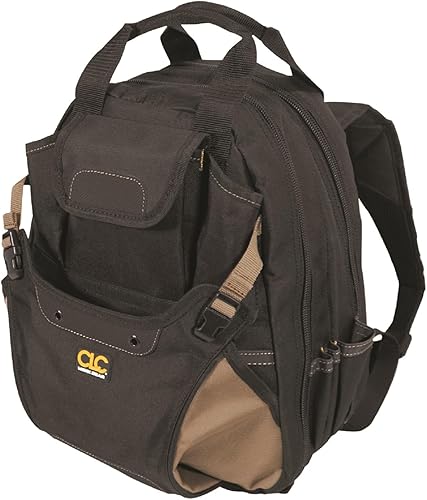
Best pocket count for the weight — the soft-sided organiser
CLC has made unglamorous, well-thought-out tool carriers for decades, and the 1134 is the pocket-density play: around 44 pockets across two zippered compartments, padded back and straps, in a soft build that weighs far less than the structured bags. The trade-offs are a fabric base you should not stand in a puddle and soft sides that rely on the pockets rather than a shell for protection.
For
- Dense pockets for slot-per-item order
- Light and comfortable for long carries
Against
- Not waterproof underneath, no armour
- UK street price sits close to mid-range structured bags
Typically £95–£130
Check price on AmazonStanley FatMax Tool Backpack
Best on a budget — a proper backpack for under £60
Stanley’s FatMax backpack is the entry point: a moulded base, a padded back, a large main compartment and a spread of tool pockets for roughly the price of a decent tape measure. Published owner feedback treats it as honest value for a first backpack, with the zips and padded straps the likely wear points under a heavy load. It will not out-organise the specialist bags, which is acceptable at this price.
For
- Moulded base and proper straps at a low price
- Good first step up from a holdall
Against
- Less padding and organisation than the dearer bags
- Zips are the likely weak point under heavy loads
Typically £45–£65
Check price on AmazonWhat actually matters — and what doesn’t
The base, the zips and the straps are the bag. Fabric and pockets rarely fail. Bottoms, zips and shoulder-strap stitching do, because a loaded backpack carries 10–15kg every working day. In a shop, run the main zip ten times, press on the base and load the straps; that takes two minutes and says more than the spec sheet.
Buy for the kit you have. Lay out what one typical job uses and buy the smallest bag that gives each item a slot. A litre figure on the label is no help. If the whole kit fits in a heap, it will end up in one.
Skip the extras. Built-in USB charging ports (a battery bank in a pocket does the same job and does not break), laptop sleeves marketed as tech compartments, and tactical styling. Pocket-count arms races too: a 75-pocket bag where you use twelve is just more to unzip.
When a backpack is the wrong answer. Long corridors, lifts and car-park-to-door jobs favour wheels or a trolley, and heavy hand tools belong in the van. The honest pattern is a backpack for the instruments you carry upstairs and something cheaper for everything else. The tool belt guide covers the pouch route for the rest.
Questions I get asked
Is a tool backpack better than a tool bag? For anyone working on stairs, ladders or in lofts, yes, mainly because both hands stay free. A tote or holdall wins on short carries where you are constantly grabbing and returning tools. Most working kits end up with one of each: instruments on the back, consumables in a cheap bag.
Are tool backpacks with wheels worth it? On purpose-built flats, hospitals and anywhere with a lift and a long corridor, they save shoulders. On gravel, stairs and uneven ground the wheels and frame are dead weight, which is why the convertible format is the one to shortlist. If your patch is rural period housing, spend the difference on a better backpack.
How do I stop instruments getting damaged in a tool backpack? Choose structure first: a rigid or semi-rigid shell stops the crush loads that kill screens. Then give each instrument its own slot or a padded zip case inside a general bag. Finally, do not let the bag travel loose in the van where a ladder can land on it. A hard case per instrument is justified for a thermal camera and overkill for a voltage stick.
What size tool backpack do I need? Smaller than you think. The instinct is to buy the biggest and fill it. A bag that holds one job’s kit with a slot each is easier to carry and easier to search. Bulk and rarely used kit can stay in the van.
If you are packing a bag for EPC work, that is the day job: the practice does domestic and commercial EPCs across Sussex, Kent and Surrey, mostly via loft hatches. Get in touch if you need one. For what goes inside the bag, there are more field-kit guides, starting with damp meters and head torches.
Small print. This guide is general information; the right bag depends on your kit, your patch and your back. Prices are indicative, move constantly and were checked at the time of writing; the linked page always shows the current price. As an Amazon Associate I earn from qualifying purchases.