Damp diagnosis is the core of what I do. Retrofit assessments under PAS 2035 stand or fall on understanding moisture, and half the building surveys I’m instructed on begin with someone pointing at a stain. So a moisture meter is the hardest-working tool on any damp survey — and it is also, comfortably, the most misunderstood instrument in British housing.
The first thing to understand is what a damp meter actually measures. It does not measure water. A pin meter measures electrical resistance between two points; a pinless meter measures capacitance through the surface. On timber, that correlates well enough with moisture content that the percentage on the screen means something. On brick, plaster and mortar it does not — the reading is qualitative, a relative signal that tells you wetter here, drier there. Good meters are honest about this and express masonry readings as wood moisture equivalent (WME). Bad meters print “27.3%” on a Victorian wall with two decimal places of false confidence.
What separates the good ones from the junk, then, is not accuracy to a decimal point. It is repeatability, an honest scale, and a design that lets you take fifty readings up a wall in a cold cellar without fighting the tool. That’s the lens for everything below.
The one I’d buy
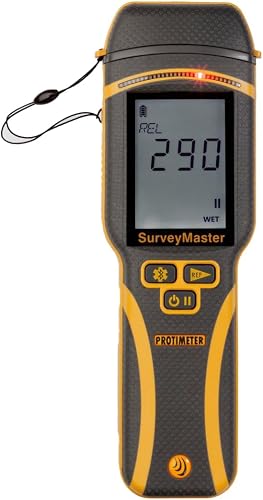
Protimeter SurveyMaster BLD5365
The dual-function meter the UK damp industry standardised on. Pin mode for confirmation, radio-frequency pinless mode for scanning, both reporting on the same WME scale so the two modes agree with each other. It is the meter every damp report you’ve ever read was written with, and there’s a reason for that.
Typically £330–£420
Check price on AmazonHow I judge a damp meter
Two modes, one scale. Survey work is a two-step: scan a wall non-invasively to map the pattern, then confirm the suspect areas with pins. A meter that does both, and reports both on the same scale, is worth more than two separate instruments — because the comparison between modes is itself diagnostic. If the pinless mode shouts and the pins stay quiet, the moisture is behind the surface, not in it. That single observation has saved clients thousands in unnecessary “damp proofing”.
Repeatability over precision. I don’t care whether a reading of 18 is “really” 17 or 19. I care that the same spot reads the same number twice, so that a moisture profile up a wall — reading every 250mm from skirting to a metre — means something. Cheap meters drift; you press harder and get a different answer.
An honest masonry scale. The meter should make clear that readings on plaster and brick are relative. Protimeter’s green–amber–red WME bands do this well. Meters that report “% moisture” in masonry to one decimal place are describing a number they cannot know.
Field manners. Pin caps that stay on in a toolbag, batteries you can buy in a village shop, a display readable in an unlit under-croft, and a body that survives being dropped from a loft hatch. This sounds trivial until you’re on your fourth survey of the day.
Spares and calibration. Pins bend and wear. A meter you can buy replacement needles for, and check against a calibration standard (Protimeter sell a “check cap” for exactly this), is a working instrument. One you can’t is a gadget.
The comparison
| Model | Type | Scale on masonry | Typical price | Best for | |
|---|---|---|---|---|---|
| Protimeter SurveyMaster BLD5365 | Pin + pinless (dual) | WME, colour bands | ~£370 | Professional survey work | View |
| Protimeter Aquant | Pinless only | Relative, colour bands | ~£350 | Non-invasive scanning of finished surfaces | View |
| Protimeter Mini BLD2000 | Pin only | WME, colour bands | ~£165 | Pin readings on a professional scale | View |
| Trotec BM31 | Pinless only | Relative index, 5–40mm depth | ~£35 | Budget scanning, tiled and finished walls | View |
| Bosch UniversalHumid | Pin only | Wood % (wood groups), traffic-light LED | ~£40 | Timber — joists, firewood, joinery | View |
| Brennenstuhl MD | Pin only | Wood % / building-material % | ~£18 | Best on a budget | View |
| Tavool pin-type meter | Pin only | Wood % / building-material % | ~£25 | The Amazon bestseller, with caveats | View |
The picks in detail
Protimeter SurveyMaster BLD5365
Best overall — the professional benchmark, and my top pick above
This is the meter most UK damp professionals standardise on, and its spec sheet reads like it was written for survey work. The pinless radio-frequency mode reads through paint, plaster and tiling to roughly 15–20mm, which is how you map a wall before touching it; the pins then confirm whether the surface itself is wet. Both modes report as wood moisture equivalent with the same green–amber–red bands, so a survey reads as one coherent story rather than two instruments disagreeing. The current model added a bigger display, much longer battery life and a self-check routine, none of which changed the fundamentals — it was already right.
Is it £350 better than a £20 meter? For a homeowner, honestly, no. For anyone writing reports, giving advice, or being paid to be right about moisture, yes — the deep-wall probe compatibility, calibration check caps and spare-pin ecosystem are what make it an instrument rather than a gadget. For more on exactly what the two modes read, what the WME scale means, and which probe or sibling model to add, see the dedicated SurveyMaster explainer.
For
- Pin and pinless in one body, one WME scale
- Comparing the two modes is itself diagnostic
- Accepts deep-wall and hammer probes; spares and check caps available
- A reputation for repeatability — the industry reference for a reason
Against
- Serious money for occasional use
- Pinless depth (~15–20mm) is shallower than dedicated scanners
Typically £330–£420
Check price on AmazonProtimeter Aquant

Best for non-invasive work — scanning finished surfaces you must not mark
The SurveyMaster’s pinless-only sibling. Same radio-frequency sensing, same colour bands, no pins — which sounds like less meter for similar money, and in one sense it is. Its case is speed and surfaces: on tiled bathrooms, dry-lined listed interiors and freshly decorated flats where the vendor is watching, you can sweep whole elevations quickly without leaving a single pinhole. Some surveyors carry an Aquant for mapping and a pin meter for confirmation; if you already own a SurveyMaster it’s a luxury, not a need.
For
- Fast, genuinely non-marking surveys
- Protimeter build and repeatability
- Simple to read — relative scale, no false precision
Against
- No pin mode, so no confirmation step
- Costs nearly as much as the dual-mode SurveyMaster
Typically £320–£390
Check price on AmazonProtimeter Mini BLD2000

Best pin-only meter — the professional scale without the professional price
The Mini has been in surveyors’ pockets for decades, and it still earns its place: a pin-only meter with the proper Protimeter WME scale and colour bands, at less than half the SurveyMaster’s price. It takes the same deep-wall probes, so it can grow into serious diagnostic work. What you give up is the pinless scanning mode — which means more holes and slower mapping. For a landlord, a keen renovator, or a caravan owner doing annual damp checks, this is the sweet spot between the toys and the flagship.
For
- Real WME scale, real repeatability
- Compatible with Protimeter probes and spares
- Simple enough to hand to a client to watch the reading
Against
- No pinless mode — every reading leaves two small holes
- Dearer than the entire budget class put together
Typically £150–£190
Check price on AmazonTrotec BM31

Best budget pinless — scanning walls without holes, for the price of a round of drinks
Trotec is a proper German drying-and-measurement firm, and the BM31 is the cheapest pinless meter I’m happy to recommend. It reads capacitively to a claimed 5–40mm depth and reports a relative index — correctly making no pretence of percentage moisture in masonry. Used as intended, sweeping a wall to find where wet becomes dry, it does most of what the Aquant does for a tenth of the money. The sensor sphere needs consistent contact pressure to give consistent numbers, and it will light up over foil-backed plasterboard and buried cables like anything else capacitive — read the false-positives section below before trusting it.
For
- Genuinely useful pinless scanning at around £35
- Honest relative scale, no fake decimals
- No holes in anyone’s decoration
Against
- Needs a consistent hand to give consistent readings
- No pin mode to confirm what the scan finds
Typically £30–£40
Check price on AmazonBosch UniversalHumid

Best for timber — joists, roof members, joinery and the log store
A pin meter aimed squarely at wood, and the best of the affordable ones at that job. It asks you to select a wood group before measuring — a small feature that most cheap meters skip and that meaningfully improves the number, because oak and spruce don’t conduct alike. The traffic-light LED (green under 12%, red over 20%) matches the thresholds that actually matter: joinery-dry, and the decay-risk zone. I’d reach for it checking suspended-floor joists near a damp sub-floor, roof timbers around a suspected leak, or whether a firewood delivery is as “seasoned” as the invoice claims. It is not the tool for walls.
For
- Wood-group calibration — rare at this price
- Sensible traffic-light thresholds for decay risk
- Typical Bosch build quality
Against
- Timber-focused; little use on masonry
- Reports of it quietly draining batteries in storage — take them out
Typically £35–£45
Check price on AmazonBrennenstuhl Moisture Detector MD

Best on a budget — the honest £15 pin meter
If you want to spend as little as possible and still get a number that means something, this is the one. Brennenstuhl is a reputable German brand, the MD has been on sale unchanged for years, and it does exactly two things: wood moisture (5–50%) and a building-materials scale (1.5–33%). Treat the building-materials figure as relative — compare a suspect patch against a known-dry bit of the same wall — and it’s a perfectly serviceable screening tool for tracking whether a wall is drying after a leak, or checking firewood. The pins are fine and will bend if you lean on them.
For
- Around £15–£20 from a brand that will still exist next year
- Simple, pocketable, does what it says
- Good enough for before-and-after drying checks
Against
- Masonry percentages look more precise than they are
- Delicate pins, no spares ecosystem
Typically £15–£20
Check price on AmazonTavool pin-type moisture meter

The Amazon bestseller — fine for what it is, know what it isn’t
Search “damp meter” on Amazon and a wall of near-identical £20 pin meters comes back; Tavool’s is the one that consistently tops the listings and it’s representative of the class. Backlit screen, wood and building-material modes, hold button, temperature readout. Owner feedback is fairly consistent: they read plausibly on timber and are usable on walls if — and only if — you treat every number as relative and take profiles rather than single readings. What you don’t get is calibration, repeatability you’d stake a report on, or any guarantee the same product is on sale under the same name next year. As a “is this getting wetter or drier?” tool for a homeowner, it’s fine. It is not evidence.
For
- Cheap, widely available, easy to read
- Adequate for tracking a known problem over time
Against
- No calibration or spares; consistency between units varies
- Two-decimal masonry readings invite over-interpretation
Typically £20–£30
Check price on AmazonWhat actually matters — and what doesn’t
The meter is a screening tool, not a diagnosis. This is the single most important thing on this page. A damp meter tells you where moisture (or something that conducts like moisture) is. It does not tell you why. Rising damp, penetrating damp, condensation, a plumbing leak and hygroscopic salt contamination can all produce similar numbers, and they have completely different remedies at completely different prices. The diagnosis comes from the pattern of readings, the building’s construction, ventilation, external ground levels and defects — the meter just narrows down where to look.
Profiles beat spot readings. One high number on a wall means almost nothing. A profile — readings at regular heights from skirting level up to about 1.2m, inside and where possible on both faces — is where the story is. True rising damp shows a characteristic band with a defined upper margin; condensation clusters on cold surfaces and corners; a leak radiates from a point. Whatever meter you buy, use it this way.
Know the false positives. Anything conductive reads as “wet”. The classics: foil-backed plasterboard (a pinless meter will paint an entire dry wall red), buried cables and pipes, dense concrete blocks, carbon-containing materials, some wallpaper adhesives — and above all, salts. Old chimney breasts and walls with historic damp carry hygroscopic salts that hold atmospheric moisture and conduct enthusiastically, so a wall can read high years after the original source was fixed. If a reading makes no sense, suspect the wall before the weather.
What the salesmen push that you can skip. Bluetooth apps, colour touchscreens, and “30 material calibration curves” on a £25 meter. Masonry readings are relative whatever the menu says, so extra material modes on a cheap instrument are decoration. Spend the money on the sensing, the build and the scale instead. The only definitive measurement of moisture content in masonry remains a drilled sample — gravimetric testing or a calcium carbide (“speedy”) test — which is lab-and-specialist territory, and rarely needed if the profile work is done properly.
Questions I get asked
What is a normal damp meter reading for walls? On the wood-moisture-equivalent scale the professional meters use, below about 16 WME is the green zone, 16–20 is borderline, and sustained readings above 20 justify investigation. But on masonry these are relative figures, not moisture percentages — so the more useful “normal” is the rest of the building. Take readings on a known-dry wall of the same construction and compare. A whole house reading 14 with one patch at 24 is telling you something; a whole house reading 18 uniformly is probably just that plaster, that meter, that day.
Do damp meters work on plaster? Yes, as screening tools — plaster is actually where they’re most used, since it’s the surface you can reach. The caveats: readings are qualitative (compare, don’t absolutise), gypsum plaster that has once been soaked can remain permanently affected, and salt-contaminated plaster will read damp indefinitely regardless of the wall behind it. Pin meters read only the surface 10mm or so; a pinless meter sees a little deeper. High readings in plaster with low readings in the masonry behind usually point at condensation or salts rather than water coming through the wall.
Pin or pinless — which should I buy? They answer different questions. Pinless scans fast, needs no holes, and finds the extent of a problem; pin measures at a point, confirms whether the surface itself is wet, and works in corners and on timber where a flat sensor can’t sit. For diagnosis you really want both — which is the whole argument for the SurveyMaster. Forced to choose one on a budget: pinless (the Trotec BM31) if your worry is walls, pin (the Brennenstuhl or Bosch) if it’s timber.
Can a damp meter give false readings? Constantly — false positives far more often than false negatives. Foil-backed plasterboard, buried services, hygroscopic salts, conductive additives and even some paints will all read as moisture when there is none. This is precisely why a meter reading is never, on its own, a diagnosis, and why “the man’s meter beeped so we need a new damp-proof course” has parted so many homeowners from so much money. A high reading is a question, not an answer.
If the readings on your own walls are the reason you’re here, that’s the day job. The practice does building surveys with proper damp investigation, and PAS 2035 retrofit assessments where moisture risk is assessed before any insulation goes near a wall — get in touch. A phone thermal camera is a useful first screen for where to point the meter over a larger wall. And if you’re kitting out a survey bag, there are more field-kit guides.
Small print. This guide is general information, not a survey of your property; damp diagnosis depends on the building in front of you, and a meter reading alone is never a diagnosis. Prices are indicative, move constantly and were checked at the time of writing; the linked page always shows the current price. As an Amazon Associate I earn from qualifying purchases.