The Protimeter SurveyMaster is the instrument the UK damp industry standardised on, and it shows up in this practice’s work constantly — not carried by me, but referenced in the paperwork: damp reports from other surveyors, insurance loss-adjuster assessments, retrofit PAS 2035 condition reports, all quoting readings from “the Protimeter” as if the brand name were the unit of measurement. It more or less is. So the question I get isn’t “which damp meter should I buy”, which is what the standalone damp meters guide answers — it’s narrower and more specific: what does a SurveyMaster reading of 22 actually mean, what’s the difference between the two buttons on the front, and why does the shop also sell an Aquant, a Mini and something called an MMS3.
This page answers that. The SurveyMaster is not one meter but the centre of a small system: a dual-mode instrument that takes a family of plug-in probes, sits alongside cheaper and more expensive siblings built from the same sensing technology, and reports everything on a scale that only makes sense once you know what it isn’t claiming to measure.
Everything below is drawn from Protimeter’s own published specifications and documentation, plus the wider feedback from people who use these professionally — features and functions, not a lab comparison. Prices are current listing prices on amazon.co.uk at the time of writing, expressed as ranges because they move.
The one I’d buy
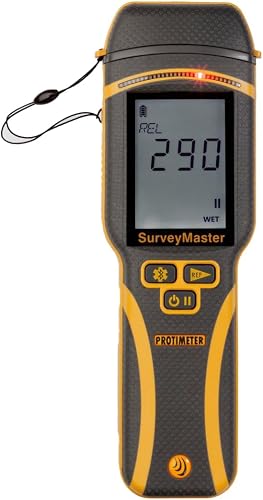
Protimeter SurveyMaster BLD5375
The current-generation dual-function instrument: the same pin-plus-pinless combination that made the older SurveyMaster the industry default, now with a bigger display, roughly three times the battery life of the previous model, and Bluetooth to Protimeter’s own Connect app for saving and timestamping readings. If you’re buying one Protimeter and want it to do both jobs — scan, then confirm — this is the one.
Typically £520–£600
Check price on AmazonHow the SurveyMaster actually works
Two modes, one instrument. Flip the SurveyMaster over and the back is a flat search pad; the front carries a pair of pins. Search mode uses the pad to sense moisture non-invasively through paint, plaster and coverings like tile and vinyl to roughly 19mm (¾in) deep, without marking anything — Protimeter’s own material calls it a way to find higher-than-normal moisture, not to diagnose it. Measure mode is the pins: press them to the surface, or drive them in for a proper reading in timber, for a direct percentage. The whole instrument is built around that workflow — scan wide, then confirm the spots that matter.
The WME scale, honestly. On timber, the pins report actual moisture content. On masonry — brick, plaster, mortar, block — there is no equivalent physical quantity, so the display reports wood moisture equivalent (WME) instead: a number calibrated against timber that tells you how wet a wall is relative to a dry one, not a moisture percentage it can’t actually know. The colour bands do the same job as the numbers, at a glance: broadly, a low double-digit reading sits in the green (dry) zone, high teens into the twenties is amber (borderline), and sustained readings above that turn red (wet) — Protimeter’s own examples cite 14% as a green-zone timber reading and 25% as a red-zone one. Search mode’s non-invasive reading uses a related but separate 0–1000 scale, “loosely based on” WME rather than reporting it directly, which is one more reason a Search hit always needs confirming in Measure mode before you trust it.
Calibration you can actually check. Protimeter sell a small accessory called the Calcheck: clip it across the pins and a correctly functioning instrument should read 18.1% ±1%. It also tests the hammer electrode and other plug-in accessories, which matters if a reading is ever going to be quoted as evidence — being able to show the instrument was verified on the day is worth more than the accessory’s £20 price tag.
Bluetooth and the Connect app. The current model pairs to Protimeter Connect to save readings with a time and date stamp, rather than relying on a paper record written up later from memory. Useful for anyone building a formal damp report or a before-and-after drying record; entirely skippable if you just want a number on a wall.
Built to take probes. The pins on the front are removable, and the same body accepts a family of accessory probes — deep wall, extension, hammer electrode, and more specialist attachments like an EIFS probe for rendered insulation systems. That’s the real difference between “a meter” and “a system”: the SurveyMaster on its own answers most questions, and the accessories below answer the ones it can’t reach.
The comparison
| Item | Type | Best for | Typical price | |
|---|---|---|---|---|
| Protimeter SurveyMaster BLD5375 | Pin + pinless instrument | The core purchase — scan then confirm | ~£560 | View |
| Protimeter Deep Wall Probe BLD5018 | Plug-in probe, 5in | Confirming moisture at depth in a cavity | ~£195 | View |
| Protimeter Extension Moisture Probe BLD5035 | Plug-in probe, 3in/6in tips | Crawl spaces and cavity insulation checks | ~£101 | View |
| Protimeter Hammer Electrode | Plug-in probe, driven | Concrete floors and dense timber | ~£310 | View |
| Protimeter Calcheck BLD5086 | Calibration accessory | Verifying the instrument, spare needles | ~£19 | View |
| Protimeter Aquant BLD5770 | Pinless only | Non-invasive-only survey work | ~£380 | View |
| Protimeter Digital Mini BLD5775 | Pin only | The WME scale for under £300 | ~£289 | View |
| Protimeter MMS3 Survey Kit BLD9800 | 4-in-1 + RH probe | Restoration work and concrete-slab RH testing | ~£1,550 | View |
The picks in detail
Protimeter SurveyMaster BLD5375
The core purchase — covered above as the one I’d buy
Out of the box it does most of what a general damp inspection needs: search a wall non-invasively, confirm the wet patches with the pins, read both on the same WME-based scale so the two modes tell one consistent story. The 2024-generation model added the bigger display, the longer battery life and Bluetooth logging without changing what it fundamentally does, which is exactly why it’s still the reference point every other Protimeter in this guide gets compared against.
For
- Pin and pinless in one body, one scale
- Accepts the whole probe family below
- Bluetooth logging via Protimeter Connect
- The instrument most damp reports already assume
Against
- A serious price for occasional use
- Search mode’s fixed ~19mm depth is shallower than the MMS3’s sensitivity setting
Typically £520–£600
Check price on AmazonProtimeter Deep Wall Probe BLD5018
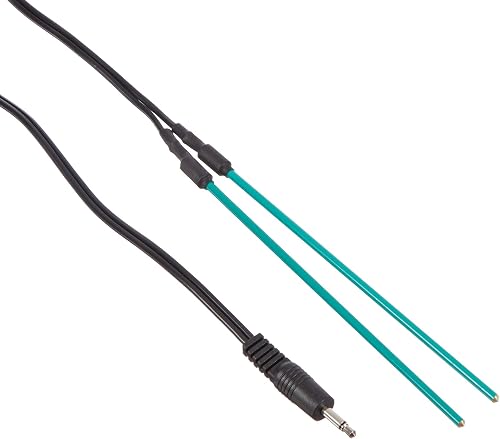
Confirming what Search mode found, below the surface
A 5in probe that plugs into the SurveyMaster in place of the standard pins, designed to establish moisture at depth in wall cavity insulation and sub-surface structure rather than just the decorated face. It’s the accessory that answers the question Search mode raises but can’t settle on its own: is this a surface issue, or is there moisture sitting behind the plaster in the cavity itself — the kind of finding that changes a £30 repaint into a cavity investigation.
For
- Reads genuinely below the surface, not just at it
- Plugs straight into the SurveyMaster body
Against
- An accessory purchase on top of an already expensive instrument
- Needs a pre-drilled access point to use properly
Typically £180–£210
Check price on AmazonProtimeter Extension Moisture Probe BLD5035

Crawl spaces and cavity wall insulation checks
Ships with two tip lengths — 3in and 6in — and is built for reaching into places the standard pins can’t: crawl spaces under a suspended timber floor, and cavity wall insulation where the question is whether the fill has gone missing or gone wet. That second use case matters more every year, given how much PAS 2035 retrofit work turns on exactly that question before anything else gets specified.
For
- Two tip lengths for different reach requirements
- Purpose-built for cavity insulation and crawl-space checks
Against
- A specialist tool, not a general-purpose probe
Typically £90–£115
Check price on AmazonProtimeter Hammer Electrode

Concrete floors and timber too dense for the standard pins
The standard pins are sized for plaster and softer timber; concrete floor slabs and dense hardwood need something driven in rather than pressed on. This is that probe — strong enough to take a mallet, with Protimeter’s own guidance stressing that both driving it in and extracting it should use a straight slide-hammer action, since angled force is what snaps the needles. It’s a specialist buy for anyone regularly checking screed or flooring moisture before a covering goes down, not a general damp-survey accessory.
For
- Reaches materials the standard pins can’t penetrate
- Purpose-built for concrete floors and dense timber
Against
- Priced like a second instrument
- Needles snap if driven or pulled at an angle
Typically £290–£330
Check price on AmazonProtimeter Calcheck BLD5086
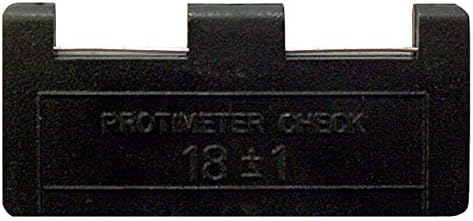
Verifying the instrument, not just trusting it
A small clip-on device that any pin-mode Protimeter should read as 18.1% ±1% across, plus two spare 1in needles in the box. It also checks the hammer electrode and other plug-in accessories, which is the point: a moisture reading is only as good as the instrument that took it, and being able to show — not just assert — that the meter was verified on the day it was used matters far more for a formal report than its low price suggests.
For
- Cheap insurance for a reading that might get quoted back at you
- Includes spare needles
Against
- Easy to lose in a toolbag; easy to forget to use
Typically £15–£22
Check price on AmazonProtimeter Aquant BLD5770

When every reading needs to be non-invasive
The SurveyMaster’s pinless-only sibling: the same radio-frequency search technology, the same colour-banded scale, no pins at all. On a listed interior, a freshly decorated flat with a vendor watching, or a tiled bathroom where a pinhole isn’t acceptable, that’s not a limitation, it’s the point — whole elevations can be swept quickly without marking anything. It has its own Bluetooth link to the Connect app, the same as the current SurveyMaster. Anyone who already owns a SurveyMaster is buying a convenience, not a new capability; anyone whose work is genuinely scan-only is buying the right tool for the job.
For
- Fast, genuinely non-marking surveys
- Same Protimeter sensing and scale as the SurveyMaster
Against
- No pin mode, so no independent confirmation step
- Costs nearly as much as the dual-mode SurveyMaster
Typically £350–£410
Check price on AmazonProtimeter Digital Mini BLD5775

The professional WME scale, without the professional price
The current generation of a meter that’s been in surveyors’ pockets for decades: pin-only, no Search mode, but reading the same WME scale and colour bands as the SurveyMaster for around half the price. It won’t map a wall the way the dual-mode instrument does — every reading is a hole, and mapping means more holes and slower work — but for a landlord doing annual checks, a renovator, or anyone who wants the real scale without the flagship price, it’s the sensible step down.
For
- Genuine WME scale and colour bands
- Roughly half the SurveyMaster’s price
Against
- No pinless mode at all
- Slower for mapping a whole wall or room
Typically £260–£310
Check price on AmazonProtimeter MMS3 Survey Kit BLD9800

When the SurveyMaster isn’t actually enough instrument
Protimeter’s flagship, and a genuinely different tool rather than just a pricier SurveyMaster: pin mode, non-invasive RF sensing that reaches to about 5in in a sensitivity setting versus the SurveyMaster’s fixed ~19mm, a built-in infrared thermometer with laser pointer, and a hygrometer — four sensing modes in one body. It logs up to 10,000 timestamped readings, embedded straight into photos via the Protimeter app, which suits fire and flood restoration work and formal diagnostics. It’s also the meter for relative-humidity-probe concrete floor testing — the in-situ method flooring manufacturers specify before a covering goes down — which the SurveyMaster and Mini can’t do. For a one-off damp check on a house, it’s a great deal more instrument than the job needs.
For
- Four sensing modes, including RH probe and IR thermometer
- Deeper non-invasive sensing than the SurveyMaster
- Built for restoration and formal diagnostic work
Against
- Roughly three times the SurveyMaster’s price
- Well beyond what an ordinary damp survey needs
Typically £1,450–£1,650
Check price on AmazonWhat actually matters — and what doesn’t
A Protimeter reading is a screening tool, not a diagnosis. This is true of every meter in the range, flagship included. It tells you where moisture — or something that conducts like it — is. It does not tell you why. Rising damp, penetrating damp, condensation, a leak and hygroscopic salt contamination can all produce a similar number, and they have entirely different remedies at entirely different prices. The pattern of readings across a wall, the building’s construction and ventilation, and what’s actually visible do the diagnosing; the meter narrows down where to look.
The probe you need depends on the job, not the budget. A deep wall probe answers “is this at depth in the cavity”; an extension probe answers “what’s happening in that crawl space or cavity fill”; a hammer electrode answers “how wet is this slab or hardwood floor”. None of them are more or less “professional” than the others — buying the one that matches the actual question in front of you beats buying the whole accessory case on spec.
Don’t buy the MMS3 for what the SurveyMaster already does. The extra sensing modes — relative humidity probing, infrared, deeper non-invasive reach — only earn their keep on work that specifically needs them: concrete-slab RH testing before flooring goes down, or restoration work logging hundreds of readings across a flooded building. For a general damp inspection, all that extra capability sits unused.
Calibration is the thing people skip and shouldn’t. A Calcheck costs less than a round of drinks and takes ten seconds to use. If a reading might ever be quoted back at you — in a dispute, a report, an insurance claim — being able to say the instrument was verified that day is worth far more than its price.
What the range doesn’t need: buying every accessory “just in case”. The probe family exists because different materials genuinely need different contact methods, not because more attachments make a better surveyor. Match the probe to the material in front of you.
Questions I get asked
What does a WME reading of 20 actually mean on a Protimeter? On timber it’s close to an actual moisture content and worth taking fairly literally — into the amber zone, worth watching. On masonry it’s relative, not absolute: compare it against a reading from a known-dry part of the same wall, of the same construction, rather than treating the number on its own as a verdict. A uniform reading of 20 across a whole house is a different story to one patch reading 20 against a background of 12.
Should I buy the SurveyMaster or the Aquant? The SurveyMaster if you want one instrument that both scans and confirms — which is what most damp inspection work actually needs. The Aquant only if your work is genuinely non-invasive-only: listed interiors, finished surfaces you can’t mark, or you already own a pin meter and want a dedicated scanning tool alongside it.
Is the MMS3 worth the extra money over the SurveyMaster? For a general building or damp survey, no — you’re paying roughly three times as much for sensing modes you won’t use. For flood or fire restoration work, concrete-slab relative-humidity testing before flooring is laid, or any job that needs hundreds of logged, timestamped readings, yes: it’s a genuinely different instrument for a genuinely different job, not a status upgrade.
How do I know my Protimeter is still reading correctly? Use a Calcheck device: clipped across the pins, a correctly functioning instrument reads 18.1% ±1%. It also verifies the hammer electrode and other plug-in accessories. Protimeter’s current SurveyMaster additionally runs an automatic calibration check roughly every 50 power cycles, but a physical Calcheck is the only way to get a number you can point to and say the instrument was verified.
Whatever the reading says, what it means for the building — and what, if anything, needs doing about it — is the actual survey. The practice carries out building surveys with proper damp investigation, and PAS 2035 retrofit assessments where moisture risk is checked before insulation goes anywhere near a wall — get in touch. For the wider field of damp meters beyond this one brand, there’s the standalone damp meters guide, and more field-kit guides if you’re kitting out a survey bag.
Small print. This guide is general information, not a survey of your property or a substitute for the manufacturer's own manual; damp diagnosis depends on the building in front of you, and a meter reading alone is never a diagnosis. Prices are indicative, move constantly and are checked at the time of writing; the linked page always shows the current price. As an Amazon Associate I earn from qualifying purchases.