A phone thermal camera is the version of this tool most people actually buy. The main thermal imaging camera guide covers the full range — phone plug-ins through to professional handhelds — but skates past this category in a paragraph, and it’s the one most homeowners and budget-conscious site staff actually want covered properly. Seven cameras that clip, plug or pair to a phone you already own, none pretending to be a £1,200 handheld.
The pitch is straightforward — a genuine 256×192 thermal sensor, the same class fitted to cameras costing four times as much, for around £250 in a module smaller than a memory stick. What the pitch leaves out is that “works with your phone” is doing a lot of quiet work: Android and iPhone use different connectors, some units tie up your phone’s only port and drain its battery, and a case that’s fine for everyday use can block the socket a dongle needs. None of that is a reason to avoid this category — it’s a reason to buy the right one first time.
Keep the physics in mind. These units measure surface temperature, not moisture, and need a real temperature difference between inside and out to show anything useful. A dongle on a mild afternoon with the heating off shows a flat grey nothing whatever the resolution on the box. Cold morning, heating on since before dawn, curtains open — that’s when any of these earn their keep.
The one I’d buy

HIKMICRO Mini2 V2
A genuine 256×192 sensor — printed on the housing, not buried in a spec sheet — in a unit that ships with both a USB-C body and a bundled Lightning adapter, so it isn’t a gamble on which phone you own. IP40-rated and drop-tested, which matters for something that lives loose in a pocket. It skips the macro lens or wireless trick some rivals here have, but for one camera that will simply work, this is it.
Typically £220–£260
Check price on AmazonHow I judge a phone thermal camera
Native IR resolution, not the “enhanced” number. The figure that matters is the sensor’s physical pixel count. 256×192 is achievable at this price point now, and the floor I’d treat as fit for a report; 160×120 and below is curiosity, not a conclusion. Software upscaling makes the on-screen image bigger, not more accurate.
Which phone it actually fits. This is the question the resolution spec doesn’t answer. USB-C and Lightning are not interchangeable, several models sell separate SKUs for each, and a wrong purchase is the single most common mistake here. Check the connector in the listing, not just the brand.
What it does to your phone while it works. Every wired unit here draws power through the port it’s plugged into, draining your phone’s battery alongside the camera’s own. A thick case can also block the socket a dongle needs — worth checking before you’re stood in a loft with a case you can’t get off.
Thermal sensitivity (NETD). The smallest temperature difference the sensor can distinguish, quoted in millikelvin. Under 50mK a cold bridge renders as a defined shape; well above it, the same defect is a vague smudge — where the cheapest options fall away.
The app. A phone thermal camera lives or dies by its software — export quality, whether it saves radiometric files you can re-analyse later, and whether it fights you every time you open it. None here are brilliant; some are noticeably less annoying than others.
The comparison
| Model | Native IR resolution | Connector / phone | Typical price | Best for | |
|---|---|---|---|---|---|
| HIKMICRO Mini2 V2 | 256×192 | USB-C + Lightning adapter | ~£245 | Best overall — works with any phone | View |
| InfiRay P2 Pro | 256×192 | USB-C (Android) | ~£315 | Premium — macro lens for electrics | View |
| TOPDON TC002C Duo | 256×192 | USB-C + Lightning cable | ~£280 | The other dual-phone option | View |
| TOPDON TC001 | 256×192 | USB-C (Android/Windows) | ~£255 | Best resolution for Android-only money | View |
| FLIR ONE Edge Pro | 160×120 | Wireless (iOS + Android) | ~£420 | Awkward angles, any phone | View |
| Seek Thermal CompactXR | 206×156 | Lightning (iPhone) | ~£150 | Best on a budget for iPhone | View |
| FLIR ONE Gen 3 | 80×60 | USB-C (Android) | ~£185 | A first look, not survey work | View |
The picks in detail
HIKMICRO Mini2 V2
Best overall — one camera, works with whatever phone you hand it
The top pick, as above, and worth the fuller case. HIKMICRO prints the sensor resolution directly on the housing — 256×192, no marketing upscale to decode — and the box includes both the native USB-C body and a Lightning adapter, so buying the wrong connector isn’t a trap you can fall into. Sub-40mK sensitivity puts it in the same bracket as pricier cameras, IP40 and a 1m drop rating suit a life in a tool bag, and there’s no internal battery to charge — it draws entirely from the phone. Android-only buyers can save further with HIKMICRO’s plain Mini2 (no Lightning adapter) for closer to £160.
For
- 256×192 native, stated plainly on the unit
- Works with Android and iPhone out of the box
- IP40 and drop-tested — built for a tool bag
- No separate battery to charge
Against
- No macro lens or fusion imaging
- Draws phone battery while in use, same as any wired unit here
Typically £220–£260
Check price on AmazonInfiRay P2 Pro

Premium — the macro lens turns this into an electrics tool as much as a building one
The best hardware in this list. A 256×192 sensor with 40mK sensitivity and a useful 25Hz frame rate — smoother panning than the 8–9Hz most of this category is limited to — plus a bundled magnetic macro lens that focuses to about an inch, letting you read individual breaker temperatures in a consumer unit. The price reflects it, and iOS listings were out of stock at review time, so check the version before ordering.
For
- 256×192 with 40mK sensitivity and 25Hz frame rate
- Bundled macro lens — genuinely useful on electrics
- CNET Best of award, for what that’s worth to a buyer
Against
- The most expensive camera in this list
- Android USB-C only — iPhone-compatible stock was thin at review time
Typically £300–£330
Check price on AmazonTOPDON TC002C Duo

The other genuinely dual-phone option, if the Mini2 sells out
TOPDON’s answer to the same problem the Mini2 solves — a native USB-C body with a bundled Lightning-to-USB-C cable, so one purchase covers Android and iPhone. Same 256×192 sensor class and sub-40mK sensitivity as its sibling below. It sits a little above the Mini2 on price for broadly equivalent hardware, which is why it’s the second dual-compatibility pick — but a sound buy if a bundle deal favours it on the day.
For
- 256×192 native, works Android and iPhone
- 25Hz frame rate, sub-40mK sensitivity
- Cable-based adapter rather than a separate SKU to get wrong
Against
- Costs more than the Mini2 for a similar spec
- Lightning cable is another loose part to lose
Typically £260–£300
Check price on AmazonTOPDON TC001

Best resolution for Android-only money — the one that started this category
The camera that made a genuine 256×192 sensor a sub-£300 proposition, and still a sound buy if you never need iPhone compatibility. USB-C only, works with Android and, via desktop software, Windows laptops too. Published sample images and user feedback are consistent that it resolves joist lines and cold bridging clearly for the money. One buying note: TOPDON’s own listing gallery includes photos of an unrelated standalone handheld further down — make sure you’re looking at the small phone-clip dongle.
For
- 256×192 native for around £250
- Works with Android phones and Windows PCs
- Wide −20°C to 550°C range if you ever need it
Against
- USB-C only — no iPhone version
- App is functional rather than polished
Typically £240–£270
Check price on AmazonFLIR ONE Edge Pro

Best for awkward angles — the only wireless option here
Every other camera here has to stay plugged into your phone. This one clips on for normal use, then detaches and connects over Bluetooth, so you can post the camera up through a loft hatch while watching the live image on the phone in your other hand. It works with both iOS and Android from the same unit, and FLIR’s MSX edge-detail processing makes its lower native resolution more readable than the raw number suggests. Against that: 160×120 is a step down from the 256×192 units above at a higher price, and it’s one more battery to charge. Buy this for the wireless trick, not outright image quality.
For
- Wireless — unique for hatches and inaccessible spots
- One unit covers iPhone and Android
- MSX processing helps a lower native resolution
Against
- 160×120 native at a 256×192 price
- Own battery, own charging routine
Typically £400–£450
Check price on AmazonSeek Thermal CompactXR

Best on a budget for iPhone — a proper thermal sensor, not a toy
iPhone owners get a thin choice in this category, and Seek Thermal’s CompactXR is worth knowing about. A 206×156 native sensor trails the 256×192 units above but is still a real working resolution, and “XR” refers to a narrower field of view tuned for longer range — sensible for scanning a wall from across a room. Stock and pricing move around more than most of this list, so check the linked page rather than trusting the price below. If unavailable, Seek’s standard Compact model covers similar ground.
For
- Real 206×156 sensor, not an 80×60 toy
- Lightning connector — a genuine iPhone option
- Narrower FOV suits scanning from further back
Against
- Sensitivity and frame rate trail the 256×192 units above
- Stock and pricing on this listing fluctuate — check before you buy
Typically £150–£240
Check price on AmazonFLIR ONE Gen 3
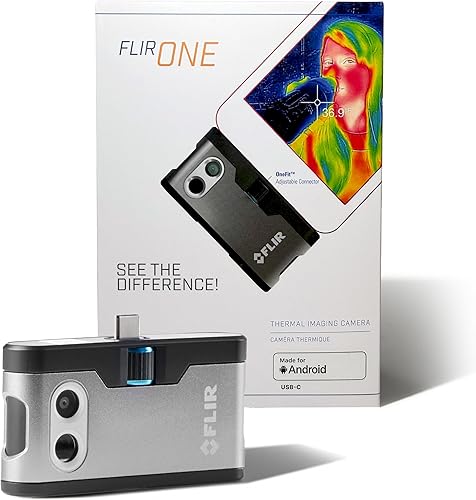
The entry point — fine for curiosity, below the bar for a report
Included because people ask about it constantly, and because the FLIR name carries weight it hasn’t fully earned here. The native sensor is 80×60 — 4,800 pixels doing the work that MSX processing and the marketing photos make look far sharper than it is. That’s enough to find a missing patch of loft insulation in your own home, and I wouldn’t use it to underwrite a paid opinion about anyone else’s. The Android/USB-C version is the one to buy; the Lightning/iOS listing was unavailable at the time of writing. If your budget stops here, the TOPDON TC001 above gives more than three times the sensor pixels for not much more.
For
- Cheapest route to the FLIR app and MSX
- Perfectly adequate for homeowner curiosity
Against
- 80×60 native — well below the working minimum for a report
- Outclassed on hardware by cheaper rivals in this list
Typically £170–£200
Check price on AmazonWhat actually matters — and what doesn’t
Check the connector before the resolution. Every spec sheet leads with pixel count. What actually stops a purchase working is the connector: USB-C, Lightning, or a wireless pairing, and several models here sell entirely separate listings per connector. Read the listing title in full before you buy.
A thick phone case can beat you before the camera does. Wired dongles need to seat fully into the port, and a rugged case with a raised bezel or port cover — exactly the kind sensible on a building site — can stop that. Either buy a case with an open port, or accept you’ll be removing it before every use.
Battery drain is real, not a footnote. Every wired camera here pulls power from the phone it’s plugged into on top of running its own sensor and screen. On a cold morning survey with the phone already working hard for photos, that adds up — a power bank in the van is cheap insurance.
“Super resolution” is a screen size, not a sensor spec. TOPDON’s TISR, and equivalents from other brands, upscale the native image with software interpolation to look sharper on screen. It changes nothing about what the camera can actually resolve — find the native pixel count before comparing two cameras.
What the salesmen push that you can ignore: temperature ranges up to 550°C (a house lives between about −10 and 60°C), the number of colour palettes, and frame rate above about 25Hz. One thing that genuinely matters and rarely gets mentioned: whether the app saves radiometric files you can re-analyse later, rather than a flattened image showing only whatever the screen displayed on site.
Questions I get asked
Are phone thermal cameras any good, or are they toys? The current 256×192 units — the Mini2, InfiRay P2 Pro, the two TOPDON models — have sensors in the same class as dedicated cameras costing three or four times as much, and the images they produce are genuinely usable for cold bridging, missing insulation and draughts. What separates them from a standalone camera is convenience, not optics: they occupy your phone and have no dedicated screen for one-handed use on a ladder. The true toy tier is 80×60 sensors like the FLIR ONE Gen 3 — fine for curiosity, not a conclusion.
Should I buy Android or iPhone compatible? Buy for the phone you actually own — but if the camera might need to work with someone else’s phone too, the dual-compatible units (HIKMICRO Mini2 V2, TOPDON TC002C Duo) remove the question for a modest premium. iPhone owners have fewer options generally; Seek Thermal’s Lightning models and the FLIR ONE Edge Pro’s wireless pairing are the two realistic routes.
Can a phone thermal camera find damp? Not directly — no thermal camera measures moisture. What it sees is the temperature signature damp often creates: evaporative cooling on a wet wall, or saturated masonry lagging behind the room’s temperature. That makes even a modest sensor a useful first screen for where to look closer, but a cold patch on a phone screen is a prompt to check with a damp meter, not a diagnosis on its own.
Will it work through my phone case? Wireless units like the FLIR ONE Edge Pro don’t care. Wired dongles need the port clear, and a case with a raised edge or port flap can stop the connector seating — check this before you’re stood in a loft unable to fit the camera on.
If a cold patch on a phone screen turns into a question worth answering properly, that’s where a PAS 2035 retrofit assessment or an EPC comes in — the camera finds the pattern, the paperwork works out what it costs to fix. For the full range up to professional handhelds, see the main thermal imaging camera guide. To have a survey done rather than a shopping list for one, get in touch. More field-kit guides live in the kit index.
Small print. This guide is general buying advice drawn from manufacturers’ specifications and published user feedback, viewed through survey-work experience — not hands-on product testing, and not a substitute for a survey; models and firmware change, so check the current specification before buying. Prices are indicative, move constantly and are checked at the time of writing; the linked page always shows the current price. As an Amazon Associate I earn from qualifying purchases.