A tool bag does most of the carrying on a normal visit — it comes out of the van, sits by the front door, and gets dipped into between rooms. A tool belt is for the minutes it doesn’t work: climbing a loft ladder with both hands needed for the rungs, crouching through a crawl-space hatch, or working a half-landing where there is nowhere flat to set a moisture meter down between readings. Whatever has to be reachable in exactly those moments — a torch, a meter, a pad and pencil, a phone for photos — needs to be on the belt, not three rooms away in the bag.
That makes a survey belt a different brief to the tool bag covered elsewhere in this series, and a lighter one than most tool belts on the market are built for. The majority of tool belts sold on Amazon are carpenter’s rigs, designed to carry a full day’s framing nails, a hammer and a pouch of fixings across a building site. A surveyor’s load-out is a fraction of that — a damp meter, a tape, a multitool, a phone — which is why the products worth buying here range from a two-pouch modular set to a full leather framer’s belt that is genuinely more rig than most surveys need, with honest reasons given either way.
What separates a good belt from a bad one at this scale has less to do with pocket count and more to do with whether it stays comfortable loaded for a whole visit, and whether a moisture meter actually stays in its pouch going down a loft ladder rather than landing on the landing below. First, the one I’d buy.
The one I’d buy

ToughBuilt TB-CT-102-3P-UK
ToughBuilt’s ClipTech system is the reason this sits top of the list: two pouches click on and off a padded base belt in seconds, so the rig can carry exactly what a given visit needs rather than committing to one fixed layout. A loft-and-damp survey might mean the meter pouch and nothing else; a fuller inspection might mean both pouches plus a multitool loop. The base belt itself is genuinely padded rather than a thin webbing strap, which is the difference between comfortable and merely bearable by the third loft hatch of the day.
Typically £28–£35
Check price on AmazonHow I judge a tool belt
Comfort loaded, not comfort in the packaging. A thin webbing strap feels fine for the thirty seconds it takes to try it on. Whether it is still comfortable after four hours and a loft ladder is a different question, and padding across the hips is what actually answers it.
Pouches that hold on to what goes in them. A moisture meter or a phone dropped through a loft hatch is not a small inconvenience — deep pouches with a snug fit beat wide, shallow ones every time, whatever the pocket count on the listing says.
Bulk that survives a hatch and a crawl space, not just a building site. A seven-bag framer’s rig is wide enough to catch on a 550mm loft hatch in a way a two-pouch belt never will. For survey work, less belt is often the better belt.
Quick on, quick off. A belt that has to be buckled and adjusted fresh every time it goes on gets left in the van out of sheer friction. A quick-release buckle or a modular clip system gets worn instead.
Material suited to a wet crawl space, not just a dry site. Leather looks and lasts the part but takes on damp and needs the occasional conditioning; synthetic dries out faster after a genuinely wet sub-floor and shrugs off a quick wipe-down.
The comparison
| Model | Pockets / pouches | Material | Typical price | Best for | |
|---|---|---|---|---|---|
| ToughBuilt TB-CT-102-3P-UK | 2 ClipTech pouches (detachable) | 1680D polyester, padded belt | ~£28–£35 | Best overall | View |
| Occidental Leather 5089 | 23 pockets and holders, 7 bags | Top-grain oil-tanned leather | ~£400–£600 | Premium/professional pick | View |
| Draper Redline 67832 | 16 pockets | Polyester | ~£12–£18 | Best on a budget | View |
| CLC 51452 | 27 pockets and holders | 1680D ballistic fabric, leather trim | ~£30–£40 | Best value full rig | View |
| Bahco 4750-3PB-1 | 3-pouch fixed set | Nylon / polyester | ~£90–£100 | Professional three-pouch rig | View |
| CLC 1614 | 20 pockets, padded suspenders | Polyester, padded belt | ~£90–£100 | Heavy-duty combo with suspenders | View |
| DEWALT DWST1-75651 | Base belt only, pouches sold separately | Leather/polyester, padded mesh | ~£22–£28 | Minimalist modular base | View |
The picks in detail
ToughBuilt TB-CT-102-3P-UK
Best overall — modular enough to match the job, not overload it
The ClipTech pouches are the whole case for this set: they lock onto the base belt with a firm click and release with a single lever, so the same belt can carry one pouch for a quick damp check or both for a fuller inspection. The padded belt itself is comfortable loaded in a way thinner webbing rigs are not, and because the pouches detach, the belt can stay on while a pouch gets swapped out at the van rather than the whole rig coming off.
For
- ClipTech pouches detach and reattach in seconds
- Genuinely padded belt, comfortable over a full day
- Scales up or down to what a visit actually needs
Against
- Only two pouches included — a third is a separate purchase
- Moulded pouches suit regular-shaped kit better than odd-shaped items
Typically £28–£35
Check price on AmazonOccidental Leather 5089

Premium/professional pick — buy once, never replace
Occidental’s reputation is built on leather that holds its shape for decades rather than sagging the way synthetic pouches eventually do, and the 5089 is the benchmark version of that: 23 pockets and tool holders across a three-pouch tool bag, a four-pouch fastener bag and a hammer holder, all on a padded work belt. It is honestly more rig than almost any survey calls for — this is a carpenter’s framing set, wide and heavy through a loft hatch, and priced accordingly. The case for it is longevity and comfort under a genuinely full load, not day-to-day survey carrying.
For
- Top-grain leather built to last years of daily use
- Padded work belt, comfortable even heavily loaded
- Enough capacity that nothing is ever left behind
Against
- Far more capacity and bulk than most survey kit needs
- Heavy and wide — awkward through a tight hatch
- Expensive relative to what a surveyor actually carries
Typically £400–£600
Check price on AmazonDraper Redline 67832

Best on a budget
Draper is a name that turns up in most UK trade vans already, and the 67832 covers the basics without ceremony: 16 assorted pockets, two chromed hammer loops, a tape measure holder, a mobile phone pocket and a quick-release buckle, at a price that makes it an easy add-on to a kit order rather than a considered purchase. There is no padding, so a full day loaded starts to make itself felt, and the pockets are soft-sided rather than structured, but for occasional use or a second belt kept in the van it does the job.
For
- Cheapest structured belt in this guide
- Familiar UK trade brand
- Dedicated phone pocket and tape holder included
Against
- No padding — noticeable on a longer day
- Soft-sided pockets let small items shift more than moulded ones
Typically £12–£18
Check price on AmazonCLC 51452
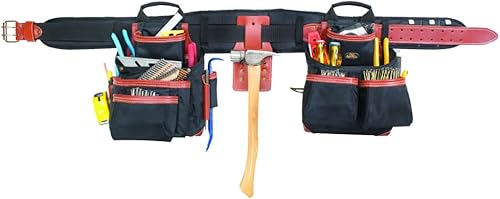
Best value full rig — most pockets for the money
CLC’s 51452 packs 27 pockets and holders across a four-piece combo for a fraction of the Occidental’s price, using double-layered ballistic fabric with leather trim rather than full leather — enough structure to keep pouches open and usable without the weight or the price of a full-leather rig. It is still a carpenter-scale layout, more capacity than most survey kit fills, and there are no suspenders included at this price point, so a fully loaded belt puts all of that weight straight onto the hips.
For
- 27 pockets and holders at a fraction of the Occidental’s price
- Leather trim adds structure without full-leather weight
- Genuine trade-brand construction
Against
- More capacity than most survey kit needs
- No suspenders — all the weight sits on the hips
Typically £30–£40
Check price on AmazonBahco 4750-3PB-1

A professional three-pouch rig with proper fittings
Bahco is a respected name across trades generally rather than tool belts specifically, and the 4750-3PB-1 reflects that in its detailing — rust-proof rivets and fittings rather than stitching alone, and lanyard rings for tethering tools when working at height, which matters more for a loft ladder than it first sounds. The three pouches are fixed to the belt rather than modular, so it is worn as a complete set or not at all, and it costs more than the CLC 51452 above for a smaller total pocket count.
For
- Rust-proof rivets and fittings, not just stitching
- Lanyard rings for tethering tools at height
- Established, trusted trade brand
Against
- Fixed three-pouch set, not modular
- Pricier than the CLC 51452 for fewer pockets
Typically £90–£100
Check price on AmazonCLC 1614
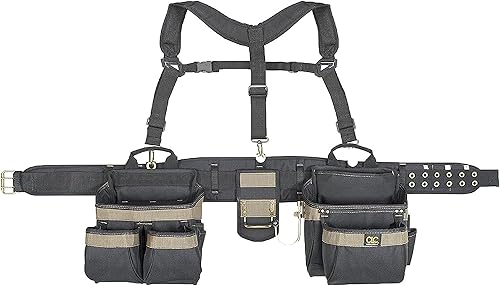
A heavy-duty combo, with suspenders included
The 1614’s padded suspenders are the feature that separates it from the belts above — once a rig is genuinely loaded, moving some of that weight from the hips to the shoulders makes a real difference over a long day, and CLC includes them here rather than selling them separately. The Sta-Open pocket design keeps pouches gaping for one-handed access, which is useful, but for the two or three items most surveys actually need, the suspenders and the extra pockets are more rig than the job calls for.
For
- Padded suspenders included, genuinely useful once loaded
- Sta-Open pockets stay accessible one-handed
- Padded roller-buckle belt
Against
- Similar price to the Bahco for a bulkier rig
- Suspenders are dead weight if the belt isn’t genuinely loaded
Typically £90–£100
Check price on AmazonDEWALT DWST1-75651

A minimalist base belt for building your own rig
This is not a complete tool belt out of the box — it is a padded, breathable base belt with D-ring hangers, designed to be built up with whatever DeWalt pouches or holsters actually get used. For a surveyor who only wants to clip on a single moisture-meter pouch and a tape holder, that is arguably a better starting point than any fixed set in this guide, because nothing sits on the belt that isn’t actually needed. The trade-off is that the true cost climbs once pouches are added, and it is not a ready-to-wear answer the way the others are.
For
- Cheapest of the structured, padded belts here
- Breathable mesh padding, comfortable base layer
- Build exactly the pouch combination actually needed
Against
- Pouches sold separately — true cost climbs quickly
- Not a ready-to-use rig out of the box
Typically £22–£28
Check price on AmazonWhat actually matters — and what doesn’t
Pocket count is a carpenter’s spec, not a surveyor’s. A framer’s belt with 27 pockets is built to sort nails by length and keep fixings separated from tools. A survey load-out is a handful of items — a meter, a tape, a pad, a phone — so two or three well-placed pouches beat a high pocket count every time. More pockets than kit just means more bulk to get through a hatch.
Leather earns its price over years, not on day one. A leather rig like the Occidental holds its shape indefinitely and looks the part decades in, but it needs breaking in, takes on damp in a wet crawl space, and costs several times what a synthetic belt does. Synthetic dries faster, needs no conditioning, and is the more practical choice for anyone not planning to wear the same belt for the next twenty years.
Suspenders only pay for themselves once a belt is genuinely loaded. Spreading weight from the hips to the shoulders is a real comfort gain on a heavily loaded framer’s rig. On a two-pouch survey belt carrying a meter and a tape, they are just extra bulk with nothing to justify it.
Modular, clip-on pouches suit a job where the load changes visit to visit. A carpenter wears the same rig all day, every day, so a fixed belt makes sense. A surveyor’s kit changes with the job — a damp-only revisit needs far less than a full building survey — and a system like ToughBuilt’s ClipTech lets the belt match that without buying multiple rigs.
A premium price tag is solving a carpenter’s problem, not a surveyor’s. The Occidental and similar leather rigs are built to survive a framing crew’s daily abuse for a decade. That is a genuine engineering achievement, but it is not the problem most survey kit carrying actually has — which is why the top pick here costs a fraction of it.
Questions I get asked
Do I need a tool belt if I already carry a tool bag?
For most of a visit, no — the tool bag does the carrying and a belt just adds bulk. Where a belt earns its place is the minutes a bag can’t follow: up a loft ladder, through a crawl-space hatch, or anywhere both hands are needed for something other than holding kit. A small, modular belt for those moments alongside a bag for everything else is a more practical combination than trying to make one do both jobs.
What should actually go in a surveyor’s tool belt?
Whatever needs to be reachable without setting anything down: a moisture meter, a tape measure, a pad and pencil, a phone for photos, and perhaps a small multitool. That is two or three pouches’ worth of kit, which is exactly why the modular, smaller-capacity belts in this guide suit survey work better than a full carpenter’s rig.
Leather or synthetic — which actually lasts longer on site?
Leather lasts longer in absolute terms if it is looked after, but it needs conditioning and doesn’t take kindly to a genuinely wet crawl space or a soaking on an external inspection. Synthetic pouches dry out faster, wipe clean, and need no maintenance, which for a job that regularly means damp sub-floors and standing water makes it the more practical material even before the price difference is considered.
Is a full carpenter’s rig like the Occidental worth it for survey work?
Only for someone who wants one belt bought once and never replaced, and is happy to carry more capacity and bulk than the job strictly needs. For most survey work, a modular two- or three-pouch belt does everything a framer’s seven-bag rig does for the kit actually carried, at a fraction of the price and without the bulk fighting a tight loft hatch.
A tool belt earns its keep in the moments a bag can’t reach — which for most surveys is a small, specific list of moments rather than a whole working day. Getting that list right on a building survey or a retrofit assessment matters more than how many pockets are on the belt. If you need a survey or assessment anywhere in Sussex, Kent or Surrey, get in touch — or browse the rest of the field-kit guides, including the tool bag and multitool guides this one sits alongside.
Disclaimer. This guide is general information based on published specifications, not a personal endorsement of any single product for every use case. Prices are indicative, move constantly and were checked at the time of writing; the linked page always shows the current price. As an Amazon Associate I earn from qualifying purchases.