Write out the kit list for an ordinary survey day and it stops looking like a tool kit at all: damp meter, laser measure, borescope, head torch, camera, spare batteries, tablet for the RdSAP software, dust masks, gloves, knee pads, a torch for the torch. Two thousand pounds of instruments and not a single hammer. Yet almost every bag on the market is designed for hammers — one cavernous compartment, a forest of identical pockets, and a base that wicks up whatever the last cellar floor had to offer.
That mismatch is the survey bag problem. Instruments have screens and lenses; they get crushed, scratched and rattled. Small kit — the borescope, the voltage stick, the spare SD cards — migrates to the bottom of a big compartment and has to be excavated by feel, usually at the top of a loft ladder with a client holding the hatch. And the whole lot gets put down on wet grass, damp concrete and worse, several times a day.
So the lens for this guide is simple: a place for everything, so a specific item can be found one-handed in a dark loft; enough padding and structure that nothing gets crushed; a base you can stand in a puddle; and a format — backpack, tote or wheels — that matches how you actually move through a job. On that last point I’ll declare a bias up front: stairs, ladders and loft hatches favour backpacks, because they leave both hands free, and most survey days are made of stairs, ladders and loft hatches.
The one I’d buy

Veto Pro Pac Tech Pac
The backpack the service trades treat as the final answer. Around 56 pockets arranged vertically across two zip-open sides, so every instrument stands upright in its own slot, on a moulded waterproof base you can drop in a wet meter cupboard without thinking. It costs silly money for a bag, and owner feedback is remarkably consistent that nobody regrets it.
Typically £280–£350
Check price on AmazonHow I judge a tool bag
Format follows the job. A backpack keeps both hands free for ladders, loft hatches and three flights of a Victorian terrace — which is why it’s the default for survey work. An open tote is faster for van-to-kitchen-table jobs where you’re grabbing and returning tools constantly. Wheels earn their keep on long corridors — blocks of flats, commercial jobs, anywhere with a lift — and are a liability on gravel drives and staircases. Most people eventually run one of each; the question is which one you buy properly.
A slot per instrument. The single biggest difference between a bag that works and a bag that doesn’t is whether every item has one home. Vertical pockets that hold tools upright — the layout Veto built its reputation on — mean you can see every handle at a glance and pull one out without unpacking three others. If the damp meter lives in the same pocket every day, your hand goes to it in the dark. That’s not a luxury; on a winter afternoon in an unlit roof void it is the difference between a survey that flows and one that doesn’t.
Padding where the fragile kit lives. Meters, borescopes and cameras want a padded, structured compartment that holds its shape when the bag is dropped — or at least dedicated pockets that stop them grinding against the SDS bits. Bags with a rigid or semi-rigid shell protect instruments even when a ladder falls on them in the van. Soft sacks protect nothing.
A base for British ground. The bag gets put down on wet grass at eight in the morning and a damp cellar floor by ten. A moulded plastic or hard rubberised base keeps the contents dry and stands the bag upright so it doesn’t slump and spill. Fabric bottoms wick water; it’s that simple.
Zips, stitching, warranty. A loaded tool backpack carries 10–15kg every working day. That kills cheap zips within a year — the failure point owner reviews mention more than any other. Chunky zips, bar-tacked stitching and an honest warranty (Veto’s is five years) are what you’re actually paying for at the top end. The counterweight is the bag’s own empty mass: heavy-duty construction can add 3–4kg before a single tool goes in.
The comparison
| Model | Format | Base | Typical price | Best for | |
|---|---|---|---|---|---|
| Veto Pro Pac Tech Pac | Backpack | Moulded waterproof polypropylene | ~£300 | Instrument-heavy professional work | View |
| DeWalt Pro Backpack DWST60102-1 | Backpack | Rigid water-resistant base | ~£85 | Best value all-round survey backpack | View |
| Milwaukee Packout Structured Backpack | Backpack, rigid shell | Impact-resistant, clips to Packout | ~£280 | Packout system owners, crush protection | View |
| Makita E-15481 | Backpack organiser | Reinforced, rubberised feet | ~£100 | Small-instrument organisation | View |
| DeWalt Pro Backpack on Wheels | Backpack + trolley | Rigid base, wheels, telescopic handle | ~£120 | Flats, corridors, heavy loads | View |
| Stanley FatMax Open Tote | Open tote | Rigid waterproof plastic | ~£35 | Van-to-door jobs, grab-and-go tools | View |
| CLC 1134 Carpenter’s Backpack | Backpack | Fabric, reinforced | ~£110 | Maximum pockets, lighter carry | View |
| Amazon Basics 16″ Tool Bag | Wide-mouth holdall | Fabric | ~£15 | Best on a budget; second bag, PPE | View |
The picks in detail
Veto Pro Pac Tech Pac
Best overall — the instrument backpack, and my top pick above
Veto designed the Tech Pac for service technicians — people who carry meters and testers rather than breaker bars — which is exactly the surveyor’s problem. The spec sheet is the argument: roughly 56 pockets, most of them vertical so every tool stands upright and visible; two independent zip-open sides so the bag works like a wardrobe rather than a sack; body panels in PVC-impregnated denier nylon over a 3mm moulded polypropylene base that is genuinely waterproof; and a five-year warranty. Published owner feedback, across trades from HVAC to fire alarms, repeats the same two points: the layout changes how you work, and the bags last the better part of a decade.
The price question, then. Around £300 buys a lot of DeWalt. The arithmetic that makes it defensible: if it protects one £300 meter from one drop, or saves five minutes of rummaging on every job for eight years, it has paid for itself. The honest counterargument is the weight — it’s heavy before you load it, and fully laden it is a serious carry.
For
- Vertical pocket layout — every instrument visible and findable one-handed
- Waterproof moulded base; put it down anywhere
- Owner feedback consistently reports many years of hard service
- Five-year warranty
Against
- Around £300, and heavy empty (roughly 4kg)
- Overkill if your kit is a drill and a screwdriver set
Typically £280–£350
Check price on AmazonDeWalt Pro Backpack DWST60102-1

Best value backpack — most of the job for a quarter of the Veto money
DeWalt’s Pro backpack is the sensible answer for most people reading this. Heavy tarpaulin-style fabric that shrugs off drizzle, a rigid base that stands upright on wet ground, a dedicated water-resistant front compartment for the kit that must stay dry, and a sensible split between a large main space and organised smaller pockets. Owner feedback rates the strap comfort and the structure — it doesn’t collapse into a slump when half-empty, which is what kills cheap backpacks for instrument work. What it lacks against the Veto is the slot-per-tool density: you’ll still want pouches inside for the small stuff.
For
- Rigid, water-resistant construction at a working price
- Stands upright; dedicated dry compartment
- Comfortable to carry up three flights
Against
- Fewer dedicated pockets than the organiser-style bags
- Big main compartment invites the everything-in-a-heap habit
Typically £70–£100
Check price on AmazonMilwaukee Packout Structured Backpack

Best crush protection — and the pick if your van already runs Packout
Milwaukee’s structured Packout backpack is closer to a rigid case with straps than a soft bag: the shell holds its shape whatever lands on it in the van, which is precisely what you want wrapped around a borescope screen and a thermal camera. The party trick is the base, which clicks onto a Packout stack — so the bag rides locked to the trolley across the car park, then comes off for the stairs. Priced up against the Veto it’s a genuine head-to-head: the Veto wins on pocket layout and findability, the Milwaukee on impact protection and system integration. If your van is already red, that settles it.
For
- Rigid structured shell — proper protection for screens and lenses
- Locks onto the Packout trolley and stack
- Impact-resistant base for wet, rough ground
Against
- Veto money without the Veto pocket density
- Rigid shell means less give when squeezing through loft hatches
Typically £250–£300
Check price on AmazonMakita E-15481 Backpack Tool Organiser

Best for small-instrument organisation — the meters-and-testers loadout
Part of Makita’s belt-and-bag range, and the one in that catalogue built as an organiser first: banks of dedicated pockets and holders rather than one big void, with a padded back panel, grab handle and a reinforced bottom. It suits the surveyor’s loadout — lots of small, valuable things — better than most general trade backpacks, and it’s noticeably lighter than the structured heavyweights above. Owner feedback praises the build and the pocket count; the recurring gripe is that there’s limited room for anything bulky, so the drill and the big first-aid kit live elsewhere. As a pure instrument bag, that’s barely a criticism.
For
- Organiser-style pockets suit meters, testers and adapters
- Lighter than the rigid-shell alternatives
- Makita build quality at a mid-range price
Against
- Limited space for bulky kit
- Base is reinforced fabric, not a moulded tub
Typically £90–£115
Check price on AmazonDeWalt Pro Backpack on Wheels

Best tool bag with wheels — corridors on wheels, stairs on shoulders
The same Pro backpack platform with a telescopic handle and wheels grafted on, and the best answer I’ve seen to the fact that no single format survives a mixed week. Block of flats with a lift: wheel it. 1930s semi with a loft conversion: straps out, wheel it no further than the hallway. The compromise every wheeled bag makes is weight and a lump of trolley frame stealing internal space, and this one is no exception — but it beats the alternative, which is a shoulder that gives out at fifty. Worth a hard look for anyone doing commercial EPCs or a lot of purpose-built blocks.
For
- Both formats in one bag — wheels for corridors, straps for stairs
- Rigid water-resistant build shared with the Pro backpack
- Kind to shoulders and knees over a long week
Against
- Trolley frame adds weight and eats capacity
- Wheels are for smooth floors, not gravel drives
Typically £110–£140
Check price on AmazonStanley FatMax Open Tote

Best open tote — everything visible, nothing zipped
The open tote is the format for jobs where the van is ten steps from the work: everything visible from above, tools dropped back in one-handed, no zips to fight with gloves on. Stanley’s FatMax version is the standard for a reason — a genuinely rigid waterproof plastic base, 600-denier fabric, a steel-tube handle and enough outside pockets to keep the frequently-grabbed items on the surface. What it will never do is protect anything from rain, brick dust or a tumble in the van, which is why it’s the second bag, not the first: consumables, sealants and hand tools in the tote, instruments in the backpack.
For
- Fastest access of any format — see everything, grab anything
- Rigid waterproof base stands up to wet ground
- Cheap enough to buy alongside a backpack
Against
- Open top: no weather, dust or theft protection
- Single-handle carry ties up a hand — wrong tool for lofts
Typically £28–£45
Check price on AmazonCLC 1134 Carpenter’s Tool Backpack
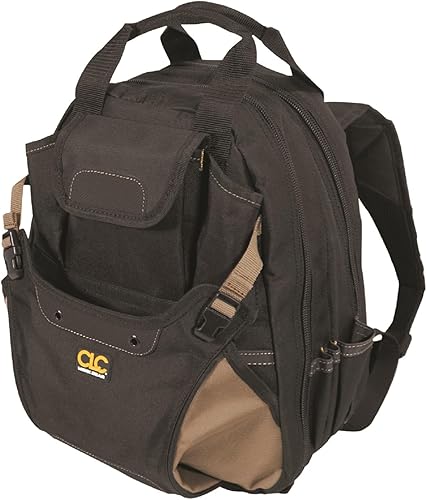
Best pocket count per pound — the soft-sided organiser
CLC (Custom Leathercraft, sold as Kunys in parts of the UK trade) has been making unglamorous, well-thought-out tool carriers for decades, and the 1134 is the pocket-density play: 44 pockets across two zippered compartments, padded back support and padded straps, in a soft-sided build that weighs far less than the structured bags. Owner feedback is warm about the layout and comfort; the honest trade-offs are a fabric base that shouldn’t be stood in a puddle and soft sides that rely on the pockets, not a shell, to protect what’s inside. For a lighter loadout carried far — and UK pricing that undercuts the Veto by a couple of hundred pounds — it earns its slot.
For
- 44 pockets — proper slot-per-item organisation
- Light and comfortable for long carries
- Decades of trade reputation behind the design
Against
- Soft sides and fabric base — neither armour nor waterproof
- UK street price has crept toward the mid-range structured bags
Typically £95–£130
Check price on AmazonAmazon Basics 16-inch Tool Bag

Best on a budget — the £15 wide-mouth workhorse
No pretence here: a wide-mouth fabric holdall with a spread of internal and external pockets, a shoulder strap, and a price that rounds to nothing. As a primary bag for instruments it’s the wrong answer — no padding, no structure, fabric base. As the second or third bag every kit eventually needs, it’s exactly right: PPE and coveralls in one, extension lead and consumables in another, one left in each vehicle. Owner feedback is what you’d expect — better than it has any right to be at the price, with the zips as the eventual failure point. At £15, that’s a fair deal.
For
- Costs less than a good tape measure
- Wide mouth — easy to load, easy to see into
- Ideal PPE, consumables or leave-in-the-van bag
Against
- No padding or structure — not for instruments
- Zips are the known weak point under heavy loads
Typically £12–£18
Check price on AmazonWhat actually matters — and what doesn’t
The base and the zips are the bag. Fabric, straps and pockets rarely fail; bottoms and zips do. A moulded or rigid water-resistant base decides whether the bag survives British ground, and zip quality decides whether it survives year two. If you handle a bag in a shop, run the main zip ten times and press on the base — that two-minute test tells you more than the spec sheet.
Discipline beats capacity. The bags that work are the ones that force a place for everything; the bags that fail are the 50-litre voids that let everything fall to the bottom. Counter-intuitively, a slightly smaller bag with more structure carries better and finds faster. If a bag can swallow your whole kit in a heap, one day it will, and that day you’ll be at the top of a ladder wondering where the head torch went.
Weigh the empty bag. Structured protection costs kilograms. A Veto or a rigid Milwaukee starts around 4kg before the first tool; a soft CLC around half that. If your kit is light instruments rather than steel, a lighter bag with good pockets may serve your spine better than armour you don’t need.
What the marketing pushes that you can skip. Pocket-count arms races (a 75-pocket bag where you use twelve), built-in USB charging ports (a battery bank in a pocket does the same job and doesn’t break), laptop sleeves pitched as “tech compartments”, and tactical styling. None of it moves the job on. Spend the money on the base, the zips and the layout — the three things you can’t retrofit.
Questions I get asked
Tool backpack or tool bag — which is better? For anyone whose work involves stairs, ladders or lofts: the backpack, without much argument. Both hands free is a safety point, not a comfort one — the Health and Safety Executive’s guidance on ladder work expects three points of contact, which is impossible with a tote in one fist. Handled bags win where the carry is short and the access is constant: van to kitchen, grab, return, repeat. Most working kits end up with one of each, and the split that works is instruments and valuables in the backpack, heavy hand tools and consumables in the tote.
Are tool bags with wheels worth it? On the right jobs, entirely. Purpose-built flats, commercial buildings, hospitals, anywhere with lifts and long corridors — wheels save your shoulders kilometre after kilometre. On gravel, mud, and staircases they’re dead weight, which is why the convertible format (the DeWalt above) is the one I’d actually shortlist: wheels for the smooth stretches, straps for everything else. If your patch is rural period housing, skip the wheels and spend the difference on a better backpack.
How do I stop instruments getting damaged in a tool bag? Three layers of defence. First, a bag with structure — a rigid or semi-rigid shell stops the crush loads that kill screens. Second, a dedicated slot per instrument so nothing grinds against anything else; padded sleeves or small zip cases inside a general bag achieve the same for a few pounds. Third, habit: meters live in the same pocket every day, batteries out of anything stored over winter, and the bag never travels loose in the van where a ladder can land on it. The most expensive option is a hard case per instrument — justified for a thermal camera, overkill for a voltage stick.
What size tool bag do I need? Smaller than you think. The instinct is to buy the biggest, then fill it, then carry the lot up every staircase in the county. A better method: lay out what one typical job actually uses — for me that’s a dozen instruments and the PPE — and buy the smallest bag that holds that with a slot each. Bulk and rarely-used kit stays in the van in cheap holdalls or crates. As a rule of thumb, if a loaded bag passes 12–15kg it has stopped being a bag and should be two.
If you’re packing a bag like this for EPC work, that’s the day job — the practice does domestic and commercial EPCs across Sussex, Kent and Surrey, carried up a great many staircases — get in touch. And for what goes inside the bag, there are more field-kit guides, starting with the damp meters and laser measures that earn their pockets.
Small print. This guide is general information; the right bag depends on your kit, your patch and your back. Prices are indicative, move constantly and were checked at the time of writing; the linked page always shows the current price. As an Amazon Associate I earn from qualifying purchases.