The parts of a building that decide a survey are almost never the parts you can see. Whether cavity wall insulation has slumped, whether the wall ties are rusting, whether there’s a lintel over that window at all, what state the joists are in under a suspended timber floor — all of it sits behind masonry, boards or a bath panel. A borescope lets you answer those questions through a hole the size of a wall plug instead of an opening-up job with a quote attached.
This is a tool with work waiting for it most weeks. Retrofit assessments under PAS 2035 regularly turn on the condition of existing cavity insulation, and the only honest way to report on it is to look. The same probe goes into sub-floor voids through airbricks, along boxed-in soil pipes, behind kitchen units, down the first metre or two of a gully. It is probably the highest ratio of information-to-cost of anything a surveyor carries.
The market splits into three tiers: £20 USB sticks that plug into your phone, £50–£150 self-contained units with a screen, and £200-plus trade kit. The junk and the genuinely useful sit surprisingly close together on price, and the spec sheets won’t tell you which is which. The differences that matter are the ones you only discover with the probe four metres into a cavity.
The one I’d buy

Teslong NTS300 Dual Lens
A 5-inch screen you can read in a dark loft, a 7.9 mm dual-lens probe that fits through a 10 mm drilled hole, and — the part that matters — a second lens looking sideways out of the probe. In a cavity you don’t want to stare at the far leaf; you want to look along the void at the insulation and the ties. The side lens does exactly that, and the 5 m semi-rigid cable holds its shape well enough to steer.
Typically £90–£130
Check price on AmazonHow I judge an inspection camera
Probe diameter against hole size. For cavity work the whole exercise depends on getting through a 10–12 mm drilled hole in a mortar joint. A 7.9 mm probe passes with room to angle it; anything over about 9 mm starts to fight you, and chunky trade camera heads of 14–17 mm simply don’t belong in this job.
Cable behaviour. Semi-rigid cable — the sort that holds a bend you put in it — is worth more than any camera spec. You pre-form a gentle curve, feed it in, and it tracks along the cavity or under the floor where you sent it. Fully flexible cable collapses into a heap the moment it meets resistance, which in a rubble-strewn cavity is immediately.
Where the lens points. A forward-only lens in a 50 mm cavity shows you a close-up of brick. A side-view second lens, a mirror attachment, or (on dearer units) an articulating tip is what turns the picture into evidence. Dual-lens probes have quietly become cheap, and I wouldn’t buy without one now.
Light you can adjust. LEDs at full blast inside a shiny cavity just bloom off the near surface. Adjustable brightness on the probe lights sounds trivial and isn’t.
Recording. If a finding is going in a report — slumped CWI, a corroded tie, a missing lintel — I need a still or a clip, not a memory. Units that record to an SD card beat units that don’t; wifi-to-phone models manage it too, with some faff.
The comparison
| Model | Probe & lens | Cable | Screen | Typical price | Best for | |
|---|---|---|---|---|---|---|
| Teslong NTS300 Dual Lens | 7.9 mm, front + side | 5 m semi-rigid | 5″ IPS, records to SD | ~£110 | Cavity walls & general survey work | View |
| DEPSTECH DS450 Dual Lens | 7.9 mm, front + side | 5 m semi-rigid | 4.5″ IPS, records to SD | ~£60 | The same job on a budget | View |
| Bosch GIC 120 C Professional | 8.5 mm, front | 1.2 m flexible | 3.5″, records to SD | ~£270 | Site-proof trade kit, 12V system | View |
| Teslong NTS500 Triple Lens | 7.9 mm, front + two side | 5 m semi-rigid | 5″ IPS, records to SD | ~£180 | Image quality & awkward voids | View |
| RIDGID micro CA-25 | 17 mm, front | 1.2 m fixed | 2.7″, no recording | ~£150 | Drains, traps & plant — not cavities | View |
| DEPSTECH WF028 Dual Lens WiFi | 7.9 mm, front + side | 5 m semi-rigid | Your phone, via wifi | ~£50 | Occasional use, phone as screen | View |
| DEPSTECH USB Endoscope | 5.5 mm, front | 5 m semi-rigid (light) | Your phone, via USB | ~£20 | A first look for the price of lunch | View |
The picks in detail
Teslong NTS300 Dual Lens
Best overall — the cavity wall camera I’d hand a new surveyor
The top pick, as above, and the unit that gets the balance right. The 7.9 mm dual-lens probe passes a 10 mm hole, the side lens looks along the cavity rather than across it, and the 5-inch screen means you’re not squinting at a phone in a crawl space with one hand on the cable. It records stills and video straight to an SD card, which is how borescope findings end up in a report rather than in anecdote. The 5 m semi-rigid cable takes and holds a set, so you can steer it under floors and along voids with reasonable confidence about where the lens actually is.
For
- Side-view lens is exactly what cavity inspection needs
- Probe fits a 10 mm drilled hole with room to manoeuvre
- Records to SD; screen is readable in the dark and the glare
- Semi-rigid 5 m cable steers rather than slumps
Against
- Screen resolution is adequate rather than lovely
- Menus are the usual far-eastern-firmware experience
Typically £90–£130
Check price on AmazonDEPSTECH DS450 Dual Lens

Best on a budget — most of the NTS300 for roughly half the money
Depstech make sensible, slightly plasticky kit, and the DS450 is the strongest argument in this list on pure value. Dual 7.9 mm lens, 5 m semi-rigid cable, a 4.5-inch screen and SD recording — the same working recipe as the Teslong, executed a notch cheaper throughout. The image is a little softer and the LEDs a little less controllable, but for a landlord checking their own CWI or a builder wanting eyes behind things a few times a month, the difference doesn’t justify the gap. If the budget won’t stretch to the Teslong this month, I’d buy this and not feel hard done by.
For
- Dual lens, semi-rigid 5 m cable and recording at a budget price
- Comes with a case and SD card; genuinely ready to work
- Battery life comfortably covers a day of surveys
Against
- Image and lighting a step behind the Teslong
- Feels like a tool you’ll replace in three years, not ten
Typically £50–£75
Check price on AmazonBosch GIC 120 C Professional

The professional option — site-proof, and part of the 12V system
The Bosch is a different sort of purchase. The camera specification is nothing special on paper — an 8.5 mm head on a 1.2 m cable, front view only — but the housing shrugs off being dropped from a loft hatch, it runs on the same 12V batteries as half the trade’s drills, and it will still be working when two generations of the cheaper units have gone to landfill. The short cable rules it out for long cavity runs and sub-floor exploration; where it earns its keep is lintel checks, boxed services, behind plant and inside stud walls, done daily by someone who is hard on tools. Buy it for the build quality or not at all.
For
- Genuinely robust; survives van life and site life
- Shares Bosch 12V batteries you may already own
- Clean, colour-accurate image and sensible controls
Against
- 1.2 m cable is too short for serious cavity or void work
- Front view only; the cheap dual-lens units see more in a cavity
- Costs more than the NTS300 and DS450 combined
Typically £230–£320
Check price on AmazonTeslong NTS500 Triple Lens
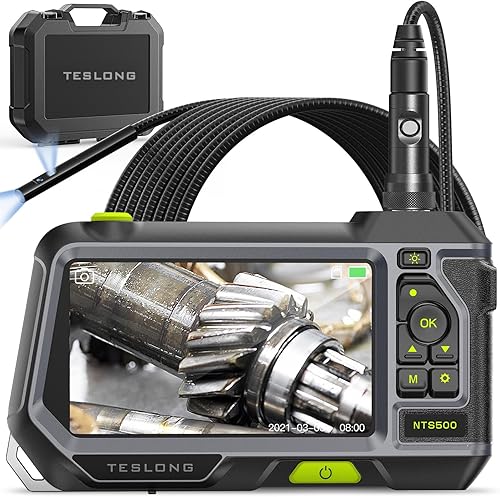
Best for awkward voids — the step-up when the picture is the product
The NTS500 is the NTS300’s bigger sibling: same 5-inch-screen format, sharper sensor options, and probe choices that include a triple-lens head — forward plus two side views — and an autofocus version that keeps close and far detail usable in the same shot. In a cavity or a shallow floor void, having side views on both flanks of the probe saves a lot of blind withdrawing and re-rotating. If your reports lean heavily on borescope evidence, or you spend real time in flues, service risers and rubble-filled cavities, the extra is justified. For everyone else the NTS300 does nine tenths of it.
For
- Triple-lens and autofocus probe options; best image of the group
- Interchangeable probes — replace the cable, keep the screen unit
- Same practical 5 m semi-rigid format as the NTS300
Against
- Meaningfully dearer, and the gain is incremental
- Probe and lens options are confusingly listed; check what you’re ordering
Typically £150–£210
Check price on AmazonRIDGID micro CA-25

Best for drains and plant — the plumber’s handheld, honestly described
The CA-25 appears in every trade catalogue and deserves an honest note rather than a reflexive recommendation. It is a tough, simple handheld with a 17 mm camera head on a fixed 1.2 m cable — and that 17 mm head means it will never go through a cavity wall drill hole, so for the headline job of this guide it is the wrong tool. Where it excels is exactly where plumbers use it: down traps and gullies, into waste runs, around cylinders and plant, anywhere access is a 40 mm opening rather than a 10 mm one. The big head carries proper LEDs, the picture is bright, and there is nothing on it to break. No recording, though, which for survey work is a real limitation.
For
- Simple, rugged, trade-grade; excellent lighting
- Ideal for traps, gullies, short waste runs and plant
Against
- 17 mm head cannot pass a cavity drill hole
- No image or video recording
- UK stock and pricing fluctuate; check the listing carefully
Typically £120–£180
Check price on AmazonDEPSTECH WF028 Dual Lens WiFi

Best wifi-to-phone — for the occasional user who already owns a good screen
The WF028 takes the same dual-lens 5 m semi-rigid probe recipe and deletes the screen: a small wifi box streams the picture to an app on your phone. The upside is price and the fact that your phone’s screen is better than anything on a sub-£100 dedicated unit. The downsides are the ones wifi always brings — a connection dance at the start of every job, a heartbeat of lag between moving the probe and seeing the result, and your phone now being a thing you’re holding in a loft with both hands already occupied. For a homeowner making occasional checks it’s a sound buy. For daily work, that lag is the complaint that runs through the user reviews — and the reason a built-in screen is worth the extra.
For
- Cheapest route to a dual-lens, semi-rigid 5 m setup
- Your phone screen beats any budget built-in display
- Stills and clips save straight to the phone for sharing
Against
- Wifi lag makes fine probe positioning tedious
- App quality varies with every update
- One more battery to have gone flat in the van
Typically £40–£60
Check price on AmazonDEPSTECH USB Endoscope

The £20 entry — a first look, and better than nothing by a distance
The cheapest tier: a 5.5 mm camera on a lightweight semi-rigid cable that plugs straight into an Android phone or a laptop by USB. There are a dozen near-identical versions under different brand names; Depstech’s is consistently one of the better-made. The 5.5 mm head goes through holes nothing else here will, the picture is serviceable in good conditions, and at this price it can live in the glovebox as a spare. Be realistic about the limits: fixed focus tuned for close range, weak LEDs, a front-only view, and a cable light enough that it wanders in a wide cavity. Plenty of surveyors started on one of these and ran it for a year or two before buying better, which is the fairest thing anyone can say about it.
For
- Costs about as much as the fuel to a survey
- 5.5 mm head fits the smallest access holes
- No batteries, no wifi — plug in and look
Against
- Front view only; in a cavity that mostly means a close-up of brick
- Fixed focus and weak lighting limit it to short-range looks
- Needs a phone that accepts USB cameras (most Android; iPhone with caveats)
Typically £15–£25
Check price on AmazonWhat actually matters — and what doesn’t
The hole comes first. A cavity inspection is a 10–12 mm hole drilled through a mortar joint — never the brick face — angled slightly downward, on an external elevation or through the inner leaf from inside a cupboard or under a window board. Drill the perp end (the vertical joint) where you can, sleeve the probe in as you withdraw the drill dust, and make good with mortar-coloured filler afterwards. You need a decent drill and a sharp bit far more than you need an expensive camera; my notes on that are in the SDS drill guide. And on someone else’s house: their wall, their permission, in writing, before the drill comes out of the van.
Megapixels are the number salesmen push, and they barely matter. Listings shout about 1080P and “5.0MP HD” sensors. Inside a cavity, the limiting factors are lighting, focus distance and where the lens points — a mediocre sensor with a side view beats a sharp one staring at the far leaf every single time. I would trade resolution for a second lens without hesitation.
Semi-rigid beats flexible; both beat “articulating” at this price. Genuine articulating-tip borescopes — where a thumbwheel steers the camera head — are wonderful and start around £300 for anything trustworthy; the cheap ones have vague, cable-pull steering that fails young. For cavity and void work, a semi-rigid cable you pre-bend does 90% of what articulation promises for a tenth of the money.
IP ratings describe the probe, not the unit. “IP67 waterproof” means the cable and camera head will survive a wet cavity or a gully — useful. The screen unit in your other hand usually isn’t rated at all, so mind it in the rain.
Know where these tools stop. A 5 m borescope will look into the first stretch of a drain from a gully or an open rodding eye and tell you something useful. It is not a drain survey. Proper drain CCTV is a self-levelling camera on a 30–60 m reel with a distance counter and, done properly, a report to a recognised defect-coding standard — that is hire-or-specialist territory at £150 a day or £150-plus a survey, and pretending a £60 endoscope replaces it helps nobody.
Questions I get asked
What size hole do you need for a cavity wall borescope? 10–12 mm is the working answer. The common survey probes are 5.5–8 mm in diameter, and you want a few millimetres of slack to angle the probe up and down the cavity once it’s through. Drill through a mortar joint, not the brick — a 10 mm hole in mortar disappears with a smear of matching filler, while a hole in a brick face is permanent. On rendered walls I go through a perp joint where I can find one and make good the same day.
Can I check cavity wall insulation myself? On your own house, with a steady hand and the points above — yes, and a £60 dual-lens camera will genuinely show you whether insulation is present, slumped or sodden. What it won’t give you is the interpretation: distinguishing blown fibre from beads from urea-formaldehyde foam, recognising tie corrosion, and judging whether wet insulation is an incident or a pattern takes a few hundred cavities’ worth of practice. If the question is “is my CWI causing this damp?” or you need evidence for an extraction claim or a retrofit plan, that’s a job for a retrofit assessment rather than a Saturday.
What’s the difference between a borescope and an endoscope? In this market, nothing but the label. “Endoscope” is the medical word, “borescope” the industrial one, and Amazon listings use both interchangeably for the same tools — searching either turns up the same products. If you want a distinction: rigid optical instruments for engineering inspection are traditionally borescopes, and the flexible camera-on-a-cable units in this guide are all, strictly, video endoscopes. Nobody on site has ever cared.
How do surveyors inspect wall cavities? Mostly exactly as described here: a drilled 10–12 mm hole in a mortar joint, a borescope with a side view, and stills recorded for the report — typically a few holes per elevation of interest rather than one token look. That sits alongside the indirect evidence: thermal imaging on a cold morning shows slumped insulation as warm and cold patches, a metal detector maps the wall ties, and the boiler flue or meter box sometimes offers a ready-made view in. For pre-1983 cavity walls with retrofilled insulation, the borescope is usually the only way to report on condition honestly, which is why one belongs in the survey bag and not in the van.
If the question behind your search is really “what state is my cavity insulation in?” or “what’s behind this wall?”, the practice does PAS 2035 retrofit assessments and building surveys across Sussex, Kent and Surrey — borescope, thermal camera and all. Get in touch. More field-kit guides live in the kit index.
Disclaimer. This guide is general information, not advice for your specific building; drilling into a wall you don’t own, or into anything you can’t identify, is on you. Prices are indicative, move constantly and are checked at the time of writing; the linked page always shows the current price. As an Amazon Associate I earn from qualifying purchases.