A surveyor’s SDS drill has a narrower job description than a builder’s. I’m not chasing walls, breaking out screeds or fixing down a hundred frame anchors a day. I’m drilling one, occasionally two, 10–12mm inspection holes through the outer leaf of a cavity wall — through the mortar joint, not the brick — so a borescope can tell me whether the cavity is clear, bridged, or full of slumped insulation. Then I fill the hole, point it to match, and put the kettle on.
That use-case changes what matters. A 5kg breaker-adjacent machine is the wrong tool when you’re at the top of a ladder holding the drill in one hand and your balance in the other. What you want is light, brushless, controllable at low speed so the bit doesn’t skate off the joint, and on a battery platform you already own. What separates the good ones from the junk isn’t headline joules — almost anything with an SDS chuck will make a 10mm hole in lime or cement mortar. It’s weight, balance, trigger control and whether the thing starts cleanly where you put it.
Everything below is SDS-plus, which is the only shank size this job needs. I’ve included one corded machine for people who want maximum value and don’t mind a cable, and two budget cordless options that are honestly fine for occasional use.
The one I’d buy

Makita DHR242Z 18V LXT Brushless SDS+
Light enough for one-handed work off a ladder, a brushless motor that sips battery, and enough capacity (24mm in concrete) that it’s barely working making a 12mm hole in hard cement mortar. Its low-speed trigger control has a reputation as the best in this class, which is what puts the hole where you aimed it. Body only — it assumes you have Makita 18V batteries, and if you’re in the trades you probably do.
Typically £150–£180 (body only)
Check price on AmazonHow I judge an SDS drill
Weight and balance first. The classic inspection hole is at first-floor level, drilled from a ladder, one-handed. Every hundred grams matters more than every extra joule. A compact SDS at 2.5–3kg with battery is comfortable; a 4kg machine is a liability up there, whatever the spec sheet says.
Low-speed control. Mortar joints are 10mm wide. You want a trigger that will spin the bit slowly and truly while you establish the hole, without the hammer action punching the tip sideways into the arris of the brick. Cheap drills tend to go from nothing to everything; good ones feather.
Brushless, on a platform you own. All the serious contenders are body-only. A bare tool at £150 is good value if you have batteries; add £80–£120 for a battery and charger if you don’t, and suddenly the kit deals or the budget brands make more sense. Brushless matters less for power than for battery life and motor longevity at our duty cycle.
Enough impact energy, not the most. For 10–12mm holes in mortar, 1.5–2 joules is ample. Even hard Victorian cement pointing gives up in seconds. The joules arms race is for people drilling 20mm holes in C40 concrete all day, which is not us.
Dust behaviour. Drilling above your head or at eye level puts silica-laden dust exactly where you don’t want it. I don’t carry an M-class extractor for two holes; I carry a £5 rubber dust cup that sits on the bit and catches most of it, and I drill from a slight downward angle where I can. More on this below.
The comparison
| Model | Impact energy | Weight (bare) | Typical price | Best for | |
|---|---|---|---|---|---|
| Makita DHR242Z | 2.0 J | ~2.7kg | ~£165 (body) | Best overall | View |
| Makita DHR183Z | 1.7 J | ~1.6kg | ~£145 (body) | Ladder work | View |
| DeWalt DCH172 | 1.4 J | ~2.0kg | ~£170 (body) | DeWalt platform | View |
| Bosch GBH 18V-21 | 2.0 J | ~2.4kg | ~£125 (body) | Value brushless | View |
| Milwaukee M18 CHX-0 | 2.5 J | ~3.1kg | ~£230 (body) | Heavy, mixed site work | View |
| Bosch GBH 2-21 (corded) | 2.0 J | 2.3kg | ~£100 (kit) | Corded value | View |
| Einhell HEROCCO 18V | 2.2 J | ~2.5kg | ~£95 (body) | Best on a budget | View |
| Ryobi R18SDS-0 | 1.3 J | ~2.2kg | ~£100 (body) | Occasional use, ONE+ | View |
The picks in detail
Makita DHR242Z 18V LXT Brushless SDS+
Best overall — the one I’d put in the van
The top pick, as above, and worth the fuller case. The DHR242Z has been in Makita’s range for years, which I count as a feature: the design is proven, spares and cases are everywhere, and the price has settled. The brushless motor and anti-vibration handle are well matched to the thirty seconds an inspection hole actually takes, and its 24mm concrete capacity means it’s never working hard, so nothing wanders. Three modes, including rotation-stop, which earns its keep when a joint needs raking out for a repointing sample. Two 5.0Ah batteries will see out a week of survey work with plenty left over.
For
- Excellent low-speed trigger control — starts exactly where you aim it
- Brushless, proven, spares and cases everywhere
- Never strained at 10–12mm, so holes stay clean
Against
- Body only — dear if you’re not already on Makita 18V
- Bulkier than the newer compact class below
Typically £150–£180 (body only)
Check price on AmazonMakita DHR183Z 18V LXT Brushless SDS+

Best for ladder work — the lightweight
At about 1.6kg bare, this is the lightest proper SDS drill I know of, and for the surveyor’s use-case that is nearly the whole argument. With a compact battery it’s in combi-drill territory for weight, which transforms one-handed work at the top of a ladder. Impact energy is 1.7 joules and capacity 18mm — modest on paper, entirely sufficient for inspection holes and fixing the odd bracket. If I were buying today with no batteries in the van, I’d think hard about starting here instead of at 01.
For
- Remarkably light and compact — the safest thing here to use off a ladder
- Brushless, with Makita’s anti-vibration mounting
- Cheaper than the DHR242Z
Against
- Two modes only — no rotation-stop for light chiselling
- 18mm capacity rules out bigger core-adjacent jobs
Typically £130–£160 (body only)
Check price on AmazonDeWalt DCH172 18V XR Brushless SDS+
Best for the DeWalt platform — the compact XR
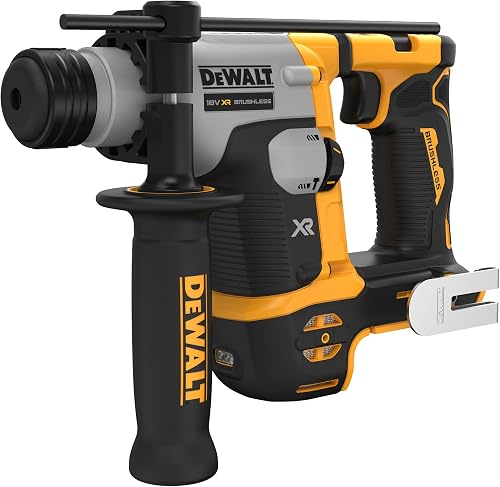
DeWalt’s answer to the lightweight question, and if your van already runs yellow batteries this is the obvious buy. It’s around 2kg bare, brushless, and its 1.4 joules is the lowest here — which for our purposes is a feature, not a flaw: it starts gently and doesn’t hammer the bit off line. Pairs beautifully with a compact Powerstack battery. Don’t buy it expecting to chisel; it doesn’t do that, and isn’t trying to.
For
- Genuinely compact and well balanced with a small battery
- Gentle, accurate starts on a mortar joint
- Sensible price for a brand-name brushless SDS
Against
- No chisel mode
- 1.4 J will feel slow if you ever need 16mm+ holes in engineering brick
Typically £150–£190 (body only)
Check price on AmazonBosch GBH 18V-21 Professional

Best value brushless — the quiet all-rounder
Bosch’s blue-line compact SDS is regularly the cheapest brushless professional option here, and there is nothing budget about the specification. Two joules, three modes, a rotation-control clutch, and the usual Bosch Professional build quality. If you’re starting a battery platform from scratch, Bosch 18V ProCORE batteries are also among the more affordable ways in. The main criticism is that it’s unremarkable — which, for a tool that gets used for a minute per survey, is close to praise.
For
- Brushless and three-mode at a very fair body-only price
- Rotation-control clutch for when a bit snags on a wall tie
- Solid, serviceable, boring in the best way
Against
- Reviews rate the trigger feathering a step behind the Makitas
- Bosch’s case ecosystem is an extra-cost afterthought
Typically £110–£150 (body only)
Check price on AmazonMilwaukee M18 CHX-0 M18 FUEL SDS+

The professional option — if drilling is half your day
The Milwaukee is more drill than the inspection-hole job needs, and I include it for the people whose week is more mixed than mine — retrofit installers, damp-proofing contractors, anyone who drills for fixings all day and inspects occasionally. Two and a half joules, 26mm capacity, a proper anti-vibration system and Milwaukee’s usual overbuilt feel. It is heavier and dearer than everything above it, and at the top of a ladder you know about the weight. Buy it for the drilling, not the surveying.
For
- Effortless power with headroom for repetitive fixing work
- Excellent vibration control on long sessions
- M18 platform depth if you’re already invested
Against
- Heavy for one-handed ladder work
- The most expensive tool here, before batteries
Typically £200–£280 (body only)
Check price on AmazonBosch GBH 2-21 Professional (corded)

Best corded value — no batteries, no economics
If the battery-platform arithmetic annoys you, here is the escape hatch: a 720W corded professional SDS, 2.3kg, three modes, usually sold with a case, depth stop and a starter set of bits for about the price of a bare budget cordless. On paper it drills as well as anything on this page, and it is never flat. The cost is the cable — an extension lead through a customer’s hallway, with their permission, and no use at a property with the power off. As a second, glovebox-tier drill it’s also the cheap insurance option.
For
- Complete working kit for around £100
- Light, compact, and immune to battery economics
- Bosch Professional build at a DIY price
Against
- Needs a socket and a lead — awkward at empty or external-only jobs
- Cable management up a ladder is its own hazard
Typically £90–£120 (with case and bits)
Check price on AmazonEinhell HEROCCO 18V Brushless SDS+

Best on a budget — brushless for under £100
The budget pick, and a genuinely surprising one: a brushless SDS with 2.2 joules and four functions, bare, for less than half the Makita money. The Power X-Change battery platform covers a large range of garden and DIY tools, and batteries are cheap. The compromises, going by user feedback, are where you’d expect — a less progressive trigger, more noticeable chuck runout — and I wouldn’t bet on it surviving a decade of trade use. For a hole or two a week it will do the job for years.
For
- Brushless and powerful at a budget price
- Cheap batteries; the platform makes sense for home use
- Includes chisel function, which nothing else does at this money
Against
- Coarser trigger — harder to start a hole exactly on the joint
- Unknown long-term durability under daily use
Typically £80–£110 (body only)
Check price on AmazonRyobi R18SDS-0 ONE+ SDS+

Best for occasional use — if you’re already on ONE+
Light, compact and well liked by its owners, with the softest hammer action here at 1.3 joules. In mortar that’s no handicap at all; in dense concrete you’ll be waiting. The brushed motor eats battery faster than the others, which matters little at two holes a job. This is the right answer for one group of people: those with a drawer full of ONE+ batteries who want an SDS in the cupboard for occasional masonry work. If that’s not you, the Einhell or the corded Bosch gives you more for the same money.
For
- Very light and easy to control
- Huge, cheap ONE+ battery ecosystem
- Four modes including chiselling
Against
- Brushed motor; the least power here
- Feels like a DIY tool, because it is one
Typically £90–£120 (body only)
Check price on AmazonWhat actually matters — and what doesn’t
Drill the joint, not the brick. This is technique rather than tooling, but it decides whether the make-good is invisible or an apology. A 10mm hole through a perp or bed joint disappears under matched mortar; a hole through a brick face never quite does, and on some stock you can’t buy a match at all. Start the drill slowly, rotation only if the mortar is soft, and let the hammer in once the hole is established. On lime mortar you barely need hammer at all.
The make-good kit costs less than a drill bit. Mine is a small tub of ready-mixed repair mortar, a jointing bar, a strip of plastic to keep mortar off the brick arrises, and a couple of mortar dyes for the estates where everything is pale or everything is soot. Fill in two lifts so it doesn’t slump into the cavity, and finish the joint profile to match the wall — bucket handle, weatherstruck, whatever the original bricklayer did. Photograph before and after for the file.
Take dust seriously, cheaply. Drilling masonry makes respirable crystalline silica, and the HSE limits exist for good reasons. For two holes I use a rubber dust cup on the bit (a few pounds, fits any SDS bit), an FFP3 mask, and common sense about wind direction and open windows. If you’re drilling indoors — say through an internal leaf — a helper holding a vacuum nozzle under the hole catches nearly everything. What you don’t need for survey work is a £500 M-class extractor bolted to the drill; that’s for people cutting chases all day.
What the salesmen push that you can ignore. Bluetooth connectivity and tool-tracking apps do nothing for a one-minute task. Chisel mode is genuinely optional — nice for raking out a joint, never essential. Anti-vibration ratings matter enormously at trade duty cycles and barely at ours; you will not approach the HSE exposure action value drilling inspection holes. And nobody drilling a 10mm hole needs SDS-max, which is a different, heavier shank system for holes from about 20mm up.
Ask before you drill. An inspection hole is minor, but it is still making a hole in someone’s house. I get explicit consent (in writing, in the booking terms and again on the doorstep), check what’s behind and around the drilling position — cables and gas barrels have no respect for mortar joints — and on anything listed or in a conservation area, think twice and drill somewhere discreet, or not at all.
Questions I get asked
What size hole do I need for a cavity wall borescope?
Ten millimetres suits most borescope probes; I carry a 12mm bit as well for chunkier dual-lens camera heads and for cavities where I want room to angle the probe. Drill through a mortar joint at a slight upward angle so the probe naturally looks across and up the cavity, and stop as you feel the bit break through the inner face of the outer leaf — you want a hole through one leaf, not a core through both. My guide to the borescopes worth buying covers what goes through the hole once you’ve made it.
SDS or combi drill for masonry?
A decent combi on hammer setting will get through soft mortar and common brick, and for years plenty of surveyors managed that way. The difference is mechanism: a combi’s hammer is two ratcheting discs pushing the whole chuck back and forth, while an SDS has a piston striking the bit itself — several times the blow energy, with the bit free to move in the chuck. In practice that means an SDS makes a cleaner hole in a fraction of the time, doesn’t glaze or wander in hard cement mortar, and doesn’t cook its gearbox doing it. If you drill masonry more than occasionally, the SDS pays for itself in tidiness alone.
Do I need SDS-plus or SDS-max?
SDS-plus, without hesitation. The two are different shank sizes for different classes of tool: SDS-plus covers bits up to roughly 20–26mm and light chiselling; SDS-max is the big-machine standard for breaking, coring and holes beyond that. Everything in this guide is SDS-plus, every 10–12mm masonry bit you’ll ever buy is SDS-plus, and an SDS-max machine is unusable for fine work — apart from anything else, small-diameter SDS-max bits barely exist.
Can you drill an inspection hole in a cavity wall and make good?
Yes — done properly it’s a minor, reversible intervention, which is exactly why borescope inspection is so useful before specifying cavity wall insulation, diagnosing penetrating damp or checking wall-tie condition. The hole goes through the mortar joint of the outer leaf only, with the owner’s consent, away from services, and is filled the same visit with a matched mortar in two lifts and the joint profile reinstated. On a well-executed repair you’ll struggle to find the hole a season later. What I don’t recommend is drilling brick faces, drilling without checking for buried cables, or leaving holes open “for ventilation” — an open 12mm hole is a wick for driving rain and an invitation for masonry bees.
Inspection holes usually happen because something bigger is being decided — whether a cavity can take insulation, why a wall is damp, whether a retrofit plan matches the building in front of it. That’s the practice’s core work: PAS 2035 retrofit assessments and building surveys across Sussex, Kent and Surrey. If you’d like the cavity looked at before anyone fills it, get in touch. More field-kit guides live in the kit index.
Disclaimer. This guide is general information, not a substitute for site-specific advice, and drilling into any wall carries risks you must assess yourself — check for services, get consent, and control dust. Prices are indicative, move constantly and are checked at the time of writing; the linked page always shows the current price. As an Amazon Associate I earn from qualifying purchases.