A head torch is the piece of kit I use on more jobs than anything else bar the tape measure. Every RdSAP assessment involves a loft hatch; most building surveys involve a roof void, and the interesting ones involve lying on my stomach in a sub-floor void working out why the joist ends have gone soft. In all of those places both hands are busy — ladder, hatch, measuring the insulation depth, holding the tablet — so the light has to live on my head.
The market is a strange one. At the bottom there are £8 units that fail at the switch inside a year; at the top there are 2,000-lumen running lamps built for people descending mountains at 4am, which is not my problem. What survey work actually needs is unglamorous: a wide, even flood beam for reading construction at arm’s length, honest battery life at moderate output, a charging socket the rest of the van already uses, and a headband that stays put when you’re crawling under pipework.
What separates the good ones from the junk isn’t brightness. It’s beam quality, switchgear you can work with dusty gloves, and whether the thing still holds a charge after two years in a bag. Those are the criteria I’ve judged this list on, working from manufacturers’ spec sheets and the pattern in long-term user feedback.
The one I’d buy

Petzl Actik Core
A wide, even flood beam that makes reading rafters and reveals at close range effortless, a rechargeable battery that now charges over USB-C, and — the clincher — it also runs on three AAAs if the rechargeable dies mid-job. Light enough to forget you’re wearing it, and the reflective headband washes.
Typically £55–£65
Check price on AmazonHow I judge a head torch
Beam shape before brightness. In a loft you are reading things half a metre from your nose — sarking felt condition, wane on rafters, the line of a purlin, whether that dark patch on the quilt is mould or dust. A tight spot beam at that distance gives you a blinding hot circle and blackness either side. What you want is flood: wide, even, no rings. A spot mode is useful for looking down the length of a roof void without crawling it, but flood is where the torch lives.
Output you can sustain, not the number on the box. Headline lumens are a burst figure that thermal regulation steps down within minutes. The number that matters is what the lamp holds for two or three hours — a survey’s worth. Around 100–300 real lumens is the working band. A torch that does seven hours at 100 lumens is worth more to me than one that does 1,000 lumens for ninety seconds.
Battery and charging. Rechargeable is right for daily use, USB-C is right because it’s the cable the van already carries, and the best answer of all is hybrid — rechargeable pack with AAA fallback. The failure mode that costs you money isn’t a dim torch, it’s a flat one at the 4pm job in December.
Colour quality. LED colour rendering (CRI) and colour temperature decide whether you can judge staining honestly. A cheap cool-white LED bleaches everything blue-white: old watermark and live damp look the same, black spot mould looks like shadow. A warmer, higher-CRI beam keeps browns brown. None of these lamps is perfect on this front, but some are noticeably more truthful than others.
The living-with-it details. A switch you can find with gloves. A head that tilts and stays tilted. A band that grips over a beanie in winter and doesn’t slide when you look straight down. And nothing that switches itself on in the bag — either a lock-out or firm enough switchgear that it can’t happen.
The comparison
| Model | Max output | Battery | Typical price | Best for | |
|---|---|---|---|---|---|
| Petzl Actik Core | 625 lm | Li-ion (USB-C) or 3×AAA | ~£60 | Best overall | View |
| Ledlenser H7R Core | 1,000 lm | Li-ion, magnetic charge | ~£75 | The professional option | View |
| Ledlenser H5R Core | 500 lm | Li-ion, magnetic charge | ~£55 | Focusable beam for less | View |
| Black Diamond Spot 400-R | 400 lm | Li-ion (micro-USB) | ~£45 | Wet, filthy voids | View |
| Olight Perun 2 | 2,500 lm | 21700 Li-ion, magnetic charge | ~£70 | Doubles as inspection lamp | View |
| Nitecore NU25 UL | 400 lm | Built-in Li-ion (USB-C) | ~£40 | Ultralight spare | View |
| Petzl Tikka | 350 lm | 3×AAA (Core-compatible) | ~£30 | The van spare | View |
| Energizer Vision Ultra HD | 450 lm | 3×AAA | ~£18 | Best on a budget | View |
The picks in detail
Petzl Actik Core
Best overall — the daily-wear survey torch
The one from the box above, in more detail. The current Actik Core claims 625 lumens, but the reason it wins is everything below that number: a genuinely wide mixed beam that reads timber and masonry evenly at arm’s length, about seven hours at the 100-lumen middle setting — which is the setting you actually use — and Petzl’s hybrid battery arrangement. The rechargeable Core pack now charges over USB-C, and if it dies on site the lamp takes three AAAs from the glovebox. At 88 grams you stop noticing it, and the headband comes off and goes through the wash after crawling season.
For
- Wide, even flood beam suited to close-up work
- Hybrid power: USB-C rechargeable pack or 3×AAA
- Light, comfortable, washable reflective band
Against
- No switch lock, so it can come on in a crowded bag
- Spare Core batteries are not cheap
Typically £55–£65
Check price on AmazonLedlenser H7R Core

The professional option — when the torch is a tool, not an accessory
Ledlenser’s focus system is the honest version of the zoom gimmick on cheap torches: a proper lens that slides from wide flood to a usable spot, so one lamp covers reading a joist end at 300mm and checking the far gable of a long terrace roof void. The battery sits in a rear pack, which balances the weight far better than front-heavy designs when you’re looking straight down through a hatch, and the dimming is stepless. Charging is by magnetic cable — convenient at the desk, one more proprietary lead to lose in the van.
For
- Genuine flood-to-spot focus, done properly
- Rear battery balances the head; comfortable all day
- Stepless dimming and strong sustained output
Against
- Proprietary magnetic charge cable, not USB-C into the lamp
- Heavier and bulkier than the Petzl
Typically £65–£80
Check price on AmazonLedlenser H5R Core

Best for a focusable beam at mid money
Most of the H7R’s ideas in a smaller, single-unit lamp. You keep the sliding focus and the solid German switchgear, lose the rear battery pack, and the head rotates through 160 degrees — which sounds like brochure filler until you’re lying on your side under a suspended timber floor and want the light pointing at the sleeper wall without pointing your face at it. Five hundred lumens flat out, sensible runtimes at the levels below. If the H7R feels like more torch than you need, this is the one.
For
- Focusable beam in a compact single unit
- Rotating head genuinely earns its keep in crawl spaces
- Robust switchgear that works with gloves
Against
- Same proprietary magnetic charging as its big brother
- Beam is cooler-toned than the Petzl; staining reads slightly less true
Typically £50–£60
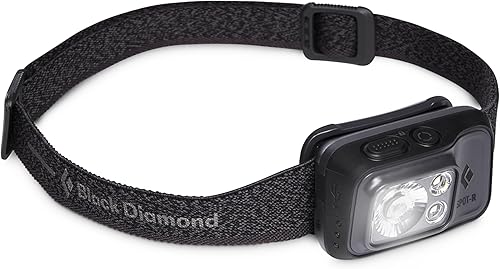
Check price on AmazonBlack Diamond Spot 400-R
Best for wet, filthy voids — the sealed unit
Black Diamond builds climbing kit, and it shows: the Spot 400-R is rated to survive being dunked — which matters the day the sub-floor void turns out to have standing water in it. The beam mixes flood and spot sensibly, the PowerTap feature lets you slap the housing for full power with a gloved hand, and battery life at working outputs is among the best here. The one real irritation: the battery still charges over micro-USB, the only lamp in this list that makes you carry a legacy cable.
For
- Properly sealed — happy in wet voids and rain
- Excellent runtimes at useful outputs
- Tap the housing for instant full power, works with gloves
Against
- Micro-USB charging in 2026
- Settings take a week to learn; the manual is required reading
Typically £40–£55
Check price on AmazonOlight Perun 2

Best for double duty — head torch and inspection lamp in one
A right-angle torch that clips out of its headband, has a pocket clip and a magnetic tail. In practice that means it spends half its life stuck to a steel beam, a boiler casing or the van door lighting a work area while your head does something else — a trick none of the conventional lamps here can do. The 2,500-lumen headline is a burst figure that steps down quickly, as they all do, but the sustained levels are strong and the 21700 cell is a big tank. Cool-white beam, so judge subtle staining with a little scepticism.
For
- Removable right-angle body with magnetic tail — sticks where you need it
- Large cell gives long runtimes at working levels
- Solid, waterproof aluminium build
Against
- Proprietary magnetic charger; the cell’s a special part too
- Cool beam tone flatters damp staining
- Headline lumens are a burst, not a working level
Typically £60–£80
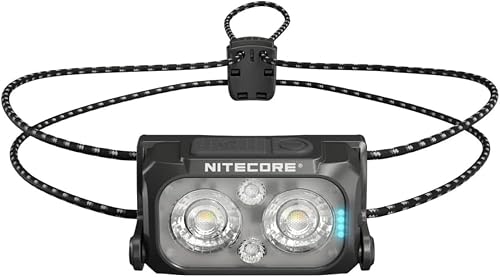
Check price on AmazonNitecore NU25 UL
Best ultralight — the one that lives in the survey bag permanently
Forty-five grams including the shock-cord band, which means it stays in the bag’s front pocket forever and you never resent it. Four hundred lumens from a built-in cell, USB-C straight into the lamp, and — unusually at this money — a separate high-CRI auxiliary flood that renders colour more honestly than the main beam, which is genuinely useful when deciding whether a patch on the plasterboard is mould or shadow. As a primary torch for daily loft work the small cell is the limit; as the always-there backup it’s the best thing here.
For
- Weightless; permanent bag resident
- USB-C into the lamp itself
- High-CRI secondary flood for honest colour judgment
Against
- Built-in cell — no battery swap, limited daily stamina
- Shock-cord band less secure over a hard hat
Typically £35–£45
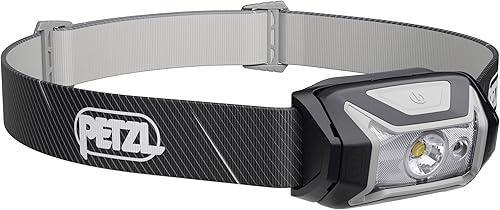
Check price on AmazonPetzl Tikka
Best simple spare — the one that lives in the van door
The Actik’s simpler sibling: 350 lumens, one button, runs on the three AAAs it ships with and takes the same Core rechargeable pack if you upgrade it later. The clever detail is a phosphorescent ring in the reflector that glows faintly in the dark, so you can find it in a black loft after you’ve put it down — the detail owners mention most often in reviews, usually after ten minutes spent patting insulation in the dark. Nothing about it excites; nothing about it fails. That is precisely the job description for a spare.
For
- Simple, reliable, one-button operation
- AAA power with the option of the Core pack later
- Glow-in-the-dark reflector — findable when switched off
Against
- Modest output; flood-only beam won’t reach a long void
- Rechargeable pack costs extra
Typically £25–£32
Check price on AmazonEnergizer Vision Ultra HD

Best on a budget — proof you don’t need £60 to get started
The honest budget answer. Around 450 claimed lumens on AAAs, a pivoting head, spot and flood modes, and a build that is entirely adequate rather than pleasing. The beam is cooler and less even than anything above it in this list, the switch is mushier, and I’d expect a working life of a couple of years rather than a decade. But it does the actual job — lights a loft, leaves your hands free, costs less than the fuel to most jobs. If you go up a ladder four times a year, buy this and spend the difference on batteries.
For
- Very cheap for genuinely usable output
- AAA power — spares in any garage forecourt
- Pivoting head, spot and flood modes
Against
- Cool, uneven beam makes staining harder to read
- Switch and headband are where the price shows
Typically £15–£22
Check price on AmazonWhat actually matters — and what doesn’t
The spec sheet is written to sell torches to trail runners, so most of it is noise for building work. Red mode is for preserving night vision on a campsite; there is no night vision to preserve in a loft, and I can’t name a single survey task that needs it. Beam throw quoted in hundreds of metres is equally irrelevant — the longest sight line you’ll meet is a terrace roof void, maybe fifteen metres. Gesture controls — wave your hand to switch modes — sound clever and trigger constantly when you’re working at arm’s length, which is always. And zoomable lenses on sub-£15 torches are a moulded plastic trick that produces an ugly square-ish hotspot; Ledlenser’s focus system is the only version of the idea I’d pay for.
What the spec sheet undersells: the shape of the beam at half a metre, which no lumen figure describes. Runtime at the middle setting, which manufacturers bury because it’s less impressive than either the burst figure or the 100-hour glow-worm figure. Whether the tilt mechanism still holds its angle after a year of dust. And the charging socket — a torch that shares a cable with your phone gets charged; a torch with a proprietary lead gets found flat.
One more thing that matters and appears on no spec sheet: buy two. A £60 primary and a £20 spare in the van door means the day one fails — and it will fail the morning of a full-house survey in February — costs you nothing but a slightly worse beam. A surveyor who cannot see is a surveyor guessing, and guessing is not what the client paid for.
Questions I get asked
How many lumens do I need in a head torch?
For loft, roof-void and crawl-space work: 100–300 real, sustained lumens. That surprises people shopping on headline figures, but at close range more light just means more glare bouncing off the quilt insulation into your eyes. The burst modes — 600, 1,000, 2,500 lumens — are occasionally handy for lighting the far end of a long void, and the rest of the time they exist to flatten the battery. Buy on the runtime at the middle setting, not the number on the box.
Rechargeable or AAA — which is better?
For daily use, rechargeable, ideally over USB-C so one van cable serves the torch, the phone and the tablet. For a spare, AAA — a lithium cell self-discharges sitting in the glovebox, while a set of AAAs in their packet is still full two years later. The best of both is Petzl’s hybrid arrangement, where the same lamp takes a rechargeable pack or three AAAs; that redundancy is a large part of why the Actik Core tops this list.
What head torch do surveyors use?
There’s no official issue — ask five surveyors and you’ll get five answers, at least one of which is “whatever was in the drawer.” The pattern among people who do lofts weekly is consistent though: a mid-range rechargeable with a good flood beam — Petzl and Ledlenser dominate — plus a cheap backup. If I were kitting a van out from scratch it would be an Actik Core on the head, a Tikka in the door pocket and an NU25 UL living in the survey bag; cover those three positions and you won’t be caught dark on a job.
Are cheap head torches any good?
Cheap branded ones — Energizer, and Silverline’s trade units in the same bracket — are fine as spares and fine for occasional use; the light itself is perfectly usable. Where the money goes on a dearer torch is everything around the LED: a switch that survives thousands of gloved presses, a beam without rings and hotspots, honest colour, a band that stays put. The no-name £7 units with five settings and a zoom lens are a different matter — they fail at the switch or the battery door, usually inside a year, and usually on a Friday.
The head torch gets more use on building surveys than anywhere else — roof voids and sub-floor inspections are where defects hide — and it’s on my head for the loft check on every EPC too. If you’d like eyes on a dark corner of your own property, get in touch. More field-kit guides live at the kit index.
Disclaimer. This guide reflects my professional opinion, not lab testing — assessments are drawn from manufacturers’ specifications and published user feedback. Specifications change between production runs, so check the listing before you buy. Prices are indicative, move constantly and are checked at the time of writing; the linked page always shows the current price. As an Amazon Associate I earn from qualifying purchases.