There are really two different jobs hiding under one product category, and it’s worth being clear which one is actually being bought for before spending anything. A modular job-site trolley — the wheeled base under a stack of PRO-STACK, TSTAK or PACKOUT boxes — folds down flat, lives behind the seats or against the bulkhead, and only comes out to wheel the whole stack up a path, across a gravel drive or through a communal hallway. A static van trolley is a different animal entirely: two lockable drawers on castors, built more like a small roll cabinet than a folding platform, that stays wedged in the back of the van or a garage and gets rolled out rather than carried in. Both get called a “tool trolley”. Only one of them is meant to leave the vehicle.
The case for either starts the same way: a survey day rarely involves one trip. An EPC or RdSAP assessment on a rural property with a hundred-metre gravel drive and no vehicle access to the door, a retrofit assessment in a third-floor flat where the lift’s out of service, a building survey where the loft hatch, the cellar and the garden boundary are all being checked in one visit — each of those means carrying the full kit somewhere the van can’t follow, more than once, without a convenient spot to leave the first load while the second one goes back. A trolley that folds flat for the drive over and unfolds to take the weight in one go turns that into a single walk instead of three.
None of the seven below has done a survey day for real — this is drawn from manufacturers’ specifications and the pattern in published owner feedback, filtered through what a domestic survey actually needs rather than a full building-site toolkit. First, the one I’d buy.
The one I’d buy

Stanley FatMax Pro-Stack Trolley
The Pro-Stack trolley is built to do one job well: wheel a stack of interlocking Pro-Stack boxes from the van to wherever the work starts, then fold flat and get out of the way again. The telescopic handle collapses for storage, the castors lock for a stable stop on an uneven path, and the buckle clip straps the stack down so a loaded tower of boxes doesn’t topple crossing a kerb. 100kg on the flat is more than any survey kit will ever weigh — what matters is that it folds small enough to actually live in a van rather than take up a permanent footprint in it.
Typically £90–£140
Check price on AmazonHow I judge a tool trolley
Folds flat for the van, not just wheels well once it’s out. A trolley that’s brilliant crossing a gravel drive but won’t collapse small enough to fit behind the seats just becomes permanent van clutter. The fold matters as much as the roll.
Wheel size and type for real ground. A block-paved drive, a cracked path, a kerb up to a Victorian terrace’s front step — small hard castors built for a workshop floor catch and tip on all of it. Bigger, softer-tyred wheels cope with the ground a survey actually happens on.
Modularity is a lock-in decision, not just a feature. Buying into Pro-Stack, TSTAK or PACKOUT means every future storage box has to match the system already owned. Worth deciding deliberately rather than by accident.
Load capacity against what’s actually being carried. Most survey kit is genuinely light — instruments, not power tools. A 100kg rating is rarely the limiting factor; stability on a slope with a top-heavy stack is the more common failure.
Lockable, if it’s doubling as static storage. A trolley that stays in the van overnight on a residential street needs a lid that locks. A trolley that only ever comes out for the walk from kerb to front door doesn’t need to bother.
The comparison
| Model | Type | Folds flat | Typical price | Best for | |
|---|---|---|---|---|---|
| Stanley FatMax Pro-Stack Trolley | Modular job-site | Yes | ~£90–£140 | Best overall | View |
| Milwaukee PACKOUT Trolley Set | Modular job-site | No (rigid cases) | ~£200–£290 | Premium/professional pick | View |
| DeWalt TSTAK Trolley | Modular job-site | Yes | ~£110–£145 | Best for the TSTAK ecosystem | View |
| Sealey AP760M | Static van/workshop | No | ~£280–£340 | Best static trolley | View |
| Draper 07635 | Static van/workshop | No | ~£215–£260 | Mid-range static value | View |
| Keter Stack n’ Roll Cart | Modular DIY-grade | Partial | ~£100–£125 | Best budget modular | View |
| VonHaus Tool Box on Wheels | Basic wheeled box | Yes (splits in two) | ~£40–£60 | Cheapest | View |
The picks in detail
Stanley FatMax Pro-Stack Trolley
Best overall — folds flat, wheels a stack of Pro-Stack boxes to the door
Stanley’s Pro-Stack system is built around exactly the problem a survey day creates — getting several boxes’ worth of kit from the van to the front door in one trip. The trolley folds down for storage, locking castors hold it steady on a slope or an uneven path, and an integral buckle clip keeps a stacked tower of boxes from shifting mid-walk. 100kg on the flat and 50kg on stairs is far beyond anything a survey kit weighs, which is the point — the headroom is there for stability, not because it’ll ever be needed.
For
- Folds flat, genuinely lives in a van
- Locking castors hold a loaded stack on a slope
- Buckle clip stops the stack shifting mid-walk
Against
- Only useful once buying into the Pro-Stack box system
- No lockable lid of its own — that’s down to the boxes on top
Typically £90–£140
Check price on AmazonMilwaukee PACKOUT Trolley Set
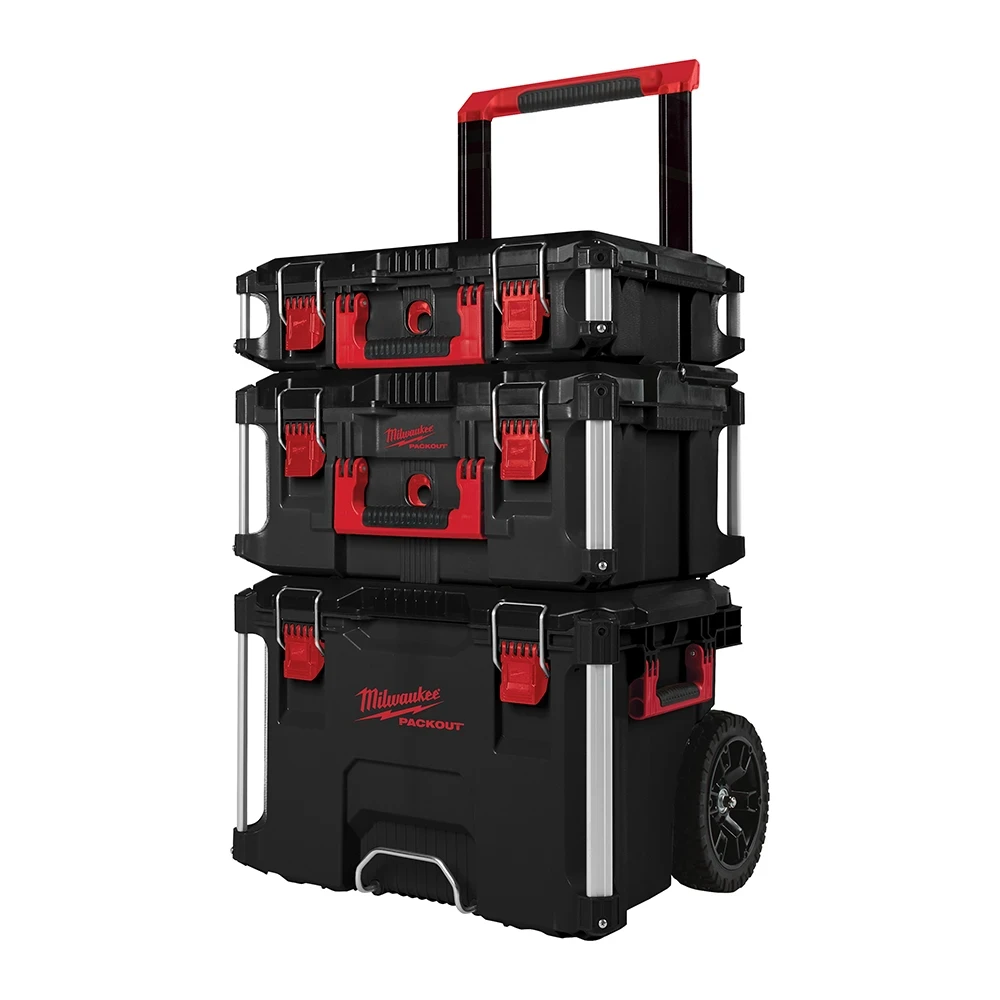
Premium/professional pick — sealed, rugged, three cases in one system
The PACKOUT trolley set is the most robust option here by a clear margin — three impact-resistant cases with reinforced metal corners, IP65-sealed lids that keep rain and site dust out of whatever’s inside, and 228mm all-terrain wheels on the base case that shrug off broken paving in a way smaller castors don’t. It’s also the heaviest commitment: buying into PACKOUT properly means every future storage box matches this system, and the set costs two to three times a Pro-Stack trolley for the privilege.
For
- IP65-sealed lids protect electronics from rain and dust
- 228mm all-terrain wheels cope with rough ground
- Reinforced corners survive being dropped off a tailgate
Against
- Most expensive trolley in this guide
- Doesn’t fold — the rigid cases take up a fixed footprint
Typically £200–£290
Check price on AmazonDeWalt TSTAK Trolley
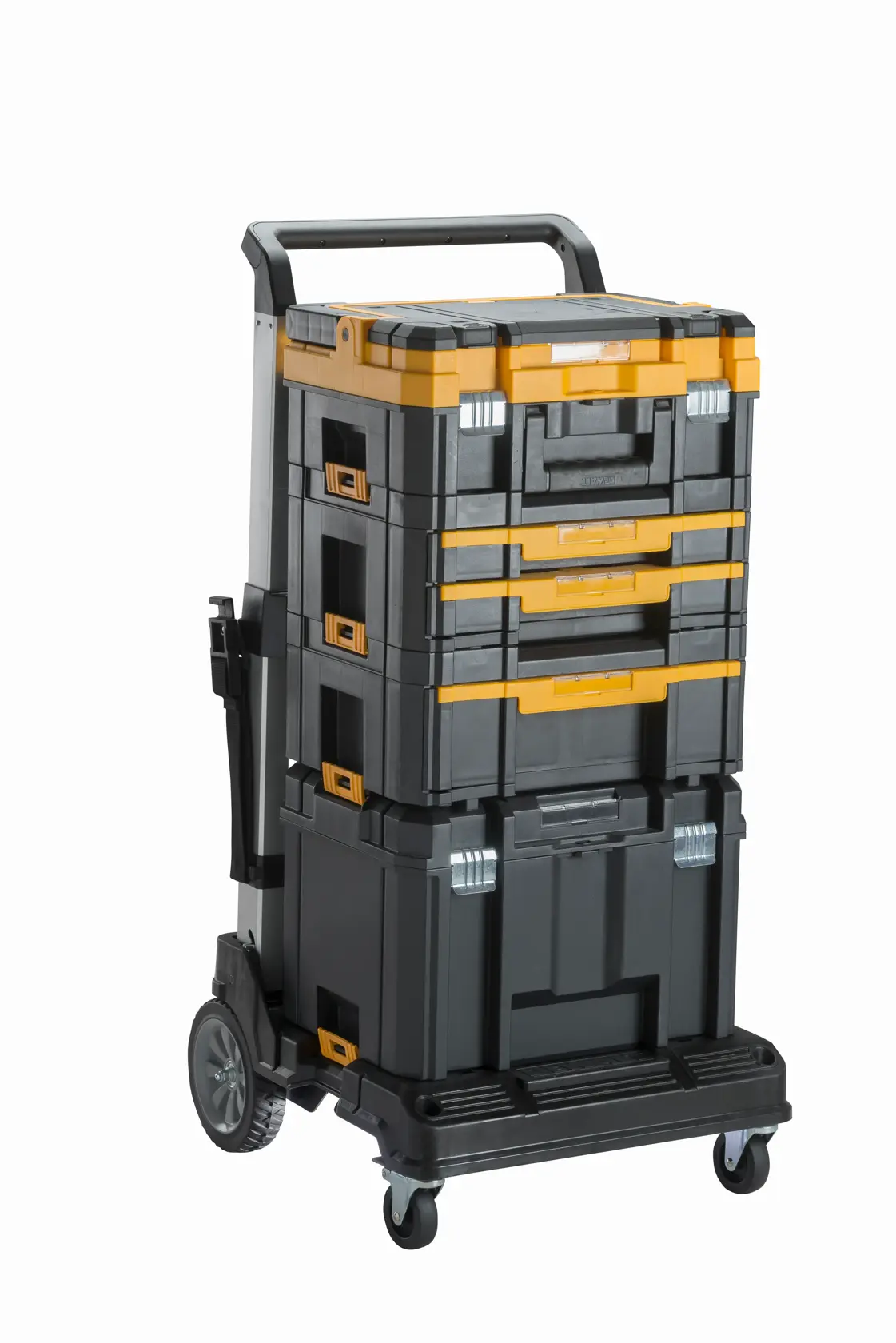
Best for the TSTAK ecosystem — already own the boxes, this is the base
Functionally close to the Stanley above — a folding, telescopic-handled base that wheels a stack of modular boxes rather than storing anything itself — but built specifically for DeWalt’s TSTAK range. Front castors swivel a full 360° for tight turns in a hallway, the rear wheels are air-filled rather than solid, which takes the edge off a rough path, and the whole thing folds down when it’s not earning its keep. The obvious pick for anyone already carrying TSTAK boxes; not worth buying into cold over the Pro-Stack system above.
For
- Air-filled rear wheels smooth out rough ground
- 360° front castors for tight indoor turns
- Folds flat for van storage
Against
- Only useful with TSTAK-compatible boxes
- Costs more than the Stanley for a similar job
Typically £110–£145
Check price on AmazonSealey AP760M Mobile Tool & Parts Trolley

Best static trolley — two lockable drawers, lives in the van or garage
A genuinely different tool to everything above — this isn’t built to be folded and carried, it’s built to be rolled out, used and rolled back. Two 40kg drawers on ball-bearing runners hold small instruments and consumables, two lower shelves take the bulkier kit, and a gas-sprung lockable lid secures the lot when it’s left in the van overnight on a residential street. Heavy and not remotely foldable — this is static van or garage storage that happens to have castors, not something wheeled up a garden path.
For
- Lockable lid, genuinely secure overnight
- Two drawers plus two shelves, well organised
- Ball-bearing drawer runners feel properly built
Against
- Doesn’t fold — a fixed, heavy footprint in the van
- Not something to wheel up a path or into a flat
Typically £280–£340
Check price on AmazonDraper 07635 Expert Tool Trolley

Mid-range static value — a cheaper alternative to the Sealey
Draper’s take on the same static-trolley idea as the Sealey above: two full-width lockable drawers on ball-bearing runners, a powder-coated steel body, and four castors — two fixed, two swivelling — for manoeuvring around a garage or wheeling to the back of the van. An integral locking system with two keys covers both drawers at once. Undercuts the Sealey by some margin without giving up much in build quality, though it’s the same story on portability: this stays in one place, it doesn’t get carried anywhere.
For
- Cheaper than the Sealey for a similar spec
- Both drawers lock with the same two keys
- Ball-bearing runners on both drawers
Against
- Static only, no folding or carrying
- Still a genuine outlay for what it does
Typically £215–£260
Check price on AmazonKeter Stack n’ Roll Modular Tool Storage Cart
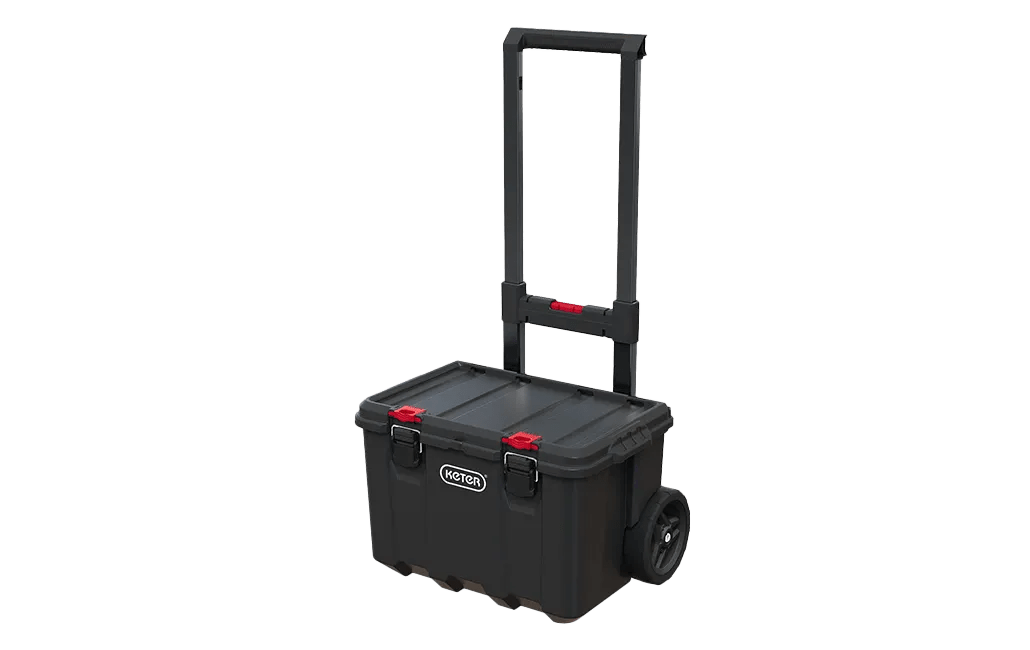
Best budget modular — a lightweight three-piece system for occasional use
The DIY-grade answer to the Pro-Stack and TSTAK trolleys above — a three-piece resin system of cart, toolbox and small-parts organiser that snaps together with an audible click and rolls on 7-inch wheels with a telescopic handle. Genuinely light, which helps carrying it in and out of the van, but the resin construction and drawer lock bar feel closer to a DIY-shop product than a trade one. Fine for the odd survey that needs the extra capacity; not something built for daily use across a full week.
For
- Cheapest genuinely modular option here
- Lightweight, easy to lift in and out of a van
- Interlocking latches click audibly when secure
Against
- Resin build feels lighter-duty than the trade trolleys
- 7-inch wheels smaller than the professional options
Typically £100–£125
Check price on AmazonVonHaus Tool Box on Wheels
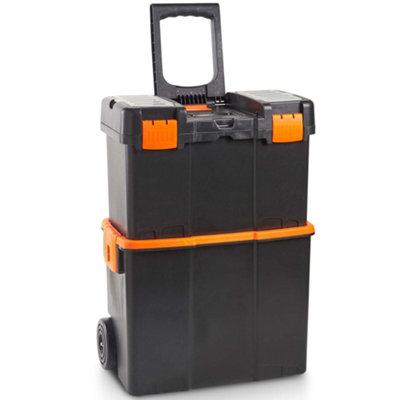
Cheapest — fine for light kit, not a trade trolley
The cheapest option here by a wide margin, and honest about what it is: two stackable boxes on basic wheels rather than a trolley in the Pro-Stack or Sealey sense. The top box’s six dividers suit small fixings and spares more than survey instruments, and a lockable double-clip cover takes a padlock for basic security. A reasonable starting point for occasional use or a very light kit; the 25kg capacity and modest wheels aren’t built for a daily site round.
For
- Cheapest trolley in this guide by some distance
- Splits into two separate boxes when needed
- Lockable cover takes a padlock
Against
- 25kg capacity, well below the trade options
- Basic wheels struggle on rough ground
Typically £40–£60
Check price on AmazonWhat actually matters — and what doesn’t
Folding matters more than the load rating. Every trolley in this guide is rated well beyond what a survey kit weighs. The number worth checking is the folded size — whether it actually fits the van once it’s not in use, not the 100kg figure on the box.
Modularity is a decision about every future purchase, not just this one. Buying a Pro-Stack, TSTAK or PACKOUT trolley means the next storage box, and the one after that, needs to match. Worth choosing the system deliberately rather than picking whichever trolley happened to be cheapest that week.
Wheel size beats wheel count. Four small castors sound sturdier than two big wheels, but it’s the diameter and tyre material that decide whether a trolley catches on a kerb or a broken flag, not how many there are.
A lockable lid only matters if the trolley lives in the van overnight. For something that only ever comes out for the walk from kerb to door and goes straight back in a locked vehicle, it’s a feature that adds cost without adding much.
A trolley isn’t a substitute for a sack truck on stairs. Wheels help across a driveway or a flat hallway; they do nothing on a communal staircase with no lift. That’s a job for a dedicated stair-climbing sack truck, not a trolley with castors.
A trolley isn’t van organisation either. It solves getting kit from the van to the door, not keeping the van itself tidy between jobs — that’s a separate problem, covered in the tool boxes and van storage guide.
Questions I get asked
Do I need a tool trolley if the van’s already organised?
Organised van storage and a tool trolley solve two different problems. A well-organised van means knowing which box the borescope’s in without digging around in the dark; a trolley means getting that box, and several others, from the van to the survey without three separate trips. A van can be immaculately organised and still leave someone carrying a tripod, a tool bag and a moisture meter case in one go down a hundred-metre gravel drive. The two are complementary, not alternatives.
What’s the difference between a tool trolley and a sack truck?
A sack truck — particularly a dedicated stair-climbing one — is built to move a genuinely heavy or awkward load up and down steps, using a cluster of small wheels that walk step to step. A tool trolley is built for flat or gently sloped ground: a driveway, a car park, a hallway. Taking a folding job-site trolley up a flight of stairs means lifting and carrying it, wheels and all, which defeats the purpose. For a stairwell with no lift, a stair-climbing sack truck is the right tool; for getting a kit from the kerb to a ground-floor front door, a trolley is faster and less to carry.
Will a tool trolley cope with a gravel drive or a broken driveway?
It depends almost entirely on wheel size and tyre material, not the trolley’s branding or price. Small, hard plastic castors — the kind fitted to budget wheeled boxes — catch on loose gravel and cracked paving and need lifting over the worst of it. Larger wheels with a softer tyre, like the air-filled rears on the DeWalt or the 228mm all-terrain wheels on the Milwaukee PACKOUT trolley, roll over the same ground without much drama. Worth checking wheel diameter specifically if the usual walk to a front door isn’t a smooth driveway.
Can a tool trolley double as static van storage?
The static-style trolleys can — the Sealey and Draper in this guide are built to live permanently in a van or garage, with lockable drawers doing the organising job a toolbox would otherwise do, and castors mainly there for repositioning within the van rather than travelling any distance. A folding modular trolley like the Stanley or DeWalt is the wrong tool for that job: it’s built to carry a stack of boxes a short distance and then get out of the way, not to sit loaded as a permanent fixture.
A tool trolley earns its keep on the surveys where the van can’t follow all the way to the door — EPCs and PAS 2035 retrofit assessments on rural properties with a long drive, or building surveys where a full kit is needed at both ends of a large plot — get in touch. Or browse the rest of the field-kit guides, including the sack trucks built for stairs a trolley can’t manage, and the tool boxes and van storage that keep the kit organised before it ever reaches the trolley.
Small print. This guide is general information, not a substitute for assessing what a specific job actually requires. Prices are indicative, move constantly and were checked at the time of writing; the linked page always shows the current price. As an Amazon Associate I earn from qualifying purchases.