A third-floor flat with no lift turns a straightforward inspection into a fitness test before the front door is even open. The instruments that make up a normal kit — a tripod, a telescopic ladder or ladder bag, a tool bag, a moisture meter case, a laptop for notes — add up to more than one person can carry in a single trip, and a block of flats rarely has anywhere convenient to leave the second load while the first one goes up. Two or three trips up four flights, twice over, before the survey itself has even started, is a genuine cost in time and in a back that has to do the same thing again tomorrow.
A sack truck turns that into one trip instead of three, provided it can actually manage stairs rather than merely tolerate a kerb. That distinction matters more than most of the spec sheet: a dedicated stair-climbing cart uses a cluster of small wheels arranged in a triangle or star, so the load rolls step to step instead of being dragged or lifted down a flight by hand. An ordinary two-wheeled sack truck, however heavy-duty the branding, still has to be tilted, carried and lowered one step at a time — fine on a driveway and into a boot, a liability on a communal staircase with a loaded tripod bag balanced on top.
Six compared below — three genuine stair climbers, and three standard folding sack trucks for the survey work that never sees a staircase at all, a house with drive access, or simply loading the van at the end of the day. First, the one I’d buy.
The one I’d buy
VEVOR Stair Climbing Cart
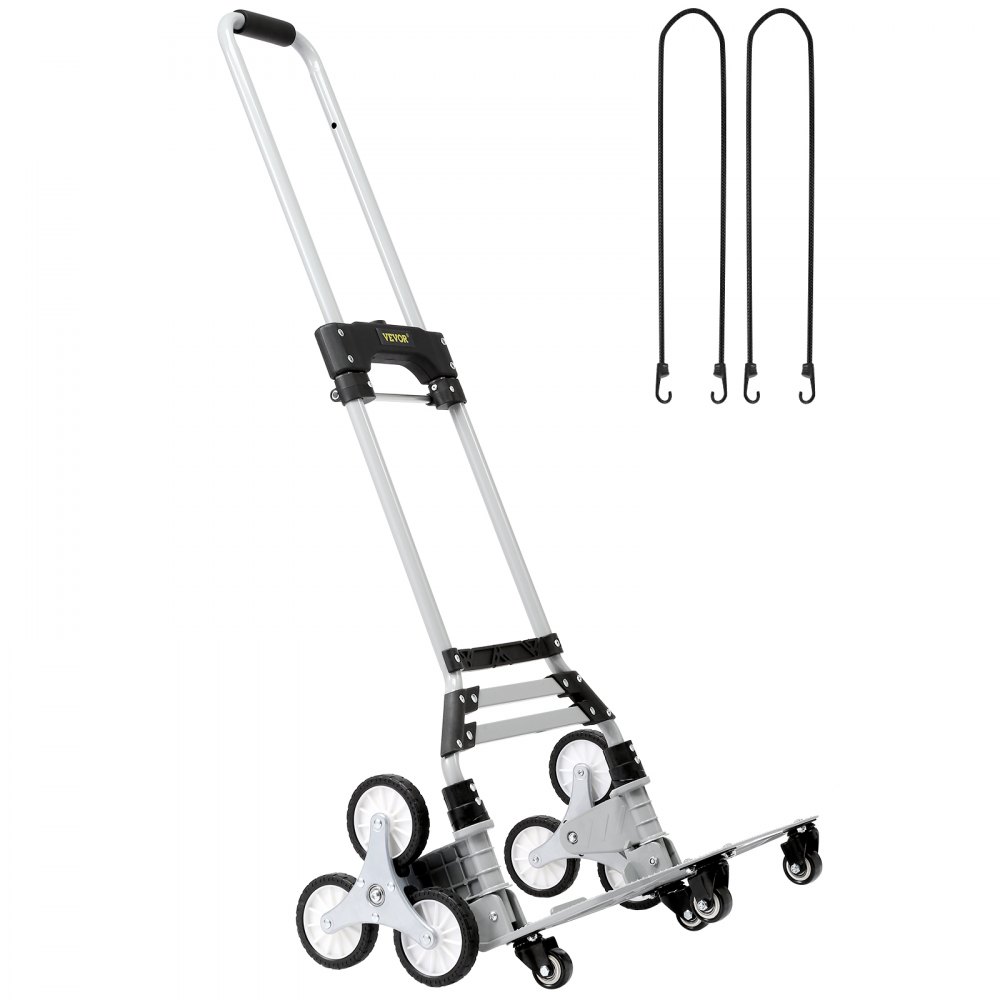
VEVOR’s stair-climbing cart earns the top spot on size as much as capability: it folds down small enough to travel in a hatchback boot alongside the rest of the kit, rather than needing a van’s worth of racking space to justify itself. Ten wheels do the work — four ordinary casters for flat ground and six arranged in two triangular clusters that walk a loaded tripod or tool bag down a flight step by step rather than dragging it. The handle telescopes across two heights and two elastic ropes are included for lashing a stacked load, which matters more on a stair truck than on one that only ever travels on the flat.
Typically £55–£75
Check price on AmazonHow I judge a sack truck
Genuine stair-climbing wheels, not just heavy-duty branding. A triangular or star-shaped wheel cluster rolls a load step to step under its own geometry; an ordinary two-wheeled truck with bigger tyres and a “heavy duty” label still has to be walked down a flight by hand, one step at a time. The two categories get marketed side by side, and only one of them actually solves the flats-without-lifts problem.
A folded size that earns its place in the van. A stair truck that only comes out once a month for a specific job needs to fold flat enough to live behind the seats or under the racking without displacing the ladder and tool boxes that are used every day.
Load capacity with headroom, not against the limit. A tripod bag, a tool bag and a ladder stacked together rarely exceeds 30–40kg, so a truck rated to 150–200kg is more stable at that load than one rated to 70–90kg and already close to its ceiling — capacity buys margin, not an excuse to load it to the limit.
Solid tyres over pneumatic, for something that sits idle between jobs. A sack truck used weekly rather than daily can sit in a cold van for a fortnight between outings, and a slow puncture found on the one morning it’s needed defeats the purpose entirely. Puncture-proof solid rubber costs nothing in ride quality that matters here.
A handle and grip that work one-handed on a step edge. The other hand is usually on a door, a stair rail, or a torch, so a handle that needs both hands to steer defeats half the point of a stair-climbing cart.
The comparison
| Model | Type | Load capacity | Typical price | Best for | |
|---|---|---|---|---|---|
| VEVOR Stair Climbing Cart | Stair-climbing | 100kg / 50kg on stairs | ~£65 | All-round stair climber | View |
| Bristol Tool Company CTR800 | Stair-climbing | 200kg | ~£105 | Heaviest-duty commercial use | View |
| Relaxdays Stair Climbing Hand Truck | Stair-climbing | 150kg / 50kg on stairs | ~£70 | Mid-weight stair climber | View |
| Draper 68854 Fold Flat Sack Truck | Standard | 90kg | ~£50 | Trusted trade-brand standard | View |
| Loadit 100kg Sack Trolley | Standard | 100kg | ~£35 | Certified budget all-rounder | View |
| VonHaus Folding Hand Truck | Standard | 90kg | ~£35 | Cheapest overall | View |
The picks in detail
VEVOR Stair Climbing Cart
Best overall — compact, genuine stair-climbing wheels, elastic ropes included
This is the top pick above, and the case for it holds up in the detail: the folded footprint is small enough for a hatchback boot, the ten-wheel arrangement climbs a flight of stairs without needing to be dragged, and the telescopic handle means it doesn’t have to be operated stooped over. It is not the highest-rated truck here, but for the specific job of getting a stacked tripod bag and tool bag up to a third-floor flat without two trips, size and manoeuvrability matter more than a capacity nobody will ever use.
For
- Genuine triangular stair-climbing wheels, not just bigger tyres
- Folds small enough for a car boot rather than needing van racking
- Elastic ropes included for securing a stacked load
Against
- 100kg ground / 50kg stair rating is the lowest of the three stair-climbers here
- Single handle rather than the dual-handle option on pricier VEVOR models
Typically £55–£75
Check price on AmazonBristol Tool Company CTR800
Best for the heaviest, most frequent loads
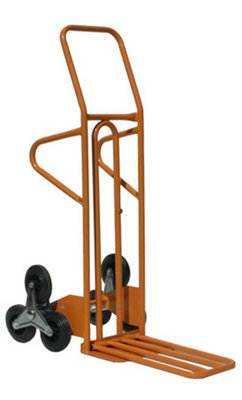
Where the VEVOR above is built around being compact, the CTR800 is built around capacity: a 200kg-rated steel frame with a tri-linked wheel assembly on each side and a fixed toe plate that folds only for storage, not in normal use. It is heavier and bulkier to carry empty than any other truck here, which is the trade-off for genuinely industrial capacity — the right choice for a practice that’s regularly moving scaffold-tower sections or a full run of test equipment rather than a single tripod bag.
For
- 200kg rated capacity, well above the other stair-climbers here
- Reinforced steel frame built for repeated commercial use
- Fixed toe plate is more stable under a heavy load than a folding one
Against
- Noticeably heavier and bulkier to carry when empty
- Most expensive truck in this comparison
Typically £90–£120
Check price on AmazonRelaxdays Stair Climbing Hand Truck

Best mid-weight stair climber
The Relaxdays truck sits between the two above on every measure that matters — a 150kg ground rating, a six-wheel star arrangement rather than VEVOR’s triangular clusters, and a steel frame that feels closer to the CTR800’s durability without quite the bulk. The height-adjustable handle folds down with the frame for storage, and the solid rubber star wheels are the same puncture-proof design used across most of this category, so the practical difference from the other two stair-climbers here is mostly about where the price and capacity land in between them.
For
- 150kg ground rating, a step up from the VEVOR at a similar size
- Six-wheel star design distributes load evenly on each step
- Height-adjustable folding handle
Against
- 50kg stair-climbing rating is no higher than the cheaper VEVOR
- Steel frame is heavier empty than the aluminium standard trucks below
Typically £60–£85
Check price on AmazonDraper 68854 Fold Flat Sack Truck

Best trusted trade-brand standard truck
None of the stair-climbing hardware above matters on a routine house survey with a driveway, and the 68854 is Draper’s answer to that job — a tubular steel frame on a cast aluminium base plate that folds genuinely flat rather than just compactly, with an integral safety pin that stops the wheels closing accidentally under load. It carries the reputation of a brand that’s supplied trade tools for ninety years rather than a newer name, which is worth something when the alternative is an unfamiliar import at a similar price.
For
- Genuinely folds flat, not just compact, for van storage
- Safety pin stops the wheels closing accidentally mid-load
- Established trade brand with a long track record
Against
- No stair-climbing wheels — standard two-wheel design only
- 90kg capacity is average for this style of truck, not class-leading
Typically £45–£60
Check price on AmazonLoadit 100kg Sack Trolley
Best certified budget all-rounder
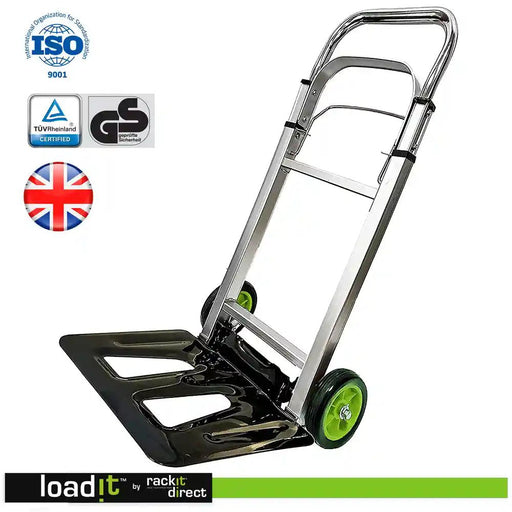
Loadit’s 100kg trolley is a plain aluminium sack truck rather than anything built for stairs, and it earns its place here on certification and price rather than novelty — ISO 9001 and TUV GS marks on a product this cheap aren’t universal, and the telescopic handle and puncture-proof wheels cover everything a driveway job or a van-loading routine actually needs. It is the closest thing in this comparison to a no-frills default choice for a second truck kept purely for flat-ground work.
For
- ISO 9001 and TUV GS certification at a genuinely low price
- Telescopic handle adjusts for user height
- Puncture-proof wheels suit infrequent, van-stored use
Against
- No stair-climbing capability whatsoever
- Aluminium frame feels less robust than the Draper under sustained daily use
Typically £30–£40
Check price on AmazonVonHaus Folding Hand Truck

Best cheapest overall
VonHaus’s version of the same basic design comes in a little cheaper than the Loadit above, with a lightweight aluminium frame, a moulded steel footplate and a retractable handle that collapses the whole thing down to a slim unit for storage. It is a perfectly adequate truck for occasional use — loading the van, moving a box of files — without pretending to be more than that, which is the honest way to buy the cheapest option in any category.
For
- Cheapest truck in this comparison
- Lightweight aluminium frame, easy to carry empty
- Retractable handle folds down to a genuinely slim unit
Against
- No stair-climbing capability
- Lighter-duty build than the Draper for daily, repeated use
Typically £30–£40
Check price on AmazonWhat actually matters — and what doesn’t
Rated capacity is headroom, not a target. A tripod bag, a tool bag and a folded ladder stacked on one truck rarely comes close to 40kg, so the difference between a 90kg-rated truck and a 200kg-rated one is stability and frame stiffness at that real-world load, not whether it can technically take more weight than it will ever see.
Stair-climbing wheels only earn their keep if stairs are actually the job. For a practice built around houses with drive access, the extra bulk, weight and price of a dedicated stair climber solves a problem that doesn’t exist day to day — a plain folding truck that fits neatly alongside the van storage boxes and the telescopic ladder is the better buy for that pattern of work.
Solid tyres beat pneumatic for anything stored between jobs. A pneumatic wheel rides slightly softer over broken paving, but a slow puncture discovered on the one morning the truck is needed is a worse outcome than a firmer ride every other day — every truck in this comparison uses solid or puncture-proof wheels for exactly that reason.
Included bungee cords are a genuine convenience, not a gimmick. Securing a tripod bag on top of a stacked tool bag properly, rather than trusting it to balance, is the difference between one trip and a dropped instrument case halfway up a flight — worth checking for on any truck being bought specifically for stairs.
Questions I get asked
Do I actually need a stair-climbing sack truck, or will a standard one do?
It depends entirely on how often flats without lifts come up. For a practice that’s mostly houses with driveway access, a standard folding truck like the Draper or Loadit above covers everything that’s actually needed, and the extra weight and price of stair-climbing wheels solves a problem that isn’t there. Where flats and maisonettes are a regular part of the diary, the time saved on even one job a fortnight justifies the difference.
What’s the safe way to get a loaded sack truck down a flight of stairs?
Slowly, and under control rather than gravity — the truck should be doing the work of holding the load, not being allowed to run ahead of it. Keep the heaviest item lowest and best secured, take stairs one at a time rather than trying to save time by rolling over two steps at once, and back down a steep flight rather than leading with the load where the staircase and the truck’s design allow it.
How much should I actually load onto one for a single trip?
Comfortably under the rated capacity rather than up to it, particularly on stairs. A tripod, a tool bag and a ladder bag together rarely exceed 30–40kg, which is well within what every truck in this comparison is rated for on flat ground; the stair-climbing rating, usually roughly half the flat-ground figure, is the number worth watching if the load is going down a flight rather than across a car park.
Solid or pneumatic tyres for something that mostly sits in the van?
Solid or puncture-proof rubber, without much debate. Pneumatic tyres ride a little smoother over rough ground but need occasional attention to stay inflated, and a tool that’s only used a few times a month is exactly the kind of thing that finds a slow puncture at the worst possible moment. Every truck recommended here uses solid or puncture-proof wheels for that reason.
Getting the kit up four flights without a lift is a solved problem next to working out what’s actually wrong with the property once you’re through the front door — which is what a building survey or retrofit assessment is for. If you need one anywhere in Sussex, Kent or Surrey, get in touch — or browse the rest of the field-kit guides, including the tool boxes that keep the rest of the van organised once the sack truck’s back in it.
Disclaimer. This guide is general information, not a substitute for the manufacturer’s instructions or your own judgement for your circumstances. Prices are indicative, move constantly and were checked at the time of writing; the linked page always shows the current price. As an Amazon Associate I earn from qualifying purchases.