Every domestic EPC involves a loft hatch. The RdSAP methodology wants to know what’s up there — insulation depth, roof construction, any room-in-roof — and “the homeowner thinks it’s about 100mm” is not evidence. So a ladder comes into the house with me on every job, and because the job might be a Victorian terrace with a hatch above the stairwell or a bungalow with a hatch in an airing cupboard, it has to be a ladder that folds down small enough to carry through someone’s hallway without redecorating it. That is what a telescopic ladder is for.
A surveyor’s ladder gets extended and collapsed perhaps a thousand times a year, in other people’s homes, boots off and full body weight on it above a staircase. That use pattern makes me fussy in ways a weekend DIYer doesn’t need to be, and it is why this guide keeps returning to two things: the EN 131 Professional certification, and what the ladder actually weighs and measures when closed, because it lives in a car boot next to the rest of the kit.
The category has a real quality problem. At the top end you have properly engineered aluminium that locks positively and barely flexes. At the bottom you have units that look identical in the photos and are not — one 3.8m ladder sold through Amazon was the subject of a government product safety report because it bent excessively under load. I’ll come back to that. First, the ones I’d trust.
The one I’d buy

Werner Soft Close Telescopic Extension Ladder 2.9m (85029)
For loft hatches — which is what a surveyor’s telescopic ladder mostly does — 2.9m is the right length, and at 9.4kg with a closed length of 0.79m this is the easiest ladder here to carry through a customer’s house. The soft-close mechanism lowers the rungs gently instead of guillotining your fingers, it locks automatically as you extend, and it’s certified to EN 131-6 Professional, so it’s legitimate kit for daily paid work.
Typically £160–£200
Check price on AmazonHow I judge a telescopic ladder
EN 131 Professional certification, non-negotiable. EN 131 is the European ladder standard; since 2018 it has split into Professional and Non-Professional classes, and Part 6 covers telescopic ladders specifically. Professional means the ladder is rated for a 150kg load and has passed a harder durability regime, including repeated cycling — which is exactly what survey work does to a ladder. If I’m using it for paid work, my insurer, the Work at Height Regulations and common sense all point the same way: EN 131-6 Professional, from a manufacturer willing to put the certificate in writing.
Closed length and real weight. The spec sheet numbers matter because the ladder lives in the boot alongside a damp meter case, a borescope, a drone case and a laser. A 2.9m ladder that closes to 0.79m fits across any boot; a 3.8m unit that closes to 1.09m has to go on the back seat of some cars. Weight matters twice: once at 7.45am lifting it out, and again when you’re carrying it up a customer’s staircase in socks.
The closing mechanism. A telescopic ladder collapsing is several kilograms of aluminium sections dropping through each other. Early designs took fingertips off; the injury even has case law. Soft-close (Werner’s term) or a controlled-descent latch (Xtend+Climb’s Lightning Latch) lowers the sections gently. On a ladder you close a dozen times a day, this is the difference between a tool and a workplace incident.
Locking indicators you can see. The better ladders show a visible indicator — green when a rung is locked. When you’re setting up in a dim landing under a loft hatch, being able to glance down the stiles and confirm every section is locked is worth real money. A rung that hasn’t engaged fully is how telescopic ladders hurt people.
Flex under load. Stand on the fourth rung of a good ladder and it feels like a ladder. Stand on the fourth rung of a cheap one and it feels like a diving board. Some flex is inherent to the telescopic design — more sections, more joints — but the gap between the best and worst here is enormous, and you only discover it at height.
The comparison
| Model | Extended / closed | Weight | EN 131 class | Typical price | Best for | |
|---|---|---|---|---|---|---|
| Werner Soft Close 2.9m (85029) | 2.9m / 0.79m | 9.4kg | Professional | ~£180 | Loft hatches, EPC work | View |
| Xtend+Climb ProSeries S2.0 3.8m | 3.83m / 0.90m | 15.5kg | Professional | ~£220 | The working surveyor’s classic | View |
| Werner Soft Close 3.8m (85038) | 3.8m / 0.88m | 14.8kg | Professional | ~£240 | Eaves and gutter-line checks | View |
| Xtend+Climb ProSeries S2.0 3.2m | 3.23m / 0.84m | 12.6kg | Professional | ~£200 | Reach without the bulk | View |
| Youngman Telescopic 3.8m (301138) | 3.8m / 1.09m | Unpublished | EN 131 | ~£180–£240 | Trade-brand alternative | View |
| Werner Telescopic 2.9m (87000 series) | 2.93m / 0.97m | ~10kg | Professional | ~£120–£160 | Werner quality, less money | View |
| Nestling Telescopic 3.8m | 3.8m / ~0.92m | 13kg | Non-professional | ~£85–£100 | Occasional home loft use only | View |
The picks in detail
Werner Soft Close Telescopic Extension Ladder 2.9m (85029)
Best overall — the right ladder for EPC and loft-hatch work
This is the top pick above, and the reasoning is mostly about honesty regarding what the ladder is actually for. Nine jobs out of ten, a surveyor’s ladder is set under a loft hatch in a house with 2.3–2.4m ceilings, where a 2.9m ladder used at the correct 75-degree angle is exactly right. The 85029 closes to 0.79m — the shortest here — weighs 9.4kg, and the soft-close function means the sections settle down gently rather than snapping shut on whatever is between them. Automatic locking on extension, single-handed release, non-marking feet for customers’ floors, EN 131-6 Professional, and a five-year guarantee from a company that has made ladders since 1922. It is not glamorous. It is the correct tool.
For
- Lightest and shortest-packing ladder in this list
- Soft close — the finger-safety feature that matters most
- EN 131-6 Professional, 150kg rated, 5-year guarantee
Against
- 2.9m won’t reach a single-storey gutter line comfortably
- Werner’s soft-close pricing is close to the pro imports
Typically £160–£200
Check price on AmazonTB Davies Xtend+Climb ProSeries S2.0 3.8m

The professional option — the classic surveyor’s telescopic
Ask a room of surveyors what telescopic ladder they carry and Xtend+Climb comes up more than anything else; TB Davies import it into the UK and even survey-supply houses stock it. The ProSeries S2.0 is the current professional version: EN 131-6:2019 Professional, 150kg, aircraft-grade aluminium, stabiliser bars that lock automatically when deployed, and rung indicators that show green when each section is locked — which, on a dim landing, is a genuinely useful safety check rather than a gimmick. The Lightning Latch gives a controlled close. At 15.5kg it is a proper lump, and 3.83m extended is more ladder than a loft hatch needs, but if one ladder has to do hatches, eaves and gutter lines, this is the one.
For
- Green lock indicators on every rung — visible confirmation
- Automatic locking stabiliser bar; very solid under load
- The de facto standard among working surveyors for a reason
Against
- 15.5kg gets old on stairs
- Stabiliser bar adds width in a small hallway
Typically £200–£240
Check price on AmazonWerner Soft Close Telescopic Extension Ladder 3.8m (85038)
Best 3.8m — eaves, gutter lines and taller stairwells
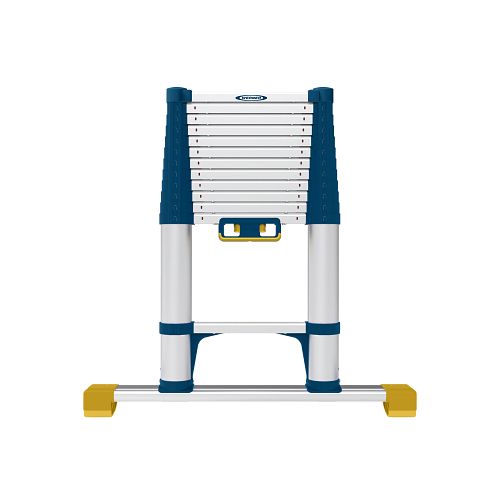
The big brother of my top pick: same soft-close mechanism, same EN 131-6 Professional certification and 150kg rating, stretched to 3.8m with thirteen rungs and a working height around 4.55m. It closes to 0.88m — usefully shorter than the Youngman — and weighs 14.8kg. If your work regularly involves looking at fascias, gutter lines and single-storey roof junctions rather than just loft hatches, the extra metre earns its keep; for damp diagnosis at eaves level it’s the difference between inspecting and squinting. Between this and the Xtend+Climb 3.8m there is honestly little in it: Werner has the gentler close and the longer guarantee, the Xtend+Climb has the lock indicators.
For
- Full 3.8m reach with the soft-close finger protection
- Closes shorter than most 3.8m rivals
- EN 131-6 Professional, 5-year guarantee
Against
- The most expensive ladder here
- 14.8kg — you won’t carry it upstairs for fun
Typically £220–£270
Check price on AmazonTB Davies Xtend+Climb ProSeries S2.0 3.2m

Best for a small boot — pro build, sensible size
The 3.2m version of the ProSeries is the compromise I’d point most assessors at if the 2.9m Werner feels short and the 3.8m units feel like furniture. It closes to 0.84m, weighs 12.6kg, keeps the 150kg EN 131-6 Professional rating, the locking stabiliser bars and the green rung indicators, and gives a last climbing height of 2.3m — enough to get head and shoulders through any loft hatch and enough working height for most porch and outbuilding roofs. In an estate-car boot it sits crossways with room to spare. The 3kg saved over its big brother sounds trivial until you’ve done six assessments in a day.
For
- All the ProSeries safety features at a friendlier weight
- Closes to 0.84m — fits across almost any boot
- 150kg professional rating
Against
- Won’t reach a two-storey gutter line, obviously
- Still not cheap for the length
Typically £180–£220
Check price on AmazonYoungman 301138 Telescopic Ladder 3.8m

Best trade-brand alternative — if you find it at the right price
Youngman is a proper British trade ladder name — their loft ladders are in half the houses I survey — and the 301138 is their 3.8m telescopic: EN 131, 150kg rated, automatic locking on extension, wide treads and a 1.09m closed length. It has been around a while and it shows in both directions: the design is proven and the trade trusts it, but it lacks the soft-close mechanism and lock indicators the newer Werner and Xtend+Climb models have, and Youngman don’t publish a weight for it, which I find mildly telling. Street pricing swings a lot; at the lower end it’s a sensible buy, at full list you’d take the Werner instead.
For
- Trade heritage brand, 150kg rating, wide treads
- Proven design, widely available spares and support
Against
- No soft close and no lock indicators
- 1.09m closed length is the longest here
Typically £180–£240
Check price on AmazonWerner Telescopic Extension Ladder 2.9m (87000 series)

Best value professional — Werner engineering without soft close
Werner’s 87000-series telescopic is the cheaper route into a professional-grade unit from a serious manufacturer. Instead of the soft-close mechanism it uses extra rung spacing, so when the ladder collapses there’s a designed gap that keeps fingers clear of the pinch points — a cruder solution than soft close, but a real one, which is more than most budget ladders offer. You still get the automatic locking, single-handed release and the 150kg rating; you give up the gentler close and a bit of packed length (0.97m against the 850-series’ 0.79m). For an assessor starting out who can’t stretch to the soft-close models, this is where I’d put the money rather than anywhere further down this page.
For
- Werner build and certification at a mid-range price
- Rung-spacing design keeps fingers out of pinch points
- Light enough to carry all day
Against
- No soft close — the collapse is abrupt
- Closes 18cm longer than the 85029
Typically £120–£160
Check price on AmazonNestling Telescopic Ladder 3.8m

Best on a budget — occasional home use, not professional work
If you are a homeowner who goes into the loft four times a year and wants a ladder that packs away in a cupboard, the Nestling 3.8m is the budget unit I’m least uncomfortable recommending. It claims EN 131 conformity, the locking buttons give an audible click when each section engages, and at around half the price of the Youngman it does a fair impression of the real thing. Be clear about what it is not: it is not EN 131-6 Professional certified, it flexes noticeably more than anything above it in this list, and I would not put it to daily trade use or claim it on a risk assessment. For its actual job — the Christmas decorations and the stopcock — it’s fine.
For
- Genuinely cheap; audible click-lock confirmation
- Packs small enough for a hallway cupboard
Against
- Not Professional-class certified — not for trade use
- Noticeable flex at height; budget-brand support if anything fails
Typically £85–£100
Check price on AmazonWhat actually matters — and what doesn’t
The certification is the whole game at the bottom of the market. In 2024 the Office for Product Safety and Standards published a product safety report on a WolfWise 3.8m telescopic ladder sold through Amazon: it presented a serious risk of injury because it bent excessively under load, and the listing was withdrawn. That ladder had thousands of glowing reviews. Reviews measure whether the ladder arrived on time and looked shiny; they do not measure what happens at cycle four hundred with 95kg of surveyor on rung nine. An EN 131-6 Professional certificate from a named test house does. When a listing says “EN131” in the title but the manufacturer won’t show the certificate, treat the claim as decoration.
Maximum height is oversold. The marketing photographs always show the ladder fully extended against a wall. In practice a telescopic ladder is at its worst fully extended — maximum flex, maximum consequence — and most of its life is spent at half height under a hatch. Buy the length your work actually needs, not the biggest number: for loft access that is 2.6–3.2m, not 3.8m. The reverse is also true: don’t buy short and stand on the top rungs. The top three rungs of any leaning ladder are not for standing on.
Weight claims deserve suspicion in both directions. A suspiciously light 3.8m ladder has thin walls; wall thickness is where budget units save money and where they fail. The professional 3.8m models cluster around 14–15.5kg for a reason. If a £90 ladder claims the same length at 11kg, the missing metal came from somewhere.
If you use it for work, inspect it and write that down. Telescopic ladders are working-at-height equipment, so the Work at Height Regulations 2005 apply, and HSE guidance expects pre-use checks plus a recorded detailed inspection at sensible intervals. A proper routine takes five minutes a month: extend fully, check every lock engages and every indicator shows, look for bent stiles, cracked feet and grit in the tubes (grit is what kills the locking mechanism), and log it. If a customer’s loft insulation has been raining grit into the tubes, a blast of air and a silicone-free dry lubricant — never oil, which holds the grit — keeps the action honest. A ladder that won’t pass that check gets retired, not “kept for light jobs”.
Things the listings push that you can ignore: carry bags (fine, but a bungee cord works), “16.5ft” imperial headline figures that quietly include your own reach, claimed ratings in pounds rather than the EN class, and colour choices. One thing pushed as an extra that is actually worth having: a stabiliser bar on anything 3.2m and over. Wider feet, less wobble, better manners on smooth floors.
Questions I get asked
Are telescopic ladders safe?
A certified one, used correctly, yes — surveyors and trades put their full weight on them every working day. The genuine risks are specific: uncertified budget units that flex or collapse (the WolfWise safety report above is the documented example), fingers caught in closing sections on ladders without soft close or rung-spacing protection, and sections that haven’t fully locked before someone climbs. Buy EN 131 certified — Professional class for work — check every lock before climbing, set the ladder at 75 degrees (one out for every four up), and keep the tubes clean so the locks keep working. Do that and a telescopic ladder is no more dangerous than any other leaning ladder.
What is EN 131 certification?
EN 131 is the European standard for portable ladders, and since 2018 it has two classes: Professional and Non-Professional. Both require a 150kg static load capacity, but the Professional class is tested for repeated, frequent use — harder durability and cycle testing — which is what distinguishes a ladder for daily trade work from one for occasional home use. Part 6 of the standard (EN 131-6) covers telescopic ladders specifically, adding tests for the locking mechanisms and the telescoping action. For anyone using a ladder at work, EN 131 Professional is effectively the baseline: it is what an insurer, a principal contractor or the HSE will expect to see on the kit list.
What length telescopic ladder do I need for a loft hatch?
Less than most people buy. A typical UK ceiling is 2.3–2.4m; with the ladder leant at the correct 75-degree angle against the hatch edge, a 2.6m ladder reaches comfortably and a 2.9m gives you margin for taller Victorian ceilings and stairwell hatches. A 3.8m ladder will do the job but you’ll only ever use two-thirds of it indoors, and you’ll carry the extra 5kg through the house every time. My rule: 2.6–2.9m if the ladder is only for loft access, 3.2m if you want one ladder for hatches plus occasional single-storey outside work, 3.8m only if eaves and gutter lines are a regular part of your week.
Can telescopic ladders be used professionally?
Yes, provided the ladder is EN 131 Professional class and you treat it as work equipment. The Work at Height Regulations don’t ban any ladder type; they require the equipment to be suitable, maintained and inspected, and ladder use to be justified for short-duration, low-risk tasks — which describes a loft-hatch inspection exactly. In practice that means buying Professional-certified kit (every ladder in the top six above qualifies except where noted), doing a pre-use check each job, keeping a simple inspection record, and replacing the ladder when it stops passing. What you cannot sensibly do is put a £90 Non-Professional unit on a professional risk assessment; if something goes wrong, that purchase decision will be the first thing examined.
The ladder gets me to the loft hatch; what happens above it — insulation depths, roof condition, ventilation, signs of damp — is the actual job. If you need an EPC or a building survey anywhere in Sussex, Kent or Surrey, the practice does both, telescopic ladder included. Get in touch — or browse the rest of the field-kit guides, including the combination ladders that add a stairwell mode to the mix.
Disclaimer. This guide is general information, not a substitute for the manufacturer’s instructions or a proper work-at-height risk assessment for your circumstances. Prices are indicative, move constantly and were checked at the time of writing; the linked page always shows the current price. As an Amazon Associate I earn from qualifying purchases.