A good many of the jobs that reach me start with the same observation: the floor slopes, the wall has dropped, the patio runs towards the house. Eyes and a spirit level will tell you something is wrong, but not by how much, and not across a whole room, a garden or a drainage run. An optical level, the dumpy level of old, does. You set it on a tripod, level it, and read a staff held at each point; every reading is a height relative to the same horizontal line.
It is an old-fashioned answer in a world of laser levels, and I will say plainly where the laser wins. For a room or a few metres of floor, a laser level is quicker and easier. An optical level earns its place over long distances and in bright daylight, where a laser line vanishes: across a garden, along a drainage run, down a terrace. It needs no batteries, and a staff reading is a number you can write down and check. The topographical survey cost guide shows what a levels survey costs if you would rather pay someone, and the drainage survey cost guide covers the falls side.
One caution first. A level gives you differences in height; it does not tell you why they exist. Settlement, a failed foundation, a sagging joist and a floor that was built out of true all give the same readings. Interpreting them is the survey.
The one I’d buy
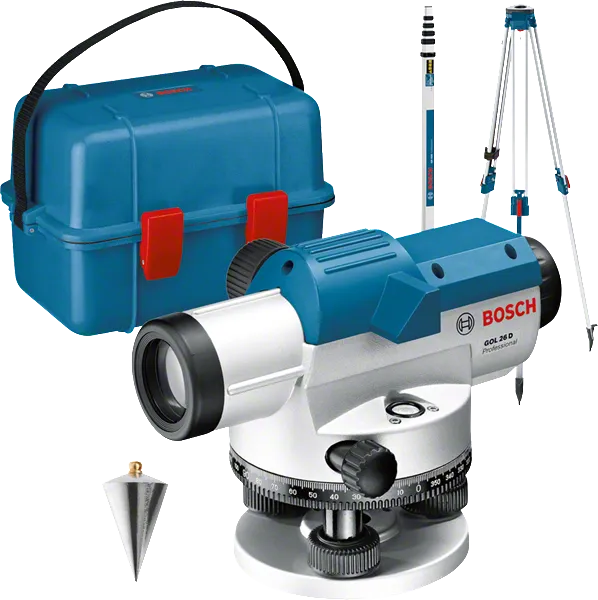
Bosch GOL 26 D Professional optical level set
If I were buying one level for house, garden and drain work, it would be the Bosch GOL 26 D set. A stated 26x magnification, 100m range, ±1.6mm accuracy at 30m and IP54 housing cover everything a building survey is likely to ask of one, and the set comes with a tripod and staff so nothing else needs buying. Check the listing: the level on its own is cheaper, but it is not a kit.
Typically £250–£350
Check price on AmazonHow I judge an optical level
Automatic compensator. Modern levels are automatic: you bubble them roughly level and an internal compensator does the rest. That is what you want. Older manual tilting levels are slower and fussier, and there is no reason to buy one new.
Magnification and range. 20x to 24x is fine for a house and garden. 32x helps on long sights or in poor light. Beyond that you are paying for a precision the staff and the person holding it cannot match.
Stated accuracy. Quoted as millimetres over a distance. For floor levels, a couple of millimetres at 30m is far tighter than the floor itself. For drainage falls it matters more: a 1 in 80 fall over 10m is only 125mm, so a few millimetres of error is small but not nothing.
The whole kit. A level without a tripod and staff is not usable. Compare the price of a complete set, and look at the staff: a 5m aluminium telescopic staff with a vial is the sensible spec.
Weather sealing. IP54 shrugs off rain and dust; IP57 survives a drenching. A level that lives in a van and gets set up on wet ground should have one or the other.
The comparison
| Model | Type | Typical price | Best for | |
|---|---|---|---|---|
| Bosch GOL 26 D Professional optical level set | 26x, tripod and staff set | ~£250–£350 | Best all-round for site work | View |
| Bosch GOL 32 D Professional optical level | 32x, 120m range | ~£260–£400 | Longer sights, finer readings | View |
| Leica NA724 automatic level | 24x, IP57 | ~£390–£500 | Professional, surveying firms | View |
| Spectra Precision AL24M automatic level | 24x, kit with tripod and staff | ~£200–£300 | Value complete kit | View |
| Silverline 20x automatic optical level | 20x, level only | ~£70–£150 | Occasional use | View |
| Bosch GR 500 Professional levelling staff | 5m, five sections | ~£50–£70 | Replacing or upgrading a staff | View |
The picks in detail
Bosch GOL 26 D Professional optical level set
Best overall — the one I’d buy first
The GOL 26 D is a 26x automatic level with a stated working range of 100m, accuracy of ±1.6mm at 30m and IP54 dust and splash protection, available as a set with a case, tripod and 5m staff. That is what a surveyor or small builder needs to check floor levels, sloping floors, drainage falls and plot levels, and nothing more. Owner feedback is consistent that it is simple to set up and holds its levels. Check the listing carefully, because the level alone and the set with tripod and staff are separate product codes at quite different prices.
For
- 26x magnification is plenty for house-scale work
- Case, tripod and staff available as one set
- IP54 housing copes with a wet site
Against
- A level on its own is not a kit; check the set code
- Amazon stock and seller vary, and specialist dealers are often cheaper
Typically £250–£350
Check price on AmazonBosch GOL 32 D Professional optical level
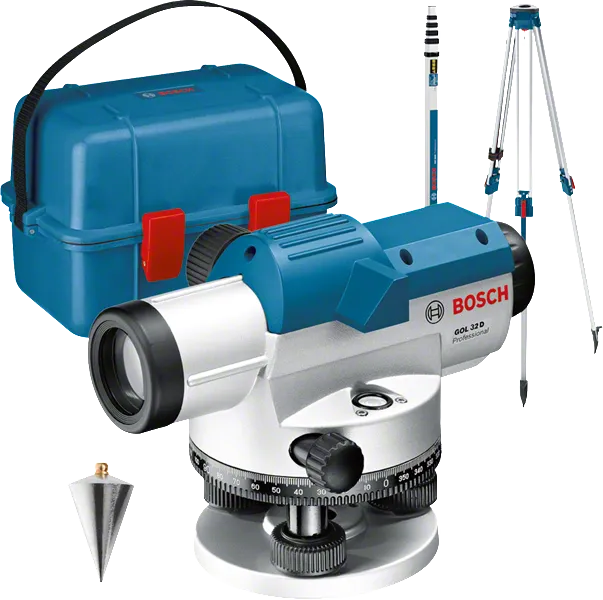
Best step up — more magnification for long sights
The same family as the GOL 26 D, with 32x magnification, a 120m working range and a stated accuracy of ±1.0mm at 30m. The extra magnification is useful on long drainage runs, across a large garden or when the staff is a long way off in poor light. For a normal house and garden it is more than the job needs, but if you set out regularly the clearer image is easier on the eyes. The set with BT 160 tripod and GR 500 staff is a separate listing from the level alone.
For
- 32x magnification gives a clearer staff reading at distance
- Tighter stated accuracy than the 26x
- Same controls and case as the 26 D
Against
- Dearer for a gain most house-scale jobs will not use
- Check whether the listing includes tripod and staff
Typically £260–£400
Check price on AmazonLeica NA724 automatic level
Best professional pick — sealed and long-lived
Leica is the name in surveying instruments, and the NA724 is its 24x automatic level with IP57 sealing, a step above the IP54 of the Bosch. It is sold through surveying dealers with a calibration and servicing route, which matters if your levels feed into drawings or a boundary dispute. For checking whether a floor has dropped it is more than most surveyors need, but it is the one built for daily professional use. It is mostly a dealer product, so check Amazon stock and the seller before ordering.
For
- IP57 sealing for a muddy, wet site
- Backed by Leica’s dealer and service network
- Built for daily professional use
Against
- Costs noticeably more than the Bosch for similar house-scale results
- Often sold without tripod and staff
Typically £390–£500
Check price on AmazonSpectra Precision AL24M automatic level
Best value — a complete kit at a lower price
The Spectra Precision AL24M is a 24x automatic level that UK dealers sell as a package with a tripod, 5m aluminium staff and carry case, at a price that undercuts the Bosch set. Spectra Precision is a Trimble-owned surveying brand, so it is a serious instrument rather than a toy. It is less commonly seen on Amazon than at surveying suppliers, so verify the listing and what is in the box before you buy.
For
- Tripod, staff and case in one package
- Surveying-brand optics at a modest price
- 24x is enough for typical house levels
Against
- Not always listed on Amazon
- Fewer UK owner reviews than the Bosch
Typically £200–£300
Check price on AmazonSilverline 20x automatic optical level
Best budget — for the odd job
Silverline sells a 20x automatic optical level with a plumb bob, carry case and instructions, designed to go with its own tripod and telescopic aluminium staff, which are bought separately. It is the answer when you want to check the levels of a patio or a garden wall twice a year and do not want to spend several hundred pounds. Accuracy and build will not match the Bosch or Leica, so treat it as good for a few millimetres over short sights, not for setting out drainage to tight falls.
For
- Lowest price in the guide
- Self-levelling, so no bubble to chase
- Fine for one-off garden and patio work
Against
- Tripod and staff are extra, which narrows the saving
- Not what I would trust for drainage falls
Typically £70–£150
Check price on AmazonBosch GR 500 Professional levelling staff

Best accessory — the staff matters as much as the level
A level reads nothing without a staff. The GR 500 is a 5m aluminium staff in five sections, graduated in metres and centimetres, supplied with a circular vial so you can check it is held upright, and a protective bag. A leaning staff always gives a reading that is too high, which is the commonest error I would expect from a beginner. It suits any metric optical level, so it is a sensible upgrade if the staff in your kit is flimsy.
For
- Vial helps keep the staff truly vertical
- Five sections pack down for the van
- Suits metric optical levels generally
Against
- Useless without a level and tripod
- Check the staff in your kit before buying another
Typically £50–£70
Check price on AmazonWhat actually matters — and what doesn’t
Technique beats the instrument. Most bad readings come from a staff that is not vertical, a tripod that is not firm, or a level that has been knocked between sights. Close the run by taking a reading back on your starting point and check you get the same number. That one habit matters more than a step up in magnification.
Sets beat parts. Buying a level, tripod and staff separately is rarely cheaper and invites mismatches. The 5/8 inch tripod thread is standard, but the sensible route is a set from one seller.
Skip the digital extras. Digital levels that read a barcoded staff cost several times more and are aimed at full-time surveyors. A conventional automatic level with a decent staff covers what a building surveyor needs.
When a level is the wrong answer. If you only want to know whether a floor is flat, a long spirit level or a laser level is quicker. For distances, a measuring wheel does the job. And a level only gives readings; deciding what they mean is the survey.
Questions I get asked
What is the difference between a dumpy level and an optical level? Nothing useful. Dumpy level is the traditional name, from the short, squat telescope of the older instruments. Today it usually means an automatic optical level, set on a tripod and read against a staff.
Is an optical level better than a laser level? They suit different jobs. A laser is faster indoors and over short distances; an optical level works over greater distances and in sunshine, and needs no batteries. Many people end up owning one of each.
How accurate does it need to be? For floor and garden levels, a stated accuracy of a couple of millimetres at 30m is more than enough. The error in how a staff is held is usually larger than the error in the instrument.
Can I check drainage falls with one? Yes, by reading levels at the manholes and working out the fall between them, but you need to take the readings carefully and know what falls are acceptable, so an inexperienced user should ask a drainage specialist.
If you are worried that a floor, wall or patio has moved, the practice does building surveys across Sussex, Kent and Surrey, with level readings where they help. Get in touch and we can talk it through. For the rest of the kit there are more field-kit guides, including laser levels and plumb bobs.
Small print. This guide is general information, not a substitute for a survey or for professional advice on structural movement or drainage. Prices are indicative, move constantly and are checked at the time of writing; the linked page always shows the current price. As an Amazon Associate I earn from qualifying purchases.