A plumb bob is the oldest tool in a surveyor’s bag by several thousand years, and it has survived onto site alongside laser levels and digital angle finders for one reason: nothing else settles an argument about vertical as cheaply, or as hard to argue with. A wall that looks like it’s leaning under artificial light, in a dim stairwell, or against a sloping ceiling can be genuinely difficult to read by eye. Hang a plumb bob against it and the answer is a straight line and a number in millimetres, not an impression.
Most calls for one come down to the same job: is that wall actually out of plumb, or does it just look it. A bowed cavity wall over a bay window, a chimney breast leaning into a loft, a retaining wall in a garden, a door reveal that’s been packed out and repainted — a plumb bob run from a fixed point at the top down to a tape at the bottom converts “looks a bit off” into an offset that goes in the report, and that offset is what decides whether it’s old movement worth a note or active movement worth flagging for further investigation.
It’s also the fallback when a laser level’s battery is flat, the site’s too bright for the dot to read, or the wall’s too far from anywhere sensible to justify carrying a laser up a ladder. None of the plumb bobs below have been carried on an actual survey — the notes are built from manufacturers’ specifications and recurring owner feedback, filtered through what a two-minute wall check on site actually needs. First, the one I’d buy.
The one I’d buy
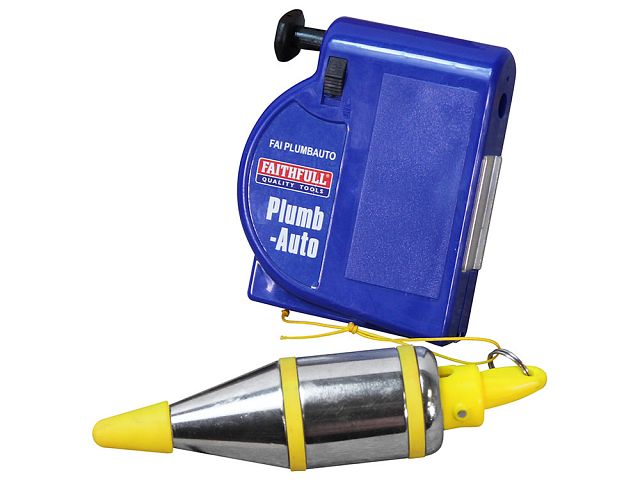
Faithfull Plumb-Auto
Faithfull’s Plumb-Auto solves the two things that make a basic bob-and-string annoying to use solo on site: it stabilises the swing in seconds rather than the usual half-minute of watching a bob settle, and it mounts itself — a magnetic panel for steel lintels and RSJs, a retractable pin for timber and plaster — freeing both hands to read the offset instead of holding a hook against a wall. The 6.7m auto-recoil line is long enough for most floor-to-ceiling and external elevation checks, and it winds itself back into the case rather than needing to be coiled by hand at the end of the job.
Typically £18–£26
Check price on AmazonHow I judge a plumb bob
Bob weight, and how fast it stops swinging. A heavier bob — 300g and up — settles into true vertical faster and resists a breeze on an external check far better than the light 100g bobs sold mainly for wallpaper hanging. On an exposed elevation or up a ladder, a bob that’s still swinging after thirty seconds is a bob that gets the job abandoned rather than finished properly.
How it mounts. A plain hook needs something to hook onto — a nail, a bradawl hole, a helpful gap in brickwork — which isn’t always available on a finished wall a vendor doesn’t want marked. A magnetic base solves it instantly on steel lintels, RSJs and stud partitions with screws in; a retractable pin works on timber and plaster where a magnet won’t grip. The auto-recoil cased tools that offer both are more expensive but genuinely faster to deploy solo.
Line length and material. Most wall and reveal checks need less than 3m, but a floor-to-ceiling or external elevation check can want 5–7m, and a line that’s too short is a wasted trip back to the van. Braided nylon holds a straighter line than twisted string and doesn’t stretch under the bob’s own weight over time.
Point accuracy. A machined, hardened tip gives a genuinely repeatable reference against a tape or a straight edge; a soft cast or moulded tip wears and rounds off, which matters less for a one-off DIY job than for a tool meant to give a consistent reading survey after survey.
Corrosion resistance. A tool that lives in a damp van door pocket for years needs brass, chromed steel or a plated finish — raw mild steel pits and the plating on the cheapest bobs flakes within a season.
The comparison
| Model | Bob weight | Mount | Typical price | Best for | |
|---|---|---|---|---|---|
| Faithfull Plumb-Auto | 400g | Magnetic + retractable pin | ~£18–£26 | Best overall | View |
| Tajima Plumb-Rite | 400g | Retractable pin, auto-recoil | ~£28–£38 | Premium/professional pick | View |
| Draper 60698 Expert Brass | 100g | Hook, 5m nylon line | ~£8–£13 | Best classic brass | View |
| Amtech G4130 Magnetic | 400g | Magnetic clip | ~£5–£9 | Best budget magnetic | View |
| Stanley 0-47-973 Brass | 225g | Hook, spare tip included | ~£14–£22 | Best heavyweight brass | View |
| Amtech G4100 | 140g | Hook, 4.5m line | ~£3–£6 | Best on a budget | View |
The picks in detail
Faithfull Plumb-Auto
Best overall — mounts itself and stabilises in seconds
Faithfull’s Plumb-Auto is built around the problem every mechanical plumb bob has on a solo job: getting it hung, held still and read without a second pair of hands. The magnetic panel grips steel lintels and RSJs outright, and the retractable pin gives a mounting point on timber or plaster where a magnet won’t work, so there’s rarely a wall it can’t be fixed to without marking it. The 400g bob is heavy enough to stop swinging within a few seconds rather than the usual half-minute wait, and the auto-recoil line winds itself back into the case at the end rather than needing to be coiled by hand. It’s plastic-cased rather than solid metal, which is the trade-off for the convenience — a dropped Plumb-Auto is more vulnerable than a solid brass bob, but for the time it saves on a site with several checks to run, it’s the one that earns a permanent place in the bag.
For
- Mounts to steel (magnetic), timber and plaster (pin) without marking the wall
- 400g bob stabilises fast
- Auto-recoil line, no hand-coiling
Against
- Plastic case is less robust than a solid metal bob if dropped
- Costs more than a basic hook-and-line bob
Typically £18–£26
Check price on AmazonTajima Plumb-Rite
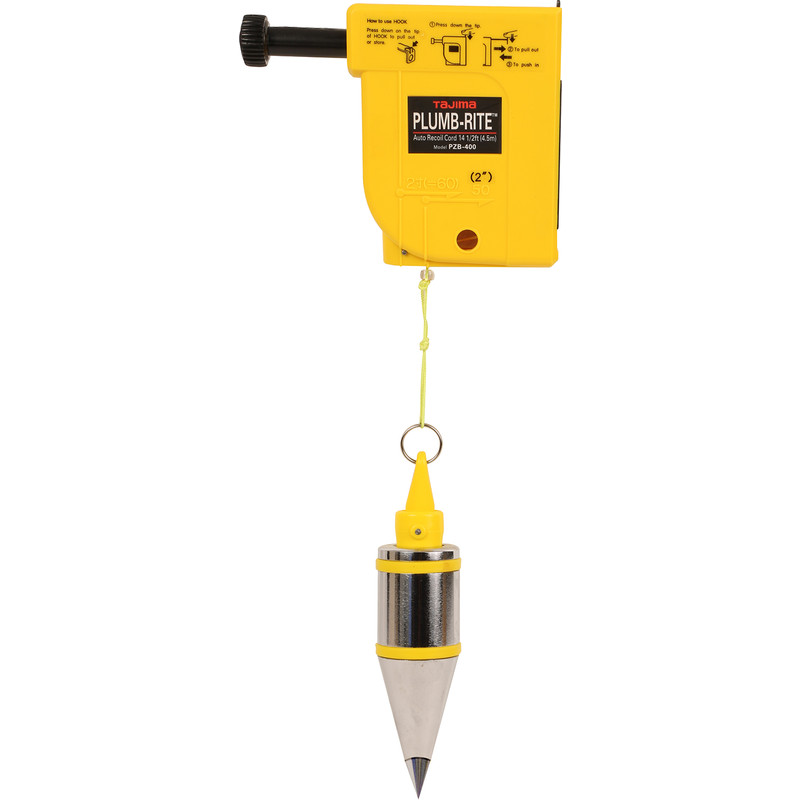
Premium/professional pick — the trade-grade auto-recoil tool
Tajima built its name on chalk lines and layout tools trusted on site rather than sold on price, and the Plumb-Rite applies the same standard to a plumb bob — an elastomer-wrapped case built to survive being dropped off a ladder, a reinforced setting pin head rather than a moulded plastic one, and a 400g quick-stabilising bob on a 4.5m auto-recoil cord. It’s a more expensive way to solve the same problem the Faithfull solves, and the case construction is the difference: this is built to survive years of daily site use rather than occasional DIY jobs. For a surveyor running plumb checks across several properties a week rather than once a month, the extra durability is what justifies the price over the cheaper auto-recoil alternative above.
For
- Reinforced case and setting pin built for daily trade use
- Fast-stabilising 400g bob, auto-recoil cord
- From a brand trusted for layout tool durability
Against
- Most expensive plumb bob in this guide
- 4.5m line is shorter than the Faithfull’s 6.7m
Typically £28–£38
Check price on AmazonDraper 60698 Expert Brass Plumb Bob
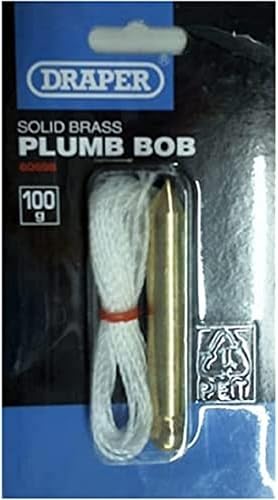
Best classic brass — the traditional weighted bob for precise, repeatable checks
Draper’s Expert 60698 is the traditional format most surveyors already picture when they think of a plumb bob: a solid 100g brass weight machined to a fine point, on a plain 5m nylon line with a simple hook mount. There’s no case, no magnet and no auto-recoil to go wrong, which is exactly the appeal — brass doesn’t corrode in a damp van bag, and a machined point gives a consistently repeatable reference against a tape or straight edge in a way a moulded plastic tip doesn’t. At 100g it settles more slowly than the 400g mounted tools above, especially outdoors in any wind, but for a quick internal reveal or wall check it’s more than sufficient and considerably cheaper.
For
- Solid brass, corrosion-resistant for years in a van bag
- Machined point gives a consistently repeatable reference
- Simple, nothing to break
Against
- 100g settles slowly and struggles in any wind, especially outdoors
- Needs a hook point — no magnet or pin
Typically £8–£13
Check price on AmazonAmtech G4130 Magnetic Plumb Bob & Line
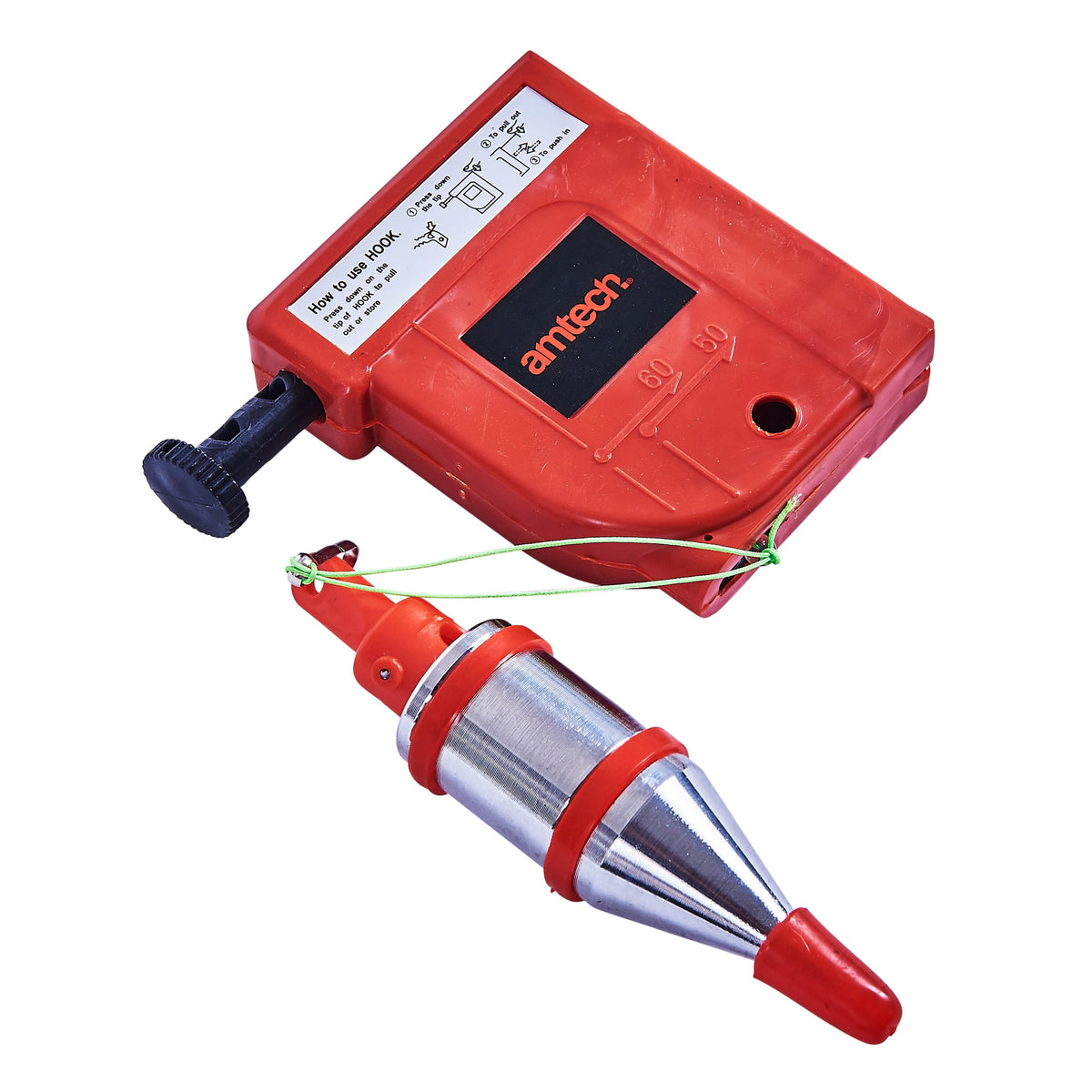
Best budget magnetic — steel lintels and stud walls without a hook point
The G4130 packs a 400g bob and a magnetic mounting clip into a straightforward, inexpensive package — a cheaper route to the same magnetic-mount convenience the Faithfull offers, without the auto-recoil case or the retractable pin for non-metal surfaces. That makes it a strong fit for steel lintels, RSJs and stud partitions with screws in, but it has no answer for a masonry or plastered wall with nothing magnetic to grip, where a hook or pin tool is still needed. Owner feedback is consistent that the magnet holds securely on genuinely steel surfaces and the 400g bob settles quickly, which is most of what the more expensive auto-recoil tools offer at a fraction of the price for the specific case it’s built for.
For
- 400g bob settles quickly
- Magnetic mount, no marking or drilling on steel surfaces
- Considerably cheaper than the auto-recoil magnetic tools
Against
- No hook or pin, so it’s no use on non-magnetic surfaces
- Basic clip-together case, less robust than the cased tools above
Typically £5–£9
Check price on AmazonStanley 0-47-973 Brass Plumb Bob
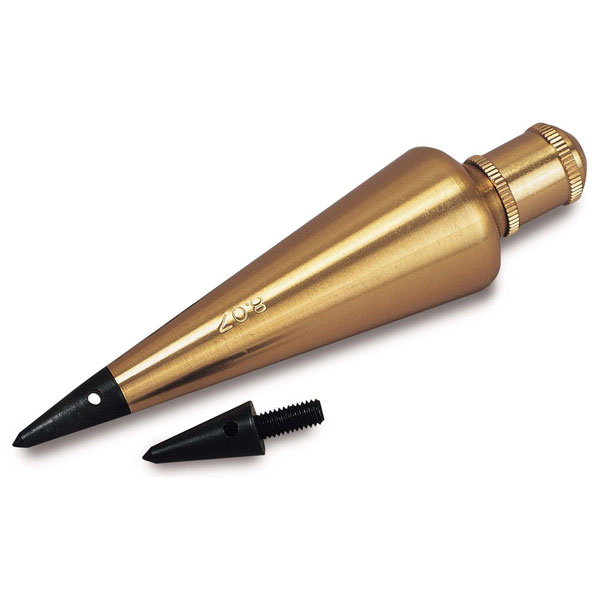
Best heavyweight brass — extra weight for exposed or windy checks
Stanley’s 0-47-973 is a heavier take on the classic brass format — 225g against the Draper’s 100g — which settles noticeably faster and holds steadier against a breeze on an external elevation or a check up a ladder. It ships with a spare hardened tip, worth having given the point is the part that eventually wears on a tool used repeatedly, and the countersunk cap keeps the line attachment tidy rather than proud of the body. It’s a hook-mounted tool with no magnet or pin, so it needs the same improvised mounting point as the Draper, but the extra weight is the reason to pick it over a lighter brass bob for anything done outdoors or somewhere higher than a stepladder reaches comfortably.
For
- 225g settles faster and holds steadier outdoors than lighter brass bobs
- Spare hardened tip included
- Solid brass, corrosion-resistant
Against
- Hook mount only, no magnet or pin
- Costs more than the lighter Draper for the same basic format
Typically £14–£22
Check price on AmazonAmtech G4100 Plumb Bob and Line
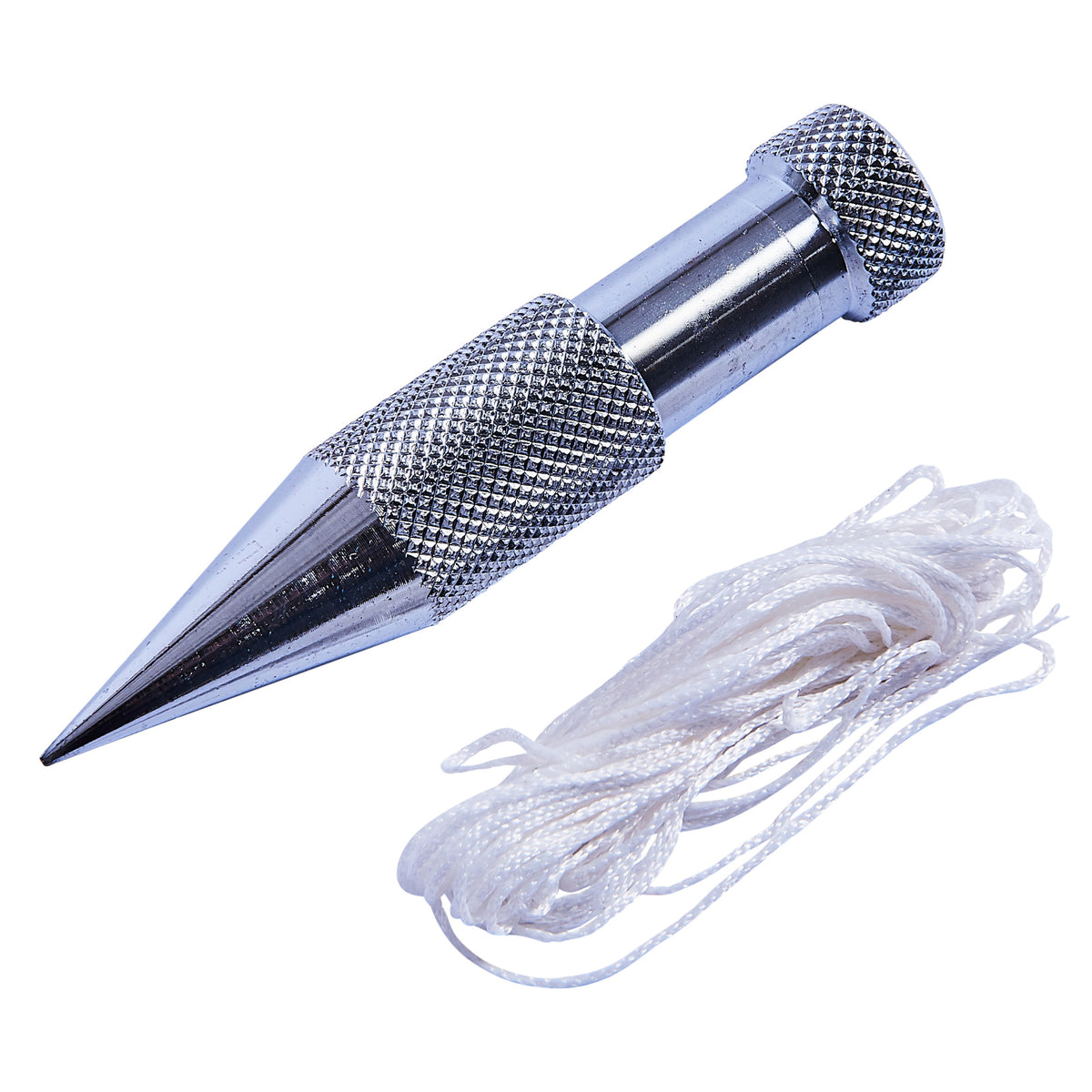
Best on a budget — a straightforward steel bob and line for under £6
The G4100 strips a plumb bob back to its simplest form — a 140g steel bob on a 4.5m line, hook mount, no case, no magnet — and prices it accordingly. It won’t settle as fast as the 400g tools above or last as long in a damp van bag as solid brass, but for a tool that mostly sits in the bag as a backup to a laser level or gets used a handful of times a month, it’s a sensible amount to spend. Owner feedback treats it as exactly what it is: a cheap, functional plumb bob rather than a compromise dressed up as one, and it’s inexpensive enough to keep a spare in the van without a second thought.
For
- Cheapest plumb bob in this guide
- Functional 140g steel bob, adequate for occasional use
- Nothing complicated to go wrong
Against
- Steel body is more prone to corrosion over years than brass
- 140g settles slower than the heavier bobs above, especially outdoors
Typically £3–£6
Check price on AmazonWhat actually matters — and what doesn’t
Weight matters more than the case it comes in. A 400g bob settles in seconds; a 100g bob can take half a minute and never fully stop in a breeze. An expensive auto-recoil case is a genuine convenience, but it isn’t what makes the reading accurate — the mass hanging on the end of the line is.
A plumb bob tells you the wall is out of vertical, not why. A bowed cavity wall could be decades-old settlement that’s long since stopped moving, or an active wall tie failure that needs an engineer’s opinion. The offset in millimetres is the data point that goes in the report; what it means comes from the rest of the survey — cracking, tie condition, age of the property — not from the plumb bob itself.
A laser level hasn’t made the mechanical bob obsolete. A laser is faster over distance and easier to read in the right light, but it needs a battery, periodic calibration and a dark enough or shaded enough surface to see the dot on. A plumb bob needs none of that, which is exactly why it’s worth keeping in the bag as a backup rather than relying on a laser alone.
Brass over steel for anything that lives in the van long-term. The price difference between a brass and a steel bob of similar weight is a few pounds; the difference in how long each survives being carried around in a damp tool bag is measured in years, not weeks.
Questions I get asked
How do I tell if a wall is actually out of plumb or just looks it?
Hang a plumb bob from a fixed point at the top of the wall — a bradawl hole, a magnet on a lintel, a retractable pin — and let it settle, then measure the gap between the line and the wall at the bottom against the gap at the top. A genuine offset gives a number in millimetres; if the line sits evenly against the wall top to bottom, what looked like a lean was probably the light or the angle it was viewed from.
Is a laser level or laser plumb better than a mechanical plumb bob for checking a wall?
A laser is quicker for repeated checks and easier to read over a longer distance in the right conditions, but it needs a charged battery, occasional calibration and a surface the dot is visible against. A mechanical plumb bob needs none of that — it’s the tool that still works when the laser’s flat, and most surveyors who carry a laser keep a plumb bob as the backup rather than the other way round.
How much lean or bow in a wall is actually a problem?
There’s no single figure that applies everywhere — it depends on the wall’s age, construction and what else is happening around it. A consistent, long-standing lean with no active cracking is usually old movement that’s settled; a bow that’s increasing, or paired with fresh cracking, is the combination that warrants a closer look or a structural engineer’s opinion rather than a number on its own.
Can a plumb bob be used accurately outdoors in wind?
A heavier bob — 300g and up — holds far steadier in a breeze than a light 100g one, though any plumb bob will swing in a genuine gust. On an exposed elevation, waiting for a lull, sheltering the line, or simply using the heaviest bob available all help more than trying to read a reference that’s still moving.
A plumb bob earns its place in the bag for one reason: it settles an argument about vertical that the eye alone can’t always win. If a bowed wall or a leaning chimney breast is the actual question on your own property, the practice carries out building surveys across Sussex, Kent and Surrey — get in touch. Or browse the rest of the field-kit guides, including the spirit levels and laser levels guides this one sits alongside.
Small print. This guide is general information, not a diagnosis of any specific property; a plumb bob reading is one data point in an assessment, not proof of structural movement or its cause. Prices are indicative, move constantly and were checked at the time of writing; the linked page always shows the current price. As an Amazon Associate I earn from qualifying purchases.