Most people buy a laser level to hang a picture straight. On a survey, the same tool finds out why a door in a Victorian terrace won’t stay shut. Set the laser on its little tripod in the middle of the room, let it self-level, and there’s a dead-level green line running around the walls at, say, a metre. Then you walk the room with a tape and measure from the line down to the floor. If the reading is 1,000 mm at the door and 1,032 mm at the bay window, the floor falls 32 mm across the room — and now you have a number, not a feeling. Same trick sideways for an out-of-plumb wall or a dropped lintel over a widened opening.
That’s the job this tool does on a survey: it converts “the floor feels a bit off” into millimetres you can write down, compare with the crack pattern, and monitor. It gets used on nearly every building survey I do, and on plenty of damp jobs too — a sloping solid floor tells you where the water goes.
What separates the good ones from the junk isn’t the number of lines. It’s whether the beam is visible in a bright south-facing room, whether the self-levelling is honest (it must warn you when it can’t level, not quietly draw a wrong line), and whether the claimed accuracy holds up. The good news is that genuinely useful accuracy — around ±0.3 mm per metre — is now available for well under £100. The bad news is that the market is full of unbranded lasers with invented specifications. Here’s what I’d actually buy.
The one I’d buy

Bosch GCL 2-50 G Professional
A green cross-line laser with two plumb points, ±0.3 mm/m line accuracy, and the build quality to survive a van. For survey work — one level line thrown across a floor, one vertical checked against a wall — the two-line-plus-points format covers everything the job actually asks, without paying for a third plane I’d rarely switch on. Runs on AA batteries, so it never arrives on site flat.
Typically £200–£280 with the RM 10 rotating mount
Check price on AmazonHow I judge a laser level
Beam colour and visibility. Green, always, for daytime work. A green beam sits close to the peak sensitivity of the human eye and reads roughly two to four times brighter than a red beam of the same power. In a bright room with the curtains open — which is every occupied house I survey — a red line simply disappears past four or five metres. Red is fine in a dim cellar or a loft; it is not fine across a sunlit living room.
Honest self-levelling. Every laser here has a pendulum that self-levels within about ±4°. What matters is the out-of-level warning: when the unit is tilted beyond the pendulum’s range, it must flash or blink rather than project a plausible-looking wrong line. Every recommendation below does this. Some cheap units don’t, and a wrong line delivered confidently is worse than no line at all.
Accuracy you can trust. The spec to read is millimetres per metre. ±0.3 mm/m means the line could be 3 mm out over a 10 m throw — well inside what matters when the floor you’re measuring falls 30 mm. Claims better than ±0.2 mm/m on a £40 laser should be treated as fiction.
Power and mounting. AA batteries are a feature, not a compromise — spares live in the van door. Platform batteries (DeWalt 12V, Makita CXT) make sense if you already own the chargers. A decent magnetic or rotating mount matters more than people think; you spend more time positioning a laser than reading it.
Survivability. A pendulum lock for transport, an IP54 or better rating, and a body that shrugs off a drop from a window board. A laser that goes out of calibration silently is a liability in this trade.
The comparison
| Model | Lines | Claimed accuracy | Typical price | Best for | |
|---|---|---|---|---|---|
| Bosch GCL 2-50 G Professional | Cross line + 2 plumb points, green | ±0.3 mm/m | ~£240 | Survey work, best overall | View |
| Huepar 603CG | 3 × 360°, green | ±0.3 mm/m | ~£150 | Value three-plane | View |
| DeWalt DCE089D1G | 3 × 360°, green | ±0.3 mm/m | ~£400 | Trades, site abuse | View |
| Bosch GLL 3-80 CG Professional | 3 × 360°, green | ±0.2 mm/m | ~£450–£600 | The premium option | View |
| Makita SK106GDZ | Cross line + 4 points, green | ±0.3 mm/m | ~£350 body only | Makita CXT owners | View |
| Huepar 902CG | 2 × 360°, green | ±0.3 mm/m | ~£80 | Best on a budget | View |
| Bosch Quigo Green | Cross line, green | ±0.6 mm/m | ~£60 | Occasional DIY | View |
| Stanley Cubix | Cross line, red | ±0.5 mm/m | ~£50–£70 | Dim rooms, tight budgets | View |
The picks in detail
Bosch GCL 2-50 G Professional
Best overall — the survey workhorse
The top pick, as above, and worth the fuller explanation. The GCL 2-50 G gives you a bright green horizontal, a green vertical, and two plumb points for transferring a position between floor and ceiling — handy when you’re checking whether a chimney breast removal lines up with what’s left below. Line accuracy is ±0.3 mm/m, the out-of-level warning is unmissable, and the pendulum locks for transport. The RM 10 rotating mount that usually comes bundled lets you swing the vertical line around a room without moving the tripod, which sounds trivial and saves ten minutes per house. It takes AA batteries: no charger, no dead platform battery at 8am in Crowborough.
For
- Bright, crisp green lines that survive a sunlit room
- Plumb points earn their keep on structural checks
- AA power and a proper transport lock
- Bosch build; owner reports have these surviving drops and still checking true
Against
- Not a 360° line — you reposition to chase a line right round a room
- Bundles vary confusingly; check what mount is in the box
Typically £200–£280 with the RM 10 mount
Check price on AmazonHuepar 603CG
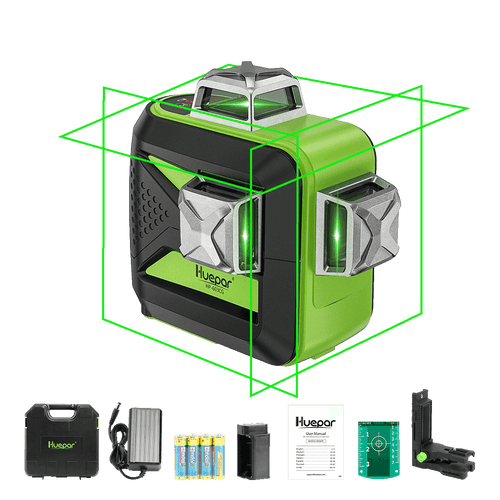
Best value three-plane laser
Huepar is the brand that made the big names sharpen their pencils. The 603CG projects three full 360° green planes — one level, two plumb at right angles — at a claimed ±0.3 mm/m, for roughly a third of the price of the equivalent Bosch or DeWalt. Side-by-side user tests against the big-brand units across an ordinary room repeatedly fail to split them. It runs off a lithium pack, AAs or the mains, has a pulse mode for an outdoor receiver, and comes with a usable magnetic base. The compromises are the ones you’d expect: the casing is more plasticky, the lines go slightly fuzzy at long range, and if it drifts out of calibration in three years you’ll replace it rather than service it. At this price, that’s a rational bargain.
For
- Three 360° planes at a two-line price
- Accuracy genuinely close to the claim in published user tests
- Triple power supply; pulse mode included
Against
- Line sharpness falls off past about 15 m
- No service network — effectively a replace-not-repair tool
Typically £130–£170
Check price on AmazonDeWalt DCE089D1G

The professional option — built for site abuse
Three 360° green planes, ±0.3 mm/m, running on DeWalt’s 12V XR batteries, wrapped in the usual DeWalt roll cage. This is the laser you see screwed to a first-fix ceiling grid, and it’s the one I’d point a builder at rather than a surveyor: it shrugs off drops, dust and rain that would kill anything else on this list, and the over-moulded housing means the glass survives the toolbox. For pure survey work it’s more laser than you need at more weight than you want, but if your van already runs on yellow batteries the sums change considerably.
For
- Toughest housing here; IP65-rated
- Full 360° coverage in all three planes
- Shares batteries with the DeWalt 12V range
Against
- Heavy and bulky in a survey bag
- Dear, and the battery ecosystem is part of the price
Typically £380–£470 with battery and charger
Check price on AmazonBosch GLL 3-80 CG Professional

The premium option — when the spec sheet has to win
Bosch’s flagship three-plane green laser, and the most accurate tool on this page at a claimed ±0.2 mm/m. The lines are the brightest and cleanest in the class by broad consensus, the 12V battery is rated for a full day of intermittent use, and there’s Bluetooth connection to a phone app that most owners report opening exactly twice. If you’re setting out kitchens, suspended ceilings or tiling to fine tolerances every day, this is the one; the extra sharpness at 20 m is real. For diagnosing a sloping floor, the honest position is that the GCL at half the price tells you the same thing. Buy this because your work is setting-out, not because your work is surveying.
For
- Best line quality and tightest accuracy spec here
- Three 360° planes; excellent range with a receiver
- Bosch calibration and service network behind it
Against
- Expensive, and prices swing wildly between bundles
- The app is a gimmick you will not use
Typically £450–£600 depending on bundle
Check price on AmazonMakita SK106GDZ

Best for Makita 12V CXT owners
A green cross-line laser with four plumb points, running on Makita’s 12V CXT batteries. Accuracy is the standard ±0.3 mm/m, it settles in under three seconds, and the up-and-down points make short work of transferring positions through a building — useful when you’re tracing whether a cracked partition sits over anything that should be holding it up. Sold body-only, so the price only makes sense if the batteries are already in your van; buying into CXT for a laser alone would be an odd decision. Within its ecosystem, a thoroughly sensible tool.
For
- Four plumb points; quick, stable settling
- Shares batteries with Makita 12V CXT tools
- Green beam with pulse mode for a receiver
Against
- Body only — battery and charger are extra
- No 360° lines at a near-360° price
Typically £320–£410 body only
Check price on AmazonHuepar 902CG

Best on a budget — the most laser per pound
If the budget stops firmly under £100, this is where I’d put it. A 360° green horizontal plus a wide vertical, claimed ±0.3 mm/m, self-levelling with a proper out-of-level flash, pulse mode, and a magnetic pivoting base in the box. That specification would have cost £400 a decade ago. It is entirely adequate for measuring a floor slope, checking a lintel, or renovating your own house; the housing won’t take site punishment and the beam is a touch dimmer than the dearer Huepar, but the readings it gives you are the same numbers. For a homeowner wanting to check what their surveyor told them, this is the one.
For
- 360° green horizontal under £100
- Real self-levelling with a real warning
- Magnetic base included
Against
- Beam noticeably dimmer than the 603CG in bright rooms
- Feels like the price; treat it gently
Typically £70–£100
Check price on AmazonBosch Quigo Green

Best for occasional DIY — the kitchen-drawer laser
Bosch’s little consumer cube: a green cross line, 12 m range, ±0.6 mm/m, and a clever clamp-mount that grips a shelf or door edge. The accuracy is half that of the professional tools, which sounds bad until you do the arithmetic — 0.6 mm/m is about 2.5 mm across an average living room, which is nothing against a 30 mm floor slope and irrelevant for hanging cupboards. It self-levels honestly and the green beam is visible in daylight where the old red Quigo wasn’t. If you’ll use a laser four times a year, buy this and spend the difference on draught-proofing.
For
- Green beam at a consumer price
- Tiny; genuinely lives in a drawer
- Bosch quality control at the bottom of the range
Against
- ±0.6 mm/m — fine for DIY, marginal for setting out
- 12 m range limits it to domestic rooms
Typically £55–£70
Check price on AmazonStanley Cubix

Best for dim rooms on a tight budget
The Cubix is here partly as a recommendation and partly as a lesson. It’s a solid, honest little red-beam cross-line laser: self-levelling, decent accuracy for the money, simple controls, Stanley’s name on the front. In a cellar, a windowless bathroom or an evening job it works perfectly well. In a bright room the red line vanishes at about four metres, and no amount of squinting brings it back — which is exactly why everything else in this guide is green. If your work is genuinely indoors-and-dim, save the money; if there’s any chance of daylight, spend the extra tenner on the Quigo Green.
For
- Cheap, simple and honestly specified
- Proper self-levelling with lock
- Fine in low light
Against
- Red beam is unusable in a bright room past a few metres
- Short working range
Typically £45–£70
Check price on AmazonWhat actually matters — and what doesn’t
Green beam: matters. It’s the single biggest usability difference in this category and worth paying for. The trade-offs — slightly higher price, hungrier on batteries — are trivial next to being able to see the line.
Number of 360° planes: matters less than the marketing says. Three planes are lovely for fitting a kitchen. For diagnosis you use one level line at a time, and a plain cross-line with a rotating mount covers ninety per cent of it. Don’t pay for planes you won’t switch on.
Pulse mode and receivers: only if you work outside. Pulse mode lets a handheld detector find the beam in sunlight at long range — essential for groundworks and fencing, irrelevant inside a house. Most lasers here include it anyway; just don’t let a “50 m range” figure sway you when the visible indoor range is what you’ll actually use.
Bluetooth and apps: don’t matter. Nothing that happens on a survey requires a laser to talk to a phone. Salesmen push connectivity because it’s the only thing left to differentiate mature products. Spend the money on a decent tripod instead — a £25 tripod improves every laser more than any app does.
Calibration checks: matter more than the purchase. Whatever you buy, check it twice a year: stand it 5 m from a wall, mark the line, spin the unit 180°, and compare. Then reverse the test at the other end of the room. Ten minutes, and it’s the difference between a measurement and a guess. A laser that’s been dropped gets checked the same day.
Questions I get asked
Green vs red laser level — is green really worth it?
Yes, for anything in daylight. The human eye is most sensitive around the green part of the spectrum, so a green laser line appears roughly two to four times brighter than a red one of the same output power. In practice that means a green line stays readable across a sunlit room where a red line disappears beyond four or five metres. Red still has a place — cellars, lofts, evening work — and red units are cheaper and easier on batteries. But if you buy one laser to do everything, buy green.
How do surveyors check if a floor is level?
With exactly the method in the introduction: a self-levelling laser projects a dead-level datum line around the room, and you measure from that line down to the floor at a grid of points with a tape or rule. The differences between readings map the floor’s slope in millimetres — direction, magnitude, whether it’s a uniform tilt or a local dip. Every Victorian floor slopes; that alone is not a defect. The diagnostic question is whether the movement is historic and stable or recent and progressive, which is where the laser evidence gets read alongside crack patterns, decoration age and, where needed, monitoring over months. A digital level or the old marble across the boards gives you a feel; the laser gives you numbers you can compare next year.
How does a self-levelling laser level work?
Inside the housing the laser diodes hang on a pendulum, usually damped by magnets so it settles in a couple of seconds. Set the tool anywhere within about ±4° of level and gravity does the rest: the pendulum swings true and the projected line is level regardless of the wonky window board you’ve stood it on. Tip it beyond that range and a decent unit flashes or blinks to warn you rather than drawing a wrong line. There’s also a transport lock that clamps the pendulum — use it, because a pendulum bouncing loose in a van is how lasers quietly lose their calibration. Most units let you lock the pendulum and project a deliberately tilted line for staircases.
What does laser level accuracy in mm per metre actually mean?
It’s the maximum error the line can accumulate per metre of distance from the tool. A ±0.3 mm/m laser could be 3 mm out at 10 m; a ±0.6 mm/m consumer unit could be 6 mm out at the same distance. Whether that matters depends entirely on the job. Diagnosing settlement, where floors are out by 20–60 mm, any of these tools is comfortably accurate enough. Setting out tiling or a worktop across a long run, the tighter spec starts to earn its money. What no spec sheet fixes is a laser that’s been knocked out of calibration — hence the twice-yearly check above.
A laser line tells you how much a floor has moved; it doesn’t tell you why, or whether it’s finished moving. If a sloping floor, cracked plaster or a sticking door is worrying you — especially in an older building — a proper inspection puts the measurements in context. The practice carries out building surveys across East Sussex, Kent and the South East, with a particular interest in Victorian and older stock. Get in touch, or browse the rest of the field-kit guides.
Disclaimer. This guide is general information, not structural advice; measurements you take yourself are a starting point for a conversation with a professional, not a substitute for one. Prices are indicative, move constantly and are checked at the time of writing; the linked page always shows the current price. As an Amazon Associate I earn from qualifying purchases.