A measuring wheel does one job and does it well: turning distance into a number without needing a second pair of hands or forty metres of tape unspooled across wet grass. Zero the counter, walk the line, read the total — a boundary fence, a driveway, the perimeter of a paddock or the long axis of a barn conversion, covered in the time it takes to walk it rather than the time it takes to measure it in five-metre bites.
It earns its keep on jobs a tape struggles with — anything over about fifteen metres, an awkward gradient along the run, or anywhere pacing out a rough estimate isn’t good enough for the report. Room and plot dimensions for an EPC’s floor area calculation, boundary walks on a rural HomeBuyer instruction, drive lengths for an access query, or a quick check of a roof run measured from ground level all come up often enough that a decent wheel earns its space in the van.
None of the wheels below have been rolled down an actual drive on an actual survey — the notes here are built from manufacturers’ specifications and recurring owner feedback, filtered through what a jobbing surveyor’s measuring needs rather than what a civil engineering firm needs off a live carriageway. First, the one I’d buy.
The one I’d buy

Bosch Professional GWM 32 Measuring Wheel
Bosch’s GWM 32 is the sensible middle ground in this guide — sold at a genuine trade-tool price rather than a specialist survey-equipment one, built with an aluminium telescopic shaft and a rubber-tread steel wheel that copes with gravel, tarmac and rough ground without much drama. A five-digit counter and a 9,999.9m range cover anything a residential or light-commercial survey is ever going to ask of it, and Bosch’s own three-year guarantee, on registration, is longer than most of the field.
Typically £70–£90
Check price on AmazonHow I judge a measuring wheel
Counter type — digital or mechanical. A digital LCD is quick to read at a glance and some models add a backlight for a dim plant room or an overcast morning; a mechanical gear counter never runs flat, needs no battery, and is arguably harder to misread once you know the dial. Neither is objectively better — it’s a question of what fails less conveniently on the day.
Wheel diameter and tread. A larger wheel turns fewer times over the same distance, which matters on gravel, loose stone or long grass where a small wheel can skip or bounce and quietly accumulate error. A rubber tread grips wet paving and mud far better than bare plastic.
Folding or telescopic handle, and stored length. A wheel that only collapses to a metre and a half is a wheel that eats a disproportionate share of the van. A telescopic handle that adjusts for height on the day and folds down small for storage between visits is worth more than it sounds on paper.
Accuracy, kept in proportion. Most wheels here claim somewhere between ±0.5% and ±1%. That’s plenty for a boundary walk or a floor area calculation; it’s the operator’s technique — walking a straight line, keeping the wheel upright, not letting it bounce over a kerb — that determines the real-world result far more than the tolerance printed on the box.
A stand or kickstand. Being able to set the wheel down upright at the end of a run, rather than leaning it against a fence or laying it in wet grass, frees both hands for a notebook, a tape or a camera — a small feature that gets used every single time.
The comparison
| Model | Counter | Wheel | Typical price | Best for | |
|---|---|---|---|---|---|
| Bosch Professional GWM 32 | Digital, 5-digit | 320mm steel, rubber tread | ~£70–£90 | Best overall | View |
| Trumeter 5500E Measuremeter | Digital LCD, 6-digit | 1m circumference, telescopic handle | ~£90–£110 | Premium/professional pick | View |
| Stanley Measuring Wheel 0.32m | Mechanical, 5-digit | Die-cast aluminium, rubber tread | ~£70–£90 | Best mechanical counter | View |
| Draper 44238 Expert | Digital, illuminated | Adjustable 600–950mm handle | ~£55–£80 | Best stand & bag as standard | View |
| Marksman Professional | Mechanical, illuminated | Light alloy, folding stand | ~£25–£32 | Best value with stand & bag | View |
| Silverline Mini 868793 | Analogue, instant zero | Dual wheels, telescopic 460–900mm | ~£25–£35 | Best compact / dual-wheel | View |
| Amtech P1910 | Mechanical, reset button | 140mm, compact aluminium handle | ~£11–£18 | Best on a budget | View |
The picks in detail
Bosch Professional GWM 32 Measuring Wheel
Best overall — trade-tool durability at a trade-tool price
The GWM 32 sits in an unusual spot: priced like a decent power tool accessory rather than dedicated survey equipment, but built to the same telescopic-aluminium-shaft, steel-wheel standard as wheels costing considerably more. The rubber-tread wheel copes with gravel drives, uneven paving and wet grass without skipping badly, and the five-digit counter with a reset button is straightforward to zero and read mid-walk. It folds down enough to travel in the back of a van without becoming the single largest item in there, and ships with its own carry bag.
For
- Trade-tool build at a sensible price
- Rubber-tread wheel handles rough and wet ground
- Three-year guarantee on registration; carry bag included
Against
- No backlit digital display for low-light readings
- Popular with trade buyers, so occasional supply gaps
Typically £70–£90
Check price on AmazonTrumeter 5500E Measuremeter Digital Measuring Wheel
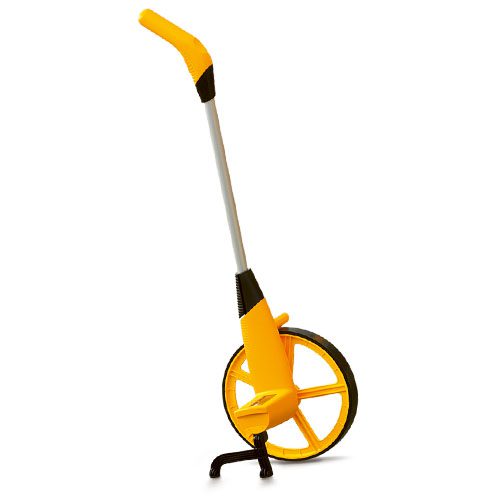
Premium/professional pick — the specialist surveying brand’s digital wheel
Trumeter has built distance-measuring equipment since 1937, and the 5500E is aimed squarely at the trade that measures distance for a living — architects, surveyors and construction professionals rather than occasional DIY use. Its backlit LCD stays legible in bright sunlight or a dim outbuilding alike, trip and total measuring modes let a run be zeroed mid-survey without losing the overall figure, and an electronic brake with pushbutton reset keeps the count honest on a stop-start walk. The retractable stand and mud scraper are small details that matter more than they sound on a site with any mud on it at all.
For
- Purpose-built surveying brand with a long track record
- Backlit LCD, trip/total modes, electronic brake
- Retractable stand and mud scraper
Against
- Priced above the general trade-tool wheels in this guide
- More capability than most residential surveys will use
Typically £90–£110
Check price on AmazonStanley Measuring Wheel 0.32m

Best mechanical counter — no batteries, no backlight, nothing to run flat
Stanley’s wheel skips the digital display in favour of a gear-driven mechanical counter under a tough plastic housing — the trade-off is a manual reset button rather than an illuminated screen, but also nothing that needs charging or a battery change mid-survey. The die-cast aluminium wheel with rubber tread and the metal folding handle with a rubber grip are built to the same standard as the pricier wheels in this guide, and the one-year guarantee and carry bag are in line with the rest of the field.
For
- Mechanical counter never runs flat
- Die-cast aluminium wheel with rubber tread
- Folding handle, carry bag included
Against
- No illumination for reading the dial in poor light
- ±1% accuracy is adequate rather than exceptional
Typically £70–£90
Check price on AmazonDraper 44238 Expert Measuring Wheel

Best stand and bag as standard — set it down and walk away
Draper’s Expert wheel pairs an illuminated digital readout with an instant zero reset button, useful on a run that needs restarting partway through, and an adjustable handle spanning 600–950mm that suits a wider range of heights than the fixed handles on some competitors. It’s supplied with its own stand and a canvas carrying bag as standard, which matters on site: a wheel that stands up on its own rather than needing to be propped against a fence saves both hands for a notebook or a camera.
For
- Illuminated digital readout with instant zero
- Adjustable 600–950mm handle
- Stand and canvas bag included as standard
Against
- List price sits above some competitors, though regularly discounted
- Wheel diameter isn’t published, making direct comparison harder
Typically £55–£80
Check price on AmazonMarksman Professional Distance Measuring Wheel

Best value with stand and bag — most of the Draper’s features for about a third of the price
Marksman’s wheel covers the same basics as the pricier stand-and-bag wheels above — a folding tripod-style stand, a canvas carry bag, and a built-in light for reading the counter in poor conditions — at a price that undercuts them by some margin. The mechanical counting head with a five-digit display is straightforward rather than sophisticated, and the light alloy steel construction is a step down from the aluminium and die-cast builds further up this list, but for occasional use it does the job the more expensive wheels do.
For
- Genuinely low price for a folding stand and bag included
- Built-in illumination for the counter
- Simple one-person operation
Against
- Lighter alloy-steel construction than the trade-brand wheels
- Less suited to daily, heavy use
Typically £25–£32
Check price on AmazonSilverline Mini Measuring Wheel 868793

Best compact — dual wheels for stability in a genuinely pocketable size
Where most wheels here are a single wide wheel, the Silverline Mini runs on two smaller wheels side by side, which adds stability on an uneven line without needing a wider single tyre. The telescopic handle collapses down to 460mm and extends to 900mm, short enough to live in a tool bag rather than needing its own space in the van, and the analogue display with an instant zero button covers runs up to 9,999.9m — plenty for anything short of a genuine land survey.
For
- Dual-wheel design adds stability
- Genuinely compact telescopic handle (460–900mm)
- Instant zero button, canvas storage bag
Against
- Plastic wheels rather than rubber-tread metal
- Smaller wheels more affected by loose gravel than one large wheel
Typically £25–£35
Check price on AmazonAmtech P1910 Measuring Wheel
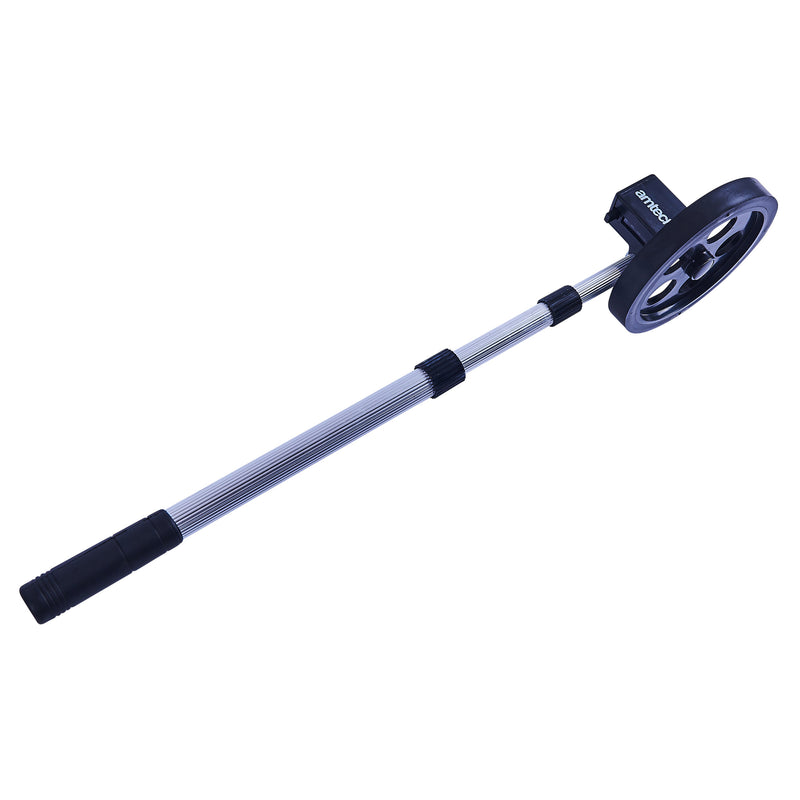
Best on a budget — a genuinely small, cheap backup for occasional use
The Amtech is the smallest and cheapest wheel in this guide by some distance: a 140mm wheel on a lightweight aluminium handle, with a basic mechanical counter and reset button covering runs up to a kilometre. It won’t survive years of daily trade use the way the Bosch or Trumeter will, but as an occasional-use wheel kept in the boot for the odd drive length or boundary check, it costs about as much as a decent tape measure and does a job a tape measure can’t.
For
- Cheapest wheel in this guide
- Small enough to genuinely forget it’s in the boot
- Does the basic job reliably
Against
- Smallest wheel here, so more revolutions and more chance of accumulated error over a long run
- Construction won’t survive heavy daily use
Typically £11–£18
Check price on AmazonWhat actually matters — and what doesn’t
A 99,999.9m range matters to nobody measuring a driveway. Every wheel here can measure distances well beyond anything a residential survey needs — the headline range is a spec-sheet number borrowed from civil engineering work, not a reason to pick one wheel over another.
A backlit display is a genuine convenience in the right setting. Reading a plain LCD or mechanical dial in full winter light or a dim outbuilding is harder than it should be; a backlight earns its keep on the wheels that have one, and it’s a fair tie-breaker between two otherwise similar wheels.
Quoted accuracy is largely academic next to operator technique. The difference between a wheel rated to ±0.5% and one rated to ±1% is smaller than the error introduced by walking a wandering line, letting the wheel bounce over a kerb, or starting the count from the wrong point. Walking a straight, steady line matters more than the number printed on the box.
Wheel size matters more on rough ground than on flat. A small wheel turns more times over the same distance, which means more opportunities to skip or bounce on gravel, long grass or a rutted farm track. On a smooth drive or a flat floor for an EPC measurement, a small wheel performs almost as well as a large one; on rough ground, the larger wheels in this guide hold their accuracy noticeably better.
Questions I get asked
How accurate is a measuring wheel really?
Most of the wheels here are rated somewhere between ±0.5% and ±1%, which on a 30m boundary run is a matter of centimetres either way — plenty for a floor area calculation, a drive length or a boundary description in a report. Accuracy degrades faster from operator technique than from the wheel itself: a wandering line, a bounced kerb crossing or a count started from the wrong point will move the result far more than the manufacturer’s stated tolerance.
Can a measuring wheel replace a tape measure or a laser measure?
Not for anything precise or close-range — a wheel is the wrong tool for a room dimension measured to the nearest millimetre, where a laser measure or a tape measure does a faster, more accurate job over a few metres. A wheel earns its place on the longer runs a tape struggles with: boundary walks, drive lengths, and plot perimeters where covering the distance quickly matters more than millimetre precision.
Digital or mechanical — which is better for survey work?
Both do the same job; the difference is what fails less conveniently. A digital counter is quicker to read at a glance and some add a backlight for poor light, but it depends on a battery that can go flat mid-survey. A mechanical gear counter needs nothing but a moment to learn the dial, and it never runs out of charge — a genuine advantage for a wheel that spends most of its life at the bottom of the van rather than on charge.
Do measuring wheels work on grass, gravel and uneven ground?
Reasonably well, with caveats. A rubber-tread wheel grips wet grass and paving far better than a bare plastic one, and a larger-diameter wheel copes with gravel and rutted ground more accurately than a small one, which can skip and quietly under- or over-count. On genuinely rough or ploughed ground, expect the reading to be a useful working figure rather than a survey-grade one — walk the line twice and compare if the distance matters.
A measuring wheel earns its keep the same way a good tape does — by turning a question about distance into an answer, quickly and repeatably enough to trust in a report. If a boundary line, a drive length or a floor area on your own property is the actual question, the practice carries out building surveys and EPCs across Sussex, Kent and Surrey — get in touch. Or browse the rest of the field-kit guides, including laser measures and tape measures.
Small print. This guide is general information, not a recommendation for any specific site condition; a wheel reading is a working figure for the report, not a substitute for the survey itself. Prices are indicative, move constantly and were checked at the time of writing; the linked page always shows the current price. As an Amazon Associate I earn from qualifying purchases.