I’m a building surveyor, not a gas engineer, and I want to be upfront about that before anything else in this guide: I don’t carry a flue gas analyser or run a combustion test myself. What I do see, on a routine survey or a HomeBuyer Survey, is the appliance itself and the paperwork sitting behind it — a boiler that’s stone cold when it should be ticking over, a gas safety certificate with a date that’s quietly slipped past twelve months, a flue terminal positioned somewhere it plainly shouldn’t be. Those are things I flag and write up. Turning a flag into a pass or fail is a Gas Safe registered engineer’s work, and the tool that does it is the one this guide is about.
A flue gas analyser clips a probe into the flue and reads what’s actually coming out of the appliance: oxygen, carbon monoxide directly, carbon dioxide calculated from the two, flue temperature, and the combustion ratio that tells an engineer whether the appliance is burning cleanly or starved of air. That reading is what turns “seems fine” into a number on a certificate — the same certificate a landlord needs for a gas safety check, and the same document I go looking for the date on when I’m writing up a survey.
The one I’d buy
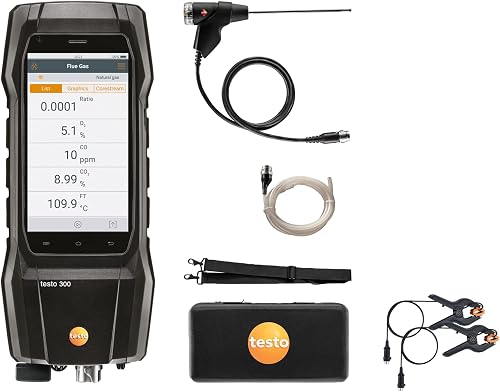
Testo 300+ Advanced Kit
Testo’s name carries the same weight in combustion testing that Fluke’s does in electrical test kit, and the 300+ Advanced Kit is the sensible middle of its range: a 5-year H2-compensated O2/CO sensor, a basic flue probe, a pressure kit and two pipe-temperature clamps, Bluetooth to the Testo Smart App, and a colour touchscreen that’s genuinely easier to read outdoors than a small monochrome display. It doesn’t carry NO measurement or a printer — both available a tier up — but for routine domestic gas servicing and safety checks it covers the job without paying for capability most days on the van won’t use.
Typically £830–£950
Check price on AmazonHow I judge a flue gas analyser
BS 7967 / EN 50379-3 compliance, not just a price that looks about right. BS 7967 is the British Standard covering the use of a portable combustion analyser to assess CO and combustion performance on domestic gas appliances, and it assumes an analyser tested to EN 50379-3 behind it. A stated compliance line on the listing is worth more than a plausible-looking spec sheet with no standard named against it.
Sensor life, and what replacing it actually costs. The electrochemical O2 and CO sensors in these units have a working life, typically quoted around five years on the mid- and premium-tier units here, before they need replacing rather than just recalibrating — worth checking the replacement cost before buying on the headline unit price alone.
Fuel scope matched to the actual diary. A gas-only analyser is cheaper and lighter, but oil-fired appliances, kerosene and wood-pellet systems need a probe and calibration gas table rated for that fuel — an OFTEC engineer with oil boilers on the round needs a genuinely multi-fuel unit, not a gas-only one with an optional accessory that was never bought.
A printer or app export for the paper trail. A printed or emailed combustion reading alongside the certificate is increasingly what a landlord or letting agent expects to see, not just a verbal “it’s fine.” Some kits build an IR printer in; on others it’s a phone photo of the display, dated and saved against the job.
Calibration cost and lockout behaviour. Most of these analysers are serviced annually against a UKAS-traceable reference gas, and several will refuse a valid reading once that calibration date has lapsed. Factor the yearly service cost into the real cost of ownership, not just the price on the box.
The comparison
| Model | Fuel scope | BS 7967 probe kit | Typical price | Best for | |
|---|---|---|---|---|---|
| Testo 300+ Advanced Kit | Gas & oil | No | ~£830–£950 | Best overall | View |
| Testo 310 (2nd Gen) | Gas, LPG & oil | No | ~£410–£450 | Best on a budget | View |
| Testo 327-1 Standard Set | Gas, oil, kerosene, LPG & pellet | No | ~£450–£510 | Multi-fuel / OFTEC-adjacent work | View |
| Anton Sprint Pro 2 | Gas | No (unit only) | ~£460–£625 | Value Anton pick | View |
| Anton Sprint Pro 5 Kit B | Gas | Yes | ~£1,080–£1,250 | Premium/professional pick | View |
| Testo 300+ Ultra-Smart Kit | Gas & oil | No | ~£930–£1,150 | Premium Testo, built-in printer | View |
The picks in detail
Testo 300+ Advanced Kit
Best overall — a trusted name at a sensible middle spec
This is the top pick above: a 5-year H2-compensated O2/CO sensor, a basic flue probe, pressure kit and two pipe-temperature clamps, Bluetooth to the Testo Smart App, and a colour touchscreen readable in poor light. It sits below the Ultra-Smart tier by leaving out the built-in printer and NO measurement, which most domestic gas work never needs, while still covering natural gas and oil appliances with the right probe.
For
- 5-year H2-compensated O2/CO sensor
- Colour touchscreen with Bluetooth app connectivity
- Covers gas and oil appliances
Against
- No built-in printer — that’s the Ultra-Smart tier below
- No NO measurement
Typically £830–£950
Check price on AmazonTesto 310 (2nd Gen) Standard Kit

Best on a budget — a genuinely compact analyser, not a stripped-down one
The 310 reads O2 directly and calculates CO2, CO, flue and ambient temperature and draught, with Bluetooth to the same Testo Smart App as the 300 series and a 30-second auto-zero that gets a reading started faster than fumbling with a fresh-air purge. It’s the smallest, lightest unit here, genuinely pocketable rather than van-only, and the probe is rated for natural gas, LPG and oil. What it doesn’t have is a printer or NO measurement, or the 5-year sensor life quoted on the pricier 300 series.
For
- Cheapest genuinely current Testo here
- Compact, pocketable form factor
- Natural gas, LPG and oil probe compatibility
Against
- No printer or app-based certificate export beyond Bluetooth readout
- Shorter-rated sensor life than the 300 series
Typically £410–£450
Check price on AmazonTesto 327-1 Standard Set
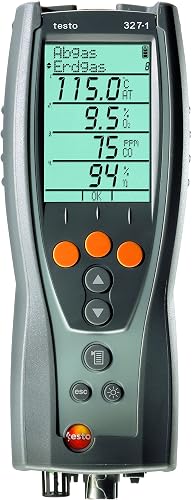
The multi-fuel pick — genuinely OFTEC-adjacent, not just gas
Where the 300 and 310 lean toward gas with oil as a secondary capability, the 327-1’s own listing states natural gas, oil, kerosene, LPG and wood-pellet compatibility outright, plus tightness and let-by pressure-test routines with the right adaptor. The trade-off for that breadth is the older LCD-and-button interface rather than the 300 series’ touchscreen and app, and a shock-proof elastomeric housing built for a rougher working life rather than a slim profile.
For
- Broadest stated fuel compatibility here — gas, oil, kerosene, LPG, pellet
- Built-in tightness/let-by pressure test routines
- Robust shock-proof housing
Against
- Older button-and-LCD interface, no touchscreen or app
- No printer or NO measurement
Typically £450–£510
Check price on AmazonAnton Sprint Pro 2

A second trusted UK trade name, at unit-only pricing
Anton is a name a lot of UK gas engineers already own other test kit from, and the Sprint Pro 2 unit brings BSI testing to EN 50379-1/3:2012, Water Stop double protection on the sensor chamber, and a washable foam dust filter for longer sensor life. Bought as a bare unit — analyser, flue probe, carry bag, USB-C charger, filters and calibration certificate — it’s the most affordable way into the Sprint Pro range; the BS 7967 flueless probe set, pressure kit and printer are Kit A/Kit B additions, not included here.
For
- EN 50379-1/3:2012 tested, hydrogen-blend ready
- Water Stop double protection and washable dust filter
- Most affordable entry into the Sprint Pro range
Against
- No BS 7967 flueless probe set at this tier
- No pressure kit or printer included
Typically £460–£625
Check price on AmazonAnton Sprint Pro 5 Kit B

Premium/professional pick — NO measurement and the BS 7967 flueless probe set
Kit B is where the Sprint Pro range earns a premium price: CO, O2, temperature and pressure measured directly, NO measured alongside them, and CO2, the CO/CO2 ratio and combustion efficiency calculated — plus a BS 7967-compliant probe set specifically for testing flueless appliances, which neither Testo kit above includes. A 14-hour Li-ion battery, USB-C charging and an iOS/Android app round it out. It’s the most expensive unit here, and NO measurement is genuinely wasted on a routine domestic combi service — it earns its keep on flueless-appliance testing and the wider scope of work that comes with it.
For
- NO measurement alongside CO, O2, temperature and pressure
- BS 7967-compliant flueless-appliance probe set included
- 14-hour Li-ion battery with app connectivity
Against
- The most expensive unit in this guide
- NO measurement and the flueless probe set go unused on routine domestic servicing
Typically £1,080–£1,250
Check price on AmazonTesto 300+ Ultra-Smart Kit

Premium Testo — the same 300+ platform, with a printer built in
The Ultra-Smart Kit runs on the same 300+ analyser as the Advanced Kit above, with a fuller accessory set and an integrated printer that produces a paper combustion certificate on the spot rather than relying on a phone photo of the display. That convenience carries a real premium over the Advanced Kit for engineers who don’t need it — worth the extra only if a printed certificate genuinely matters to how the job gets signed off, not as a default upgrade.
For
- Same trusted 300+ platform as the Advanced Kit
- Built-in printer for an on-the-spot certificate
- Fuller accessory set out of the box
Against
- Meaningful price premium over the Advanced Kit for the printer alone
- No NO measurement, same as the Advanced Kit
Typically £930–£1,150
Check price on AmazonWhat actually matters — and what doesn’t
NO/NOx measurement is rarely needed on routine domestic servicing. It earns its keep on commercial catering appliances and incident investigation, where nitrogen oxide levels are genuinely part of the assessment — not on an ordinary annual combi or regular boiler safety check, which most engineers will run hundreds of times before NO measurement changes the outcome.
A printer is convenience, not compliance. A dated, saved phone photo of the display is an accepted record for most gas safety documentation. A built-in printer saves a step and looks tidier in a folder; it isn’t the only route to a valid one, and it’s not worth the price jump between kits if the paperwork process already works without it.
A high CO measurement ceiling matters for investigation, not routine testing. Readings on a normally functioning appliance sit well below the top of any analyser’s range here; a 10,000ppm-plus ceiling is there for a badly malfunctioning appliance or a post-incident investigation, not for the numbers a routine service actually produces.
Fuel-probe breadth is only worth paying for if the diary actually spans it. The 327-1’s gas, oil, kerosene, LPG and pellet compatibility is genuinely useful for an engineer who also does OFTEC oil work — buying that breadth “just in case” on a gas-only round pays for capability that may never get used.
Electrical CAT ratings don’t apply here. That’s the relevant safety marking on a clamp meter or multimeter working near live wiring; a flue gas analyser’s relevant standards are BS 7967 and EN 50379, and a stated compliance line on the listing is what’s worth checking here instead.
Questions I get asked
What does a flue gas analyser actually measure?
Directly: oxygen (O2) and carbon monoxide (CO), via an electrochemical sensor, plus flue temperature and often draught or differential pressure through a separate probe. From those direct readings the unit calculates CO2, the CO/CO2 combustion ratio, and combustion efficiency — the figures that actually appear on a gas safety certificate.
Does a Gas Safe engineer have to use a BS 7967-compliant analyser?
BS 7967 is the British Standard that frames how a portable combustion analyser should be used to assess CO and combustion performance on domestic gas appliances, and it assumes an analyser tested to EN 50379-3 behind it — effectively the industry baseline a registered engineer’s kit is expected to meet, even where it isn’t spelled out as a standalone legal requirement for every job. Every analyser in this guide states EN 50379 compliance on its own listing.
How often does a flue gas analyser need calibrating?
Commonly annually, checked against a UKAS-traceable reference gas by the manufacturer or an approved service centre — several of the units here will refuse to give a valid reading once that calibration date has lapsed, and a Gas Safe inspection can ask to see the calibration certificate. Build the yearly service cost into the real cost of owning one, not just the purchase price.
Can the same analyser test an oil-fired boiler as well as a gas one?
Only if it’s fitted with the right probe and fuel setting — a gas-only analyser reads nothing useful pointed at an oil-fired flue. The Testo 327-1 above states natural gas, oil, kerosene, LPG and wood-pellet compatibility outright, and the Testo 310 and 300+ both support an oil probe; check the exact kit contents before assuming multi-fuel capability comes as standard on any given listing.
A flue gas analyser is the instrument that turns a survey flag — a cold boiler, a lapsed certificate, a smell that shouldn’t be there — into an actual number a Gas Safe engineer can act on. If you’re a homeowner or landlord working out what a gas safety certificate should cost, or want a wider survey that flags exactly this kind of issue before it becomes an emergency call-out, get in touch — or browse the rest of the field-kit guides, including the carbon monoxide detector guide this one sits alongside.
Disclaimer. This guide is general information, not a substitute for a gas safety check or combustion test by a registered Gas Safe engineer. Prices are indicative, move constantly and were checked at the time of writing; the linked page always shows the current price. As an Amazon Associate I earn from qualifying purchases.