An immersion heater that won’t heat, an extractor fan that doesn’t turn, a storage heater that’s stone cold on a January visit — once the obvious explanations are ruled out (switched off, tripped, simply unplugged), the next question is whether the fault is electrical at all. A multimeter is the tool that answers it: is this cable continuous end to end, does this element or connection have the resistance it should, is a fuse actually blown rather than just suspected. It is the general-purpose instrument in this series — not built to prove one specific fault the way a damp meter or a socket tester is, but to reach anywhere a probe can go and measure what’s actually happening once something is already off or already suspect.
That makes it a different animal to the socket tester covered elsewhere in this series. A socket tester is a fixed-format plug-in check on one 13A outlet. A multimeter goes wherever the job goes — immersion heater terminals, an extractor fan’s flex, a suspect junction box behind an access panel, the element on a storage heater — and reads voltage, continuity and resistance rather than just flagging a wiring pattern. The two do different jobs and a lot of survey kit bags end up carrying both.
It is worth being clear about what a multimeter is not, too. HSE guidance on safe isolation calls for a dedicated two-pole voltage tester that meets GS38, proved before and after use — not a multimeter’s rotary dial and shared probe sockets, which are built for diagnosis rather than the specific job of proving a circuit dead before hands go near it. Treat a multimeter as the tool for working out what’s wrong once something is already switched off or already suspect, not as the thing that makes it safe to touch. First, the one I’d buy.
The one I’d buy

Klein Tools MM720
Klein Tools has built a reputation among electricians on tools that survive daily site use without fuss, and the MM720 brings that reliability to a multimeter that covers everything this job actually needs: true RMS, auto-ranging, a CAT III 1000V/CAT IV 600V rating, and a built-in non-contact voltage detector for a first-pass check before probes go anywhere near a terminal. It sells for roughly half of what the Fluke pick below costs, without giving up any of the features that matter for continuity, live-dead and appliance checks on site. For a surveyor who wants one meter that won’t need replacing, this is it.
Typically £85–£100
Check price on AmazonHow I judge a multimeter
Auto-ranging over manual, and a CAT rating stated plainly. There is no time on site to guess which range a manual-ranging dial should sit on before a reading appears, and a rating of CAT III 300V or better should be printed on the casing itself — not implied by the price or buried in a spec sheet nobody reads before buying.
Non-contact voltage detection as the first check, not the only one. A built-in NCV sensor is a fast, useful first pass — hover it near a cable or terminal before anything else happens — but it is a screening tool, not proof of anything, and the meter’s proper voltage function still has to confirm what NCV suggests.
A continuity buzzer loud enough to hear from a loft hatch. Testing a cable run or an appliance element usually means one hand on the probes and eyes somewhere else entirely — the buzzer needs to do the work the display can’t.
True RMS if it will ever see anything other than a clean sine wave. Modern LED drivers, variable-speed fan controllers and some heating controls distort the waveform enough that an averaging meter reads the wrong number. A true-RMS meter reads correctly regardless.
Robust enough for a tool bag, not a bench instrument. A rubberised overmould, a sensible bail stand or magnetic hang point, and probes that won’t need replacing after a few months matter more day to day than an extra decimal place of resolution.
The comparison
| Model | CAT rating | TRMS / NCV | Typical price | Best for | |
|---|---|---|---|---|---|
| Klein Tools MM720 | CAT III 1000V / CAT IV 600V | Yes / Yes | ~£85–£100 | Best overall | View |
| Fluke 115 | CAT III 600V | Yes / No | ~£165–£185 | Premium/professional pick | View |
| KAIWEETS HT118A | CAT III 1000V / CAT IV 600V | Yes / Yes | ~£22–£30 | Best on a budget | View |
| AstroAI TRMS 6000 Counts | CAT IV 600V | Yes / Yes | ~£25–£35 | Budget CAT IV alternative | View |
| UNI-T UT139C | CAT III 600V | Yes / Yes | ~£40–£50 | Mid-range all-rounder | View |
| Amprobe AM-520-EUR | CAT III 600V | No / Yes | ~£65–£80 | HVAC-oriented trade pick | View |
| Martindale MM39 | CAT III 600V | No / No | ~£45–£55 | UK trade-familiar name | View |
| Draper 41818 | CAT III 600V | No / No | ~£18–£25 | Cheapest in this guide | View |
The picks in detail
Klein Tools MM720
Best overall — trade-grade features at half the price of the premium pick
This is the top pick above, and it earns the place by matching a trusted trade brand to a spec sheet that covers everything this job needs at once: true RMS, auto-ranging, CAT III 1000V/CAT IV 600V, and a built-in non-contact voltage detector. Klein Tools is established in the electrical trade rather than being a newer name chasing the multimeter category, and the display auto-optimises contrast so readings stay legible in poor light — a loft hatch or a dim understairs cupboard being exactly where this tool tends to get used.
For
- True RMS, auto-ranging and CAT IV 600V in one unit
- Built-in non-contact voltage detection
- Established trade brand, roughly half the price of the Fluke
Against
- Costs more than the budget picks below for a similar spec sheet
- No temperature or capacitance measurement
Typically £85–£100
Check price on AmazonFluke 115
The trusted brand-name pick
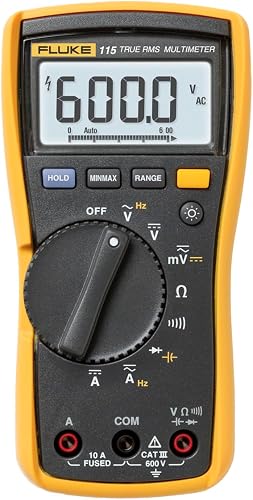
Fluke’s reputation extends well beyond electrical trades into a byword for reliable test equipment generally, and the 115 is a compact, true-RMS, auto-ranging meter with a CAT III 600V rating and a backlit display, built to survive daily use rather than sit in a drawer. What it lacks against the Klein pick above is non-contact voltage detection, which is a genuine gap at this price — the 115 sits closer to its own 117 sibling in build quality than in features, and that omission is the main reason it sits second here rather than first.
For
- Widely recognised, trusted brand across trades
- True RMS and auto-ranging with CAT III 600V
- Backlit display and compact, durable build
Against
- No non-contact voltage detection
- Roughly double the price of the top pick for a narrower feature set
Typically £165–£185
Check price on AmazonKAIWEETS HT118A

Best on a budget — hard to beat under £30
The HT118A packs a 6000-count auto-ranging true-RMS meter with CAT III 1000V/CAT IV 600V, a colour-coded continuity buzzer and non-contact voltage detection into a price that undercuts most of this guide by a wide margin. That spec sheet would have looked like a professional-tier meter a decade ago; the trade-off now is brand history rather than capability — KAIWEETS is newer to test equipment than Fluke, Klein or Amprobe, so it has less of a track record behind it, but nothing in the specification suggests it is short-changing the buyer.
For
- True RMS, auto-ranging, CAT IV 600V and NCV, all under £30
- Colour-coded LED alongside the continuity buzzer
- Large, legible backlit display
Against
- Newer brand, less established than the trade names above
- Build quality reports are less consistent than the pricier picks
Typically £22–£30
Check price on AmazonAstroAI TRMS 6000 Counts

A CAT IV budget alternative to the KAIWEETS pick
AstroAI’s TRMS 6000 Counts matches the HT118A spec-for-spec almost line by line — true RMS, auto-ranging, CAT IV 600V, non-contact voltage detection and a backlit display — and adds a small rear flashlight, which is a genuinely useful extra when a socket or junction box is in a dark corner. There is little to separate the two on capability; the choice mostly comes down to which is in stock or better priced on the day, or which brand’s user feedback reads more consistently at the time of buying.
For
- Same CAT IV, TRMS and NCV spread as the top budget pick
- Built-in rear flashlight for dark corners
- Auto-ranging with a clear backlit display
Against
- No meaningful functional advantage over the KAIWEETS pick
- Newer brand, limited long-term track record
Typically £25–£35
Check price on AmazonUNI-T UT139C
A mid-budget all-rounder with a foldout stand
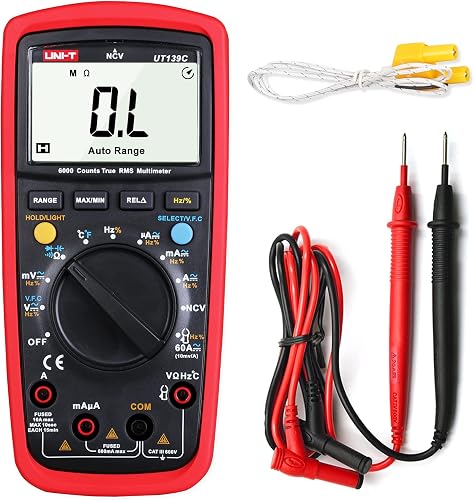
UNI-T has built a large share of the mid-range test equipment market on meters like the UT139C — true RMS, auto-ranging with a manual override, non-contact voltage detection and a backlit display, plus a temperature probe input that the cheaper picks in this guide don’t offer. It sits between the sub-£30 budget picks and the Klein Tools top pick on both price and polish, with a fold-out stand that makes it easier to read hands-free during a continuity check.
For
- True RMS, auto-range and NCV in one unit
- Adds a temperature probe input over the cheaper picks
- Fold-out stand for hands-free reading
Against
- CAT III only, not CAT IV like the budget picks above
- Costs more than the KAIWEETS or AstroAI for a similar core spec
Typically £40–£50
Check price on AmazonAmprobe AM-520-EUR

A trade brand pick with an HVAC lean
Amprobe’s background is in HVAC and industrial test equipment, and the AM-520-EUR reflects that — auto-ranging with a manual override, a CAT III 600V rating, non-contact voltage detection and an acoustic continuity test, but average-sensing rather than true RMS. That is a real limitation against a variable-speed fan controller or an LED driver, where a true-RMS meter would read more accurately, so this is best suited to straightforward mains checks rather than anything with a distorted waveform behind it.
For
- Established trade brand with HVAC pedigree
- Non-contact voltage detection and acoustic continuity
- Auto-ranging with manual override available
Against
- Not true RMS, unlike most of this guide
- Priced above several picks with a stronger overall spec
Typically £65–£80
Check price on AmazonMartindale MM39

A UK trade-familiar name without the extras
Martindale is a name that already turns up in a lot of UK electrical test kit, and the MM39 is a straightforward CAT III 600V auto-ranging meter with an audible continuity check and a rotary dial sized for use with gloves on. It has no non-contact voltage detection, no backlight and is not true RMS, which puts it behind several cheaper picks in this guide on paper — the appeal here is mainly the familiar brand name rather than anything the spec sheet does better.
For
- Established UK trade brand
- Large rotary dial, usable with gloves on
- Auto-ranging with an audible continuity check
Against
- No non-contact voltage detection or backlight
- Not true RMS, and priced above cheaper meters with more features
Typically £45–£55
Check price on AmazonDraper 41818

The cheapest tester in this guide
Draper is a recognisable name off any DIY shelf, and the 41818 is a basic backlit multimeter covering voltage, current, resistance and continuity with an audible buzzer, at the lowest price of anything here. The trade-off is manual ranging rather than auto, and no true RMS or non-contact voltage detection — fine for a straightforward dead-or-live check or a continuity test on an accessible cable, less suited to anything where speed or waveform accuracy matters.
For
- Cheapest meter in this guide
- Widely stocked, recognisable brand
- Backlit display and audible continuity buzzer
Against
- Manual ranging, not auto-ranging
- No true RMS or non-contact voltage detection
Typically £18–£25
Check price on AmazonWhat actually matters — and what doesn’t
Count number is marketing, CAT rating and auto-range are not. A “6000 counts” display resolution sounds like a spec that matters, but every meter in this guide reads clearly enough for site use. The genuine difference between a £20 meter and an £90 one is CAT rating, auto-ranging and whether it is true RMS — not how many digits the screen can show.
Non-contact voltage detection is a first check, not a diagnosis. Hovering an NCV sensor near a cable is a fast, useful screen for “is something live here,” but it can be fooled by nearby live cables or induced voltage on a dead one. Always confirm with the meter’s proper voltage function, and never treat NCV alone as proof a circuit is dead.
True RMS matters for anything that isn’t a clean sine wave. A modern LED driver, dimmer or variable-speed fan controller can make an averaging meter read a voltage that is simply wrong. For plain mains checks the difference is smaller, but true RMS is cheap enough now that there is little reason to buy without it.
A stated CAT rating is not the same as a certified one. A genuine CAT III or CAT IV marking is printed on the casing and stated plainly in the listing — if it is missing entirely, assume the meter is not rated for what it is being sold to do. On premium brands that rating is independently certified; on budget meters it is often closer to a printed claim than a tested one, which matters more for anything worked near a consumer unit than for a straightforward continuity check.
Temperature probes and capacitance testing are rarely worth paying extra for. They turn up on some mid-range meters as an added extra, and they are pleasant to have, but they are not the reason to choose one multimeter over another for the checks a survey actually calls for.
Questions I get asked
Is a multimeter safe to use to prove a circuit is dead before work starts?
Not on its own, by HSE guidance. Safe isolation calls for a dedicated two-pole voltage tester that meets GS38, proved on a known live source, used to test dead, then proved again afterwards — a process built around a tool with fixed, non-interchangeable probe sockets so it can’t accidentally be left on the wrong function. A multimeter’s shared sockets and rotary dial make it a better diagnostic tool than a safe-isolation one; use it to work out what’s wrong once a circuit is already off, not to decide that it is.
What’s the difference between a multimeter and a socket tester?
A socket tester is a fixed-format plug-in device that checks one 13A outlet’s wiring, and on the fuller models its earth loop and RCD, in a single go. A multimeter is a general-purpose instrument that reaches wherever a probe can go — an immersion heater’s terminals, a fan’s flex, a suspect junction box — and measures voltage, continuity and resistance rather than reading a fixed wiring pattern. Most survey kit bags carry both, for different moments.
Do I need true RMS for general survey work?
For a plain mains voltage or continuity check, an averaging meter and a true-RMS one usually agree closely enough that it makes little practical difference. The gap opens up around anything with a distorted waveform — a dimmer, an LED driver, a variable-speed controller — where an averaging meter can read a figure that is simply incorrect. True RMS costs little extra on most meters now, so there is not much reason to go without it.
What does CAT III mean, and is CAT IV worth paying for?
CAT ratings describe the transient voltage spikes a meter is built to withstand at different points in an electrical installation. CAT III covers fixed wiring and distribution circuits within a building, which is the baseline for anything a surveyor would be testing domestically. CAT IV extends that to the origin of the installation — the meter tails and supply side of the consumer unit — and is a genuine extra margin of protection rather than just a bigger number on the box, though CAT III 600V is adequate for the great majority of checks covered in this guide.
A multimeter earns its place for the same reason as most of the kit in this series — it turns “doesn’t seem to be working” into something specific enough to write down. On a retrofit assessment or an EPC, that is often the difference between a vague note about a heating control and a clear finding an installer can act on. If you need a survey or assessment anywhere in Sussex, Kent or Surrey, get in touch — or browse the rest of the field-kit guides, including the socket tester and voltage tester guides this one sits alongside.
Disclaimer. This guide is general information, not a substitute for a proper electrical inspection by a qualified, registered electrician. Prices are indicative, move constantly and were checked at the time of writing; the linked page always shows the current price. As an Amazon Associate I earn from qualifying purchases.