Every EPC starts with the heating. Before I’ve measured a single wall, RdSAP wants to know what burns in the house — the boiler, the fire, the stove, the back boiler nobody has serviced since 1987. So I stand in front of fixed combustion appliances all day, in everything from new-build flats to Wealden cottages with a wood burner in an inglenook. And the question I ask in each of those rooms is the same one the law now asks: where is the carbon monoxide alarm?
Since October 2022, the answer has legal weight. The Smoke and Carbon Monoxide Alarm (Amendment) Regulations 2022 require a CO alarm in any room of a rented home — private or social — that is used as living accommodation and contains a fixed combustion appliance, with gas cookers the one exclusion. Landlords must also repair or replace an alarm once a tenant reports it faulty, and the local authority can fine up to £5,000 per breach. Building regulations reach further still: fit a new fixed combustion appliance in any home, rented or not, and a CO alarm comes with it. It is one of the cheapest pieces of compliance in housing, aimed at something that genuinely kills people, quietly, every winter.
The good news is that this is an easy category to buy well in, because there is one certification that does the heavy lifting. The bad news is that Amazon will happily sell you unbranded units that don’t carry it. That filter, and what separates the certified alarms from each other, is what this guide is for.
The one I’d buy

Kidde 10LLDCO
Everything the regulations want and everything I’d want, at an unremarkable price: EN 50291-1 certified with a BSI Kitemark, a sealed 10-year lithium battery that closes the missing-battery failure mode for good, and a digital display with peak-level memory — so it tells you about the low-level CO that never reaches alarm volume but still says something about the flue.
Typically £23–£30
Check price on AmazonHow I judge a carbon monoxide alarm
EN 50291-1, or it doesn’t exist. This is the British and European standard for domestic CO alarms, and it specifies the behaviour that matters: the alarm must stay quiet at 30 parts per million for two hours (so it doesn’t cry wolf over a cold-start whiff), must sound within 60–90 minutes at 50ppm, within 10–40 minutes at 100ppm, and within three minutes at 300ppm. That curve mirrors how CO poisoning actually works — dose over time, not a single threshold. A BSI Kitemark on top means the certification has been independently audited rather than self-declared. Every alarm below carries EN 50291; much of what surrounds them in the search results does not.
A sealed 10-year lithium battery. The most common fault I see is not a failed sensor, it’s a missing battery — borrowed for the TV remote, or removed when the low-battery chirp got annoying at 3am. A sealed-for-life unit closes that failure mode completely: no compartment, nothing to remove, and when the battery dies the whole unit is due for replacement anyway. For a landlord this is the difference between compliance that survives a tenancy and compliance that lasts until the first quiet Tuesday.
An honest end of life. The electrochemical cell inside every one of these alarms is a consumable. It is slowly used up from the day it leaves the factory, which is why alarms carry a replace-by date and a 7–10 year life. The test button, usefully, does not test the cell — it tests the circuitry and the sounder. So I want a unit that declares its own end of life loudly and unambiguously, because nothing else will.
A display, or at least a peak-level memory. An alarm that only sounds at 50ppm-plus tells you nothing about the appliance that has been idling at 20–30ppm all winter — below the alarm curve, above what anyone should live with. A digital readout and a peak-level button turn the alarm from a siren into an instrument: press it, and it tells you the worst thing that happened while you were out.
Fit-and-forget practicalities. Bracket and screws in the box, a test/hush button a tenant can reach and understand, and a sounder that will carry through a door. These are solved problems on every unit below; they are not solved on the £9 specials.
The comparison
| Model | Battery | Display | Typical price | Best for | |
|---|---|---|---|---|---|
| Kidde 10LLDCO | Sealed 10-year lithium | Digital ppm + peak memory | ~£25 | Best overall — homes and rentals | View |
| Aico Ei208 | Sealed 10-year lithium | LEDs; data via AudioLINK | ~£30 | The landlord standard | View |
| FireAngel FA3322 | Sealed 10-year lithium | Digital ppm + temp/humidity | ~£38 | Low-level CO monitoring | View |
| FireAngel FA3820 | Sealed 10-year lithium | LEDs only | ~£22 | No-frills fit-and-forget | View |
| X-Sense SC07 | Sealed 10-year lithium | Digital ppm (combi smoke + CO) | ~£28 | One ceiling, two hazards | View |
| X-Sense CO03D | Replaceable, 10-year sensor | Digital ppm | ~£25 | Budget digital readout | View |
| FireAngel FA3313 | Replaceable, 10-year sensor | LEDs only | ~£17 | Best on a strict budget | View |
The picks in detail
Kidde 10LLDCO
Best overall — sealed battery, digital display, sensible money; my top pick above
Kidde make fire-safety kit at industrial scale, and the 10LLDCO is their UK domestic staple: EN 50291-1 certified, Kitemarked, sealed 10-year lithium battery, and — the bit that lifts it over the equally worthy plain alarms — a digital display with a peak-level button. The display reads current CO from low concentrations upward, and the memory recalls the highest level seen since it was last reset. That second feature is quietly excellent: a tenant who says “it went off while the boiler was running” can show an engineer the stored number rather than an anecdote.
Owner feedback is consistent on the basics — easy to fit, clear display, test button that behaves — and it costs so little more than the display-less competition that I struggle to argue for the saving. Kitting out a rental portfolio tomorrow, this is the one I’d buy by the box.
For
- EN 50291-1 and Kitemark certified, 10-year warranty
- Sealed lithium battery — nothing for a tenant to remove
- Digital display with peak-level memory
- Usually the cheapest of the display-equipped, sealed units
Against
- Plain looks, if that matters to you
- Display only helps if someone occasionally reads it
Typically £23–£30
Check price on AmazonAico Ei208

The landlord standard — what the professionals specify
Walk into social housing anywhere in the UK and the alarms on the walls are overwhelmingly Aico — the Ei Electronics brand, made in Ireland, that housing associations standardised on years ago. The Ei208 is their battery CO unit: sealed 10-year lithium cell, EN 50291-1, Kitemarked, and a party trick called AudioLINK that plays the alarm’s event log — activations, background readings, battery state — to a phone app through the sounder. For an agent or landlord who wants evidence of a working alarm rather than a hopeful tick-box, that is genuinely useful, and no consumer brand offers it at this price. The trade buys these from electrical wholesalers, but Amazon stocks them at close to trade money; the Ei208D adds a display if you want one.
For
- The specification-grade choice — what social landlords fit
- AudioLINK event log for compliance evidence
- Sealed 10-year lithium, EN 50291-1, Kitemark
Against
- No display on the base Ei208
- AudioLINK needs the app, which most owners will never open
Typically £28–£36
Check price on AmazonFireAngel FA3322

Best for low-level monitoring — the one that talks before it screams
FireAngel’s top domestic CO unit, and the most instrument-like alarm here. Beyond the standard alarm curve it runs a low-level pre-alarm: sustained CO below the statutory thresholds brings a chirp, an amber screen and the actual ppm figure, long before a standard alarm would make a sound. That is exactly the behaviour you want near an ageing open-flued appliance or a wood burner with a lazy flue — the situations where CO idles rather than spikes. It reads temperature and humidity too, which is incidental but harmless. Sealed 10-year battery, Kitemarked, and a colour-coded screen that a non-technical occupant can read at a glance.
For
- Low-level pre-alarm with real ppm figures
- Sealed 10-year battery, Kitemark certified
- Clear colour-coded display; portable enough for holidays
Against
- The dearest single-hazard unit here
- Temperature and humidity readouts are padding
Typically £33–£42
Check price on AmazonFireAngel FA3820

Best no-frills alarm — the modern successor to the ubiquitous CO-9X
If you have ever noticed a CO alarm in a UK rental, odds are it was a FireAngel CO-9 series — the alarm landlords bought by the pallet after the 2015 regulations. The FA3820 is the current version of that idea: sealed 10-year battery, EN 50291-1, Kitemark, no display, no app, nothing to configure. LEDs and a test button. It exists to be screwed to a wall and ignored for a decade, and owner feedback suggests it does exactly that. Buy it when you don’t want the readout — or buy several, because at this price protecting every appliance room of a house costs less than a boiler service.
For
- Sealed 10-year battery at a bargain price
- The lineage most UK landlords already know
- Compact, and cheaper still in multi-packs
Against
- No display, no peak memory — it only speaks at alarm level
Typically £20–£26
Check price on AmazonX-Sense SC07 (combined smoke + CO)
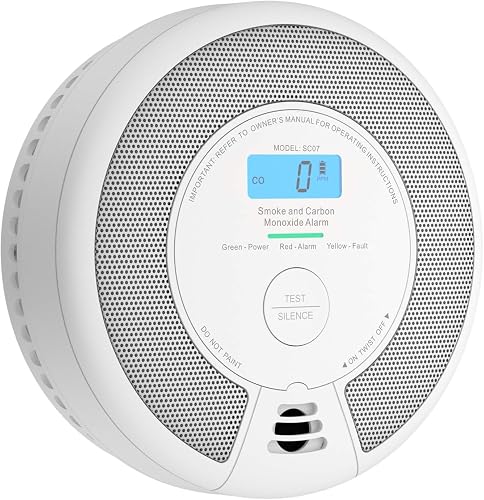
Best combined unit — one ceiling fitting, two hazards
Combination alarms used to mean the Google Nest Protect, but Google discontinued it in 2025 and remaining stock is being run out — so the sensible combi money now goes elsewhere. X-Sense’s SC07 pairs a photoelectric smoke sensor with an electrochemical CO cell in one ceiling-mounted body, with a sealed 10-year battery and an LCD showing CO in ppm; the listing cites compliance with both EN 14604 (smoke) and EN 50291 (CO). The honest use-case is the room that needs both anyway — a lounge with a log burner, an open-plan cottage, a bedsit. One caveat for landlords: a combi counts once. You still need a smoke alarm on every storey and a CO alarm in every appliance room; one clever disc cannot be in two places.
For
- Smoke and CO in one fitting, sealed 10-year battery
- LCD readout, at the price of one branded CO alarm
- A credible successor to the departed Nest Protect niche
Against
- Newer brand — a thinner UK track record than Kidde, Aico or FireAngel
- Ceiling mounting is a compromise between smoke and CO ideals
Typically £25–£35
Check price on AmazonX-Sense CO03D

Best budget digital — a ppm readout without the brand premium
The CO03D is the value route to a digital display: a 10-year-life electrochemical sensor, an LCD that shows live CO concentration, and EN 50291 cited on the listing, usually for a few pounds less than the Kidde. The compromise is the battery — replaceable rather than sealed, which for an owner-occupier who will actually change it on schedule is arguably a feature, and for a landlord is precisely the failure mode the sealed units were invented to close. Owner feedback runs positive on build and clarity for the money. It sits below the Kidde here purely on that battery compartment.
For
- Digital ppm display at a budget price
- 10-year sensor life; EN 50291 cited
- Battery swap keeps it alive cheaply for an attentive owner
Against
- Replaceable battery — the wrong choice for rentals
- Less UK heritage behind the badge
Typically £20–£30
Check price on AmazonFireAngel FA3313

Best on a strict budget — certified protection for the price of a takeaway
The cheapest alarm here from a brand with a real UK support operation. Same 10-year CO sensor family as its dearer siblings and the same certified alarm behaviour; what the lower price buys out is the sealed cell — the FA3313 runs on replaceable batteries with roughly a year per set. That makes it the classic second alarm: the holiday cottage, the caravan (strictly, EN 50291-2 units are the ones rated for that environment — check before relying on one afloat or on wheels), or the spare bedroom with a rarely-used gas fire. As the only alarm in a rental I’d spend the extra fiver on a sealed unit — but as certified CO protection per pound, nothing respectable beats it.
For
- Certified FireAngel protection at the lowest price here
- Light and portable — travels well
Against
- Annual battery changes — a maintenance habit, not fit-and-forget
- No display; LEDs only
Typically £15–£20
Check price on AmazonWhat actually matters — and what doesn’t
Placement is half the product. A perfect alarm in the wrong place is a worse buy than a cheap one in the right place. The guidance is consistent: between one and three metres horizontally from the appliance — close enough to respond, far enough to avoid nuisance from normal start-up. Wall-mounted, it goes high, above the height of any door or window and at least 150mm down from the ceiling, because warm CO-laden air rises with the convection currents; ceiling-mounted, keep it at least 300mm from any wall. Keep it out of cupboards, away from extractor fans, windows and vents that would wash fresh air past the sensor, and not directly above the appliance itself or anywhere steam reaches.
The test button is not testing what you hope. It confirms the electronics and the sounder work — worth doing monthly, and after any period the property stood empty. It does not confirm the electrochemical cell can still smell CO. The only guarantee on the cell is its lifespan, which is why the replace-by date printed on the unit matters more than any amount of enthusiastic button-pressing, and why a “still beeps fine” alarm from 2013 is a talisman, not a safety device.
What the listings push that you can skip. Unbranded ten-packs with impressive claimed certifications and no Kitemark; alarms priced on the number of features rather than the quality of the cell; and “CO detector patches” — the colour-change spot cards — which have no sounder, don’t satisfy the regulations, and rely on you staring at a dot during the event that’s meant to wake you. Smart connectivity is pleasant if you’ll use it, but it adds nothing to compliance. Spend on the cell, the certification and the sealed battery; everything else is trim.
One per appliance room, not one per house. The regulations are written per room for a reason. The boiler cupboard’s alarm doesn’t hear the lounge stove, and CO from a shared or leaky flue can surface in rooms with no appliance at all — which is why, in older terraces with chimneys running up the party wall, I’d quietly add one in the main bedroom too, whatever the minimum says.
Questions I get asked
Where should a carbon monoxide detector be placed? In each room with a fixed combustion appliance: 1–3m horizontally from the appliance, high on the wall (above door and window height, 150mm or more below the ceiling) or on the ceiling at least 300mm from walls. In rooms you sleep in, breathing height is the advice, because the point is the dose you inhale. And put one where it will be heard at night — an alarm behind two closed doors protects the boiler, not the family.
Do landlords have to provide carbon monoxide alarms? In England, yes: since 1 October 2022 every rented room used as living accommodation with a fixed combustion appliance — boiler, fire, stove, but not a gas cooker — needs a CO alarm, checked working at the start of each tenancy, and repaired or replaced promptly once a tenant reports a fault. Councils can fine up to £5,000 per breach. Scotland goes further and requires CO detection beside any fixed combustion appliance in every home, not just rentals; and building regulations require an alarm whenever a new appliance is installed, whoever owns the house.
How long do carbon monoxide detectors last? Seven to ten years, set by the electrochemical cell, which is consumed slowly from manufacture regardless of how clean the air is. Every certified alarm carries a replace-by date and will signal its own end of life; sealed-battery units retire themselves when the battery goes. The practical advice is to write the install date on the unit in marker when you fit it — future-you, or the surveyor squinting at it a decade later, will be grateful.
Do carbon monoxide detectors detect gas leaks? No, and the confusion is dangerous. A CO alarm detects carbon monoxide — the product of incomplete combustion. It will not respond to unburnt natural gas from a leaking pipe or a blown-out hob; that needs a separate flammable-gas detector, and mains gas carries its added smell precisely so your nose does that job. The reverse also holds: a gas detector won’t save you from a blocked flue. If you smell gas, ring the National Gas Emergency line on 0800 111 999.
If you’re wondering about the flues and appliances in your own place — that’s the day job. Every EPC assessment starts with the heating appliances, and a building survey looks properly at flues, ventilation and the rooms the regulations care about — get in touch. And if you’re kitting out a survey bag or a landlord’s toolkit, there are more field-kit guides.
Small print. This guide is general information, not advice on your property, and no alarm is a substitute for having combustion appliances installed and serviced by a competent registered engineer. Prices are indicative, move constantly and were checked at the time of writing; the linked page always shows the current price. As an Amazon Associate I earn from qualifying purchases.