A storage heater that’s stone cold, an immersion heater that never quite warms the tank, an extractor fan that looks switched on but isn’t moving air — the multimeter guide elsewhere in this series covers checking continuity and resistance once something is already off. A clamp meter answers a different, earlier question: is this circuit actually carrying current right now, with the appliance switched on and nothing disturbed. Clip the jaw around a single conductor — a meter tail, a length of twin and earth, an appliance flex — and read the current flowing through it, without breaking the circuit open or putting a probe anywhere near a live terminal.
That non-contact reading is the whole appeal. A multimeter measures current in-line, which on a domestic circuit means breaking into the wiring and inserting the meter itself into the loop — not something to attempt casually on a live circuit, and often simply impractical mid-survey. A clamp meter reads the same figure by sensing the magnetic field the current generates, so the conductor stays intact and the check takes seconds: is the storage heater actually drawing its rated load, is an immersion element pulling current at all.
It sits alongside the multimeter and socket tester already covered in this series rather than replacing either — a socket tester checks one 13A outlet’s wiring pattern, a multimeter reaches wherever a probe can go, and a clamp meter answers how much current is actually flowing, live, without opening anything up. First, the one I’d buy.
The one I’d buy
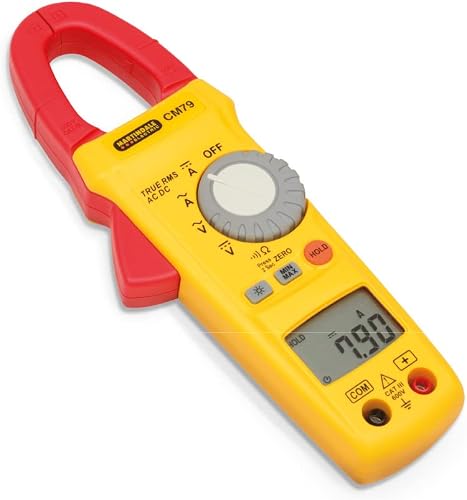
Martindale CM79
Martindale already turns up in a lot of UK electrical test kit as a trusted name, and the CM79 covers what this job needs: AC and DC current and voltage, true RMS, a CAT III 600V rating stated plainly on the casing, and an elliptical jaw sized for a meter tail or a bundle of twin and earth, not just a slim single cable. Min/Max hold catches a brief surge — a motor starting, an element cycling on — that a snapshot reading would miss. For a surveyor who wants AC and DC without premium-brand pricing, this is it.
Typically £115–£140
Check price on AmazonHow I judge a clamp meter
Jaw size that matches what’s actually being clamped. A slim single cable slips into almost any jaw, but a meter tail or a bundle of twin and earth needs real clearance — check the stated jaw opening in mm before assuming a compact meter will fit what’s on site.
True RMS for anything that isn’t a clean sine wave. The same distortion that catches out an averaging multimeter — a variable-speed fan controller, an LED driver, a modern heat pump’s inverter — catches out an averaging clamp meter too. True RMS is cheap enough now on most models that there is little reason to buy without it.
AC and DC current only if the work actually calls for it. Most domestic electrical fault-finding never sees anything but AC, but solar PV strings, EV charger circuits and battery storage systems run DC, and an AC-only clamp meter simply reads zero on them.
A CAT rating printed plainly on the casing, not implied by the price. CAT III 600V is the sensible minimum for fixed wiring and distribution circuits within a building; CAT IV extends that margin to the supply side of the consumer unit and the meter tails themselves.
Auto-ranging, plus a proper resistance and continuity function. A clamp meter that also does voltage, resistance and an audible continuity check earns its place in the bag twice over — useful as a backup multimeter when the dedicated one is elsewhere.
The comparison
| Model | CAT rating | AC/DC · TRMS | Typical price | Best for | |
|---|---|---|---|---|---|
| Martindale CM79 | CAT III 600V | AC/DC · Yes | ~£115–£140 | Best overall | View |
| Fluke 323 | CAT IV 300V / CAT III 600V | AC only · Yes | ~£130–£165 | Premium/professional pick | View |
| KAIWEETS HT208D | CAT III 1000V / CAT IV 600V | AC/DC · Yes | ~£45–£70 | Best on a budget | View |
| Amprobe AMP-220-EUR | CAT III 600V | AC/DC · Yes | ~£210–£260 | Full AC/DC step-up from the Fluke | View |
| Di-LOG DL6404 | CAT IV 1000V | AC/DC · Yes | ~£130–£150 | Highest CAT rating and current range | View |
| Kewtech KT203 | CAT III 300V / CAT II 600V | AC/DC · No | ~£85–£100 | UK trade-familiar name | View |
| UNI-T UT210E | CAT II 600V / CAT III 300V | AC/DC · Yes | ~£55–£65 | Most compact pick | View |
The picks in detail
Martindale CM79
Best overall — AC and DC true RMS without premium-brand pricing
This is the top pick above, and it earns the place with a spec sheet that covers this job without compromise: AC and DC current and voltage, true RMS, and a CAT III 600V rating printed plainly on the casing. The elliptical jaw is sized for a meter tail or a bundle of twin and earth, and Min/Max hold catches a brief surge a snapshot reading would miss. Martindale doesn’t carry the same name recognition as Fluke, but the spec sheet holds its own against meters costing considerably more.
For
- AC and DC current and voltage with true RMS in one unit
- CAT III 600V stated plainly on the casing
- Elliptical jaw sized for a meter tail or cable bundle
Against
- No non-contact voltage detection
- No temperature or capacitance measurement
Typically £115–£140
Check price on AmazonFluke 323

Premium/professional pick — the name every electrician already trusts
Fluke’s reputation extends well beyond clamp meters into a byword for reliable test equipment generally, and the 323 keeps things simple: true RMS AC current to 400A, AC/DC voltage, resistance and continuity, and a built-in non-contact voltage detector, all in a compact 30mm jaw. What it doesn’t do is DC current — that’s reserved for the step-up 325 — worth knowing before assuming the brand name buys every function.
For
- Trusted, widely recognised brand across trades
- True RMS AC current with CAT IV 300V/CAT III 600V
- Built-in non-contact voltage detection
Against
- AC current only, no DC
- Costs more than several picks here with a broader feature set
Typically £130–£165
Check price on AmazonKAIWEETS HT208D

Best on a budget — a spec sheet that undercuts meters two to three times the price
The HT208D matches or beats the CAT rating of every other meter here — CAT III 1000V/CAT IV 600V — while adding inrush current capture, a VFD mode for variable-speed drives, non-contact voltage detection and a full secondary function set: capacitance, frequency, temperature and diode test, all at a fraction of the trade names’ price. The trade-off is brand history rather than capability: KAIWEETS is newer to test equipment than Fluke or Martindale, though nothing in the spec sheet suggests it is short-changing the buyer.
For
- CAT III 1000V/CAT IV 600V and true RMS AC/DC for well under £100
- Inrush current capture and a VFD mode
- Wide function set — capacitance, frequency, temperature, NCV
Against
- Newer brand, less established than the trade names above
- Build quality reports are less consistent than the pricier picks
Typically £45–£70
Check price on AmazonAmprobe AMP-220-EUR

A step up for genuine AC and DC current, above the Fluke’s AC-only spec
Amprobe (badged BEHA-Amprobe on this model) covers what the Fluke 323 deliberately leaves out — full AC and DC current and voltage to 600A/600V, true RMS, plus capacitance, frequency and an Amp-Tip function for awkward terminals. That completeness comes at the highest price here, and the extra DC capability will go unused on most domestic surveys; it earns its place mainly where solar, battery storage or EV charging infrastructure is genuinely in scope.
For
- Full AC and DC current and voltage, true RMS
- Capacitance, frequency and low-pass filter functions
- CAT III 600V with a 35mm jaw
Against
- The most expensive meter in this guide
- DC current capability goes unused on most domestic surveys
Typically £210–£260
Check price on AmazonDi-LOG DL6404

Highest CAT rating and current range — supply-side and meter-tail work
Di-LOG’s DL6404 is rated CAT IV 1000V, the highest margin in this line-up, with AC and DC current to 1000A and true RMS AC voltage to 600V — a different tier from a consumer-unit-only meter. It adds a supplied K-type thermocouple for temperature, plus frequency and capacitance, on a 4000-count display with a bargraph. That headroom is rarely needed for a single domestic circuit; it earns its keep on larger installations, or on supply-side and meter-tail checks.
For
- CAT IV 1000V, the highest rating in this guide
- AC and DC current to 1000A with true RMS
- Includes a K-type thermocouple for temperature
Against
- More current range and CAT margin than most domestic work will use
- Product photography on some listings runs lower resolution than the other picks
Typically £130–£150
Check price on AmazonKewtech KT203

A familiar UK trade name, at the cost of true RMS
Kewtech is a brand a lot of UK domestic and EICR electricians already own other test kit from, and the KT203 is a straightforward AC/DC current and voltage clamp meter with a continuity buzzer and a DC-zero function useful for automotive or solar work. What it doesn’t have is true RMS, which matters more on a modern non-linear load than a plain resistive one. There are several near-identical KT203 listings on Amazon at different stock levels; check the exact one is live before buying.
For
- Familiar UK trade brand
- AC and DC current and voltage in one meter
- DC-zero function useful for automotive/solar checks
Against
- Not true RMS, unlike the rest of this guide
- Multiple similar listings, some out of stock — check before buying
Typically £85–£100
Check price on AmazonUNI-T UT210E

The most compact pick — clips onto a single conductor in a tight terminal space
UNI-T’s UT210E trades outright capability for size: a genuinely pocketable meter with a 17mm jaw, small enough to clip onto a single conductor inside a crowded consumer unit or tight terminal block where the larger jaws elsewhere in this guide won’t fit. It is still true RMS AC/DC current with non-contact voltage detection, just at a CAT II 600V/CAT III 300V rating lower than the rest of this guide — fine for domestic checks, not for a distribution board’s supply side.
For
- Smallest jaw here, 17mm — fits where bigger meters can’t
- True RMS AC/DC current with non-contact voltage detection
- Genuinely pocket-sized for a kit bag
Against
- Lower CAT rating than the rest of this guide
- Lower maximum current (100A) than every other pick
Typically £55–£65
Check price on AmazonWhat actually matters — and what doesn’t
A four-figure current range is rarely the deciding factor. Domestic MCBs run 6–32A and even a single-phase meter tail rarely exceeds 100A, so a meter rated to 1000A buys headroom for a distribution board or three-phase installation, not for the circuit checks most surveys involve — not worth paying extra for on a purely domestic job.
True RMS is the genuine dividing line, not the display resolution. As with a multimeter, a modern LED driver, dimmer or inverter-driven heat pump can make an averaging clamp meter read a current figure that is simply wrong. True RMS is inexpensive enough now that there is little reason to buy a meter without it, budget or premium.
AC-only is fine for most domestic work; DC only matters if the job calls for it. A plain consumer-unit or appliance current check never touches DC, but solar PV strings, battery storage and EV charger circuits do — check which side of that line a job sits on before assuming an AC-only meter, like the Fluke 323 above, covers everything.
A stated CAT rating is not the same as a certified one. A genuine CAT III or CAT IV marking is printed on the casing and stated plainly in the listing; on budget meters it is sometimes closer to a printed claim than an independently tested one, which matters more for anything worked near a consumer unit’s supply side than for a downstream appliance check.
Jaw size is a physical constraint, not a spec-sheet afterthought. A meter with a tight 17–20mm jaw is genuinely more portable, but it will not close around a bundle of twin and earth or a thick meter tail — check the jaw opening against what’s actually going to be clamped before choosing size over capability.
Questions I get asked
What can a clamp meter do that a multimeter can’t?
A clamp meter reads current without breaking the circuit open — clip the jaw around a conductor and it senses the current from the magnetic field around it. A multimeter measures current in-line, which means physically inserting the meter into the circuit, impractical on a live domestic circuit mid-survey. For voltage, continuity and resistance the two overlap, but for a live current reading a clamp meter is the only sensible tool of the two.
Is a clamp meter safe to use to prove a circuit is dead before work starts?
No. As with a multimeter, HSE guidance on safe isolation calls for a dedicated two-pole voltage tester that meets GS38, proved on a known live source, used to test dead, then proved again afterwards. A clamp meter is a diagnostic tool for reading current on a circuit that is already known to be live or already switched off — not a safe-isolation device.
Do I need a clamp meter that measures DC current, or is AC enough?
For the great majority of domestic electrical fault-finding — heaters, fans, immersion elements, general circuit checks — AC current is all that is ever measured, and an AC-only meter like the Fluke 323 covers it completely. DC only becomes relevant once solar PV, battery storage or EV charging is genuinely part of the job, at which point the Martindale or Amprobe picks above take over.
What CAT rating do I actually need for survey work?
CAT III 600V is the sensible baseline for fixed wiring and distribution circuits within a domestic building, covering most of what a surveyor would clamp onto. CAT IV extends that margin to the origin of the installation — the meter tails and supply side of the consumer unit — a genuine extra safety margin rather than a bigger number on the box, though CAT III 600V is adequate for most checks in this guide.
A clamp meter earns its place for the same reason as the rest of the kit in this series — it turns “doesn’t seem to be drawing power” into a number worth writing down. On a retrofit assessment or an EPC, that is often the difference between a vague note and a clear finding an installer can act on. If you need a survey or assessment anywhere in Sussex, Kent or Surrey, get in touch — or browse the rest of the field-kit guides, including the multimeter and socket tester guides this one sits alongside.
Disclaimer. This guide is general information, not a substitute for a proper electrical inspection by a qualified, registered electrician. Prices are indicative, move constantly and were checked at the time of writing; the linked page always shows the current price. As an Amazon Associate I earn from qualifying purchases.