Half the calls I get about a house feeling too expensive to heat aren’t about the boiler — they’re about one specific room. A converted garage that never quite joined the heating system, a box room used as a home office three days a week, a bay-windowed lounge that a Victorian terrace’s single loop of radiators was never really sized for. The honest answer in a lot of those cases isn’t a bigger boiler or a system upgrade — it’s a portable heater doing a job the whole-house system was never asked to do.
What it isn’t is a like-for-like swap with gas central heating on cost. Electricity in the UK runs at roughly three to four times the price per kWh of mains gas, so an electric heater only comes out ahead financially when it lets you turn the rest of the system down or off — heating the one occupied room instead of the whole house through a cold evening, not running on top of a heating system that’s already on.
There’s also a persistent myth worth clearing up before the list: every plug-in electric heater here converts electricity to heat at close to 100% efficiency, whatever the box says about the technology inside. A 2kW oil-filled radiator, a 2kW convector and a 2kW infrared panel all cost exactly the same to run for an hour. What actually differs is how fast the room feels warm, whether the heat lingers after it switches off, and whether it’s warming the air or the people in it — which is what the picks below are ranked on, not invented efficiency claims. And if a room needs one running for hours every evening all winter just to be usable, that’s usually telling you something about the room itself, worth a look before treating the heater as the permanent fix — exactly what an EPC assessment turns up, and a decent draught-proofing pass is often cheaper than a winter of running one every evening.
The one I’d buy

De’Longhi Dragon 4 TRD40820T Oil-Filled Radiator
This is the default answer for most single rooms, and there’s no exciting reason why: a straightforward 2kW oil column with three heat settings, a thermostat and a mechanical 24-hour timer, and it keeps radiating warmth for a while after it switches off rather than going cold the second it cuts out. Enclosed element, low surface fire risk compared with a bar or fan heater, and castors so it isn’t a fixture.
Typically £120–£140
Check price on AmazonHow I judge an electric room heater
What it actually costs to run. Every heater here is a resistive electric heater, so the running cost is wattage times hours times the unit price of electricity — full stop. A 2kW heater on for three hours costs the same whether it’s an oil radiator, a convector or an infrared panel, regardless of what the marketing implies about “efficiency.” A plug-in energy monitor will confirm exactly what a specific heater is costing, for a few pounds.
Response time versus retained heat. A ceramic or convector heater warms the air fast and goes cold the moment it’s switched off; an oil-filled radiator takes longer to get going but keeps radiating for twenty minutes or more after it cuts out, which suits a room used for a whole evening rather than a quick top-up.
Whether it heats the air or heats you. Infrared panels warm surfaces and people directly rather than the air in the room, which matters in a draughty space, a conservatory, or anywhere air changes fast enough that a convector is just heating air that leaves through a gap in the frame.
A real thermostat, not just heat settings. “Low, medium, high” is a fixed output; a thermostat cycles the heater to hold a set temperature, which is what actually stops it running flat out all evening once the room’s warm enough.
Safety features for something left running. Tip-over cut-off and overheat protection matter more than most of the spec sheet if this is going in a room with pets, kids, or is likely to get left on while nobody’s watching it.
The comparison
| Model | Type | Wattage | Typical price | Best for | |
|---|---|---|---|---|---|
| De’Longhi Dragon 4 TRD40820T | Oil-filled radiator | 2000W | ~£120–£140 | Reliable background heat for hours | View |
| Dimplex HeatLite Smart Convector | Convector, fan-assisted | 2000W | ~£85–£100 | Fast warm-up with app scheduling | View |
| Herschel Select XLS400W | Infrared panel | 400W | ~£245–£270 | Wall-mounted spot heat, no moving air | View |
| Duronic HV220 Micathermic | Micathermic panel | 1000/2000W | ~£50–£80 | Faster heat-up than oil, lighter to move | View |
| VonHaus Oil Filled Radiator | Oil-filled radiator | 1500W | ~£40–£55 | Budget background heat | View |
| Pro Breeze Mini Ceramic | Ceramic fan heater | 2000W | ~£28–£38 | Cheapest fast top-up heat | View |
| Sunheat 180W Far Infrared | Infrared panel | 180W | ~£75–£90 | Low-level trickle heat, small room | View |
The picks in detail
De’Longhi Dragon 4 TRD40820T Oil-Filled Radiator
Best overall — the safe, boring default for a room used for hours, and my top pick above
The Dragon 4 range has been the default oil-filled radiator on Amazon for years, and the reason isn’t excitement — it’s that the format works. Three heat settings across a 2kW element, a thermostat, and a 24-hour mechanical timer so it can be set to come on before anyone’s home rather than run all day on a plug timer. The oil column keeps radiating heat for a while after the element switches off, which smooths out the room’s temperature rather than the on/off swings a fan heater produces.
It’s slower to get a cold room properly warm than a convector or fan heater — expect twenty to thirty minutes before it’s doing its job properly — and it’s a genuinely heavy, occupies-a-corner object rather than something tucked under a desk. For a room that’s occupied for hours at a stretch, that trade is worth it.
For
- Even, lingering heat after switch-off
- Thermostat and 24-hour timer, not just heat settings
- Enclosed element — lower burn risk than a bar heater
- Castors and a carry handle
Against
- Slow to warm a cold room from scratch
- Bulky — needs a permanent-ish spot, not a desk-side heater
Typically £120–£140
Check price on AmazonDimplex HeatLite Smart Convector Heater
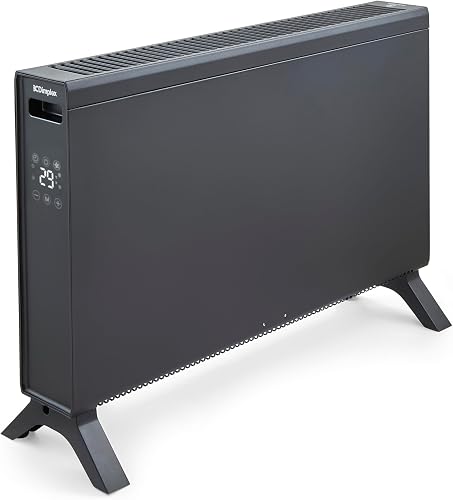
Best for fast warm-up with scheduling — a convector that can be set and forgotten
Where the Dragon 4 is slow and steady, the HeatLite is the opposite: a fan-assisted convector that pushes warm air out fast, with a proper thermostat (10–35°C) rather than fixed settings, a 24-hour timer, and WiFi app control so it can be scheduled or switched on from a phone before getting home. The dimmable LED display and child lock are aimed squarely at a room used on a routine — a home office, a spare room warmed before a guest arrives — rather than left running indefinitely.
The trade-off is the usual one for convectors: it stops producing heat the moment it’s switched off, and the scheduling that’s most of the point of buying this over a cheaper convector needs a WiFi connection to work.
For
- Genuine thermostat with app control and scheduling
- Fast warm-up, useful for a room used on a routine
- Tilt shut-off and overheat protection
Against
- No retained heat once switched off
- Smart features depend on a WiFi connection
Typically £85–£100
Check price on AmazonHerschel Select XLS400W Infrared Heating Panel

Best infrared — wall-mounted, warms people and surfaces rather than air
Herschel’s Select XLS is a frameless white glass panel meant to be wall or ceiling mounted rather than stood on the floor, which suits a home office or living space where a visible heater is unwelcome. At 400W it isn’t trying to be a whole-room heater the way a 2kW convector is — it’s aimed at direct, targeted warmth for whoever’s sitting in front of it, which is genuinely useful in a high-ceilinged or draughty room where warming the air is a losing battle. SMART-R receiver tech means it can be paired with Herschel’s own wireless thermostat controllers for proper temperature control, though those are sold separately rather than bundled.
One thing worth knowing before ordering: Amazon’s listing photo for this exact SKU is actually of the 600W panel in the same frameless design — same glass finish, same look, different output. Worth double-checking the wattage on the listing itself rather than assuming the pictured panel matches the price being paid.
For
- Warms people and surfaces directly, not wasted on air changes
- Frameless glass finish, unobtrusive on a wall
- 5-year warranty
Against
- No thermostat included — Herschel’s wireless controllers are an extra purchase
- At 400W, not a substitute for a full room heater in a large space
Typically £245–£270
Check price on AmazonDuronic HV220 Micathermic Panel Heater

Best fast-heating alternative to oil — warm in about a minute, without the weight
Micathermic heaters are the middle ground between an oil radiator and a convector: a flat panel with a mica-insulated element that heats up in around a minute rather than the twenty-plus of an oil column, while still radiating some heat rather than just blowing warm air. The HV220 runs at 1kW or 2kW with a built-in thermostat, and at a fraction of the weight of an oil-filled radiator it’s genuinely easy to move between rooms rather than something that lives permanently in a corner.
It doesn’t hold heat after switch-off the way an oil radiator does, so it suits short, defined bursts — a workshop, a conservatory, before a guest arrives — better than background heat left running all evening.
For
- Heats up in about a minute
- Much lighter than an oil-filled radiator, easy to relocate
- Built-in thermostat, 1kW/2kW settings
Against
- Doesn’t retain heat after switching off
- Less established brand recognition than De’Longhi or Dimplex
Typically £50–£80
Check price on AmazonVonHaus Oil Filled Radiator (7 Fin)

Best budget oil-filled — the same basic format for less, without the timer
This is the Dragon 4’s cheaper sibling in spirit rather than name: a 1500W oil column with three power settings and an adjustable thermostat, on castors, at roughly a third of the price. It does the same fundamental job — steady, lingering background heat for a small to medium room — without the 24-hour timer, which matters if the plan is to have it switch on automatically before anyone’s home.
At 1500W rather than 2000W it’ll take a little longer to bring a larger room up to temperature, and a cheap plug timer covers the missing built-in one if that feature matters.
For
- Same steady radiator format as the pricier options, for less
- Adjustable thermostat plus overheat and tip-over protection
- Castors for moving between rooms
Against
- No built-in timer
- Lower wattage means a slower warm-up in a larger room
Typically £40–£55
Check price on AmazonPro Breeze 2000W Mini Ceramic Fan Heater

Best cheap, fast top-up — small, quick, and the least expensive thing on this list
For genuinely quick heat in a small room — a box room, an ensuite, a home office for an hour — the Pro Breeze does the job a fan heater is meant to do: switch on, warm within a few minutes, switch off when the room’s done. 2000W on the top setting with a 1300W and 900W step-down plus fan-only mode, and an adjustable thermostat so it doesn’t have to be babysat.
It’s audible, and it offers nothing once switched off — no retained heat, no timer, no app. For occasional bursts of heat in a small space it’s hard to beat on price.
For
- Cheapest heater on this list
- Fast warm-up for a small room
- Adjustable thermostat, overheat and anti-tip protection
Against
- Audible fan noise
- No retained heat and no timer
Typically £28–£38
Check price on AmazonSunheat Portable 180W Far Infrared Panel Heater

Best low-level trickle heat — a supplementary panel, not a room’s only heater
At 180W this is a different proposition to everything else on the list — it isn’t trying to heat a room from cold, it’s a slim, splash-proof (IP54) panel meant to run as a constant low background trickle of infrared warmth in a small space like a bathroom or box room, or as supplementary spot heat near a desk. It can stand on its own feet or be wall-mounted, and at 22mm thick it’s unobtrusive either way.
There’s no built-in thermostat, so it runs on a plug timer or is switched manually — and at 180W, anyone expecting it to replace a proper room heater will be disappointed. It’s a top-up tool, not a from-scratch one.
For
- Splash-proof, safe for a bathroom
- Slim, unobtrusive wall or floor mounting
- Low running cost thanks to low wattage
Against
- No built-in thermostat
- Too low-powered to be a room’s sole heat source
Typically £75–£90
Check price on AmazonWhat actually matters — and what doesn’t
“Efficient” infrared marketing is mostly noise. Every heater here converts electricity to heat at close to 100% efficiency at the point of use — that’s just how resistive electric heating works. Claims that infrared is inherently more “efficient” than a convector are really claims about how it’s used — heating people rather than a whole volume of air — not about the physics of the element.
Wattage sets the running cost, not the technology. A 2kW heater costs the same to run for an hour whether it’s an oil radiator, a convector or an infrared panel. A listing promising lower bills at the same wattage is making a marketing claim, not an electrical one.
A thermostat saves more than an extra heat setting ever will. A heater that cycles to hold a set temperature uses meaningfully less electricity over an evening than one left running on “high” with no way to tell it the room’s warm enough.
Double-check wattage against the listing title, not just the product name. A few infrared panels I looked at while researching this guide had listing titles and spec bullets that didn’t match — one seller’s higher-wattage listing reused the identical photo and copy of a lower-wattage model. Check the spec sheet or plug rating, not just the headline number.
If a room needs one running every evening all winter, that’s not really a heater problem. A portable heater bridging an occasional cold room, a converted outbuilding, or a home office on set hours is sensible. One running for hours every evening because a room is permanently cold points at the fabric of the house — draughts, missing loft insulation, single glazing — worth an honest look before accepting it as the new normal. That’s what an EPC assessment or a retrofit assessment is for.
Questions I get asked
Is it cheaper to heat one room electrically than run the whole central heating system? Only if it lets you turn the rest of the system down or off. Electricity costs roughly three to four times as much per kWh as mains gas, so an electric heater running on top of gas central heating that’s already on is adding cost, not saving it. It only wins financially when it replaces heating a house-full of rooms with heating the one that’s occupied.
Are infrared heaters actually cheaper to run than an oil-filled radiator? Watt for watt, no — a 400W infrared panel costs less to run than a 2000W oil radiator because it’s using a fifth of the power, not because infrared is inherently more efficient. Compare heaters of the same wattage and the running cost is identical; what differs is what the heat actually does once it’s produced.
Can I leave an oil-filled radiator on overnight? Check the manufacturer’s guidance for the specific model, since this varies. Look for tip-over cut-off and overheat protection as a minimum, and treat it like any other unattended appliance — nothing flammable nearby, and not relied on for months without checking it’s still behaving as it should.
Will a room heater help with condensation in a cold room? Indirectly, and only a little. Electric heaters don’t add moisture the way an unflued gas or paraffin heater does, so they’re not making it worse. But warming a room without addressing ventilation just moves where condensation happens rather than solving it — that’s a job for proper ventilation, not a heater. Worth a look at PIV units or a dehumidifier if condensation is the actual complaint.
None of these fix a house that’s expensive to heat — they manage one room, honestly and cheaply, while something bigger gets sorted, or if it never needs sorting at all. If the real question is why a room, or the whole house, needs this much help to stay warm, an EPC assessment is the place to start, or a full retrofit assessment if the aim is to bring the running costs down properly. Get in touch for a second opinion, and there are more field-kit guides if you’re working through the rest of the list.
Small print. This guide is general information, not an assessment of your own property or heating system; check manufacturer instructions before leaving any heater running unattended, and don’t rely on an extension lead or multi-socket adaptor for a heater rated above a few hundred watts. Prices are indicative, move constantly and are checked at the time of writing; the linked page always shows the current price. As an Amazon Associate I earn from qualifying purchases.