Let me say the important thing first, because it is the sentence I repeat on more damp inspections than any other: a dehumidifier manages moisture in the air. It does not fix moisture coming through the fabric. If water is rising from the ground, driving through pointing, or leaking from a gutter or a pipe, a dehumidifier will hum away in the corner drinking electricity while the wall stays wet. Find the source first. That is a diagnosis job — a moisture profile up the wall, a look at ground levels, gutters, ventilation — not a shopping job.
Where a dehumidifier genuinely earns its keep is condensation — and condensation is most of British damp. Cold bedrooms with black mould in the window reveals, streaming glass on a January morning, laundry drying on radiators. Modern life puts ten to fifteen litres of water vapour into an average home every day, and if the building can’t ventilate it away, it condenses on the coldest surfaces it can find. A properly sized dehumidifier, run properly, breaks that cycle — and dries washing cheaper than a tumble dryer while it’s at it.
The market, though, is a mess of inflated extraction claims and marketing litres. So this guide explains the compressor-versus-desiccant choice, translates the ratings on the box into what a unit will actually pull out of a cold English bedroom, and picks eight machines — from a whole-house workhorse to an honest budget box.
The one I’d buy

Meaco Arete One 20L
The default answer for most three-to-four-bed UK homes. Meaco is a British firm that only does air treatment, the Arete range was designed around quietness and low running costs rather than headline litres, and owner feedback is consistent on the things that matter: it holds a set humidity accurately, it’s quiet enough to live with, and the five-year warranty is honoured. A big tank, a laundry mode and a proper continuous-drain point finish the job.
Typically £220–£280
Check price on AmazonHow I judge a dehumidifier
The right technology for the room temperature. Compressor units chill a coil and condense water onto it — efficient in warm, humid air, increasingly useless as the room cools, because the coil can’t get much colder than the air around it. Desiccant units soak moisture into a zeolite wheel and drive it off with a heater — extraction barely drops with temperature, and they blow air out a few degrees warmer. So the rule I give clients: heated living space, compressor; unheated or barely heated space — the cold bedroom, the conservatory, the garage, the boat — desiccant. Most of the condensation I’m called to look at is in the second category.
Honest extraction expectations. The litres on the box are measured at 30°C and 80% relative humidity — Singapore, not Sussex. In a UK home at 15–20°C a compressor unit will do perhaps a quarter to a half of its rated figure, and that is normal, not a fault. Desiccants are usually rated at 20°C/60%, so their smaller number is closer to the truth. This is why an “8 litre” desiccant can out-extract a “20 litre” compressor in a cold room, and why comparing boxes by litres alone is a mug’s game.
Running cost per litre, not per hour. At around 27p/kWh, a 200–300W compressor costs 5–8p an hour; a desiccant pulling 600W or more costs 16p-plus. But the desiccant’s heat isn’t wasted in a room you were heating anyway, and a compressor achieving little in a cold room costs more per litre removed than a desiccant working properly. What you want either way is an accurate humidistat, so the machine idles once the air hits target instead of grinding on regardless.
Sizing by the house, not the marketing. As a rule of thumb: a 10–12L compressor or any 7–8L desiccant suits a flat or small house with a condensation problem in one or two rooms; 20L covers a typical three-to-four-bed; 25L for larger, wetter or busier houses, or serious laundry drying. Oversizing slightly is the better error — a bigger unit on a humidistat cycles gently and quietly, while an undersized one runs flat out forever and never gets there.
Tank, drain and manners. A small tank means twice-daily emptying in the wet months — tedious enough that people stop, and the mould comes back. Look for a decent tank and a continuous-drain spigot so it can run unattended into a sink or gully. Then the livability items: noise (under about 40dB for anywhere near a bedroom), a laundry mode, an auto-restart after a power cut if it’s minding an empty property.
The comparison
Claimed extraction is the manufacturer’s lab figure — 30°C/80%RH for compressor units, typically 20°C/60% for desiccants. Expect a fraction of it in a normal UK house, and remember the desiccant figures survive the cold far better.
| Model | Type | Claimed extraction | Tank | Typical price | Best for | |
|---|---|---|---|---|---|---|
| Meaco Arete One 20L | Compressor | 20L/day | ~4.8L | ~£250 | Most three-to-four-bed homes | View |
| Meaco DD8L Junior | Desiccant | 8L/day | ~2L | ~£140 | Cold rooms and unheated spaces | View |
| Meaco Arete Two 25L | Compressor | 25L/day | ~5L | ~£340 | Large homes; the premium pick | View |
| EcoAir DD1 Simple MK3 | Desiccant | 7.5L/day | ~2L | ~£145 | Quiet running near bedrooms | View |
| De’Longhi Tasciugo AriaDry Multi 14L | Compressor | 14L/day | ~2L | ~£200 | Flats and smaller houses | View |
| Pro Breeze 20L | Compressor | 20L/day | ~5.5L | ~£160 | Whole-house capacity on a budget | View |
| Silentnight Airmax 1200 | Compressor | 12L/day | ~2.5L | ~£105 | Small homes, laundry, first dehumidifier | View |
| Russell Hobbs RHDH1001 | Compressor | 10L/day | ~2L | ~£80 | Best on a budget — one damp room | View |
The picks in detail
Meaco Arete One 20L
Best overall — the whole-house default, and my top pick above
Meaco built its name selling dehumidifiers to museums and archives before the domestic market noticed, and the Arete One is the range that made them the name UK owners recommend to each other. The spec reads like someone listed the usual complaints and fixed them: a large tank instead of the usual thimble, low noise figures, an accurate humidistat that shuts the machine off rather than letting it grind on, a laundry mode, a HEPA filter and a five-year warranty. Owner feedback is unusually consistent for this category — what people praise after two winters is the quietness and the electricity bill not moving much.
It’s a compressor, so it belongs in the heated body of the house — landing, hallway, kitchen-diner — not a freezing box room. Placed centrally with doors open, it will hold a typical three-to-four-bed at 55% humidity through a wet winter.
For
- Accurate humidistat — runs only when needed
- Quiet enough for living space; big tank plus hose drain
- Five-year warranty and a UK firm that answers the phone
Against
- Compressor extraction falls away in unheated rooms
- Costs more than the no-name 20L boxes it outlasts
Typically £220–£280
Check price on AmazonMeaco DD8L Junior

Best desiccant — for the cold rooms where the mould actually is
This is the machine for the classic British condensation case: the unheated bedroom, the north-facing single-skin extension, the conservatory, the caravan over winter. Its 8L/day rating is a desiccant rating — taken in conditions close to a real UK room — and unlike a compressor it keeps extracting at 10°C, at 5°C, at 1°C. It weighs about six kilos, so it goes up the stairs without ceremony, and the air leaving it is a few degrees warmer than the air entering, which takes the edge off exactly the sort of room it’s parked in. The trade-off is the heater: expect 300–650W while running, so use the humidistat and let it cycle rather than leaving it on continuous.
For
- Full extraction in cold spaces where compressors give up
- Light, simple, with a gentle warming effect
- Meaco support and owner feedback both strong
Against
- Higher wattage per hour than any compressor here
- Small tank — plan on daily emptying or a hose
Typically £120–£160
Check price on AmazonMeaco Arete Two 25L

The premium pick — big houses, laundry every day, app control
The Arete Two is the current flagship: 25L/day rated capacity, an H13 HEPA filter that makes the air-purifier claim more than a sticker, and Wi-Fi app control. The app matters more than it sounds — for a landlord or anyone drying out a property they don’t live in, seeing humidity remotely and confirming the machine is actually running is worth real money. For a large, busy household the extra capacity means it loafs where a smaller unit would labour. If the house is average-sized and nobody needs the app, save the difference and buy the One.
For
- Headroom for big, wet, busy houses
- Remote monitoring — genuinely useful for empty properties
- Meaco’s quietness and warranty carried over
Against
- Flagship price for capacity many homes won’t use
- Still a compressor — not the answer for cold outbuildings
Typically £300–£380
Check price on AmazonEcoAir DD1 Simple MK3
Best for bedrooms — the quiet desiccant with one knob
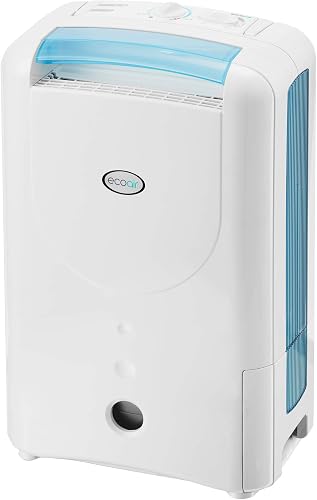
EcoAir’s long-running DD1 is the other desiccant worth shortlisting, and its case rests on two numbers: 34dBA on low — about as quiet as this category gets, quiet enough to sleep near — and 7.5L/day of cold-weather-proof extraction. The “Simple” name is literal: a rotary dial instead of a control panel, which owner feedback treats as a feature, particularly for older relatives’ homes where nobody will ever programme a timer. Same desiccant caveats as the Meaco: heater wattage on the meter, small tank, so let the humidistat cycle it. Between the two, the Meaco has the stronger support reputation; the EcoAir is the quieter, simpler machine.
For
- 34dBA low mode — sleepable
- Desiccant extraction that ignores the cold
- Controls anyone can operate
Against
- No precise humidity set-point, just a dial
- Running wattage typical of desiccants
Typically £130–£160
Check price on AmazonDe’Longhi Tasciugo AriaDry Multi 14L

The established name — a polished mid-size compressor for flats
De’Longhi has been making the Tasciugo since before dehumidifiers were an Amazon category, and it shows in the details: a proper carry handle, a tank that slots home positively, a three-stage filter, and build feedback that skews towards “still going years later”. At 14L/day rated it suits a flat, a two-bed terrace or one floor of a larger house, with a laundry function for the overnight airer. You pay a brand premium over the value 20L boxes below for less rated capacity; what you’re buying is fit, finish and longevity rather than litres.
For
- Reputation for lasting; established brand and spares
- Well-mannered design — handle, tank, filter all sensible
- Right size for flats and smaller homes
Against
- Dearer per rated litre than the value brands
- Smallish tank for continuous winter duty — use the hose
Typically £170–£230
Check price on AmazonPro Breeze 20L

Best value at full size — 20L capacity for budget money
If the Arete One’s price is the sticking point, this is the value route to the same rated capacity. Pro Breeze is a UK-based value brand rather than a manufacturer with Meaco’s pedigree, but this 20L unit has picked up mainstream consumer-test endorsements and the owner feedback is solid: it moves serious water, the 5.5L tank is one of the biggest here, and it has the humidistat, timer, laundry mode and hose outlet you actually need. The compromises are the expected ones — a bit noisier and less refined than the Meaco, a shorter warranty, and less certainty the brand’s support will match a specialist’s five years from now.
For
- Full-size extraction and a genuinely big tank
- All the useful features, none of the fluff
- Regularly £100 less than the specialist brands
Against
- Louder and less refined than the Arete
- Value-brand warranty and support
Typically £140–£180
Check price on AmazonSilentnight Airmax 1200

The sensible first dehumidifier — small homes and laundry duty
A 12L/day compressor from a household name, pitched — as you’d expect from a bedding brand — at quiet running near bedrooms. Owner feedback rates it as straightforward and effective for the typical first-dehumidifier brief: a two-bed house or flat, condensation on the windows, washing drying indoors four months a year. It has the humidistat, timer and laundry mode, a usable 2.5L tank and a hose option. The caveat is the one this whole guide keeps making: its 12L rating is a warm-lab figure, and in a cool room it will collect steadily rather than dramatically. For its price and purpose, that’s fine.
For
- Quiet, simple and cheap to run for its class
- Right size for flats and two-bed houses
- Recognised brand at a value price
Against
- Modest real-world extraction in cold rooms
- Not the tool for a large or very wet house
Typically £90–£120
Check price on AmazonRussell Hobbs RHDH1001

Best on a budget — one damp room, minimum outlay
The cheapest machine on this page that I’d still call a dehumidifier — a real compressor with a 10L/day rating, not one of the £40 Peltier-effect boxes that dribble out a teacup a day and belong nowhere near a damp problem. For a single problem room in a heated house, owner feedback says it does the job: humidity comes down, windows stop streaming, laundry dries. The compromises are what the price implies: a small tank, basic controls, more noise per litre than the Meaco, and a brand that licenses its name rather than specialising in air. As a first response to a mouldy window reveal, it’s honest value.
For
- Real compressor extraction at a budget price
- Compact and light enough to move room to room
- Vastly better than Peltier “mini dehumidifiers”
Against
- Small tank needs frequent emptying in winter
- Basic humidistat; noisier than the specialists
Typically £70–£90
Check price on AmazonWhat actually matters — and what doesn’t
Fix the source, or the machine becomes a subscription. If a dehumidifier needs to run all winter, every winter, with the tank always full, that is not the machine working well — that is a building telling you something. Persistent condensation is nearly always a ventilation and heat problem: extract fans that don’t work or don’t exist, trickle vents painted shut, cold single-skin walls, washing dried on radiators. And if the moisture is coming through the wall rather than out of the air, no box on the carpet will ever win. The machine is the bridge while you sort the building, not instead of sorting it.
Run it where the moisture is made. Kitchens, bathrooms and drying laundry generate most of a home’s vapour. A dehumidifier next to the airer with the door shut does more good in three hours than the same machine sulking in the hall all day. For whole-house duty, a landing placement with bedroom doors open works surprisingly well — moist air migrates.
Target 50–60% relative humidity, not dryness. Below about 60% RH, mould stops germinating and dust mites struggle; below 40% you’re wasting electricity and cracking furniture. A machine with a proper set-point humidistat pays for itself here — set 55% and let it decide when to run. This is also the answer to running costs: a well-sized unit on a humidistat in a reasonable house runs a few hours a day, not twenty-four.
What the listings push that you can skip. Ionizers and “plasma” modes — marketing garnish. UV lights. Twenty-litre claims on £60 machines — check whether it’s even a compressor. “Smart” control on a budget unit that can’t hold a humidity set-point in the first place. And the Peltier-effect “mini dehumidifiers” sold for wardrobes: physics limits them to a few hundred millilitres a day in ideal conditions — a novelty, not a damp remedy. Spend on the humidistat, the tank, the noise figure and the warranty.
Questions I get asked
Will a dehumidifier get rid of damp? It depends which damp. Condensation and its mould — yes, a dehumidifier is a legitimate part of the fix, alongside ventilation and heating. Rising damp, penetrating damp, leaks — no. It may dry the surface while the wall stays wet behind, which mostly disguises the problem and delays the proper repair. If you don’t know which kind you have, that diagnosis is worth getting right before spending on machines or building work (my damp meter guide covers what the readings do and don’t mean).
Desiccant or compressor — which should I buy? Answer one question: how warm is the room where it will live? Regularly above about 15°C — compressor; it removes more water per unit of electricity in warm air. Cooler than that — unheated bedrooms, conservatories, garages, boats, static caravans — desiccant, because compressor extraction collapses in the cold and a desiccant’s doesn’t.
How much does a dehumidifier cost to run? At around 27p/kWh: a 20L compressor drawing roughly 200–300W costs about 5–8p an hour; a desiccant at 300–650W about 8–17p. But hours matter more than watts — a decent humidistat means the machine idles most of the day once the house reaches target. Budget a few pounds a week in the depths of winter — and compare that with a tumble dryer at 60p-plus per load, which a laundry-mode dehumidifier largely replaces.
What size dehumidifier do I need for my house? Ignore the room-size claims on the listings; they come from the same warm lab as the litres. By UK experience: one or two damp rooms in a flat or small house — a 10–12L compressor or any 7–8L desiccant; a typical three-to-four-bed with general condensation — 20L; large, busy or particularly wet houses — 25L. If in doubt, size up: an oversized machine on a humidistat cycles quietly and cheaply, while an undersized one runs constantly and never quite gets there.
If the condensation keeps returning no matter what the machine does, the building is trying to tell you something — usually about ventilation, insulation or both. The practice does ventilation assessments to Part F, and PAS 2035 retrofit assessments where moisture risk is worked out before any fabric measures go in — get in touch. And if you’re building out the toolkit, there are more field-kit guides.
Small print. This guide is general information, not a survey of your property; whether a dehumidifier is the right answer depends on the cause of the moisture, which is a diagnosis job. Prices are indicative, move constantly and were checked at the time of writing; the linked page always shows the current price. As an Amazon Associate I earn from qualifying purchases.