A caliper doesn’t come out of the bag on every job. When it does, it’s usually because a tape measure’s nearest-millimetre reading isn’t good enough to answer the actual question — is this stud timber 44mm or the older 47mm, is that cavity wall tie’s protrusion within tolerance, how thick is the spacer bar in a sealed glazing unit, and exactly how wide is a crack that a client’s asking whether to worry about. None of that needs machinist-grade tooling; it needs a caliper that gives a confident reading to a tenth of a millimetre or better and survives living in a tool bag rather than a drawer.
Where this overlaps with existing kit is worth being clear about. A crack monitor tracks movement over weeks or months with a fixed tell-tale or glass gauge left in place; a caliper gives a single precise reading on the day, useful for that same crack before a monitor goes up, or for a hundred other dimensions a monitor was never meant to measure. A tape measure or laser measure still does the room dimensions; the caliper is for the handful of measurements each survey throws up where a millimetre either way changes the answer.
None of the seven below has been used on a live survey under my own supervision — this is drawn from manufacturers’ specifications and published owner feedback, filtered through what actually matters for a caliper that spends most of its life in a tool bag rather than a machine shop. First, the one I’d buy.
The one I’d buy

Moore and Wright MW110-15DBL Digitronic Digital Caliper 0-150mm
Moore & Wright is a proper UK engineering brand rather than an unfamiliar import, and the MW110-15DBL is priced roughly halfway between the budget calipers and the Mitutoyo below while matching most of what a site survey actually needs — hardened stainless steel jaws, ±0.02mm accuracy, and a thumb roller for smooth, controlled closing. That accuracy is comfortably beyond what any survey reading demands, which is exactly the point: it’s buying durability and a name that stands behind its tolerances, not paying for machinist precision that goes unused.
Typically £55–£70
Check price on AmazonHow I judge a digital caliper
Accuracy that matters, not resolution that doesn’t. Every caliper in this guide reads to 0.01mm, but the accuracy behind that reading — usually ±0.02–0.03mm on a decent unit — is already far tighter than any survey description needs. The number worth checking is whether the manufacturer states an accuracy figure at all, not chasing a smaller one.
Stainless steel jaws over painted or plastic ones. A caliper living loose in a tool bag gets dropped, sat on and left in a damp van. Hardened stainless steel shrugs that off; a plastic-bodied caliper marketed on price alone usually doesn’t survive a season of site use.
A display readable in a dim loft, not just a bright workshop. Large LCD figures matter more on a survey than they do on a bench, where the tool's usually read under a fixed light rather than a head torch beam in a crawl space.
Zero-set at any jaw position. Being able to zero the display with the jaws already closed on a reference point turns the caliper into a comparative gauge — useful for checking how much a crack has opened relative to a fixed mark, not just an absolute dimension.
A battery type worth carrying a spare of. SR44, LR44 and CR2032 cover most of the calipers here and are all cheap and common, but a flat battery mid-survey is still a flat battery. Worth keeping a spare in the same pocket as the caliper rather than assuming it’ll last.
The comparison
| Model | Accuracy | Battery | Typical price | Best for | |
|---|---|---|---|---|---|
| Moore and Wright MW110-15DBL | ±0.02mm | CR2032 | ~£55–£70 | Best overall | View |
| Mitutoyo 500-181-30 | ±0.02mm | SR44 (~5yr) | ~£120–£145 | Premium/professional pick | View |
| Teng Tools CALD150 | ±0.02mm | CR2032 | ~£45–£55 | Best trade-brand build | View |
| Draper Expert 80859 | Not stated | SR44 | ~£26–£36 | Best dual mm/inch display | View |
| Sealey AK962EV | ±0.02–0.03mm | LR44 | ~£20–£28 | Best value stainless | View |
| Neoteck 150mm | Not stated | LR44 | ~£12–£18 | Cheapest stainless build | View |
| Silverline 380244 | ±0.02mm | SR44 | ~£10–£15 | Budget pick | View |
The picks in detail
Moore and Wright MW110-15DBL Digitronic Digital Caliper 0-150mm
Best overall — engineering-grade quality without engineering-grade price
Moore & Wright has built dimensional measuring tools in the UK for over a century, and the 110 Series reflects that rather than a rebadged import. Hardened stainless steel jaws and frame, a thumb roller for controlled closing, and ±0.02mm accuracy cover everything from timber sections to crack widths with room to spare. It costs more than the Draper or Sealey below, but roughly half the Mitutoyo for accuracy no condition survey will ever fully use.
For
- Hardened stainless steel build from an established UK engineering brand
- ±0.02mm accuracy, well beyond what a survey reading needs
- Thumb roller and zero-set at any position for controlled, comparative measurements
Against
- No stated dust or water ingress rating, so still wants its case in a damp loft
- Roughly double the price of the cheapest calipers here
Typically £55–£70
Check price on AmazonMitutoyo 500-181-30 Digital ABS Caliper 0-150mm

Premium/professional pick — for calibration certificates and expert witness work
Mitutoyo is the name most engineers reach for first, and the 500-181-30’s Advanced Onsite Sensor is built to keep reading accurately even with light dirt or moisture on the scale — a genuine advantage over a caliper stored loose in a van. A quoted five-year battery life and a certificate of calibration available on request make it the one to reach for if findings need to hold up under formal scrutiny, such as a boundary or party wall dispute, rather than a routine condition note.
For
- AOS sensor tolerates dust and light contamination without losing accuracy
- Quoted five-year battery life, one less thing to check before a job
- Certificate of calibration available, relevant for findings that may be challenged
Against
- Roughly double the Moore & Wright for accuracy no condition survey requires
- No fractions or extra display modes — the price buys the name and the sensor, nothing else
Typically £120–£145
Check price on AmazonTeng Tools CALD150 Digital Caliper 150mm

Best trade-brand build for a van already carrying Teng
Teng’s all-metal build quality is the reason a lot of vans already carry their sockets and ratchets, and the CALD150 brings the same construction to a caliper — a four-function unit measuring height, width, depth and step to 0.01mm, on a common CR2032 battery. It sits in an awkward middle price between the Draper and the Moore & Wright without either’s clear advantage, but for a toolbox already standardised on Teng it’s one fewer brand to think about.
For
- All-metal body built to the same standard as Teng’s other trade tools
- Four-function measurement — height, width, depth and step
- Common CR2032 battery, easy to find a spare for
Against
- Priced above the Draper and Sealey without a stated accuracy advantage over either
- No fine-adjustment thumb wheel, unlike the Moore & Wright or Mitutoyo
Typically £45–£55
Check price on AmazonDraper Expert 80859 Dual Reading Digital Vernier Caliper 150mm

Best dual-scale display — mm and inches shown together
Most calipers make you toggle between metric and imperial; the 80859 shows both on its extra-large display at once, useful when a reading needs converting on the spot rather than after the fact. The stainless steel body and auto power-off are standard for the price bracket, and Draper’s a name most vans already trust for hand tools generally. It’s a straightforward, no-frills caliper rather than one with a headline feature beyond the dual display.
For
- Extra-large display shows mm and inches simultaneously, no toggling needed
- Stainless steel construction from a recognisable trade brand
- Auto power-off keeps the SR44 battery alive between infrequent uses
Against
- Busier display than a single-unit caliper, slightly slower to read at a glance
- No fine-adjustment thumb wheel found on the pricier picks above
Typically £26–£36
Check price on AmazonSealey AK962EV Digital Vernier Caliper 0-150mm

Best value stainless caliper for occasional site use
Sealey’s AK962EV undercuts the Teng and Draper on price while still using hardened and tempered stainless steel rather than a painted or plastic body, and its 11mm-high LCD figures are genuinely easier to read at arm’s length than most calipers at this price. Accuracy is quoted at ±0.02mm up to 100mm and ±0.03mm beyond it — still tighter than any survey reading demands, just worth knowing if measuring larger sections regularly.
For
- Hardened and tempered stainless steel despite the low price
- Large 11mm LCD figures, easy to read in poor loft light
- Stated accuracy band comparable to calipers costing twice as much
Against
- Accuracy loosens slightly to ±0.03mm beyond 100mm
- Basic plastic storage case next to the Teng or Moore & Wright
Typically £20–£28
Check price on AmazonNeoteck 150mm Digital Vernier Caliper
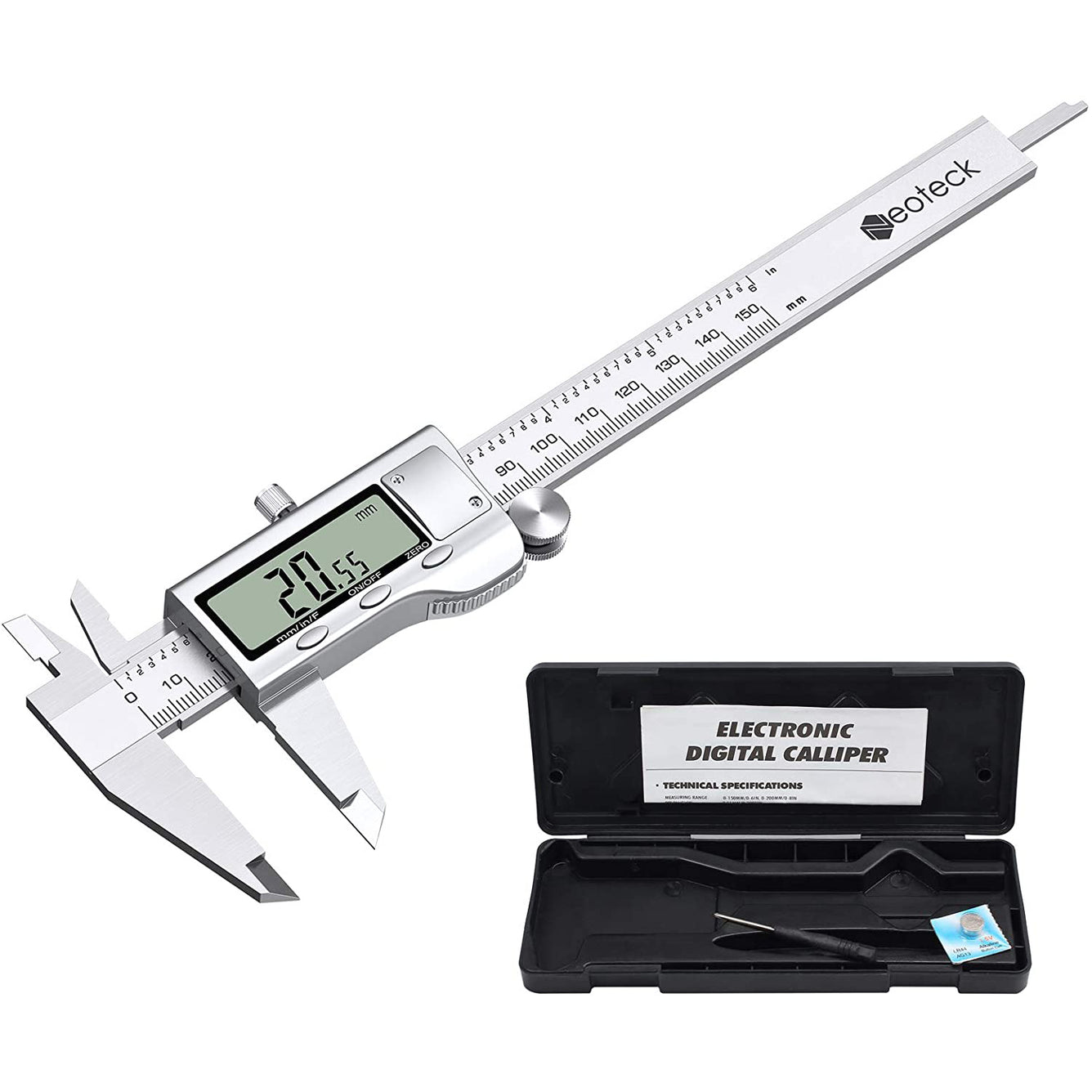
Cheapest stainless build, with a few extras thrown in
Neoteck gets a full stainless steel body down to a price closer to the plastic-bodied calipers most budget brands sell, and adds a fractions display alongside mm and inch — occasionally useful against older imperial drawings, though rarely needed on a UK survey. It ships with a spare LR44 battery and a mini screwdriver for the battery hatch, a small but genuinely useful inclusion at this price. The trade-off is unbranded internals with no stated accuracy figure to check against, and owner feedback describes some inconsistency between batches.
For
- Full stainless steel body at a near-budget price
- Fractions display alongside mm and inch
- Spare battery and mini screwdriver included in the case
Against
- No stated accuracy tolerance to compare against the branded options
- Published owner feedback describes inconsistent build quality between batches
Typically £12–£18
Check price on AmazonSilverline 380244 Digital Vernier Caliper 150mm

Budget pick — the cheapest one actually worth buying
Silverline undercuts every other caliper here while still using hardened stainless steel rather than plastic, and includes a thumb wheel for fine adjustment that’s often missing at this price. Accuracy is quoted at ±0.02mm, matching the far more expensive Moore & Wright and Mitutoyo on paper, even if the display and overall finish don’t match either. It’s a sensible spare kept in the van for when the main caliper’s battery dies mid-survey, or a first caliper for occasional use.
For
- Lowest price here, still hardened stainless steel rather than plastic
- Thumb wheel fine adjustment, often missing at this price point
- ±0.02mm stated accuracy, matching far pricier calipers on paper
Against
- Smallest, dimmest display of the calipers in this guide
- Feels the part of a budget tool in the hand next to the Teng or Sealey
Typically £10–£15
Check price on AmazonWhat actually matters — and what doesn’t
Sub-0.01mm resolution is a spec-sheet number, not a survey requirement. Every caliper here reads to 0.01mm, and every one of them is already far more precise than any survey description needs to be. The number worth comparing is the stated accuracy — usually ±0.02–0.03mm — not chasing a smaller resolution figure that won’t change what gets written in a report.
Calibration certificates matter for a minority of jobs, not most of them. A UKAS or manufacturer’s calibration certificate is worth having if a measurement might end up disputed — a boundary line, a party wall matter, or anything heading toward expert witness territory. For a routine condition survey, it’s an unnecessary cost.
Digital is faster to read, but a dead battery is a dead caliper. Every unit in this guide is digital rather than a plain vernier or dial gauge — faster to read at a glance, but useless the moment the battery dies mid-survey. Worth carrying a spare in the same pocket as the caliper itself.
Fractions and inch displays are largely irrelevant for UK survey work. Several calipers here advertise fraction conversion aimed at a US or hobbyist market. It doesn’t hurt to have it, but it's no reason to pick one caliper over another when every measurement in a UK report is in millimetres.
A 150mm range covers almost everything a survey needs. Longer-range calipers exist, but jaw width and depth beyond 150mm rarely come up on site — timber sections, cavity ties, glazing spacers and crack widths are all comfortably within range. A bigger caliper just means more to carry for capability that goes unused.
Questions I get asked
Do I need a caliper if I already carry a tape measure and a laser measure?
For room dimensions and floor plans, no — a tape or laser measure remains the right tool. A caliper earns its place for the smaller number of measurements where a millimetre either way changes the answer: identifying a timber section size, checking a glazing unit’s spacer bar width for an approximate age or U-value estimate, or putting a precise figure on a crack width rather than an estimate. It’s a specialist tool for a specific job, not a tape replacement.
What’s the difference between a digital caliper and a crack monitor?
A crack monitor is fixed in place across a crack and read repeatedly over weeks or months to track whether it’s actively moving. A caliper gives one precise reading on the day, useful before deciding whether a crack needs monitoring at all, or for measuring anything else that isn’t a crack. The two do different jobs and often get used together on the same defect.
How accurate does a measurement need to be for a survey report?
Most survey descriptions work to the nearest millimetre, sometimes less precisely than that. Sub-millimetre accuracy matters less for the number itself than for the confidence it gives — distinguishing two similar timber sizes, or placing a crack reading clearly within one BRE damage category rather than borderline between two. Any caliper in this guide comfortably delivers that; the differences between them are mostly about durability and price, not accuracy.
Will a budget caliper actually be accurate enough to trust?
Generally yes, at this specific measurement range. Several budget calipers here quote the same ±0.02mm accuracy as calipers costing several times more — the difference tends to be build quality, display size and how long the caliper survives being dropped, not whether the reading itself can be trusted. Where it's worth spending more is if a measurement might ever need a calibration certificate behind it, which none of the budget options offer.
A caliper reading doesn’t replace judgement, but a precise number behind a defect — a crack width, a timber section, a joint gap — carries more weight in a building survey than an estimate does. If it’s the survey itself that’s overdue rather than the kit, get in touch. Or browse the rest of the field-kit guides, including the crack monitors and tape measures guides for what else lives alongside it in the bag.
Small print. This guide is general information, not a substitute for choosing kit against a specific survey's accuracy and evidential requirements. Prices are indicative, move constantly and were checked at the time of writing; the linked page always shows the current price. As an Amazon Associate I earn from qualifying purchases.