No defect frightens a homeowner like a crack. Damp is unpleasant, but a diagonal crack over a bay window says subsidence to most people before I’ve got out of the van — and subsidence says underpinning, blighted sale, insurance war. The truth from the survey side is far less dramatic. The great majority of cracks in British houses are the building doing what buildings do: shrinking as plaster and timber dry out, flexing as clay soils swell in winter and shrink in a dry summer. They open a little, close a little, and go precisely nowhere.
The industry framework for this is BRE Digest 251, which classifies crack damage into six categories by width. Category 0 is hairline, under about 0.1mm; category 1 is fine cracking to about 1mm; category 2 runs to 5mm — and everything up to here is treated as aesthetic, redecoration-grade damage. Category 3 (5–15mm) and category 4 (15–25mm) need repair and investigation; category 5 (over 25mm) is structural. Notice what the framework turns on: width, measured — and, crucially, whether it is changing. A stable 4mm crack from decades-old settlement is a filler-and-paint job. A 1mm crack that becomes 3mm by October is a different conversation entirely.
Which is why this is the most surveyor-ish kit in the whole shop. None of it is electronic, most of it costs less than lunch, and used properly it answers the only question that matters: is this crack moving? Monitoring beats panic, and it beats premature underpinning by an even wider margin.
The one I’d buy

Standard tell-tale crack monitor kit (3-pack)
The classic two-plate tell-tale: a calibrated grid on one acrylic plate, a red cursor cross on the other, fixed rigidly either side of the crack so any movement in two axes reads directly off the grid. This is the Avongard pattern the UK monitoring industry standardised on, in a multi-pack — and you want a multi-pack, because a crack worth monitoring is worth monitoring in two or three places along its length.
Typically £9–£14 for three
Check price on AmazonHow I judge a crack monitor
Rigid fixing, both sides. A tell-tale is only as honest as its fixings. Each plate must be fixed rigidly to sound material on its own side of the crack — screws into plugs, epoxy, or ideally both — never bridged with a fixing that spans it. A tell-tale stuck on with double-sided tape is an ornament. I look for kits that ship with screws and plugs, and I’d add epoxy regardless.
Two axes, readable at a glance. Cracks don’t just open; they shear. A proper monitoring gauge reads horizontal and vertical movement independently — the standard grid covers ±20mm across and ±10mm up and down. Anything that only measures width tells half the story, and on subsidence the vertical half is often the interesting one.
A record system. The gauge doesn’t monitor anything; you do. What turns a plastic plate into evidence is a dated log and a photograph at every visit. Kits that include a printed record chart nudge people into actually doing this, which is worth more than any accuracy claim.
Survives a full season cycle. Meaningful monitoring runs twelve months minimum, because clay-soil movement is seasonal. An external tell-tale therefore needs UV-stable plastic and fixings that won’t rust-streak the render; a gauge that clouds or falls off in month seven takes seven months of data with it.
Cost per crack. You are not buying one instrument; you’re buying a small population of them. A monitored house might carry gauges on three or four cracks, inside and out. At £3–£5 a gauge that’s trivial — and no excuse for monitoring only the dramatic crack while ignoring the quiet one by the drain.
The comparison
| Product | Type | Range / resolution | Typical price | Best for | |
|---|---|---|---|---|---|
| Standard tell-tale kit (3-pack) | Two-plate tell-tale | ±20mm H, ±10mm V, 1mm grid | ~£12 | Monitoring a crack over months | View |
| Shinwa 58699 crack scale card | Width comparator, stainless | 0.10–1.40mm, 0.05mm steps | ~£8 | One-visit width categorisation | View |
| Sealey AK962EV calliper | Digital calliper monitoring | 0–150mm, 0.01mm resolution | ~£25 | Numeric records between datum points | View |
| Mitutoyo 500-196-30 | Digital calliper, professional | 0–150mm, 0.01mm, ±0.02mm accuracy | ~£120 | Professional-grade repeatability | View |
| Linestorm corner tell-tale | Corner tell-tale | XY grid, 1mm | ~£8 | Cracks at internal/external corners | View |
| Aspire crack width ruler (10-pack) | Width comparator, film | 0.10–2.50mm + 0.1–7.0mm | ~£20 | A comparator in every folder and toolbox | View |
| Budget acrylic tell-tale + chart | Two-plate tell-tale | ±20mm H, ±10mm V, 1mm grid | ~£7 | Best on a budget | View |
| Araldite Rapid 24ml syringe | Epoxy fixing | Sets in ~5 min | ~£8 | Fixing tell-tales properly | View |
The picks in detail
Standard tell-tale crack monitor kit (3-pack)
Best overall — the standard tell-tale, and my top pick above
The two-plate tell-tale is the Avongard design every structural engineer and loss adjuster in the country recognises on sight — Avongard’s own originals come and go on Amazon, but the pattern-copies follow the same format: one plate carries a millimetre grid, the overlapping plate a red hairline cross, and once both are fixed rigidly either side of the crack, any movement displaces the cross against the grid. Owner feedback on these acrylic kits is consistent that the plates and fixings do the job; the discipline of reading them is on you. Three in a pack means the same crack monitored at top, middle and tail, which is how you tell rotation from uniform opening.
For
- Reads horizontal and vertical movement independently
- The format engineers and insurers already understand
- Multi-pack — monitor several stations per crack
- Screws and plugs included; no batteries, nothing to fail
Against
- 1mm grid — fine for trend, not for precision
- Unbranded acrylic; long-term UV life outdoors is unproven
Typically £9–£14 for three
Check price on AmazonShinwa 58699 crack scale card
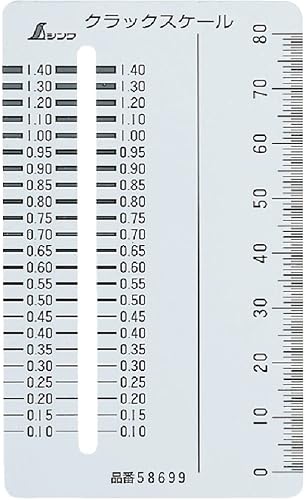
Best crack width gauge card — one-visit categorisation from a proper maker
Before you monitor anything you need a width, because width is what the BRE categories run on — and eyeballing widths is a mug’s game; a 1mm crack and a 2mm crack look identical from standing height and sit in different categories. A comparator card settles it in seconds: hold it against the crack, find the printed line that matches, read the number. Shinwa is a serious Japanese measuring-tool maker, and this one is etched stainless — lines from 0.10mm to 1.40mm in 0.05mm steps plus a rule edge — so it lives in a wallet indefinitely without wearing blank the way laminated cards do.
For
- Stainless, credit-card sized, effectively indestructible
- Fine gradations exactly where the aesthetic/serviceability boundary lives
- Made by a proper measuring-tool firm, not a print shop
Against
- Tops out at 1.40mm — wide cracks need the film ruler or a calliper
- A snapshot tool; it tells you nothing about movement
Typically £6–£10
Check price on AmazonSealey AK962EV digital vernier calliper

Best for numeric records — calliper monitoring between fixed datum points
The step up from a tell-tale is calliper monitoring: fix two datum points — stainless screws or studs epoxied either side of the crack — and measure between them at each visit with a calliper reading to 0.01mm. It’s the method professional monitoring contractors use, because it produces a column of numbers you can plot rather than a cursor you squint at. Sealey’s AK962EV is the sensible tool for it: hardened stainless, big LCD digits, zero-set for comparative readings, and a spec of ±0.02mm accuracy — comfortably finer than anything a wall will do between visits. Measure the same two points three times, log the average and the date.
For
- 0.01mm resolution turns a crack into a graph
- Zero-set makes change-since-last-visit readable directly
- A trade brand at a hobby price, with a storage case
Against
- Needs datum points fitted — slightly more setup than a tell-tale
- LR44 button cells have a habit of dying quietly in storage
Typically £22–£34
Check price on AmazonMitutoyo 500-196-30 Absolute Digimatic calliper

The professional pick — when the readings might end up in front of an engineer
If the monitoring might one day sit in an insurance file or an engineer’s appendix, buy the calliper the metrology world treats as the reference. Mitutoyo’s 500-196-30 is standard issue in engineering inspection: the Absolute encoder never loses its zero between visits, stated accuracy is ±0.02mm with repeatability that owner feedback describes as boringly perfect, and the battery runs for years. The difference over a £25 calliper isn’t the display — it’s that measurement four hundred reads like measurement one, which is precisely what a twelve-month record depends on. Overkill for one crack in a lounge; correct for a professional who monitors buildings for a living.
For
- The reference instrument — repeatability beyond argument
- Absolute scale: no re-zeroing, no drift between visits
- Years of battery life; calibration services widely available
Against
- Four to five times the price of the Sealey for the same resolution
- Counterfeits exist — buy carefully and check the seller
Typically £100–£140
Check price on AmazonLinestorm corner tell-tale crack monitor

Best for corners — where the diagnostic cracks actually live
The cracks that matter most rarely sit politely in the middle of a flat wall. They run at the junctions — where a bay meets the main house, where an extension pulls away from the original build. A flat tell-tale can’t sit across a 90-degree corner; a corner tell-tale is made for exactly that, one leg on each face with the same gridded cursor reading. Linestorm’s version comes with screws, plugs and a calibrated XY grid, and a named UK brand gets you a listing that will still exist when you want a second one to match. The gap between extension and house is the single most common crack I’m asked about, and this is the right shape of instrument for it.
For
- Purpose-made for the commonest worrying crack: junctions and returns
- Supplied with proper fixings
- Same read-and-record routine as the standard tell-tale
Against
- Only for corners — you still need standard tell-tales for flat runs
- Alignment during fitting is fiddlier than the flat pattern
Typically £6–£12
Check price on AmazonAspire concrete crack width ruler (10-pack)

Best comparator multi-pack — a width gauge in every folder, van door and kitchen drawer
The same idea as the Shinwa card in transparent film form, with a wider span: comparator lines from 0.10 to 2.50mm on one scale and a coarse 0.1–7.0mm scale on the other — between them covering the whole range where measurement, rather than the obvious hole in the wall, is doing the work. Being see-through, you lay it over the crack rather than beside it, which is genuinely easier on rough render. Ten in a pack is the point: give one to the client so their “it’s definitely got bigger” phone call in six months comes with a number attached.
For
- Transparent overlay — easier to match on textured surfaces
- Coarse scale covers wide cracks the pocket cards can’t
- Cheap enough to hand out and lose without grief
Against
- Printed film scratches and clouds with wallet wear
- Imperial-first labelling on the fine scale takes a moment’s translation
Typically £18–£24 for ten
Check price on AmazonBudget acrylic tell-tale with record chart

Best on a budget — one crack, one gauge, one printed chart to fill in
If you have exactly one crack and a fiver, this class of listing — a single acrylic tell-tale with screws, plugs and a printed monitoring record chart — is all you need. The gauge is the same standard pattern as the top pick; the useful extra is the paper. A pre-printed chart with dated boxes sounds trivial, and is exactly what separates households who monitored their crack from households who fitted a gauge and forgot it existed. Buyer feedback is what you’d expect at the price: the plastic is serviceable, the instructions are translated, and the ones who used the chart got their answer.
For
- Complete single-crack kit for the price of a coffee and a bun
- The record chart builds the habit that makes monitoring work
- Same grid format an engineer will recognise later
Against
- Brand names on these listings change with the wind
- Thin acrylic — treat it gently during fitting
Typically £5–£9
Check price on AmazonAraldite Rapid epoxy syringe (24ml)

The fixing — because a loose tell-tale is worse than no tell-tale
Not a monitor, but the thing that makes monitors honest. Screws into plugs are right for solid brick; on friable render, painted stone or anywhere you’d rather not drill, an epoxy bond pad is the correct fixing — it’s what the professional monitoring firms specify for their own gauges. Araldite Rapid in the double-syringe dispenser meters the two parts evenly, sets in about five minutes, and one syringe fits a houseful of gauges. Rough both surfaces, bed the plate fully, and don’t take reading one until it has cured hard: a tell-tale that can rock on its fixings will manufacture “movement” out of nothing, and false movement is how monitoring creates panic instead of curing it.
For
- Rigid, permanent fixing without drilling delicate surfaces
- Syringe dispenser meters the mix; five-minute set
- A household name you can buy anywhere, forever
Against
- Once it’s on a painted wall, it’s staying — warn the decorator
- Slow to cure below about 10°C; plan winter fixings for midday
Typically £6–£9
Check price on AmazonWhat actually matters — and what doesn’t
Twelve months, including a full summer. The commonest monitoring mistake is stopping early. Clay soils — and the South East sits on a lot of them — shrink through a dry summer and swell back over winter, so a crack read from March to June shows steady opening and looks like a building falling down, when a further six months would show it closing again. Cyclical movement that returns to roughly where it started is generally a managed non-event. Progressive movement — opening through the cycle and not coming back — is the pattern that needs an engineer. You cannot tell the two apart in less than a year.
Fit it properly or don’t bother. Rigid fixing to sound substrate on both sides, plates never bridged, cursor zeroed and photographed on day one, gauge numbered if there’s more than one. Every reading afterwards is: look, photograph, log. Ten minutes a month.
Width is a triage number, not a verdict. The BRE categories are about ease of repair, not imminent collapse — a 6mm crack that hasn’t moved since 1987 is less interesting than a 1.5mm crack that’s grown every month since Easter. Direction matters too: vertical cracks following mortar joints are usually shrinkage or thermal; stepped diagonal cracks radiating from the corner of an opening are the ones that earn a tell-tale.
What you can skip. For a house you do not need displacement transducers, dataloggers, or the “structural monitoring systems” end of the catalogue — that’s party-wall and civil-engineering kit at civil-engineering prices. Nor does a £7 acrylic gauge need laboratory accuracy: the decisions all live at the whole-millimetre scale. And be sceptical of anyone whose gut says “underpin” on the first visit — most subsidence claims are resolved without underpinning, usually by fixing a leaking drain or dealing with the offending tree. The gauge’s job is to buy you the evidence to resist expensive guesswork.
Know when it stops being a DIY job. Monitoring is for cracks in categories 0–2 with no other symptoms. Go straight to a professional — not a tell-tale — if doors and windows have started racking out of square, floors slope, cracks show inside and outside at the same spot, brickwork is stepped and displaced, or the crack sits near drains or a large tree on clay. If subsidence is genuinely on the cards, ring your buildings insurer early: monitoring and investigation are exactly what the policy is for, and insurers would far rather fund a season of monitoring than the underpinning a panicked contractor proposed on day one.
Questions I get asked
How long should I monitor a crack before doing anything? Twelve months as a rule, monthly readings, spanning a full summer–winter cycle — that’s what separates seasonal from progressive movement. The exceptions run the other way: if a gauge shows several millimetres of continuing movement inside a couple of months, or other symptoms appear, don’t sit out the year — escalate to a structural engineer or your insurer with the readings you have. A dated photographic record even three months long is far more useful to them than an adjective.
What width of crack is serious? Using the BRE Digest 251 bands: under 1mm is fine cracking, up to 5mm is still usually cosmetic to repair, 5–15mm needs investigation, and beyond that you’re into serious structural territory. But treat width as triage, not diagnosis — what decides whether anyone should worry is whether it’s moving, in what pattern, and what else the building is doing. That is exactly what a £10 tell-tale answers and a one-off glance cannot.
How do I fit a tell-tale crack monitor properly? Choose a representative point on the crack, ideally with two more stations along it. Offer the assembled gauge up with the cursor on zero and mark the fixing holes — each plate entirely on its own side of the crack. Drill, plug and screw, bedding the plates on epoxy if the surface is uneven; on delicate surfaces use epoxy pads alone. Confirm the cursor still reads zero, photograph it with the date, and log every subsequent reading the same way. If the gauge gets knocked or a plate loosens, note it, refix, and restart the record — don’t splice the data.
Are cracks a sign of subsidence — and should I claim on insurance? Usually not: shrinkage, thermal movement, lintel deflection and plain old age produce the vast majority of cracking. The classic subsidence signature is stepped diagonal cracking wider at the top than the bottom, appearing or growing in late summer, often near a tree on clay or a leaking drain. If that’s what the monitoring shows, contact your buildings insurer sooner rather than later — subsidence is an insured peril, the excess is typically higher (often around £1,000), and the insurer appoints its own investigators. Your tell-tale record doesn’t replace that process, but it can shorten it considerably, and it protects you from being talked into works the evidence doesn’t support.
A monitored crack has a way of becoming a survey instruction — and that’s the day job. If the readings are creeping, or you’d rather someone read the building as a whole before you commit to a year of watching, the practice carries out building surveys across Sussex, Kent and the South East, with cracking and movement assessed in context rather than in isolation — get in touch. And if you’re building out the toolkit, the damp meter guide covers the other half of what worried walls get accused of, along with more field-kit guides.
Small print. This guide is general information, not a survey of your property or structural advice; cracking can only be diagnosed in the context of the building in front of you, and significant or progressive movement should be assessed by a chartered structural engineer. Prices are indicative, move constantly and are checked at the time of writing; the linked page always shows the current price. As an Amazon Associate I earn from qualifying purchases.