Most of what a surveyor’s hands do during a visit rewards bare skin — a laser measure, a phone camera, the fiddly latch on a loft hatch. Gloves earn their keep for the other half: pulling back loft insulation undisturbed for decades, feeling along a corroded pipe in a crawl space, or gripping a manhole cover rusted into its frame. What is in a pair matters less than whether it goes on and off without a fight, because a glove wrestled off to answer a phone ends up left in the door pocket instead.
The other reason a decent pair earns its place has less to do with cuts than what is on the other side of the material. Loft insulation sheds glass fibre that sits in skin for days; damp and mould-affected timber is not worth handling bare-fingered before a coffee break; and the debris in an unmodernised crawl space — old nails, glass, whatever has dropped through a floor void over the decades — is exactly what a decent palm coating is built to shrug off.
None of the picks below have been worn on an actual survey — the notes are built from manufacturers’ specifications and recurring owner feedback, filtered through what a surveyor’s hands actually do on a visit. First, the one I’d buy.
The one I’d buy

Showa 310 Grip Gloves
Showa’s 310 is about as close to an industry-standard grip glove as this category has — a seamless knitted liner with a latex palm coating, sold across almost every trade counter and builders’ merchant in the country. The coating grips reliably on wet timber, muddy ladder rungs and rusted metal covers, and the knitted back stays breathable enough for a full day’s wear rather than turning into a sweat bag by lunchtime. It offers no meaningful cut resistance and no warmth, but as the pair that lives in the door pocket for the majority of jobs that just need a decent grip, it is the sensible default.
Typically £5–£8
Check price on AmazonHow I judge a work glove
Dexterity that survives contact with a phone or laser measure. Half a survey’s tools have a touchscreen or a small button, and a glove that has to come off for every reading gets left off entirely. Touchscreen-compatible fingertips are worth having; a bulky palm that turns a laser measure into a two-handed job is not.
Grip that holds wet and dirty, not just in a dry product photo. A palm that grips a dry drill handle is a different test to a rusted manhole cover after rain. Latex, nitrile and PU coatings behave differently once wet — worth checking which the listing specifies.
Protection matched to a real hazard — not a marketing cut rating. Cut resistance matters for a handful of jobs: clearing broken glass in a derelict crawl space, handling a lath-and-plaster ceiling coming down, reaching past an old nail in a loft hatch edge. For the rest of a visit, a high cut rating just adds bulk and cost for a risk not there.
Breathable enough to still be on by the third hour. A fully rubber-dipped glove that felt fine trying on in a shop turns into a swamp after ninety minutes of loft crawling. A knitted or fabric back that lets air through is the difference between a glove worn all day and one abandoned after twenty minutes.
Cheap enough that losing one in a loft does not matter. Gloves get left behind — on a joist, in a skip, in whichever van was parked next to the site. Anything much over a tenner a pair starts to feel like a loss worth avoiding, defeating the point of kit meant to be grabbed without thinking.
The comparison
| Model | Coating | Cut protection | Typical price | Best for | |
|---|---|---|---|---|---|
| Showa 310 | Latex-dipped palm, knitted liner | Grip-focused, not cut-rated | ~£5–£8 | Best overall | View |
| Ejendals Tegera 882 | Fully dipped nitrile, oil/water-repellent | Light abrasion resistance | ~£4–£8 | Premium/professional pick | View |
| Scan Rigger Gloves | Split leather palm, canvas back | Heavy-duty, not cut-rated | ~£2–£4 | Best on a budget | View |
| Ansell HyFlex 11-618 | PU-coated nylon, ultra-thin | Light abrasion resistance | ~£2–£5 | Best for dexterity | View |
| Portwest A722 | Nitrile sandy palm, TPR knuckle guards | Cut + impact (ANSI A4) | ~£6–£10 | Best for cut & impact risk | View |
| Portwest A140 | Latex crinkle grip, acrylic thermal liner | Grip-focused, not cut-rated | ~£2–£4 | Best for cold weather | View |
| Nitrile disposable (100-pack) | Nitrile, powder-free | Not applicable — single-use | ~£8–£14 per box | Best for damp/mould sampling | View |
The picks in detail
Showa 310 Grip Gloves
Best overall — grip that holds wet or dry, breathable enough for a full day
The latex palm coating is the whole story here — it grips reliably on wet timber, muddy ladder rungs and rusted metal covers without needing to come off between tasks, while the knitted back stays breathable enough for a full shift. It offers no meaningful cut resistance and the latex is not an option for a latex sensitivity, but for the majority of a visit that just needs a decent grip, it asks the least of the person wearing it.
For
- Latex coating grips reliably wet or dry
- Knitted back stays breathable over a full shift
- Cheap enough to keep several pairs in the van
Against
- No meaningful cut resistance
- Not an option for a latex sensitivity
Typically £5–£8
Check price on AmazonEjendals Tegera 882

Premium/professional pick — fully dipped, oil and water repellent, built for regular use
Ejendals is a Swedish brand that turns up across professional trades for the same reason Portwest does in the UK — consistent build quality built around a full working day rather than an occasional task. The 882 is fully dipped in nitrile rather than just palm-coated, so the back of the hand gets the same water and light-oil resistance as the palm, useful from a wet crawl space to a boiler cupboard with a weeping pipe. It costs more and is warmer and less breathable than a knitted-back glove, but for regular use the extra durability is the point.
For
- Fully dipped — water and light-oil resistance all round, not just the palm
- Consistent professional-grade build quality
- Durable enough for daily use
Against
- Costs more than a palm-coated alternative
- Less breathable than a knitted-back glove
Typically £4–£8
Check price on AmazonScan Rigger Gloves

Best on a budget — leather palm for rough handling, cheap enough to keep as spares
A rigger glove is a different shape of job to the coated grip gloves elsewhere in this guide — a split-leather palm and canvas back built for rough, repeated contact rather than fine dexterity. That makes it the right glove for handling insulation batts, rough-sawn timber in a loft, or clearing debris where the concern is abrasion and splinters rather than a precision task. It gives up any real dexterity — a phone or laser measure is not realistic in these — so it suits the stretch of a visit where hands need protecting rather than the whole job.
For
- Cheapest genuinely durable option in this guide
- Leather palm shrugs off splinters and rough timber
- Cheap enough to keep several pairs as spares
Against
- No dexterity — not for handling tools or a phone
- Canvas back offers no water resistance
Typically £2–£4
Check price on AmazonAnsell HyFlex 11-618

Best for dexterity — thin enough for a touchscreen, still has a coated palm
Ansell’s HyFlex range is aimed at precision handling rather than heavy protection, and the 11-618 is about as thin as a coated glove gets while still offering some abrasion resistance. The PU coating is thin enough that a phone or tablet screen still responds through the fingertips, which matters for anyone recording readings or photos without wanting to strip a glove off every time. It offers little cut resistance and will not survive rough handling, so it suits the parts of a visit about not getting a hand dirty rather than protecting it from anything sharp.
For
- Thin enough for genuine dexterity — phone and tablet screens still respond
- Breathable, comfortable for extended wear
- Widely available, often sold in bulk packs
Against
- Minimal cut or puncture protection
- Wears through faster than a heavier coating on rough surfaces
Typically £2–£5
Check price on AmazonPortwest A722 Anti Impact Cut Resistant Glove

Best for cut & impact risk — TPR knuckle guards for demolition-adjacent work
This is the outlier in the lineup — a nitrile-coated palm rated to ANSI cut level A4 with moulded TPR knuckle guards, built more for demolition than a typical residential visit. It earns its place for jobs with real risk: pulling back a collapsed ceiling to check a joist, clearing glass and debris in a derelict property, or working in a part-stripped-out room with exposed fixings. Overkill for an ordinary survey, but for work that regularly crosses into properties mid-renovation or post-fire, the extra protection is worth the bulk.
For
- ANSI A4 cut resistance — a genuine step up from the rest of this guide
- TPR knuckle guards add impact protection
- Sandy nitrile palm grips well even when dusty
Against
- Bulkier than anything else here — little real dexterity
- Overkill for a standard residential survey
Typically £6–£10
Check price on AmazonPortwest A140 Thermal Grip Gloves
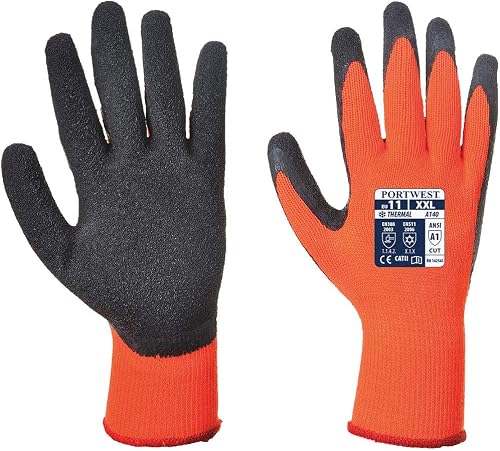
Best for cold weather — acrylic thermal liner under a latex crinkle grip
External inspections in January are the reason this exists — a 10-gauge acrylic liner for warmth under a crinkle-latex palm that still grips reliably in the wet. The crinkled texture grips better on a frosted ladder rung or a wet roof edge than a smooth coating does, which matters more in winter than the rest of the year. It is warmer and bulkier than every other pick here, so it is a seasonal addition to the van rather than a year-round default.
For
- Genuinely warm — a 10-gauge acrylic liner, not just a thin fleece
- Crinkle-latex grip holds on wet and frosted surfaces
- Cheap enough to keep a pair for the whole winter
Against
- Too warm and bulky for anything but cold-weather work
- No cut or puncture protection
Typically £2–£4
Check price on AmazonNitrile Disposable Gloves, Pack of 100

Best for damp/mould sampling — single-use hygiene, not a handling glove
This is a different category of glove entirely, kept in the van for hygiene rather than protection. Taking a mould swab, handling a contaminated air sample, or checking a soil pipe that has backed up are better done with something disposable than with a pair that then sits in the door pocket for the rest of the week. A box of a hundred lasts a long time at this price, and powder-free nitrile avoids the latex sensitivity issue of the cheapest disposable alternative.
For
- Disposable — no cross-contamination between jobs
- Powder-free nitrile avoids latex allergy concerns
- A box lasts a long time relative to the cost
Against
- No protection from cuts, punctures or rough handling
- Tears easily under any real load
Typically £8–£14 per box
Check price on AmazonWhat actually matters — and what doesn’t
Cut ratings matter for a specific hazard, not every glove in the van. EN388 and ANSI ratings are worth checking for jobs that actually involve something sharp — broken glass, exposed nails, a stripped-out room. A high cut rating as a default for every pair pays for bulk and cost most of a visit does not need.
Touchscreen compatibility is genuinely useful; padded “anti-vibration” extras rarely are. A glove that lets a phone or laser measure respond through the fingertip saves stopping to strip it off. Gel inserts and anti-vibration padding are aimed at people running power tools all day, not a surveyor’s occasional SDS bit.
Fit matters more than the spec sheet. A glove one size too big loses most of its dexterity advantage, and one too small tears at the seams within a few uses. Most picks above are sold across a full size range — worth checking against a hand measurement.
Disposable and reusable gloves solve different problems. A rigger or coated grip glove protects hands from a task; disposable nitrile keeps one job’s contamination away from the next. Wearing a reusable glove for a mould sample defeats the point of both.
A stocked van beats one do-everything pair. No single glove here covers grip, cut resistance, warmth and dexterity at once, and finding one that does usually means compromising on all four. Two or three pairs — a grip glove, something disposable, something for winter — cost less than one expensive do-everything glove and cover more of what a visit needs.
Questions I get asked
Do surveyors actually need cut-resistant gloves?
For most residential surveys, no — the bulk of a visit is inspection and measurement rather than handling debris. Cut resistance earns its place for specific situations: a part-demolished property, a loft with old exposed nails, or clearing glass and rubble in a derelict crawl space. Keeping one cut-resistant pair in the van for those jobs, rather than wearing one as a default, covers the risk without adding bulk to the rest of the visit.
What does an EN388 or ANSI cut rating actually mean?
Both are lab tests rating how much force a blade needs to cut through the material, translated into a scale — EN388 uses letters A to F, ANSI uses A1 to A9, and the two do not convert directly. Higher is not automatically better for survey work: a high rating usually means a thicker, less dextrous glove, the wrong trade-off for tools or a touchscreen.
Are disposable nitrile gloves worth carrying alongside proper work gloves?
Yes, for hygiene rather than protection. Mould, contamination, or a soil pipe that has backed up are better handled with something thrown away afterwards than a reusable glove that then travels to the next job. A box in the van costs little and covers a genuinely different need to a grip or cut-resistant pair.
How often should work gloves actually be replaced?
Coated palms wear through at the fingertips and thumb well before the rest of the glove looks tired, and that is the point to replace them — a worn patch stops gripping properly and lets debris through to the skin. A pair used regularly needs replacing every few months; a spare kept in the van will outlast that considerably.
Gloves are one of the cheapest lines in a survey kit list, and one of the easiest to get wrong by buying a single pair to do every job. Getting the practical details right on a building survey or retrofit assessment matters more than what is on your hands doing it — but the right pair, or two, makes the physical side of the job easier. If you need a survey or assessment anywhere in Sussex, Kent or Surrey, get in touch — or browse the rest of the field-kit guides, including the safety glasses and knee pads guides this one sits alongside.
Disclaimer. This guide is general information based on published specifications, not a personal endorsement of any single product for every use case. Prices are indicative, move constantly and were checked at the time of writing; the linked page always shows the current price. As an Amazon Associate I earn from qualifying purchases.