Nobody puts knee pads on a kit list until the week their knees make them. Survey work is sold as walking around with a clipboard; the reality involves a remarkable amount of time at floor level. Reading a damp profile means kneeling at the skirting for the length of a wall. A suspended timber floor means going through the hatch and crawling across oversite that is somewhere between damp earth and broken brick. Lofts mean kneeling on joists — a 47mm edge under your kneecap, repeatedly, with insulation hiding exactly where the next one is. None of this is heavy work. All of it is knee work.
The knee is badly designed for it. Kneel and your upper-body weight goes through the kneecap onto whatever is underneath; do that often enough on hard ground and you get the swelling the textbooks still call housemaid’s knee — one of the oldest occupational injuries in the trades, and entirely preventable for the price of a takeaway.
The market splits into two families. Strap-on pads buckle around the leg and work with any trousers; trouser-insert pads slide into the knee pockets of work trousers and simply live there. My view, for what survey work involves — up, down, walk, kneel, climb a ladder, kneel again — is that inserts win for all-day wear and strap-ons win for the occasional brutal crawl. The seven below cover both, from a £10 van spare to the pads floor layers wear for a living.
The one I’d buy

Snickers 9110 KneeGuard knee pad inserts
The default insert of the European trades, and the strongest argument for the insert system itself. A shaped polyethylene foam pad that slots into the knee pockets of Snickers — and most other — work trousers, certified to EN 14404 Type 2 Level 1, weighing next to nothing, and costing about what two coffees and a bacon roll do. Once it’s in the trousers, knee protection stops being a decision you make each morning.
Typically £15–£25
Check price on AmazonHow I judge a knee pad
It has to be there when you kneel. This is the whole game. An insert in a trouser pocket is always there — but a badly cut pocket lets it ride up, so the pad is over your thigh when your kneecap hits the joist. A strap-on stays put — until you crawl, at which point cheap ones rotate round the side of the leg with impressive determination. Whichever family you buy, the question is the same: is the pad over the kneecap at the moment of contact?
All-day wearability. Survey work is intermittent kneeling: two minutes at a skirting, ten walking, forty in a crawl space. Anything you have to take off to walk comfortably ends up in the van. Inserts weigh 50–100g each and you forget them entirely; strap-ons make themselves felt with every step. That is the case for inserts in one sentence.
The strap problem. The back of the knee carries the popliteal artery and a bundle of nerves close to the surface. A thin elastic strap cinched tight enough to stop a pad slipping sits directly across them, and owner reviews of cheap strap-on pads repeat the same two words: numb feet. Good designs answer this with wide, soft straps, or by hanging the pad from a thigh cradle so the strap never needs to be tight.
Cap and padding matched to the surface. A hard cap spreads a point load — kneel on hardcore or a joist edge and the shell bridges it. Exactly right for crawl spaces, exactly wrong for a client’s new engineered oak, where a hard shell scratches and skids; soft-faced gel pads are the reverse. Under the cap, foam is light and adequate, gel spreads pressure better over long kneeling, and D3O-type polymers stay soft until struck, then firm up.
EN 14404, read properly. The knee-protector standard tells you two things. Type is how the protection is worn: Type 1 straps to the leg; Type 2 is an insert carried in trouser pockets. Level is performance: Level 1 means tested for kneeling on flat ground, including resistance to penetration by small stones; Level 2 adds harsher conditions. An uncertified £10 pad may be fine — but nobody has had to prove it.
The comparison
| Model | Type | Padding / cap | EN 14404 | Typical price | Best for | |
|---|---|---|---|---|---|---|
| Snickers 9110 KneeGuard | Trouser insert | Shaped PE foam | Type 2, Level 1 | ~£20 | All-day wear, the default | View |
| Snickers 9191 XTR D3O | Trouser insert | D3O impact polymer | Type 2, Level 1 | ~£40 | Heavy kneeling days, the upgrade | View |
| Blaklader 4032 gel inserts | Trouser insert | Gel over foam, 25mm | Type 2, Level 1 | ~£25 | Gel comfort in an insert | View |
| ToughBuilt GelFit Thigh Support | Strap-on | Gel + foam, hard shell | Type 1, Level 1 | ~£40 | Crawl spaces, rubble, joists | View |
| Redbacks Strapped | Strap-on | Leaf-spring TPE, soft face | Type 1, Level 1 | ~£30 | Long kneeling without the strap pinch | View |
| OX Tools Heavy Duty Soft Gel | Strap-on | Gel, soft non-marking face | Not stated | ~£20 | Finished floors, tiling, flooring | View |
| Silverline 633711 gel | Strap-on | Gel, moulded cap | Not stated | ~£12 | Best on a budget, the van spare | View |
The picks in detail
Snickers 9110 KneeGuard knee pad inserts
Best overall — the insert that made inserts the trade default, and my top pick above
The 9110 is shaped polyethylene foam, channelled to flex at the right points and moulded so it cups the knee rather than sitting in front of it like a beer mat. It slides into the knee-pad pockets of Snickers trousers — where the pairing is certified to EN 14404 Type 2 Level 1 — and fits most other makes’ pockets in practice. Owner feedback is consistent on the two things that matter: they stay put, and after a day you forget they exist.
The honest limitation is inherent to the type: on sharp rubble a couple of centimetres of foam is comfort, not armour, and it slowly compresses over a year or two of hard use — at this price you replace them and move on. As the everyday layer that means you never kneel unprotected, nothing else is this good per pound.
For
- Always in the trousers — protection with zero daily decisions
- Certified EN 14404 Type 2 Level 1 with knee-pocket trousers
- Light enough to forget; nothing behind the knee at all
- Cheap to replace when the foam tires
Against
- Needs trousers with knee-pad pockets
- Foam alone is modest protection on rubble and joist edges
Typically £15–£25
Check price on AmazonSnickers 9191 XTR D3O knee pad inserts

Best premium insert — impact-polymer protection for people who kneel for a living
Same pocket, different physics. The 9191 XTR uses D3O — the orange impact polymer from motorcycle armour — which stays soft and flexible while you walk, then stiffens instantly under a sharp load. Kneel gently and it’s a cushion; drop your full weight onto a joist edge and it behaves like a shell. It carries the same EN 14404 Type 2 Level 1 certification as the 9110, and the spec sheet’s claims of better shock absorption and durability are broadly supported by owner feedback from floor layers and plumbers. You pay roughly double the 9110 for it; if your knees see joists and concrete every working day, or already complain, it’s the cheapest professional-grade upgrade in this guide.
For
- D3O firms on impact — soft in wear, hard where it counts
- Certified Type 2 Level 1; outlasts plain foam
- Slimmer in the pocket than its protection suggests
Against
- Twice the price of the foam default
- Still needs knee-pocket trousers, and pocket fit varies by brand
Typically £35–£50
Check price on AmazonBlaklader 4032 gel knee pad inserts

Best gel insert — pressure spread for long static kneeling
Blaklader’s answer to the 9110 adds a gel layer over the foam, 25mm thick, certified to the same EN 14404 Type 2 Level 1. The gel is the point: foam pushes back hardest where the load is highest, which after twenty static minutes is precisely where your kneecap aches, while gel flows sideways and spreads the pressure across the whole pad. For long, still kneeling — reading moisture profiles along a skirting, tiling, laying floor — that difference is what owners consistently praise. The trade-offs are a little more weight and thickness in the pocket, and Blaklader cut them for their own trousers first, so check the fit if your workwear is another brand. Between this and the 9110 there is no wrong answer; this one favours the static kneeler, the Snickers the up-and-down surveyor.
For
- Gel spreads pressure noticeably better for static kneeling
- Certified Type 2 Level 1, from a serious workwear house
- Barely dearer than plain foam
Against
- Thicker and heavier in the pocket than the 9110
- Sized for Blaklader pockets first — fit elsewhere varies
Typically £20–£30
Check price on AmazonToughBuilt GelFit Thigh Support knee pads
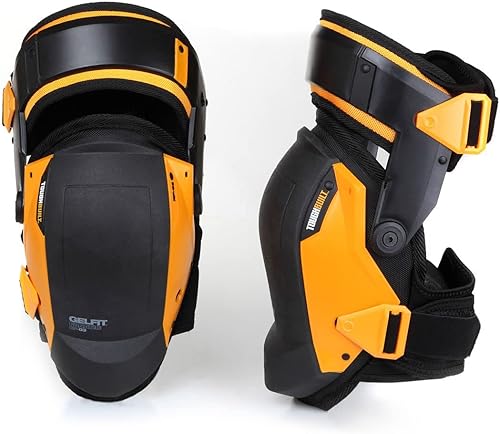
Best for crawl spaces and rubble — the strap-on that solved the strap-on’s problems
The cleverest design in this guide. ToughBuilt hung a gel-and-foam pad inside a hard outer shell, then extended the whole thing upward into a cradle that takes the strap around the lower thigh instead of the back of the knee. That addresses both classic strap-on failures at once: nothing presses on the back of the knee, so your feet stay awake, and the thigh cradle stops the pad rotating off the kneecap when you crawl — owner feedback singles these out as the strap-ons that stay put. On broken oversite in a sub-floor void, or along loft joists, a hard shell bridging the sharp stuff is exactly what you want. The costs are the obvious ones: bulky, warmer than inserts, and a hard shell is precisely what you don’t wear on a client’s finished floor — though ToughBuilt’s SnapShell system offers a swappable non-marring cap for that.
For
- Thigh cradle keeps straps off the back of the knee
- Stays over the kneecap while crawling — rare in strap-ons
- Hard shell bridges rubble and joist edges; gel underneath for comfort
Against
- Bulky and warm; you will take them off to drive
- Hard shell can mark or skid on finished floors
Typically £35–£45
Check price on AmazonRedbacks Strapped Knee Pads
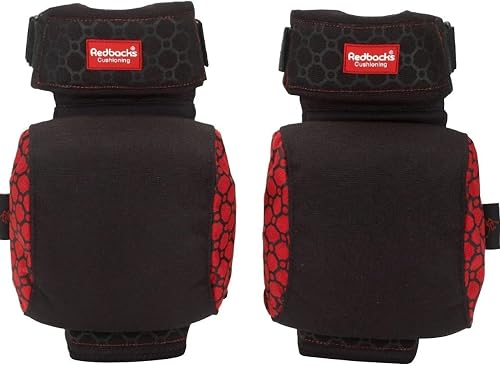
Best for long kneeling in strap-ons — British leaf-spring design, circulation-friendly straps
Redbacks are a British firm with one idea, well executed: instead of foam or gel, a thermoplastic leaf spring inside the pad flexes under load and spreads your weight across the whole surface — suspension rather than cushioning. Published user feedback from people who kneel for hours, not minutes, is notably warm. The wide, soft straps are designed around exactly the circulation problem cheap pads create, the pads are certified to EN 14404, and the soft fabric face is kind to finished floors — which makes these the strap-on for the working day rather than the crawl; on sharp rubble I’d still want the ToughBuilt’s hard shell. They look faintly agricultural. Knees don’t care.
For
- Leaf-spring spreads load — owner feedback praises hours-long comfort
- Wide soft straps designed against the circulation pinch
- Soft face safe on finished floors; UK company, certified
Against
- No hard shell for the worst crawl-space rubble
- Bulkier than any insert; dearer than basic gel strap-ons
Typically £25–£35
Check price on AmazonOX Tools Heavy Duty Soft Gel Knee Pads

Best for finished floors — the tiler’s and floor layer’s gel strap-on
OX is a proper trade brand — you’ll see their levels and trowels on any site — and these are the classic soft-faced gel pad done properly: a thick clear gel dome in a fabric body, no hard shell anywhere, wide elasticated straps. The soft rounded face won’t scratch tile, engineered board or fresh screed, which is why this pattern is what flooring trades actually wear, and the gel makes flat hard ground comfortable for long stints. They are single-purpose: on rubble the gel is comfort rather than protection, and like every conventional strap-on, some owners find the back-of-knee pressure builds over a full day. For kneeling work on surfaces you must not damage — which describes a lot of occupied-house surveying — they’re the sensible mid-priced answer.
For
- Soft non-marking face — safe on tile, timber and screed
- Thick gel dome, comfortable for long flat-ground kneeling
- Trade brand at a reasonable price
Against
- No hard cap — not the pad for broken ground
- Conventional straps, with the usual behind-the-knee caveat
Typically £15–£25
Check price on AmazonSilverline 633711 gel knee pads

Best on a budget — the £10 pair that lives in the van
Silverline is the budget arm of the Toolstream stable, and these are the cheapest pads here that still have a gel core and a moulded wear face rather than a slab of packing foam in a sleeve. Owner feedback is what you’d expect at the price: decent cushioning on flat ground, stitching and strap elastic that won’t survive years of daily trade use, and thin straps behind the knee that are exactly where the circulation complaint comes from if you cinch them hard. As a primary pad for someone who kneels all day, no. As the pair that lives in the van door for the day you forgot your insert trousers, or for a homeowner laying one floor, they’re honest money — and Silverline’s three-year guarantee is a bonus nobody else at this price offers.
For
- Real gel core and moulded face at a bottom-rung price
- Fine as a spare, a loaner or a one-project pad
- Three-year Silverline guarantee
Against
- Thin straps — the circulation problem lives here
- Not certified; longevity under daily use is the trade-off
Typically £8–£14
Check price on AmazonWhat actually matters — and what doesn’t
The system decision comes first. Before comparing pads, decide insert or strap-on, because it decides your trousers. Inserts only work with knee-pocket work trousers — Snickers, Blaklader, Scruffs, Dickies and most trade brands make them — and if you’re buying those anyway, the insert route costs £20 extra and gives you protection that is simply always on. If your working wardrobe is ordinary trousers, strap-ons are the honest answer. The worst outcome is good inserts in a drawer because none of your trousers have pockets for them.
Buy for your worst surface, then your longest. One pad rarely covers everything. My reading of the market is a two-layer answer: inserts in the trousers as the permanent baseline, and a hard-shell strap-on in the van for the days the job is a sub-floor void or an unboarded loft. If you kneel long hours on one kind of surface — a floor layer, say — buy the best single pad for that surface and ignore the layering.
Straps are a design problem, not a tightness problem. If a pad only stays put when the strap is tight enough to make your foot tingle, the pad has failed, and no amount of adjustment fixes it. Look for width, for neoprene rather than bare elastic, for anchoring on the thigh or shin — anywhere but a thin band across the back of the knee joint.
What the marketing pushes that you can skip. “Tactical” styling, aluminium-look caps, and pivoting shells on a £12 pad that pivot mostly in the product renders. Breathability claims matter less than whether you can hose the thing down after a crawl space. And a high gel content is not a virtue in itself — gel’s job is pressure distribution, and a well-shaped foam pad beats a badly shaped gel one every time. Shape, retention and strap design are the spec-sheet lines that predict whether a pad gets worn; everything else is photography.
Questions I get asked
Are gel knee pads better than foam? For long static kneeling, generally yes — gel flows sideways under load and spreads pressure across the whole pad, where foam pushes back hardest at the highest point, which is your kneecap. For intermittent kneeling the difference shrinks, and foam’s lightness wins the all-day-wear argument, which is why the standard trouser insert is foam. The premium alternative is an impact polymer like D3O, which behaves like soft foam until something sharp arrives. Honest summary: foam for wearing, gel for kneeling, polymer if your knees are your living.
What do the EN 14404 types and levels mean? Type describes how the protector is worn: Type 1 straps to the leg independently of clothing, Type 2 sits in pockets on the trousers. Level describes tested performance: Level 1 covers kneeling on flat ground, including resistance to penetration by small stones; Level 2 covers harsher conditions such as kneeling on obstacles. For inserts, the certification formally applies to the pad-and-trouser combination — one quiet argument for matching the insert brand to the trousers. A certificate isn’t everything, but between two similar pads, take the one that’s been through the lab.
Why do my knee pads make my feet go numb? Because the strap crosses the back of the knee, where the popliteal artery and nerves run close to the surface, and it’s tight enough to compress them — usually because the pad slips when it’s looser. The fixes, in order of preference: pads that anchor on the thigh or shin instead (the ToughBuilt approach), wide soft straps that grip without cinching (the Redbacks approach), or trouser inserts, which have no straps at all and make the entire question disappear.
What knee pads are best for flooring work? Flooring is the hardest test: hours of kneeling on a surface you must not mark. That points to soft-faced gel strap-ons (the OX pattern) or a leaf-spring pad like the Redbacks, and away from hard shells, which scratch and skid on finished boards. Many floor layers instead run gel or D3O inserts in knee-pocket trousers — Snickers make floor-layer-specific versions of the 9110 family — which also spares the strap problem across a full day. On abrasive substrates like fresh screed, expect the wear face to be a consumable.
If the reason you’re reading about crawl spaces is a floor that bounces or a musty smell under the boards, that’s the day job — the practice does building surveys that get under the floor and into the loft, not just around the rooms. Get in touch if a building in the South East needs looking at properly. And if you’re kitting out the rest of the survey bag, there are more field-kit guides — including the one on damp meters, which is what you’ll be holding while you kneel.
Small print. This guide is general information, not personal protective equipment advice for your specific work; if you kneel for a living, your employer’s risk assessment and the pad manufacturer’s documentation take precedence. Prices are indicative, move constantly and were checked at the time of writing; the linked page always shows the current price. As an Amazon Associate I earn from qualifying purchases.