A good chunk of a working survey involves putting a hole in something. A 10–12mm cavity wall inspection hole with an SDS drill, a bolster and hammer to lift a section of skirting, a loft hatch that’s been painted shut and needs persuading with a scraper — all of it throws small debris towards your face at exactly the moment you’re leaning in close to see what you’ve just exposed. None of it is dramatic enough to think about twice, which is precisely why it’s worth thinking about once, properly, rather than reaching for whatever pair is rattling around in the door pocket.
Most survey work doesn’t call for a sealed goggle — that’s a different job, for genuinely dusty strip-out or chemical exposure. An open-frame or wraparound pair of safety spectacles covers the actual risk on a typical survey: a chip of mortar off a drill bit, dust dislodged pulling back an old loft hatch above your head, grit falling as you probe a suspect area of ceiling. Worth having on any time you’re drilling, using a bolster, or working directly under something that could drop material on you — which on an older building is more often than the job description suggests.
What separates a pair worth keeping on your face from one that migrates to the glovebox and stays there is not much: a genuine dual coating rather than a single spray doing two jobs badly, a proper EN166 rating with the marking actually visible on the lens or frame, and a frame low-profile enough to sit comfortably alongside ear defenders, a bump cap, and sometimes a dust mask, all stacked on the same head. That’s the lens for everything below.
The one I’d buy
Uvex Pheos Safety Glasses
uvex’s supravision excellence coating is a genuine two-sided treatment — anti-fog bonded to the inside of the lens, scratch- and chemical-resistant coating bonded to the outside — rather than one compromise coating trying to do both jobs. The duo-spherical lens gives a noticeably wide field of vision, and the narrow, duo-component frame with soft temple tips is specifically shaped to sit comfortably under ear defenders or a bump cap for hours rather than minutes.
Typically £8–£15
Check price on AmazonHow I judge safety glasses
Anti-fog that’s actually two coatings. A cheap pair often has a single spray-on treatment trying to handle both fogging and scratching, and it wears off within weeks of being wiped on a sleeve. A genuine dual coating — anti-fog bonded to the inside, scratch-resistant bonded to the outside — keeps working after real use. It matters most exactly when you need it: bent over into a loft hatch, breathing hard after the ladder, in a cold void on a warm day.
EN166 rating, and what the letters actually mean. EN166 is the base standard for all safety eyewear sold as PPE in the UK; optional markings on top of it cover things like F (low-energy impact), B (medium-energy impact), K (resistance to surface damage from fine particles) and N (anti-fog tested to a standard, not just claimed). A pair with no visible marking on the lens or frame isn’t legally safety eyewear, whatever the online listing calls it.
How it sits with the rest of the PPE stack. Ear defenders, a hard hat or bump cap, and a dust mask or half-mask respirator often all need to share the same head at once. A temple arm that’s perfectly comfortable worn on its own can dig in painfully the moment ear defenders clamp down over the top of it — worth trying before you buy six identical pairs.
Lens tint for the job in front of you. Clear lenses for anything indoors, in a loft or in a void, where you need every bit of the available light. A tinted or mirrored lens belongs on a roof in bright sun, not in a dim crawl space where it just makes the job harder.
Weight and comfort over a full day. A pair worn for ten minutes while drilling a single inspection hole is a different proposition to one worn continuously through a loft survey. A few grams and a soft nose pad matter more than the spec sheet suggests once they’ve been on for two hours.
The comparison
| Model | Coating | EN166 rating | Typical price | Best for | |
|---|---|---|---|---|---|
| Uvex Pheos | Anti-fog in / anti-scratch out | 1 F | ~£11 | Best overall, PPE-stack comfort | View |
| 3M SecureFit 400 (SF401AF-EU) | Anti-fog / anti-scratch | 1 F | ~£13 | All-day comfort, Pressure Diffusion temples | View |
| Bollé Rush+ | Platinum anti-scratch/anti-fog | 1 F | ~£9 | Professional workhorse, small-fit option | View |
| JSP Stealth 16g | Premier Shield anti-mist | 1 F | ~£6 | Lightest here at 16g | View |
| Honeywell A800 | Fog-Ban anti-fog | 1 FT | ~£10 (pack of 3) | Best value multipack | View |
| Portwest PS32 | Anti-scratch/anti-fog | 1 FT | ~£3 | Cheapest genuinely rated pair | View |
| Amazon Basics 12-pack | Anti-fog | EN166 CE | ~£18 (pack of 12) | Spares for the van, visitors | View |
The picks in detail
Uvex Pheos Safety Glasses
Best overall — the one I’d buy, above
uvex’s supravision excellence coating is a genuine two-sided treatment: anti-fog bonded to the inside of the lens, scratch- and chemical-resistant coating bonded to the outside, rather than one compromise coating trying to do both. The duo-spherical lens shape gives a noticeably wider field of vision than a flat lens, and uvex’s duo-component temple tips use two grades of plastic — rigid where it needs to hold shape, soft where it touches skin — so the narrow frame sits comfortably under ear defenders or a bump cap for hours rather than minutes. EN166 and EN170 rated with full UV400 protection, fully metal-free so there’s nothing to corrode in a damp crawl space, and under 20g.
For
- Genuine dual anti-fog/anti-scratch coating that doesn’t wash off
- Narrow frame designed to stack with ear defenders and hard hats
- Metal-free, nothing to corrode in a damp void
- EN166 + EN170 rated with UV400 protection
Against
- Sold in several near-identical variants (Pheos, Pheos S, Pheos Guard) — check the exact listing
- No hard case included
Typically £8–£15
Check price on Amazon3M SecureFit 400 Safety Glasses (SF401AF-EU)

Best for all-day comfort — the pick for long survey days
3M’s Pressure Diffusion Temple Technology is the genuine point of difference here: dual-injected padded touchpoints at the temple flex and spread the clamping force across a wider area of your head rather than concentrating it behind the ears, which is where most safety glasses start to hurt after four or five hours. At around 19g it’s barely noticeable once it’s on, the nose pads are soft and adjustable rather than fixed, and the rimless lens gives a genuinely wide field of vision with nothing at the edge of your peripheral view to catch on. The wide, flexible temple arms are specifically shaped to work under ear defenders without a pressure point forming.
For
- Pressure Diffusion Temple tech genuinely reduces the ear-ache safety glasses cause by lunchtime
- Rimless lens, wide field of vision
- Works well stacked with ear defenders
Against
- Costs more than most of the trade-brand picks here
- Clear anti-fog lens has less UV tint than some prefer outdoors
Typically £9–£16
Check price on AmazonBollé Safety Rush+ Safety Glasses
Best professional workhorse — the one most trade sites stock
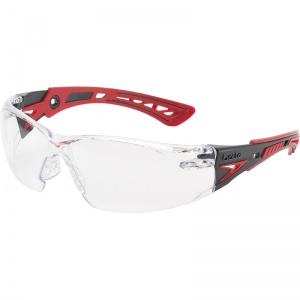
Bollé’s Platinum coating technology is independently tested to a tougher scratch- and fog-resistance standard than the basic EN166 requirement, and it’s the pair you’ll see most often on a genuine building site rather than a DIY shelf — there’s a reason it’s become close to the default trade choice. The adjustable nose bridge and ultra-flex temples cope with a wider range of face shapes than most fixed-frame designs, and a small-fit version (Rush+ Small) is available for anyone who finds the standard frame too wide, which most safety glasses ranges don’t bother offering.
For
- Platinum coating tested tougher than the basic EN166 anti-fog/anti-scratch requirement
- Adjustable nose bridge, genuinely flexible temples
- Small-fit version available for narrower faces
Against
- Slightly heavier in the hand than the 3M and JSP picks
- Styling is more overtly “safety glasses” than some prefer for client-facing work
Typically £7–£13
Check price on AmazonJSP Stealth 16g Safety Glasses
Best ultra-lightweight — for a full day worn continuously
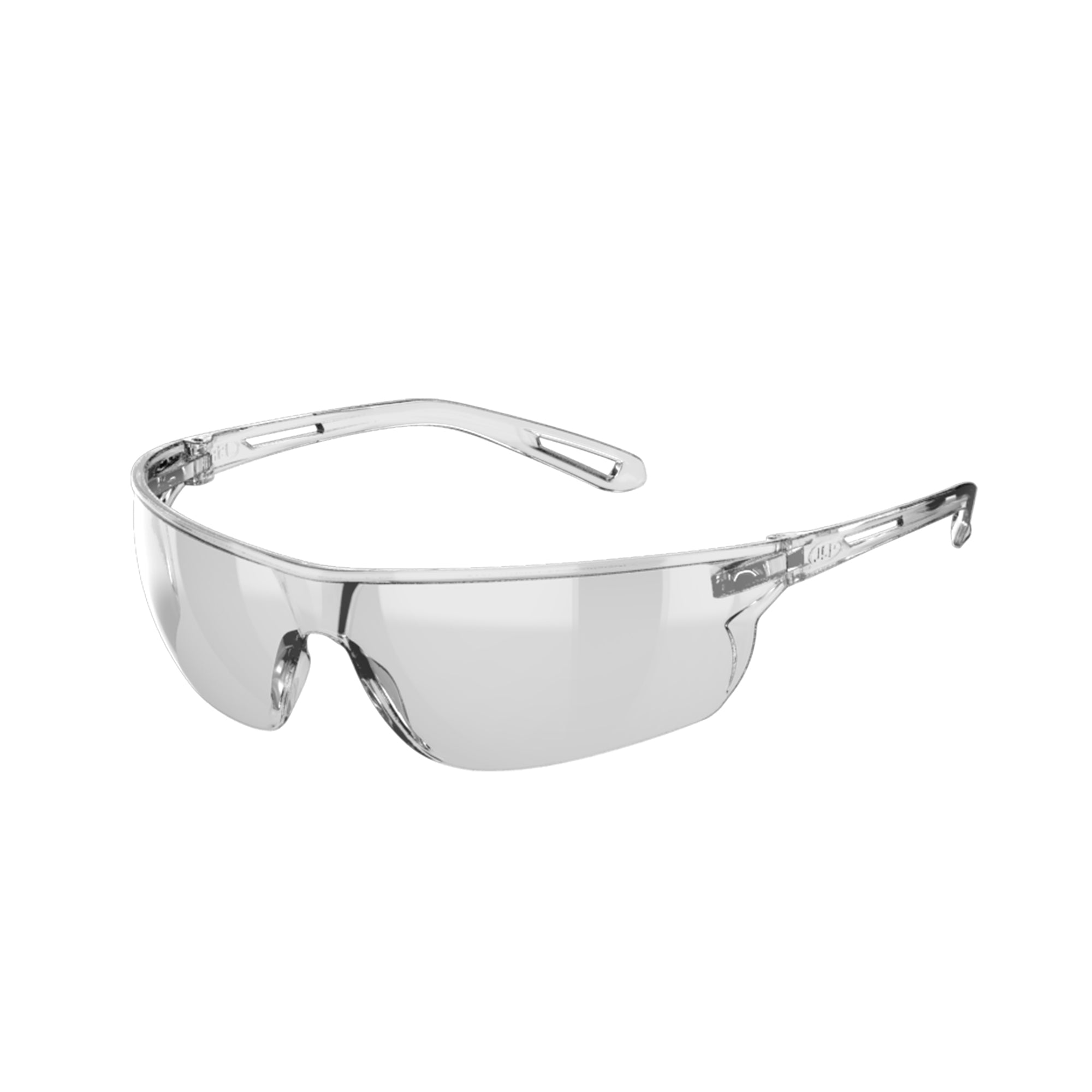
Sixteen grams is genuinely light — about the weight of a couple of coins — and it’s the pair I’d reach for on a day that means wearing safety glasses continuously rather than on and off for individual tasks: a loft survey with repeated hatch access, or a run of cavity inspection holes through a terrace. The dual 9.5-base lens is moulded thinner than most while still meeting the EN166 1.F impact rating, and the sports-style flexible temples with soft rubber tips add almost no bulk. The trade-off for that light weight is a slightly narrower lens than the wraparound picks, so it suits controlled tasks better than genuinely dusty, gritty environments.
For
- 16g — the lightest pair on this list by some margin
- Sports-style flexible temples, minimal bulk under other PPE
- EN166 1.F rated despite the thin lens
Against
- Narrower lens than the wraparound picks, less peripheral coverage
- Feels less substantial in the hand than the trade-brand options
Typically £4–£9
Check price on AmazonHoneywell A800 Safety Glasses

Best value multipack — three pairs for less than one premium pair
The A800’s Fog-Ban coating is a genuine anti-fog treatment rather than a basic anti-scratch-only lens, and buying it as a pack of three rather than a single pair changes the maths on keeping spares: one pair lives in the van, one in the tool bag, and one gets handed to whoever’s tagging along on site without a second thought about cost. EN166:2001 1FT rated — the T covers resistance to a higher-energy impact than the basic F rating — with a sporty wraparound shape and a non-slip rubber nose bridge that copes reasonably well with a sweaty forehead in a warm loft.
For
- Sold as a pack of three — genuinely cheaper per pair than most single listings
- EN166 1FT rated, above the basic impact standard
- Spare pairs cost nothing to hand to a visitor or apprentice
Against
- Coating doesn’t match the dual-sided treatment on the Uvex or 3M picks for longevity
- Frame feels more disposable than the trade-brand options
Typically £8–£14 (pack of 3)
Check price on AmazonPortwest PS32 Wrap Around Plus Safety Glasses
Best on a budget — a properly rated pair for a few pounds
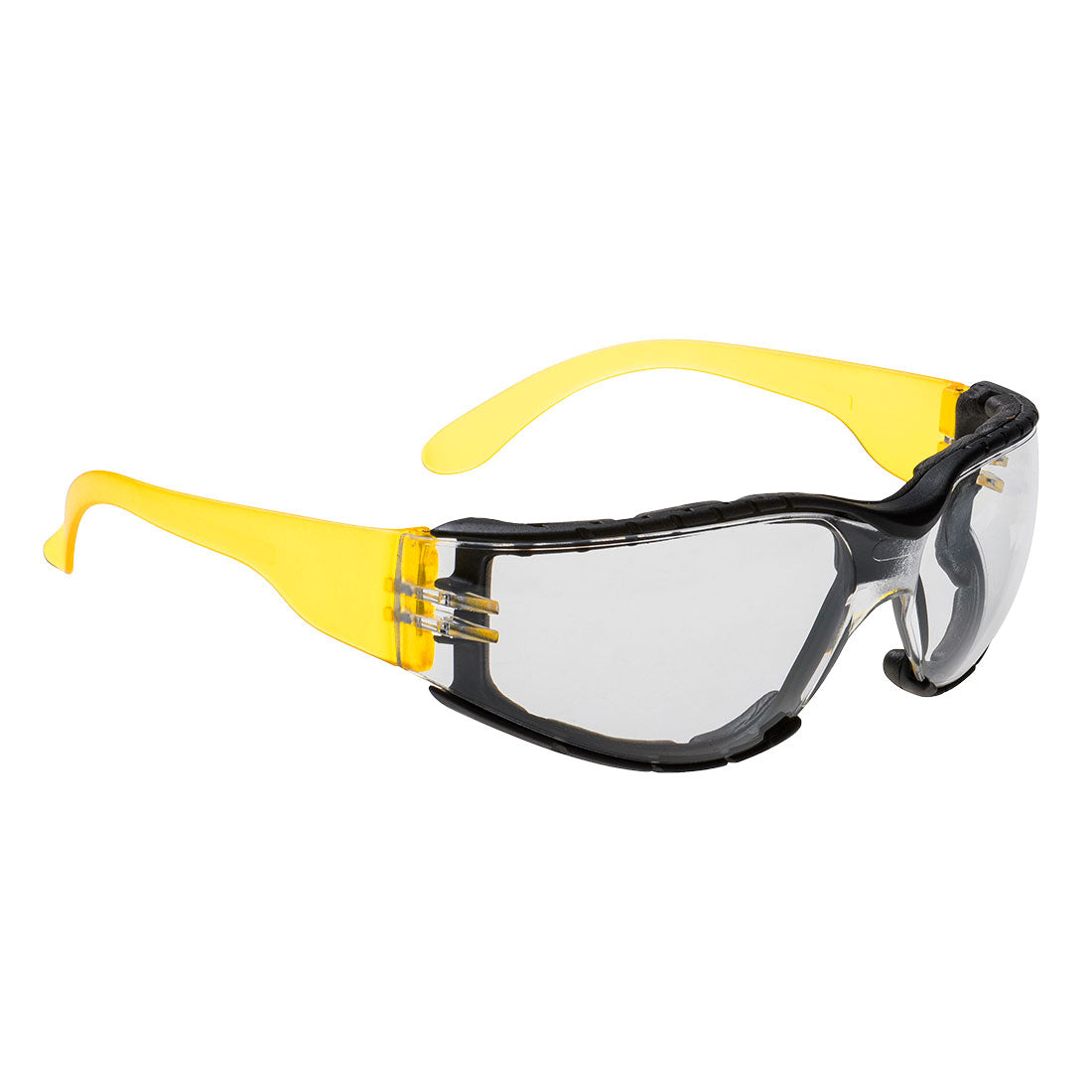
The PS32 adds a removable foam gasket around the lens edge that the standard PW32 doesn’t have, improving the seal against dust at the temples without turning it into a full goggle — useful if you’re regularly in loft insulation or disturbing old ceiling material. It’s EN166 1FT rated with anti-fog and anti-scratch coating as standard, which is more than some considerably pricier unbranded listings can claim, and at this price there’s no reason not to keep two or three scattered around the van, bag and glovebox.
For
- Genuinely EN166 1FT rated at a price most unbranded glasses can’t match
- Removable gasket improves the seal against loft dust
- Cheap enough to keep several spares
Against
- Basic frame, doesn’t stack quite as comfortably under ear defenders as the shaped trade picks
- Gasket is an extra part that can be lost
Typically £2–£5
Check price on AmazonAmazon Basics Safety Glasses, Anti-Fog, 12-Pack

Best for spares and visitors — a box for the van, not a daily driver
Every survey eventually involves a second person on site — a client, a contractor, an apprentice — who needs eye protection for the two minutes they’re stood next to a drill or a bolster and chisel, and buying twelve pairs at once solves that without thinking about it again for a year. They carry EN166 CE marking and an anti-fog coating, which is the minimum worth checking for on any bulk multipack — plenty of unbranded bulk listings skip the certification mark entirely and are worth avoiding regardless of price. Not the pair to rely on as your own daily-wear glasses, but exactly right as the box that lives in the van door pocket.
For
- EN166 CE marked, unlike a lot of unbranded bulk multipacks
- Twelve pairs solves the “who’s got spare glasses” problem for a long time
- Cheap enough not to mind losing one
Against
- Basic comfort and coating quality next to the named trade brands
- Not the pair to wear all day, every day
Typically £15–£25 (pack of 12)
Check price on AmazonWhat actually matters — and what doesn’t
A dual coating beats a marketing sticker. “Anti-fog” printed on a listing can mean a genuine bonded treatment on the inside face of the lens, or it can mean a spray applied at the factory that lasts a few wipes. The manufacturers who describe their coating in two parts — anti-fog inside, anti-scratch outside — are telling you it’s a real dual-sided treatment rather than a single compromise coating. Worth reading the actual product description rather than trusting the headline word.
EN166 marking is non-negotiable, whatever the price. Any glasses sold as PPE for work in the UK should carry visible EN166 marking on the lens or frame, sometimes with additional letters (F, B, K, T) for the specific protection level. A pair with no marking at all — common among the cheapest unbranded multipacks — isn’t legally safety eyewear no matter how the listing is titled, and shouldn’t be relied on for anything more than keeping dust out of your eyes.
Buy for the PPE stack, not the glasses alone. A frame that’s comfortable on its own can become genuinely painful once ear defenders clamp over the top of the same temple arm for a few hours. If you regularly wear ear defenders or a dust mask alongside eye protection, try the combination before committing to six identical pairs.
Clear is the right default for survey work. Tinted and mirrored lenses look the part but make a dim loft, cellar or void genuinely harder to read. Save the tint for outdoor roof work in bright sun; keep a clear pair as the one that lives in the bag for everything else.
Prescription wearers have a real option, not just a compromise. Over-the-glasses (OTG) safety spectacles, such as Portwest’s PS24 Peak OTG, are designed to fit comfortably over an existing pair of prescription glasses rather than forcing a choice between the two. Worth knowing about before assuming a full prescription safety pair is the only route.
Questions I get asked
Do I actually need safety glasses for a routine building survey? Whenever you’re drilling a cavity wall inspection hole, using a hammer and bolster to open up a small area, or working under a loft hatch or anything else that could drop debris on you. The risk on most survey visits is low-level rather than dramatic, but a chip of masonry or a fall of old plaster dust in the eye is a genuinely avoidable inconvenience for the cost of a pair of glasses.
What’s the difference between anti-fog and anti-scratch coatings, and do I need both? Anti-fog stops condensation forming on the inside of the lens when your breath, body heat or a sudden change in temperature meets a cooler surface — the exact scenario climbing into a loft after exertion. Anti-scratch protects the outer face from the daily wear of being pocketed, wiped and knocked about in a tool bag. For anything worn regularly rather than kept as an emergency spare, both are worth having.
Can I wear safety glasses over my own prescription glasses? Yes — over-the-glasses (OTG) designs are a genuine category, built with extra depth and width to sit over an existing frame rather than replace it. They’re not as sleek as a standard pair but solve the problem properly, and are worth searching for by name if a standard safety spectacle keeps slipping over your own glasses.
Are the cheap unbranded multipacks from Amazon actually safe? Some are, some aren’t — the only reliable way to tell is checking for EN166 marking on the lens or frame itself, not just a mention of “safety” in the listing title. A named brand with a stated EN166 rating, even at the cheap end like the Portwest pick above, is a safer bet than an anonymous listing with no marking mentioned at all.
Eye protection is one small part of a wider PPE picture on site — if you’re also stacking up ear defenders for a noisy job or drilling cavity wall inspection holes regularly, it’s worth thinking about the combination rather than each item alone. The practice carries out building surveys and PAS 2035 retrofit assessments that involve exactly this kind of hands-on investigation — get in touch. And if you’re kitting out a survey bag, there are more field-kit guides.
Small print. This guide is general information, not a risk assessment for your site or task; the right eye protection depends on the specific hazard in front of you, and this guide doesn’t replace a proper PPE assessment where one is needed. Prices are indicative, move constantly and were checked at the time of writing; the linked page always shows the current price. As an Amazon Associate I earn from qualifying purchases.