An SDS drill going into masonry runs comfortably past 100dB at the operator’s ear. An angle grinder on brick is louder still. For context, the Control of Noise at Work Regulations 2005 draw their lines at 80dB(A) — where an employer must make hearing protection available — and 85dB(A), where wearing it stops being optional and areas have to be signed as hearing protection zones. Every rotary hammer, chop saw and breaker in Britain operates well beyond both. If you’ve read my SDS drills guide, this is the other half of that purchase.
The cruel arithmetic of noise is that the scale is logarithmic: every 3dB doubles the sound energy, and halves the exposure time your ears can take. Eight hours at 85dB carries the same dose as roughly fifteen minutes at 100dB. Noise-induced hearing loss is permanent, cumulative and completely preventable, and I meet the end of the story often enough — retired trades on surveys who ask me to repeat everything twice, because the seventies and eighties happened to their ears before anyone made them wear muffs.
I spend my working life around this noise rather than making most of it — but between drilling for cavity-wall inspections, workshop jobs and garden machinery, hearing protection belongs in the van door with the head torch. What separates a good set of ear defenders from a bad one is not the number on the box. It’s whether they’re still on your head at four in the afternoon.
The one I’d buy

3M Peltor X5A
The SNR benchmark. At 37dB the X5A attenuates more than any other mainstream headband earmuff, which means it covers everything from a hammer drill to a demolition breaker without dual protection — and it does it for around £40. Owner feedback is remarkably consistent: bulky, slightly firm-clamping, and worth both.
Typically £40–£55
Check price on AmazonHow I judge a set of ear defenders
The SNR, decoded. SNR — Single Number Rating — is the attenuation figure from the EN 352 test: subtract it from the noise level to estimate what reaches your ear. A 100dB grinder through SNR 30 muffs is roughly 70dB. Two caveats. The lab figure assumes a perfect fit, so HSE guidance knocks about 4dB off for real-world wear. And more is not automatically better — the target at the ear is 70–80dB, and cutting below 70 leaves you straining to hear shouted warnings and reversing plant. SNR 30 or so suits most site noise; 35-plus earns its keep on the brutal stuff.
Comfort decides compliance. Ear defenders only work while they’re on: a few minutes unprotected in a loud environment wipes out most of the benefit of the other eight hours. So clamping force, headband padding, cup depth and weight matter more than the last two decibels of SNR. Owner reviews are the best data here, and the pattern is clear — people abandon muffs that squeeze, and keep wearing comfortable ones.
Glasses and hard hats. Spectacle arms — or safety-glasses arms — break the cushion seal, and the published research puts the penalty at anywhere from 3 to 9dB depending on the frame. Thick-cushioned cups with soft foam handle glasses better; thin flat cushions handle them worst. If you wear a hard hat all day, helmet-mounted cups beat fighting a headband under a brim.
Passive or electronic. Passive muffs are foam and plastic: nothing to charge, nothing to fail. Electronic level-dependent muffs carry microphones that reproduce ambient sound inside the cup and cut it off the instant it exceeds a safe level — so you can hold a conversation and catch a shout with the muffs still sealed. That solves the lifting-the-cup problem, and it’s why I think a level-dependent set is worth the premium for anyone wearing muffs all day around other people.
Spares and hygiene. Cushions and foam inserts compress and crack with use, and attenuation quietly degrades with them. The proper brands (3M especially) sell hygiene kits — replacement cushions and inserts — so a £40 muff can be refreshed for a tenner every year or so. Muffs with no spares ecosystem are disposable, whatever they cost.
The comparison
| Model | SNR | Type | Typical price | Best for | |
|---|---|---|---|---|---|
| 3M Peltor X5A | 37dB | Passive, headband | ~£45 | Maximum attenuation — the benchmark | View |
| 3M Peltor Optime III | 35dB | Passive, headband | ~£26 | The professional workhorse | View |
| 3M Peltor ProTac III | 32dB | Electronic, level-dependent | ~£110 | Hearing conversation with the muffs on | View |
| ISOtunes Air Defender | 30dB | Electronic, Bluetooth | ~£75 | Workshop days with audio, volume-limited | View |
| Milwaukee BOLT | 30dB | Passive, helmet-mounted | ~£36 | Hard-hat wearers on the BOLT system | View |
| Stihl Concept 24 | 24dB | Passive, headband | ~£24 | Garden machinery — mowers, strimmers, saws | View |
| Portwest PW40 Classic | 27dB | Passive, headband | ~£6 | Best on a budget — spares for every van | View |
| Alpine Muffy Kids | 25dB | Passive, kids’ sizing | ~£24 | Children visiting noisy places | View |
The picks in detail
3M Peltor X5A
Best overall — the attenuation benchmark, and my top pick above
SNR 37 is about as high as passive earmuffs go, and 3M gets there with deep cups, a spacer plate in the shell and a twin-wire headband that spreads the necessary clamping force. The practical upshot: on a 105dB breaker the X5A still puts you around 70dB at the ear — most 30dB muffs are marginal there, especially after the real-world fit penalty. Owner feedback flags the two honest costs of that performance — the cups are big, and the grip is firm — but full-day comfort reviews are better than the clamping figure suggests, and the cushions are replaceable via 3M’s hygiene kit.
The counter-argument is isolation: for intermittent noise with people around you, 37dB is more than you want, and the ProTac below is the smarter tool.
For
- SNR 37 — covers breakers and grinders without dual protection
- Headroom for imperfect fit and worn cushions
- Hygiene kit keeps it serviceable for years
- Modest price for what it does
Against
- Bulky — awkward in tight lofts and around beams
- Overkill for conversation-heavy, intermittent-noise days
Typically £40–£55
Check price on Amazon3M Peltor Optime III

Best value professional — the muff you see on every serious site
The Optime III has been the default professional earmuff in Europe for decades: SNR 35 from a double-shell cup design that specifically targets low-frequency noise — the plant-and-machinery end of the spectrum where cheap muffs are weakest. It gives up 2dB to the X5A but sits slimmer on the head, weighs less, and typically costs almost half as much. Published user feedback across thousands of reviews is boringly uniform: comfortable, durable, does what the tin says. If the X5A didn’t exist this would be the top pick, and for anyone working around compressors, mixers and diggers rather than their own drill, it arguably still is.
For
- SNR 35 at a workhorse price
- Double-shell design strong on low-frequency machinery noise
- Slimmer and lighter than the X5A; hygiene kits available
Against
- Firm clamp out of the box, by broad owner consensus
- Cushions less forgiving over glasses than deeper-foam designs
Typically £22–£32
Check price on Amazon3M Peltor ProTac III

Best electronic — level-dependent hearing, so the muffs never come off
This is the one that fixes the actual problem. External microphones feed ambient sound into the cup at a safe level, so speech, footsteps and reversing bleepers come through naturally — then the electronics clamp instantly when a gun nailer fires or a grinder spins up. SNR 32 passive underneath means it protects even with the batteries flat — buy the full-size MT13H221A for site work, not the SNR 21 “Slim”. It runs on two AAs with an auto shut-off. The premium over passive muffs is real, but it buys the thing no passive muff can do: protection that stays sealed while you talk.
For
- Conversation and warning sounds with full protection in place
- SNR 32 passive baseline — works with batteries dead
- AA batteries, auto shut-off; hygiene kits available
Against
- Three to four times the price of the passive equivalent
- Electronics add weight and another thing to look after
Typically £100–£150
Check price on AmazonISOtunes Air Defender

Best Bluetooth — audio and calls inside proper EN 352 protection
ISOtunes built its name doing hearing protection with audio properly, and the Air Defender is the over-ear expression of that: SNR 30 to EN 352, Bluetooth streaming and calls, a claimed 40-hour battery, and — the bit that matters — an output limiter that caps what the speakers deliver to your ear at a safe level. That last feature is what separates certified audio muffs from wearing ordinary headphones in a workshop, which protects nothing. For long solo days — sanding, mowing, machine-minding — this is the format that keeps protection on heads. It is not level-dependent, so buy it for solo noise, not site teamwork.
For
- Certified SNR 30 with volume-limited streaming and calls
- Claimed 40-hour battery — a working week per charge
- Makes all-day wear genuinely likely
Against
- No level-dependent ambient mode for conversation
- Audio can be its own distraction around moving plant
Typically £65–£90
Check price on AmazonMilwaukee BOLT ear protectors

Best helmet-mounted — for anyone living in a hard hat
Headband muffs and hard hats fight each other all day. Milwaukee’s answer clips into the BOLT accessory slots on its hard hats and helmets: SNR 30 cups that pivot up out of the way between noisy jobs and park flat against the shell, so the protection travels with the hat rather than living in a pocket. Owner feedback rates the mounting as solid and the attenuation as honest; the obvious catch is that it’s a system purchase — no Milwaukee BOLT lid, no dice. 3M makes P3E helmet-mount Optime versions for its own lids; this entry stands for the format as much as the badge.
For
- SNR 30 that’s always attached to the hat
- Cups pivot clear between noisy tasks — no muffs round the neck
- Solves the headband-under-hard-hat problem outright
Against
- Only fits Milwaukee’s BOLT helmet system
- Costs more than better-attenuating headband muffs
Typically £30–£40
Check price on AmazonStihl Concept 24

Best for garden machinery — light, low-profile, from the chainsaw people
Stihl knows exactly what its customers’ ears are up against, and the Concept 24 is built to that brief: a light, slim SNR 24 muff designed to be comfortable through a full day of strimming, mowing and saw work, and to sit properly alongside a face shield. The modest SNR is a feature, not a shortfall — a petrol mower at 90-odd dB through 24dB lands you in the safe-but-aware band, where a 35dB muff would leave you deaf to anything going wrong with the machine. For chainsaws at 105dB-plus, step up the attenuation.
For
- Light and low-profile — all-day comfort by design
- Sensible attenuation for garden machinery levels
- Plays well with visors and face shields
Against
- SNR 24 is marginal for the loudest tools
- Dearer than plain muffs of similar attenuation — some badge tax
Typically £20–£28
Check price on AmazonPortwest PW40 Classic

Best on a budget — certified protection for the price of a sandwich
Portwest is a proper Irish PPE house that supplies half the sites in Britain, and the PW40 is its no-frills classic: EN 352 certified, SNR 27, adjustable headband, routinely under £7. At that money the right question isn’t “is it as good as a Peltor” (no) but “is there any excuse for an unprotected ear in the building” (also no). Buy two or three: one for the van door, one by the mower, one for whoever turns up to help. SNR 27 handles the drill-and-saw tier honestly; for sustained breaker work spend more.
For
- Certified SNR 27 for £5–£9
- Cheap enough to stage everywhere noise happens
- Reputable manufacturer, not a marketplace mystery brand
Against
- Thin cushions — comfort fades over long sessions
- No replacement-cushion kits; worn out means binned
Typically £5–£9
Check price on AmazonAlpine Muffy Kids
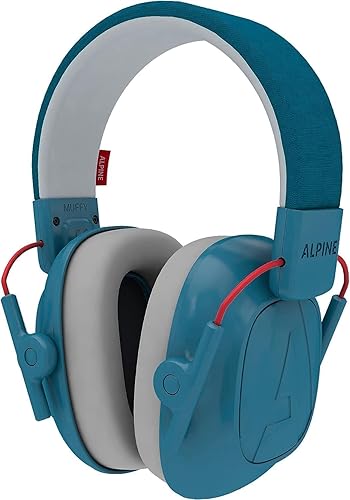
Honourable mention — the kids’ sizes, for family buyers
Adult muffs don’t fit children — the headband spans wrong, the cups don’t seal on a smaller head, and a bad seal means the SNR on the box is fiction. Alpine’s Muffy Kids is the sensible answer: CE and UKCA certified, SNR 25, sized for roughly age five to sixteen, light enough to be tolerated for a whole airshow. If a self-build or renovation has children visiting site — and they always do visit, usually at the loudest moment — a set of these in the car is cheap insurance. The same logic covers fireworks night and motorsport. Children’s ears are more vulnerable than adults’, not less.
For
- Properly sized and certified for children — the seal actually seals
- Light, adjustable, widely liked by reviewing parents
- Covers site visits, fireworks and festivals alike
Against
- SNR 25 is for visiting noise, not operating machinery
- Costs as much as an adult Optime III
Typically £20–£28
Check price on AmazonWhat actually matters — and what doesn’t
Wear time beats attenuation. The arithmetic is unforgiving: SNR 35 muffs worn for all but fifteen minutes of a loud eight-hour day protect you like SNR 10 muffs worn constantly. Every purchase decision on this page is downstream of that fact. Comfortable muffs you keep on outperform heroic muffs you keep lifting, which is the whole case for the level-dependent electronics in the ProTac — they remove the main reason cups come off.
In-ear or over-ear. Foam plugs carry impressive lab SNRs and cost pennies, but their performance depends entirely on being rolled, inserted deep and left alone — and site studies consistently find them badly fitted. With plaster dust on your hands, re-fitting plugs is also a hygiene event. Muffs go on right every time, visibly. Plugs win in tight crawl spaces where cups snag, and as the second layer of dual protection (plugs plus muffs) for sustained 105dB-plus work. For everything else, over-ear is the honest default.
Check the certification, not the claim. Legitimate hearing protection sold in the UK carries EN 352 certification and a stated SNR with its test data. Marketplace listings festooned with “38dB noise cancelling” claims at £12 deserve suspicion — and note that “noise cancelling” in the headphone sense (ANC) is not hearing protection at all. ANC electronics soften low-frequency drone for comfort; they do not attenuate a 110dB impact peak, and ordinary consumer headphones add their own noise dose on top.
What the salesmen push that you can skip. Camouflage colourways, “tactical” branding, app connectivity for a set of earmuffs, and gel cushions on a muff you’ll wear twenty minutes a week. What’s genuinely worth paying for: a hygiene-kit ecosystem, level-dependent microphones if you work around people, a volume limiter if you want audio, and cushions deep enough to seal over glasses. The rest is margin.
Questions I get asked
What SNR do I need for site work? Work it backwards from the noise: aim for 70–80dB at the ear, subtracting the SNR from the tool’s noise level and then around 4dB more for real-world fit. A 100dB SDS drill through SNR 30 muffs lands about 74dB — right in the band. SNR 25–30 covers most power-tool work; 35-plus earns its place on breakers and demolition; and going far below 70dB is counterproductive, because you stop hearing the things that keep you alive on site.
Are electronic ear defenders worth it? If you work around other people, genuinely yes. The biggest practical failure of hearing protection isn’t weak attenuation, it’s cups lifted to hear a question and never quite going back on. Level-dependent muffs like the ProTac III let conversation through electronically while clipping anything dangerous, so the seal never breaks. Working alone, a passive muff or a volume-limited Bluetooth set does the job for less.
Can you wear ear defenders with glasses or a hard hat? Yes, with penalties worth managing. Spectacle arms break the cushion seal and published testing puts the loss at roughly 3–9dB — thin, flat frame arms lose least, chunky ones most, and deeper foam cushions forgive more. If the numbers are marginal, that lost seal is your margin gone, so size the SNR up a band. With hard hats, headband muffs physically fight the shell; helmet-mounted cups like the Milwaukee BOLT set (or 3M’s P3E-mount Optime versions) exist precisely for this.
Is 85dB really the legal limit? The Control of Noise at Work Regulations 2005 set three lines. At 80dB(A) daily exposure, an employer must provide hearing protection to anyone who asks. At 85dB(A), protection becomes mandatory and areas must be signed as hearing protection zones. And 87dB(A) is the absolute exposure limit at the ear, measured with the protection’s effect included. For scale: a hammer drill will breach the 85dB action value in well under an hour of trigger time.
Noise is a health topic, and so are the houses it happens in. The practice does PAS 2035 retrofit assessments — where drilling, cutting and blowing insulation all feature — along with building surveys across Sussex, Kent and the South East; get in touch if that’s the help you need. The tool making most of the noise has its own write-up in the SDS drills guide, and there are more field-kit guides for the rest of the bag.
Small print. This guide is general information, not occupational-health advice; noise exposure depends on your tools, your hours and your ears, and nothing here replaces a proper noise assessment where the regulations require one. Prices are indicative, move constantly and were checked at the time of writing; the linked page always shows the current price. As an Amazon Associate I earn from qualifying purchases.