A good share of the defects I write up start above head height: blocked and back-falling gutters, fascias quietly rotting behind the paint, slipped flashings on low chimneys. And a good share of the injuries in British housing start the same way — someone at the top of a ladder, over-reaching with a trowel in one hand. A ladder is a way of getting to a height; it is a poor place to work at one. The moment a job involves two hands, more than a few minutes, or moving along a run — a gutter clear-out, a fascia repair, repointing a gable verge — a mobile scaffold tower is the right answer, and the Work at Height Regulations have said as much since 2005.
The market splits cleanly in two, and the split matters more than any brand name. On one side are towers certified to EN 1004 — the mobile access tower standard, current version EN 1004-1:2020 — with guardrails, toe boards, stated platform loads and a safe method of building the thing without ever standing on an unprotected deck. On the other side is the “DIY scaffold tower”, sold on working height and price: at best a well-made aluminium frame kit from a long-established British firm, at worst an unbranded marketplace special with no paperwork at all. This is the same enforcement world as ladders — the Office for Product Safety and Standards has spent years pulling non-compliant telescopic ladders off the market, and the unrated end of the tower trade deserves exactly the same scepticism. (If a ladder genuinely is the right tool for your job, I’ve written up the telescopic ladders worth having separately.)
The other thing to get straight before spending anything is the height game. Towers are marketed on working height — platform height plus roughly two metres of you. A “5m scaffold tower” puts the platform, and your boots, at about 2.75–3m. That reaches a single-storey gutter and first-floor windows comfortably; it does not reach a two-storey gutter, whatever the headline number suggests. Every height in this guide is stated both ways.
The one I’d buy
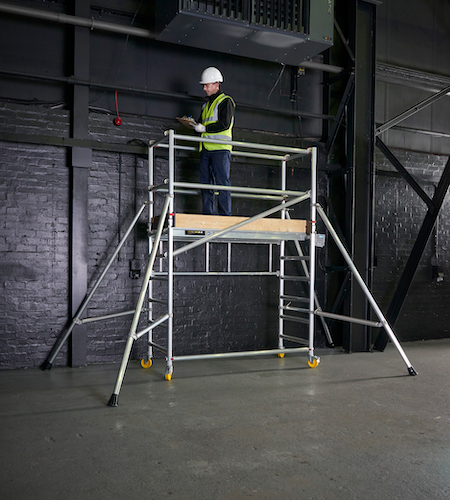
Youngman MiniMax
A genuinely EN 1004-certified trade tower that folds to fit through a standard doorway, builds by one person with snap-click fittings, and grows from a 0.6m platform base unit to 5.8m of platform with add-on packs. It is the tower you actually meet on site, from a firm — Youngman, owned by WernerCo, the people behind BoSS — that has been making access kit for a century, and the smaller packs cost less than many people spend on an unrated kit plus a hire weekend.
Typically £700–£1,400 depending on platform height pack
Check price on AmazonHow I judge a scaffold tower
Certification first. EN 1004-1:2020 is not a sticker; it is a design standard covering strength, rigidity, guardrail heights, platform loading and — crucially — a safe assembly method, so you are never standing on a deck with nothing around your knees. A tower that carries it can be used for paid work. A tower that says “load tested to EN 1004” is making a strength claim, not a certification claim — read those words as carefully as I read a damp-proofing quote.
Platform height, honestly stated. Decide the height your feet need to be, then shop on platform height and treat working height as marketing. Gutter on a bungalow: platform around 1.5–2m. First-floor windows, single-storey roofs and porch roofs: 2.5–3m. Two-storey gutters and fascias: about 4m of platform, which means a “6m working height” tower and a step up in money and weight.
Stabilisers as standard, not accessories. Outriggers transform a tower — owner feedback on every DIY kit in this guide says the same thing: wobbly at full height without them, planted with them. EN 1004 towers specify exactly when stabilisers must be fitted for a given height and exposure. If a seller offers them as an optional extra on a tall kit, price them in; you will want them.
One-person reality. A tower you cannot carry through the side gate, or assemble without a second pair of hands, stays in the garage while you fetch the ladder. Component weight, pack size and whether the frames fit in an estate car matter as much as the load rating. This is the entire argument for the MiniMax and the MI TOWER below.
A firm that will still exist. Castors seize, platform hooks crack, wingnuts walk off into the flower bed. Youngman, Toptower, Loyal and BPS have been selling spares for years and answer a phone in England. The unbranded £250 special has no spares, no manual worth the name, and no one to write to when a weld looks wrong.
The comparison
| Model | Platform / working height | Rating | Typical price | Best for | |
|---|---|---|---|---|---|
| Youngman MiniMax | 0.6–5.8m platform, by pack | EN 1004 certified | £700–£1,400 | Buying once for regular work | View |
| MI TOWER (Pop Up) | 2–4m platform / 4–6m working | EN 1004 Class 3 | £1,400–£1,800 | One-person assembly, trade use | View |
| Loyal Super DIY 5 | 3m platform / 5m working (3-in-1) | Load-tested claim, not certified | £450–£550 | The better class of DIY tower | View |
| Home Master DIY 5m | 2.75m platform / 5m working | Component test claim, not certified | £280–£340 | Best on a budget | View |
| BPS Premium DIY 5m | ~2.8m platform / 5m working | DIY grade, outriggers included | £400–£500 | DIY kit with the stability sorted | View |
| Toptower Classic 5.5m (steel) | 3.5m platform / 5.5m working | DIY grade, galvanised steel | £400–£550 | Static, longer jobs on firm ground | View |
The picks in detail
Youngman MiniMax
Best overall — a certified trade tower at a householder’s price, and my top pick above
The MiniMax’s trick is that the folding base unit passes through a standard internal doorway fully built, then extends with snap-click packs from a 0.6m platform (ceilings, stairwell heads, soffits) up to 5.8m of platform for genuine two-storey work. It is certified to the current EN 1004 standard, builds through the trapdoor so there is a guardrail around you before you stand up, and the spares — castors, platforms, braces — are all still buyable years later. Owner and trade feedback agrees on the two things that matter: it goes up quickly single-handed, and it feels like site equipment rather than a garden gadget. The honest caveat is that the pricing is modular — each extension pack adds real money — so price the platform height you actually need before comparing it against the DIY kits below.
For
- EN 1004 certified — usable for paid work, satisfies site rules
- Fits through a doorway fully built; genuinely one-person
- Modular from ceiling height to two-storey gutters
- WernerCo/Youngman spares and support behind it
Against
- Extension packs make the full-height versions serious money
- Heavier than a DIY kit of the same nominal height
Typically £700–£1,400 depending on platform height pack
Check price on AmazonMI TOWER (Pop Up Products)

Best for professionals — the one-person tower the hire fleets carry
The MI TOWER’s entire design brief was “one person, no help, under ten minutes”, and it delivers that while staying EN 1004 Class 3 compliant with a 200kg platform rating. Platform heights of 2, 3 or 4m give working heights of 4 to 6m — two-storey gutters and fascias, exactly the territory where lone tradespeople are otherwise tempted to do silly things off ladders. The parts pack onto their own wheeled trolley that fits in a small van, and this is the unit the national hire chains hand over when you ask for a one-man tower — which tells you how it survives being used by strangers. For a householder it is hard to justify against hiring; for anyone who works alone at eaves level more than a few times a year, surveyors included, it is the defensible professional buy.
For
- Genuine one-person build, guardrails in place before you stand up
- EN 1004 Class 3; 200kg platform rating
- Packs onto its own transport trolley
- Hire-fleet proven — robust and idiot-tolerant
Against
- Serious money for occasional use — hire first, buy when the maths says so
- Small 1.02m × 0.60m platform; a work position, not a loading bay
Typically £1,400–£1,800
Check price on AmazonLoyal Super DIY 5 (3-in-1)
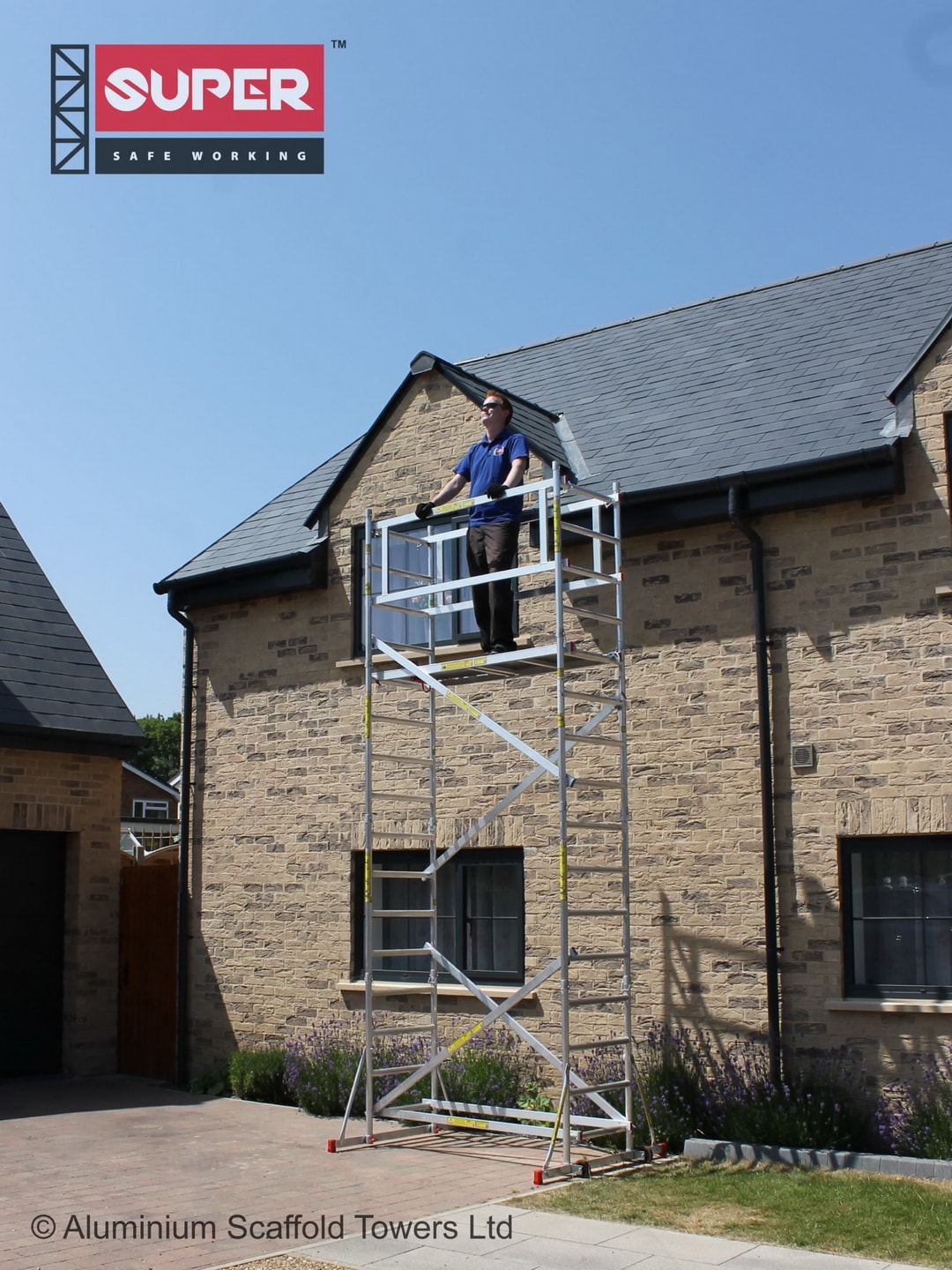
Best DIY aluminium tower — the heavy-duty end of the domestic class
Loyal are a long-standing Cambridgeshire tower firm, and the Super DIY 5 is their heavier-gauge domestic kit: a 600mm-wide aluminium scaffold tower that builds to 3, 4 or 5m working heights from the same parts, with a 3m maximum platform height, a 150kg rating and stiffener bars to square the frames up. The maker quotes load-testing against EN 1004 requirements — a strength claim rather than certification, and the firm itself points commercial users elsewhere. Owner feedback rates the welded frames and the slim footprint for squeezing along side returns; the flip side of slim is that at full height it wants its outriggers fitted and a level base underneath.
For
- Noticeably heavier-gauge than the cheapest DIY kits
- Three working heights from one kit; +2m extension pack later
- Narrow 600mm frame gets down passageways
- Established UK firm, spares and extensions available
Against
- Not EN 1004 certified — domestic use only
- One person on the platform, and it needs its stiffeners and outriggers up high
Typically £450–£550
Check price on AmazonHome Master DIY Scaffold Tower 5m
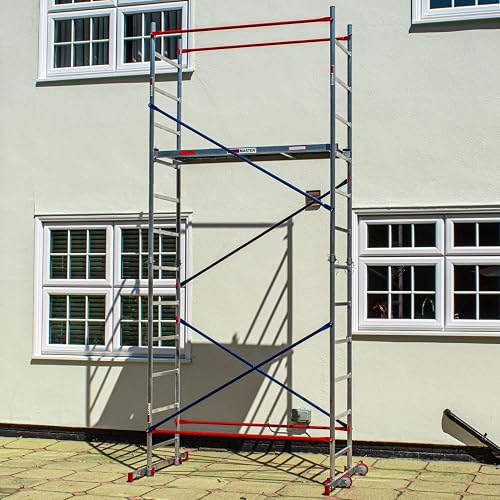
Best on a budget — the honest entry point to tower ownership
BPS’s Home Master is the perennial Amazon bestseller of this category: for around £300 you get a fully-welded aluminium frame kit, colour-coded braces, a trapdoor platform adjustable in 300mm steps and a 150kg rating. The 5m working height means your feet stand at 2.75m — single-storey gutters and first-floor windows, not the roofline. Published owner feedback is remarkably consistent: easy to move and store, fine for upstairs windows but not the apex, a little wobble at full height that the outriggers cure, instructions written by someone who never met the product, and strictly one person up it at a time. Treat that as the terms of the deal and it is a lot of useful access for the money.
For
- Around £300; light enough to shift and store easily
- Welded frames and tool-free assembly
- 2m extension pack available if you outgrow it
- From BPS, a 20-year UK access firm — not a nameless import
Against
- Not EN 1004 certified; domestic use only
- Wants the outrigger set at full height — budget for it
- Marine-ply platform shouldn’t live outdoors
Typically £280–£340; taller kits to 7m cost more
Check price on AmazonBPS Premium DIY Scaffold Tower 5m

The step-up DIY kit — outriggers in the box, quicker to build
The Premium is BPS’s better-specified line: twist-and-lock braces instead of wingnuts, tilt-and-roll wheels, the same 150kg rating, and — the meaningful difference — four outriggers in the box rather than sold as an afterthought. Since the most repeated line in DIY-tower owner feedback is “fine once the outriggers went on”, that is worth real money. Working heights run 4m to 7m across the range; the 5m kit again puts the platform a shade under 3m. Same class and caveats as the Home Master — domestic grade, one person, level ground — just less faff per build.
For
- Outriggers included — the stability problem pre-solved
- Twist-and-lock braces speed up assembly noticeably
- Same BPS spares and guarantee behind it
Against
- Not EN 1004 certified; not for paid work
- £100+ over the Home Master buys convenience rather than reach
Typically £400–£500 for the 5m kit
Check price on AmazonToptower Classic 5.5m (galvanised steel)

The steel option — most platform height per pound, honestly flagged
Toptower have been welding these in Halesowen for over forty years, and the Classic is a different philosophy: pre-galvanised steel frames, timber scaffold boards, a 200kg distributed rating and a ten-year weld guarantee, at a price that undercuts aluminium kits of the same reach — the 5.5m working height version puts the platform at a genuine 3.5m. The honesty part: steel is heavy. Assembly is a proper job, and once built it tends to stay put — which is precisely why it suits a porch re-roof, a gable repaint or a season-long renovation better than a Saturday gutter clean. Domestic grade, firm level ground, and buy the adjustable bases if your drive falls away.
For
- 3.5m of real platform height for DIY-kit money
- Galvanised steel and a 10-year weld guarantee; spares from the factory
- 200kg distributed rating — tools and materials, not just you
Against
- Heavy; assembly and moving are two-person work
- Not EN 1004 certified; no guardrail-first build method
Typically £400–£550 depending on kit and base size
Check price on AmazonWhat actually matters — and what doesn’t
Hire or buy: do the arithmetic before the shopping. A decent alloy tower hires for roughly £60–£80 a week from the national chains, plus delivery, and what turns up is usually a BoSS Clima or similar — the £1,500-plus trade benchmark few private buyers could justify owning. For a one-off soffit repaint, hiring a proper EN 1004 tower is both cheaper and safer than buying a budget kit. The buying case starts when the weeks add up: a £300 DIY tower pays for itself in four or five hire-weeks, a MiniMax in nine or ten, the MI TOWER only if working at height is part of how you earn. Most people’s honest answer is a modest owned tower for the recurring low jobs and a hired trade tower for the occasional big one.
Ground and gradient beat everything above them. A tower is only as good as what its castors sit on. Firm, level and locked is the whole religion: boards or slabs under soft lawn, adjustable legs on a fall, castors braked before anyone climbs. Tower incidents rarely start with a failed weld; they start with the setup — no outriggers, a slope nobody measured, or someone wheeling the tower along with themselves still on the platform. Climb down, clear the deck, then move it.
If it’s for work, it’s PASMA territory. Use a tower in the course of paid work and the Work at Height Regulations expect demonstrable competence — in practice a PASMA Towers for Users card, a one-day course, and a tower assembled by the 3T (through-the-trap) or advance-guardrail method. Site managers ask for the card and the tower’s EN 1004 plate, in that order. None of this applies in law to your own gutters at home; all of the physics does.
What the listings push that you can skip. Working-height superlatives, mostly. A “massive 8m reach” on a 600mm-wide domestic frame is not a feature, it is a warning — the sensible DIY makers cap their platforms around 3m and say so. Ignore tool trays, ladder clips and “aircraft-grade aluminium” (all of it is, when the copywriter needs it to be). Spend the attention, and the money, on the boring things: certification if you work, outriggers regardless, platform height in metres, and a manufacturer with a phone number.
Questions I get asked
What size scaffold tower do I need for gutter work? Work from your feet, not the marketing. A typical single-storey gutter line sits around 3–3.5m, so a platform at 1.5–2m does it — a “4m working height” kit. A two-storey gutter at about 5–5.5m needs your boots at roughly 3.5–4m: that is the Toptower 5.5m, a MiniMax with the right pack, or the 4m-platform MI TOWER — not a “5m scaffold tower”, whose platform stops nearly a storey short of a two-storey eaves line.
Do I need training to use a scaffold tower at home? Legally, no — the Work at Height Regulations bite on work, not on householders. Practically, borrow the professional habits anyway: build it exactly per the manual, fit every brace and guardrail, come up through the trapdoor rather than climbing the outside, and never stand on an unguarded platform “just for a second”. If you are a tradesperson, assume any organised site will want a PASMA card and an EN 1004 tower before you leave the ground.
Are cheap DIY scaffold towers legal — and are they safe? Legal to sell and to use at home, yes; certified for work, no. The gap between a £280 kit and an EN 1004 tower is real: no guardrail-first assembly method, lighter frames, a rating that assumes one careful adult rather than a site. Used within those limits — level ground, outriggers on, one person, no improvised extensions — the established-brand kits here have years of owner feedback behind them. The ones to avoid are the unbranded marketplace towers with no stated standard, no manufacturer and no spares; that is exactly where product-safety enforcement keeps finding trouble with ladders, and towers fall further.
Can I use a scaffold tower on a slope or on grass? Only with the tools designed for it, and only modestly. Adjustable legs take out small falls — a driveway crossfall, a patio step-down — they do not make a hillside level. On grass or soft ground, spread the load with boards or slabs under the castors and recheck after rain: a leg that sinks 20mm moves the top of a 4m tower a long way. If the setup starts to feel like an engineering problem, that is the signal to hire proper access, or someone who owns it.
If what sent you up there in the first place is a stained fascia, a dropping gutter line or a chimney you don’t quite trust, the looking part is the day job here. The practice carries out building surveys across Sussex, Kent and Surrey — roofline, rainwater goods and all the defects that start above head height — so get in touch before the repair bill writes itself. And if you’re kitting out for more of this, there are more field-kit guides, including the binoculars I’d use for roof checks before anyone leaves the ground.
Small print. This guide is general information, not instruction, and no substitute for the manufacturer’s manual or — for work purposes — proper training; working at height punishes improvisation. Prices are indicative, move constantly and were checked at the time of writing; the linked page always shows the current price. As an Amazon Associate I earn from qualifying purchases.