Every building survey includes a roof I am not going to walk on. The question is how well I can read it from the ground, and the oldest answer is still one of the best: a decent pair of binoculars. From the pavement, the far side of the garden or an upstairs window across the street, 8x magnification turns a grey slope into legible detail — slipped and delaminating tiles, cracked ridge flaunching, nail sickness in a slate roof, lead flashings lifting at the abutment, moss damming a valley, a chimney stack leaning out of plumb. That is real evidence, and it goes straight into the report.
Drones changed the game for the difficult cases — I’ve written a separate guide to drones for roof inspections — but a drone needs airspace you’re allowed to fly in, weather that permits it, charged batteries, and in plenty of suburban streets a conversation with the neighbours. Binoculars need none of that. They work in drizzle, next to an airfield, under trees, in a conservation area, on a fifteen-minute EPC visit where a drone was never leaving the van.
The catch is that binoculars are sold on numbers that mislead. Magnification is the headline figure, and it is the one that matters least. What follows is how I’d actually choose a pair for survey work, and seven that the spec sheets and owner feedback support.
The one I’d buy
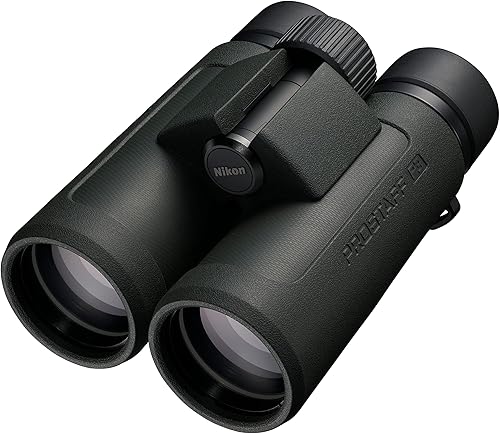
Nikon Prostaff P3 8x42
The sweet spot for survey work: proper Nikon optics, 8x magnification you can hold steady freehand, a bright 42mm objective, and a waterproof rubber-armoured body at around 485g — light enough to live in a survey bag without complaint. Owner feedback is consistent on the sharpness for the money, and there is nothing on it to break.
Typically £120–£160
Check price on AmazonHow I judge binoculars for roof work
Steadiness beats magnification. The counter-intuitive truth of hand-held optics: 8x shows you more than 10x, because you can hold it still. Every wobble of your hands is multiplied by the magnification, and at 10x and above the fine detail you paid for is smeared by tremor — exactly the detail you need to tell a hairline crack in a ridge tile from a shadow. 8x also gives a wider field of view, so tracking along fifteen metres of ridge line is a sweep rather than a hunt. The exception to the rule is image stabilisation, which is a genuine technology rather than a marketing line — more on that with the Canon below.
Objective size against bag weight. The second number (the 42 in 8x42) is the objective lens diameter in millimetres. Bigger means brighter — and heavier. A 42mm objective gives a 5mm+ exit pupil at 8x, which keeps a north-facing slope readable on a dull December morning; a 25mm compact gives you a dim little image the moment the light drops. But a 42mm pair weighs 500–700g, and everything in a survey bag is a negotiation. For me 8x42 is the right compromise; 8x30 or 8x32 is defensible if the bag is already full of damp meter, laser measure and borescope.
Close focus. Bird-watchers care about this and surveyors should too. On a terraced street you are often standing eight or ten metres from the eaves, not eighty. A pair that focuses down to 2–3m lets you read the mortar in a verge from the pavement below it, and doubles as a tool for examining high-level render, cills and hopper heads you can’t reach a ladder to.
Eye relief, if you wear glasses. Eye relief is how far the image floats behind the eyepiece. Under about 15mm, spectacle wearers lose the edge of the picture. Anything designed with 15–20mm and twist-up eyecups works with glasses on — worth checking the spec line before anything else if that’s you.
Field manners. Waterproofing and nitrogen purging (so the internals don’t fog when you walk out of a warm van into a cold morning), rubber armour that shrugs off the footwell, and a focus wheel you can turn in gloves. A lens that shipped with a stiff, precise diopter adjustment matters more than any coating acronym on the box.
The comparison
| Model | Spec | Weight | Typical price | Best for | |
|---|---|---|---|---|---|
| Nikon Prostaff P3 8x42 | 8x42, waterproof | ~485g | ~£140 | Best overall for survey work | View |
| Nikon Prostaff P7 8x42 | 8x42, 20.2mm eye relief | ~590g | ~£190 | The step-up; glasses wearers | View |
| Canon 10x30 IS II | 10x30, image stabilised | ~600g | ~£500 | The genuine upgrade — fine detail at distance | View |
| Celestron Nature DX 8x42 | 8x42, ~2m close focus | ~625g | ~£100 | Best value all-rounder | View |
| Bushnell Prime 10x42 | 10x42, IPX7 | ~660g | ~£95 | If you must have 10x | View |
| Olympus 8x40 S | 8x40 porro, 8.2° field | ~710g | ~£65 | Best on a budget | View |
| Occer 12x25 compact | 12x25 pocket folder | ~290g | ~£30 | Glovebox compact, with caveats | View |
The picks in detail
Nikon Prostaff P3 8x42
Best overall — the survey-bag sweet spot, and my top pick above
Nikon’s entry-level full-size roof-prism pair, and the spec sheet reads like it was drawn up for this job: 8x magnification for a steady hand-held image, a 42mm objective for dull-morning brightness, multilayer-coated optics, a waterproof and fog-proof body, and — the quiet star — a weight of around 485g, unusually light for the class. Owner feedback consistently rates the image as sharp and bright beyond the price, with the usual honest caveat that the edges soften a touch compared with glass costing three times as much. For reading a ridge line at thirty metres, that trade could not matter less.
For
- Light for a full-size 8x42 — lives in the bag without argument
- Waterproof, nitrogen-purged, rubber armoured
- Nikon glass and coatings at a working-tool price
Against
- Edge softness versus dearer glass
- No case to write home about, per owner feedback
Typically £120–£160
Check price on AmazonNikon Prostaff P7 8x42

The step-up — better prism coatings, and the one for glasses wearers
Same family, one rung up. The P7 adds phase-corrected and dielectric-coated prisms — jargon that translates to a visibly brighter, crisper image in flat light — plus a locking diopter and oil-repellent lens coatings that survive being wiped with whatever is in your pocket. The line that earns it a place here, though, is 20.2mm of eye relief: if you survey in glasses, this is the pair on this page designed around you. It runs heavier than the P3 at roughly 590g, and costs £50-odd more; whether the sharper prisms justify that is the only question.
For
- Phase and dielectric prism coatings — brighter on grey days
- 20.2mm eye relief; genuinely usable with spectacles
- Locking diopter stays put in a kit bag
Against
- ~100g heavier than the P3
- The optical gain over the P3 is real but not dramatic
Typically £170–£220
Check price on AmazonCanon 10x30 IS II

The genuine upgrade — image stabilisation, for when the detail is the job
The exception to the 8x rule. Press the button on top and Canon’s optical image stabiliser — the same technology as their camera lenses — cancels your hand tremor, and 10x suddenly resolves like a tripod-mounted 10x. Owner feedback on the IS series is remarkably consistent: the first press of that button sells the technology on its own. For roof work it means reading mortar joints in a chimney stack, tingles in a slate roof, and cracked flaunching at distances where conventional binoculars show you a suggestive blur. The costs are batteries (2×AA), no weather sealing worth the name, and a price that buys three P3s — justified the day it settles an argument about a chimney without unpacking a drone.
For
- Stabilisation is transformative — fine detail freehand at 10x
- Canon optics; a porro-type design with good depth to the image
- Faster to deploy than any drone, no flight rules
Against
- Not weather-sealed — keep it out of the rain
- Needs AA batteries (stabiliser only; the optics work without)
- Serious money
Typically £450–£550
Check price on AmazonCelestron Nature DX 8x42

Best value all-rounder — the birder’s budget favourite, ideal on terraces
Celestron’s Nature DX has been the standard recommendation to beginning bird-watchers for a decade, and the same virtues transfer straight to survey work: fully multi-coated optics, BaK-4 phase-coated prisms, waterproof nitrogen-filled body, and a close focus of about two metres — the best on this page. That last figure is worth underlining. On a tight terraced street where you’re practically under the eaves, a two-metre close focus lets you examine verge mortar, fascia junctions and hopper heads nearly overhead. At 625g it’s no featherweight, and the focus wheel gets mixed reports for smoothness, but the optics-per-pound ratio is hard to argue with.
For
- ~2m close focus — genuinely useful at the base of a building
- Phase-coated BaK-4 prisms at a three-figure price, just
- Waterproof and fog-proof
Against
- Heavier than the Nikon P3 for a dimmer-edged image
- Focus action less refined than the pricier picks
Typically £90–£125
Check price on AmazonBushnell Prime 10x42

If you must have 10x — hunting-grade weatherproofing at a fair price
I’ve made the case for 8x, but there are legitimate 10x jobs: large detached houses set well back, farm buildings read across a field, church towers. If that is your work, Bushnell’s Prime is the sensible way in. It is built for hunters, which shows in the right places — IPX7 waterproofing (submersible, not merely shower-proof), Bushnell’s EXO Barrier coating that sheds rain and grime from the objectives, and 19mm of eye relief. The trade-offs are exactly the 10x trade-offs from earlier: a narrower 305ft/1000yd field of view, a 4m close focus, and hand shake you will need to manage by bracing against a lamp post or the van. At 660g it is also the heaviest full-size pair here.
For
- Properly weatherproof — IPX7 and grime-shedding coatings
- 10x reach for set-back and rural buildings
- Generous eye relief for the class
Against
- All the usual 10x penalties: shake, narrower field, dimmer exit pupil
- 4m close focus is limiting on tight streets
Typically £80–£110
Check price on AmazonOlympus 8x40 S

Best on a budget — old-fashioned porro prisms doing honest work
The cheapest pair here from a proper optics firm, and it is cheap for an interesting reason: it uses the traditional porro-prism layout — the classic stepped shape — which delivers more image per pound than the sleek roof-prism designs because it’s simply an easier geometry to make well. The result is a wide 8.2-degree field of view and a bright, three-dimensional image that owner feedback regularly describes as embarrassing to binoculars at twice the price. What you give up: it is not waterproof, at 710g it is the heaviest thing on this page, and the styling is pure 1988. As a first pair for reading roofs in dry weather, it is the best £65 you can spend.
For
- Wide, bright porro-prism image for very little money
- 8.2° field makes sweeping a long ridge effortless
- Simple, mechanical, nothing to go wrong
Against
- Not waterproof — a fair-weather instrument
- Heavy and bulky in a survey bag
Typically £55–£75
Check price on AmazonOccer 12x25 compact

The glovebox compact — better than nothing, know what it isn’t
Search “compact binoculars” on Amazon and this is what tops the listings: a £30 folding 12x25 with tens of thousands of reviews, most of them pleasantly surprised. For concerts, holidays and a first pair for the kids, it delivers. For roof work, treat the numbers with suspicion: 12x through a 25mm objective means a 2mm exit pupil (dim the moment the sky clouds over) and hand shake that 12x magnifies into soup — in practice you’ll resolve less genuine detail than through a steady 8x. As a glovebox spare for the day the good pair stays at home, it would earn its £30. It is not the pair to write a report from.
For
- Cheap, pocketable, glovebox-sized
- Large eyepieces are easier to use than most compacts
Against
- 2mm exit pupil — dim in dull light, which is when you survey
- 12x hand shake defeats the extra magnification
- Optimistic marketing numbers; treat the spec sheet as fiction
Typically £25–£35
Check price on AmazonWhat actually matters — and what doesn’t
Technique is worth more than glass. A £60 pair used well beats a £500 pair waved about. Work the roof systematically, the way you’d read a wall: start at the ridge and track its whole length (humps, gaps, missing mortar, slipped ridge tiles), then each slope in overlapping passes from ridge to eaves, then the details — hips, valleys, verges, abutment flashings, the chimney and its flaunching, and finally the rainwater goods. Brace your elbows on something: a car roof, a wall, a gatepost. Sitting with elbows on knees is worth roughly one full step of magnification.
Use the light. Roofs read best in low, raking light — early or late in the day, when every proud tile and dished slate throws a shadow. At midday under flat cloud a defective roof can look immaculate. If a roof matters and the light is wrong, look again from a different angle or come back; and always read a slope from at least two positions, because a slipped tile hides behind its neighbour from one direction and waves at you from another.
What the listings push that you can skip. “High-power” magnification is the big one — anything hand-held beyond 10x without stabilisation is a downgrade dressed as an upgrade, and the 30x60 and 80x zoom compacts flooding the listings are toys with fictional numbers printed on them. Zoom binoculars in general trade away brightness and sharpness for a feature you’ll never use. Ruby-red “anti-glare” coatings, gimmicky night-vision claims (a binocular gathers light, it doesn’t make it) and bundled phone adapters are all decoration. Spend the money on the glass, the coatings and the build.
Know where the tool ends. Binoculars tell you the far slope exists; they don’t show it to you. Anything you cannot see from the ground — hidden valleys, flat roofs behind parapets, the back of the chimney, box gutters — needs a drone, a pole camera or, where the evidence justifies it, scaffold and a closer look. Binoculars are the reconnaissance; they establish where the questions are. A survey report should be honest about which slopes were inspected, from where, and with what.
Questions I get asked
Are 8x or 10x binoculars better for surveying? 8x, for almost everyone. The extra reach of 10x is cancelled by amplified hand shake, a narrower field of view and a dimmer image — three penalties for one benefit you can usually get by taking four steps forward. The genuine 10x cases are buildings you physically cannot approach: set-back rural properties, towers, roofs read across a road. If fine detail at distance is routinely the job, the better answer is stabilised 10x — the Canon — or a drone.
Can you really inspect a roof with binoculars instead of a drone? For the slopes you can see, yes — surveyors did it for generations, and a ground-level binocular inspection is still the standard first pass on most house surveys. You can identify slipped, cracked and delaminating tiles, nail sickness, defective ridge and hip mortar, lifting flashings, blocked valleys and leaning stacks perfectly well from the pavement. What binoculars cannot do is see what ground level cannot see: hidden valleys, parapet gutters, flat roof coverings, rear slopes with no vantage point. An honest inspection uses both — binoculars first, drone or access equipment where the geometry demands it.
Are compact binoculars any good for roof inspections? They’re better than squinting, and a 25mm compact in the glovebox gets used more often than a 42mm pair left at home. But be clear-eyed about the physics: a small objective means a small exit pupil, which means a dim image in exactly the flat grey light most UK surveys happen in, and the 10x–12x magnifications compacts are sold with multiply hand shake. If a compact is the budget, choose 8x25 over 12x25 every time.
What do image-stabilised binoculars actually do? A gyro-sensed prism or lens group inside the binocular tilts continuously to cancel the tremor of your hands — the same optical stabilisation as a camera lens. The effect on fine detail is dramatic: steadying the image lets your eye integrate detail that shake otherwise smears away, which is why a stabilised 10x resolves more in the hand than a conventional 12x or 15x. For survey work it is the one genuine upgrade over a good 8x42 — at the cost of batteries, weather fragility and several hundred pounds.
If what the binoculars found on your roof is the reason you’re reading, that’s the day job. The practice carries out building surveys across Sussex, Kent and Surrey — roof coverings, structure and all — with drone photography where the geometry demands it. Get in touch. For detail binoculars can’t reach — over a parapet or into a valley gutter — a telescopic inspection camera pole covers the gap. And if you’re kitting out a survey bag, there are more field-kit guides.
Small print. This guide is general information, not a survey of your property; a ground-level inspection has limits, and no pair of binoculars sees a hidden valley. Prices are indicative, move constantly and were checked at the time of writing; the linked page always shows the current price. As an Amazon Associate I earn from qualifying purchases.