A pitched roof needs air moving through the space above the ceiling and below the tiles, so warm, moist household air — leaking up through loft hatches, downlighters and pipework gaps — doesn't condense the moment it hits a cold roofing felt. On a "cold roof" (insulation flat at ceiling level, the loft void left at outside temperature), that ventilation runs from soffit or eaves level, through the void, and out at the ridge. Block enough of that path and the felt underside starts sweating on cold, still nights — black mould, rotten sarking and rusted fixings, not just a smell.
How much ventilation is needed is set out in BS 5250, the UK code of practice for moisture in buildings, repeated with worked figures in NHBC's technical standards. It's a free area per metre run of eaves, not a fixed number of vents — exactly where trade advice tends to go vague. A roof with an old bituminous felt underlay needs roughly 25,000mm² per metre below a 15° pitch, or 10,000mm² above it, plus a further 5,000mm² at the ridge on steeper or wider-span roofs. A modern breathable membrane needs far less, one reason a recent re-roof behaves very differently to the felt-and-batten original it replaced.
Where I find staining or mould at roof level and it isn't an obvious leak, a look with a borescope through the hatch beats assuming the worst. If loft insulation is under review, loft insulation costs covers that properly, and if a full re-roof is on the table, new roof costs is where ventilation usually gets specified in one go. Here's the vent I'd reach for first on a typical remedial job.
The one I’d buy

Klober Universal 20K Hi-Flow Tile Vent
When eaves ventilation is boxed in or can't be improved without lifting the soffit, an in-line tile vent fitted mid-roof is the standard remedial fix. Klober's 20K is the highest free-area universal unit in that category: 20,000mm² per vent, a profile that adapts to most interlocking tile patterns, and an optional 150mm adaptor if it ever needs to double as a mechanical extract termination. It's the vent I'd specify first where the covering is a common interlocking tile and the shortfall is worked out from the free-area figure.
Typically £38–£55
Check price on AmazonHow I judge a roof or soffit vent
Free area against the actual BS 5250 figure, not a guess at "a few more vents should help." Under 15° pitch needs roughly 25,000mm² per metre of eaves, over it needs 10,000mm², and steeper or wider-span roofs need a further 5,000mm² at the ridge — work from the vent's published figure, not the grille's size.
Where it sits in the ventilation path. Soffit and over-fascia vents feed air in at the eaves; tile and ridge vents let it out higher up. A roof missing either end won't move air properly.
Whether it fits the roof covering. Universal tile vents adapt to most interlocking profiles; pantile and slate vents are shaped for one covering and won't seat or weather properly on the wrong one.
Vermin and weather sealing built in, not bolted on afterwards — an open soffit vent invites birds and insects the same way an unguarded air brick invites mice.
Whether a fan is actually solving the problem. Most of what's sold as a loft or solar fan isn't a BS 5250 ventilation strategy at all — worth knowing before paying a premium for one.
The comparison
| Model | Type | Free area | Typical price | Best for | |
|---|---|---|---|---|---|
| Klober Universal 20K Hi-Flow Tile Vent | In-line tile vent | 20,000mm² | ~£38–£55 | Remedial mid-roof fix, most interlocking tiles | View |
| Manthorpe Slimline Over Fascia Vent, 10mm x 5m | Eaves-level continuous vent | 10,000mm²/m | ~£11–£15 | Eaves ventilation on pitches >15° | View |
| Timloc 1140 70mm Round Soffit Vent, pack of 10 | Push-in soffit vent | ~1,600mm² each | ~£3–£7 per pack | Cheapest basic soffit ventilation | View |
| Manthorpe GTV-SP Single Pantile Vent | In-line pantile vent | 5,000mm² | ~£25–£40 | Marley/Redland/Sandtoft pantile roofs | View |
| Klober 20K Slate Vent (Grey) | In-line slate vent | 20,000mm² | ~£40–£50 | Natural or man-made slate roofs | View |
| Timloc 6m Dry Fix Clay Ridge Kit | Continuous ridge vent | 5,000mm²/m | ~£45–£60 | Steeper pitch or >10m span roofs | View |
| Dryzone In-Line Extractor Fan Kit (100mm) | Ducted room fan, loft-sited | 145–187m³/h airflow | ~£75–£95 | A bathroom/kitchen fan run through the loft, not loft-space ventilation | View |
| Solar Powered Ventilation Extractor Fan | Solar attic fan (generic) | ~11.6 CFM (≈20m³/h) | ~£25–£32 | Low-power heat relief, not a condensation fix | View |
The picks in detail
Klober Universal 20K Hi-Flow Tile Vent
Best all-round remedial fix — the vent for a boxed-in or inaccessible soffit
Plenty of roofs can't get more ventilation at eaves level without expensive soffit work — a boxed fascia, or a soffit already sealed up. The Klober 20K sidesteps that, fitted mid-roof in place of a tile, with 20,000mm² of free area and a universal profile fitting most interlocking patterns. The highest free-area option here, and the one I'd specify first when eaves access is the limiting factor.
For
- Highest free area here at 20,000mm²
- Universal fit across most interlocking profiles
- Accepts a 150mm mechanical-extract adaptor
Against
- Won't seat on a pantile or slate roof
- Fitting means lifting and replacing a tile
Typically £38–£55
Check price on AmazonManthorpe Slimline Over Fascia Vent, 10mm x 5m

Best for genuine eaves-level ventilation on a normal-pitch roof
An over-fascia vent sits under the first tile course, in the gap between the fascia and the roofing felt — the correct place to introduce air on most re-roofs rather than relying on a soffit alone. This 10mm profile is rated at 10,000mm² per metre, matching the BS 5250 figure for a roof over 15° with felt underlay, and fits without disturbing the soffit at all.
For
- 10,000mm²/m matches the >15° pitch BS 5250 figure
- Fits without disturbing an existing soffit
- Sold in continuous 5m lengths
Against
- Under 15° pitch the figure doubles to 25,000mm²/m
- A visible black strip on some elevations
Typically £11–£15
Check price on AmazonTimloc 1140 70mm Round Push-In Soffit Vent, Pack of 10

Budget pick — the cheapest genuine ventilation for a soffit board
Where a continuous strip isn't practical, or the soffit's being replaced anyway, a round push-in vent is the traditional, cheap way of getting air into the eaves. Each 70mm vent gives a modest free area, so the count adds up fast on a longer run, but a pack of ten keeps the per-unit cost low and fitting is a five-minute job with a holesaw. A built-in insect grille stops it becoming an entry point of its own.
For
- Cheapest genuine ventilation here
- Simple holesaw-and-push-fit, no specialist tools
- Built-in insect grille
Against
- Small individual free area, needs several per metre
- Less discreet than a continuous strip
Typically £3–£7 for the pack of 10
Check price on AmazonManthorpe GTV-SP Single Pantile Roof Tile Vent

Best for a genuine pantile roof — Marley, Redland or Sandtoft profiles
A universal tile vent doesn't sit flush on every roof, and a pantile's deep profile is a common mismatch. The GTV-SP is moulded to fit Marley Anglia, Redland Fenland and Sandtoft Shire pantiles, giving 5,000mm² of free area with a 100mm outlet that doubles as an extract termination. Smaller free area than the universal vents above, so a large shortfall needs more of these rather than one doing a 20K unit's job.
For
- Correct profile match for pantile roofs
- 100mm outlet doubles as an extract termination
- Sits genuinely flush, less leak risk at the joint
Against
- 5,000mm² — a fraction of the 20K units here
- Only fits the pantile profiles it's moulded for
Typically £25–£40
Check price on AmazonKlober 20K Slate Vent (Grey)

Premium/professional pick — the vent for a natural or man-made slate roof
Slate roofs need an entirely different fixing to tiles — the vent sits on a flexible flashing sheet dressed in under the slates above and over the ones below. Klober's 20K slate vent gives the same 20,000mm² as its tile equivalent, in PVC rated to a minimum 22.5° pitch, fitting natural and man-made slate sizes — the highest free-area unit in Klober's slate range, which earns it the premium slot here.
For
- 20,000mm², matching the best tile vent here
- Flashing-sheet fixing is the correct method, not a workaround
- Fits natural and common man-made slate sizes
Against
- Needs a minimum 22.5° pitch
- A specialist fitting, better suited to a roofer
Typically £40–£50
Check price on AmazonTimloc 6m Roll Out Dry Fix Clay Ridge Kit (Black)

Best for ridge-level ventilation on a steeper pitch or wider roof
Eaves and mid-roof vents alone aren't enough on a roof over 35° pitch or spanning more than 10m — BS 5250 asks for a further 5,000mm² per metre at the ridge, which a mortared ridge with no vent doesn't give. This kit provides that as a continuous roll, fits round or angled clay ridge tiles up to 30mm thick, and drops mortar for mechanical clips and stainless fixings — the dry-ridge approach most re-roofs now specify by default.
For
- Delivers the extra ridge-level area steeper roofs need
- Mortar-free, less prone to cracking than a mortared bed
- 6m continuous roll for a full ridge run
Against
- Clay-tile-specific — check for a concrete ridge
- A roofing job, not a DIY afternoon
Typically £45–£60
Check price on AmazonDryzone In-Line Extractor Fan Kit with Timer (100mm)
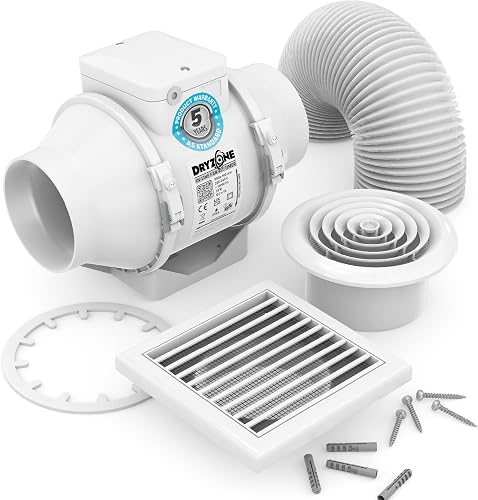
A bathroom or kitchen fan sited in the loft — not a loft ventilator
Worth including precisely because it's so often bought under the wrong assumption: this two-speed duct fan is meant to be sited in the loft for noise, ducted from a bathroom or kitchen and terminating at a vent — it extracts from the room, not the loft space, and contributes nothing to BS 5250 ventilation. Where it earns a place is exactly that job: a loud fan swapped for a quieter loft-mounted unit, kit included with ducting and both grilles, an overrun timer rather than a humidistat.
For
- Genuinely quieter than an in-room fan
- Full kit — fan, ducting, both grilles, fixings
- 5-year manufacturer warranty
Against
- Doesn't ventilate the loft — not a condensation fix
- Overrun timer only, no humidistat
Typically £75–£95
Check price on AmazonSolar Powered Ventilation Extractor Fan
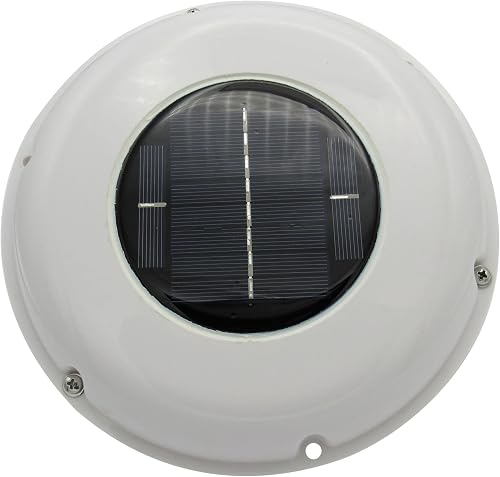
Cheap, low-power heat relief — not a BS 5250 fix, and worth knowing that up front
Genuinely the most misunderstood category here. A solar loft fan like this moves a modest amount of air on a sunny day and nothing after dark or through a grey winter week — exactly when a cold roof most needs ventilation. Marketed for summer heat relief in a loft, shed or caravan, which it can do cheaply, but it isn't a substitute for the passive vents above. Listed mainly so it's clear what this category does before it's bought as a condensation cure.
For
- Cheapest item in this guide
- No wiring, genuinely fit-and-forget for summer heat relief
Against
- Low airflow, and none at all without sunlight
- Not a recognised BS 5250 ventilation strategy — don't rely on it for winter condensation
Typically £25–£32
Check price on AmazonFans, condensation, and what a powered vent actually solves
Worth being blunt, because the marketing rarely is: neither a mains-powered loft fan nor a solar attic fan is a recognised BS 5250 route to roof ventilation. The standard's compliance routes are passive cross-ventilation sized to the free-area figures above, or a continuous, well-sealed vapour control layer at ceiling level instead. A fan bolted into a soffit or ridge is neither — a comfort add-on, not a fix for a roof short on free area through a cold, still winter night, exactly when a solar fan produces nothing.
Where a fan genuinely belongs is the in-line extractor kit above: a bathroom or kitchen fan re-sited in the loft for noise, still ducted to the room it serves. Legitimate, common — but not loft-void ventilation, and conflating the two is the mix-up worth avoiding before spending on the wrong product.
What actually matters — and what doesn’t
Loft insulation pushed into the eaves is the single most common cause of blocked ventilation I see. A generous depth of mineral wool feels responsible, but piled against the soffit it closes the airway — an eaves spacer, fitted before topping up insulation, keeps both.
The 15° pitch threshold matters more than it looks. Drop below it and the required free area roughly doubles — a shallow-pitch extension roof is a genuinely different job to the main house.
The underlay changes the calculation. Older bituminous felt needs the full figures above; a breathable membrane needs a fraction, sometimes none with a well-sealed ceiling.
A warm roof (insulation at rafter level, as in most loft conversions) is a different job entirely — a genuine ventilated airspace above the insulation, or a continuous vapour control layer with none at all. No safe halfway house.
A vent that doesn't match the roof covering will leak before it earns its keep — a common cause of the very damp problem it was meant to prevent.
Questions I get asked
How many soffit vents do I actually need? Work from the free-area figure for the roof's pitch and underlay, not a round number: 25,000mm² per metre below 15° pitch (10,000mm² above it) for a felt roof, less for a breathable membrane, divided by each vent's published area.
Is a solar loft fan worth buying for condensation? Not on its own. Little airflow overnight and none through a grey winter week, precisely when risk is highest. Fine for summer heat relief, not a ventilation upgrade.
My loft insulation's been topped up and now there's mould on the felt — is that the cause? Usually not directly, but if it's pushed over the eaves it can block ventilation that kept the void dry. Pulling it back, or fitting a spacer, is usually the fix.
Do I need Building Regulations approval to add roof vents? Like-for-like replacement generally doesn't. Adding ventilation as part of a re-roof or loft conversion falls under Approved Document C and F — worth confirming rather than assuming exemption.
I don’t fit roof vents myself, but if damp staining, mould on the felt or a musty smell in the loft is what's brought you here, a building survey traces the cause before any vents get specified, and a borescope is often the quickest way to see how far it's spread. If loft insulation is part of the picture, loft insulation costs sets out what that involves, and if a re-roof is on the cards, new roof costs covers where ventilation typically gets specified alongside it. Ventilation testing, getting in touch, and more field-kit guides are all worth a look.
Small print. This guide is general information, not a ventilation calculation for your specific roof — get that checked properly before fitting or removing vents, especially on a listed building or in a conservation area where a change to the roof covering may need consent. Prices are indicative, move constantly and are checked at the time of writing; the linked page always shows the current price. As an Amazon Associate I earn from qualifying purchases.