Every external elevation I look at starts with getting a ladder somewhere it doesn’t really want to be: against a UPVC fascia with no proper stay point, on a sloped block-paved drive, propped over a flower bed that turns out to be soft clay under a thin skin of bark chip. By that point the ladder itself is rarely the weak link — it’s whatever the top two feet are leaning against, or whatever the bottom four feet are standing on, that decides how the next twenty minutes go.
None of the accessories in this guide do the same job as each other, which is worth being clear about before buying any of them. A stand-off bracket keeps the stiles off guttering and downpipes rather than resting the ladder’s full weight on a section of plastic that was never designed to take it. A leveller or a stabiliser tray solves the opposite end — the feet, on ground that isn’t flat, isn’t hard, or both. A roof rack clamp has nothing to do with using the ladder at all: it’s what stops a nine-metre extension ladder becoming a hazard on the A22, or simply not being there when you get to the job. Buy the one that matches the actual problem in front of you, not the one with the most confident name on the listing.
None of this is exotic engineering — a bracket, a set of rubber pads, a locking clamp — which is exactly why the manufacturer’s own spec sheet tells you most of what you need before buying. The verdicts below are built from those specifications and from published buyer feedback, not from carrying each one up a ladder myself.
The one I’d buy

Sealey LAD001 Ladder Stabiliser
HSE’s own ladder guidance keeps coming back to the same point: most falls start with the base moving, not the top. The LAD001 is a proper trade-grade answer to that specific problem — a zinc-plated steel tray that widens a stile’s footprint from around 26cm² of rubber foot to just over 3,000cm² of tray, with four eyelets for pegging it to soft ground and an integral tie-down for the ladder itself. It’s a Sealey product, which on a UK trade counter usually means the spec sheet is accurate, and it does the one job — keeping the bottom of the ladder where you put it — more thoroughly than a mat or a wedge ever will.
Typically £120–£145
Check price on AmazonHow I judge a ladder accessory
Which failure mode it actually fixes. A ladder can fail at the top — slipping sideways, crushing a gutter, sliding down smooth render — or at the bottom, where a foot skids on a hard surface or sinks into soft ground. A stand-off bracket only ever addresses the top; a leveller or stabiliser only ever addresses the bottom. Buying one because it’s cheaper than the other, when the actual problem is at the opposite end, fixes nothing.
A stated figure, not just ‘heavy duty’. A genuine load or footprint number matters more than the adjective printed on the box. The Sealey stabiliser above states the actual footprint increase in cm²; some of the stand-off brackets further down state a warranty length rather than a working load, which is different information and worth reading as such rather than assuming it means the same thing.
Fit checked before ordering, not after. ‘Universal, fits most ladders’ is printed on almost everything in this category. Stile spacing, tube diameter and rung profile vary enough between a budget DIY extension ladder and a trade-grade EN131 unit that a universal claim is a starting point to check against your own ladder’s dimensions, not a guarantee.
What it’s actually protecting. A stand-off bracket is as much about the building as the ladder — keeping weight off a plastic gutter or a downpipe joint that will crack under it. A roof rack clamp is about the ladder and the van, not the job at all: security and safe transport, a concern nowhere else in a typical tool or PPE kit.
Whether the mechanism adjusts, or just pads. A rubber mat with nodules compresses slightly on hard ground and adds grip, but does nothing about a genuine slope; a stabiliser tray or a hinged leg actually changes the geometry underneath the ladder. Know which one you’re buying before assuming either solves a sloped drive.
The comparison
| Model | Type | Key spec | Typical price | Best for | |
|---|---|---|---|---|---|
| Sealey LAD001 Ladder Stabiliser | Base stabiliser tray | Footprint 26cm² → 3,097cm² | ~£131 | Soft or uneven ground | View |
| TB Davies Roof Rack Ladder Clamps | Van roof rack clamps | Pair, with padlocks | ~£37 | Securing a ladder to the van | View |
| BPS Ladder Mat Leveller | Base leveller (4-mat kit) | 1.6cm adjustment per mat, UK made | ~£30 | Slightly uneven hard standing | View |
| JAOSY Heavy Duty ‘V’ Stand-Off | Stand-off bracket | 10-year warranty stated | ~£21 | Guttering and downpipes | View |
| Toptower Ladder Stay/Stand-Off | Stand-off bracket | Rubber protection strips | ~£21 | Budget alternative stand-off | View |
| HITEGEAR SWSP213 Leveller Kit | Base leveller (4-mat kit) | Rubber nodule mats, adjustable | ~£24 | Cheapest complete leveller kit | View |
The picks in detail
Sealey LAD001 Ladder Stabiliser
Best overall — solves the base-slip problem properly
This is the top pick above. The zinc-plated steel tray bolts the argument for buying it into a single number: it turns roughly 26cm² of rubber ladder foot into a 3,097cm² base, with four eyelets for pegging it into soft ground and an integral tie-down so the ladder itself is secured to the tray rather than just resting on it. Sealey states the tray dimensions as 500 x 125mm and the overall footprint as 605 x 515 x 112mm, and the unit is made in the UK.
For
- Genuine trade brand with a documented spec sheet
- Footprint increase turns soft ground into something close to a hard pad
- Integral tie-down covers top-securing as well as the base
Against
- Priciest item in this guide by a wide margin
- Overkill for a five-minute job on ground that’s already flat and hard
Typically £120–£145
Check price on AmazonTB Davies Universal Roof Rack Ladder Clamps (Pair with Padlocks)

Best for keeping a ladder on the van, not just at the job
TB Davies is a proper UK ladder manufacturer rather than a generic import, and this pair of clamps addresses a problem neither a stand-off bracket nor a leveller touches: getting the ladder to the job locked down, instead of resting on a bungee cord across the roof bars. The listing states the clamps fit any roof or ladder rack and any ladder, install without tools, and come with a pair of padlocks included rather than sold separately — the actual difference between a clamp and real security is whether anyone can undo it without a key.
For
- Established, named UK ladder manufacturer
- Padlocks included, not an extra purchase
- Stated to fit any roof bar system and any ladder
Against
- Only as secure as the padlock shackles supplied
- A pair is the minimum for a ladder over about 3m; longer ladders want a third clamp
Typically £32–£42
Check price on AmazonBPS Ladder Mat Leveller

Best-documented leveller — a genuine UK-manufactured kit
Four heavy rubber mats, each stated to give roughly 1.6cm of height adjustment, with a moulded nodule surface designed to grip grass, gravel and decking rather than just sit on top of it. The listing states UK manufacture, which is worth something in a category where most competitors are unbranded imports with no country of origin given at all, and the mats link together with a metal loop so they don’t end up scattered around the back of the van.
For
- UK manufacture stated on the listing
- Genuinely spreads load rather than just adding grip
- Height adjustment per mat is documented, not vague
Against
- A mat only compresses so far — a real slope needs an adjustable leg, not four mats of equal thickness
- Priced close to the Sealey stabiliser for a simpler mechanism
Typically £26–£34
Check price on AmazonJAOSY Heavy Duty ‘V’ Type Ladder Stand-Off (10 Year Warranty)

Best stand-off bracket for guttering and downpipes
The V-shaped bar is the standard geometry for this job: it straddles a downpipe or sits square across a corner, holding both stiles off whatever is behind them rather than letting the ladder’s full weight rest on a section of plastic guttering that was never rated for it. JAOSY’s listing states a 10-year warranty, which is an unusual commitment on a roughly £21 bracket and worth taking as a signal of confidence, even without a separate stated working-load figure.
For
- Genuine V-section design, not a flat pad
- 10-year warranty stated on the listing
- Light enough to leave permanently clipped to the ladder
Against
- No working-load or material-thickness figure stated
- ‘Fits most ladders’ needs checking against actual stile spacing before buying
Typically £18–£24
Check price on AmazonToptower Ladder Stay/Stand-Off with ‘V’
Budget alternative — the same idea, a different maker
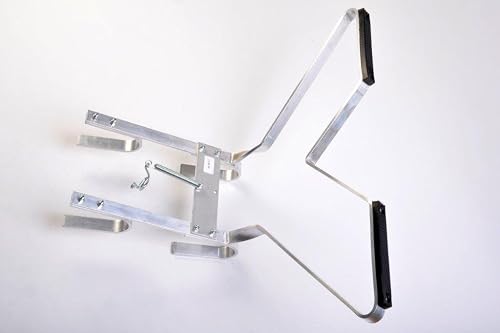
The same V-shaped principle as the JAOSY bracket above, from a different UK seller, with rubber protection strips fitted to the contact faces specifically to stop the bracket marking render or fascia rather than only protecting the gutter itself. It’s lightweight aluminium construction, which keeps it practical to leave attached to the ladder permanently, at the cost of a working-load figure the listing doesn’t state either.
For
- Rubber protection strips guard the wall as well as the gutter
- Lightweight aluminium construction
- Near-identical function to the JAOSY bracket at the same price
Against
- No stated load rating, same gap as most of this category
- No warranty length stated, unlike the JAOSY bracket above
Typically £18–£24
Check price on AmazonHITEGEAR SWSP213 Ladder Leveller Kit

Cheapest complete leveller kit
The same rubber-nodule-mat mechanism as the BPS kit above — heavy-duty matting, fully adjustable underfoot — at a lower price and with a much thinner listing to go on. It does the same basic job: spreading a stile’s load and adding grip on ground that’s uneven or soft rather than genuinely sloped. Buy it for that specific problem, not as a substitute for an adjustable leg on an actual incline.
For
- Cheapest way into a mat-based leveller kit
- Still heavy-duty rubber matting, not a thin doormat offcut
Against
- Far less specification detail published than the BPS kit
- No stated country of manufacture
Typically £20–£26
Check price on AmazonWhat actually matters — and what doesn’t
The base is the more common failure, but the stand-off is the more common accessory. HSE’s own ladder guidance consistently points at the base — a foot slipping or sinking — as the more frequent cause of a fall, yet stand-off brackets are the accessory most readily sold alongside a new ladder. Buy for the ground underfoot as often as the wall in front of you, not just whichever accessory happens to be on the shelf next to the ladder.
‘Fits most ladders’ is a starting point, not a guarantee. Check stile spacing and rung profile against your own ladder before ordering any bracket or clamp in this category. A universal claim on a listing photograph rarely comes with dimensions attached, and the failure mode is finding out on site rather than before it arrives.
A mat compresses; a stabiliser tray adjusts the geometry. The BPS and HITEGEAR kits both spread load and add grip, but neither one changes the ladder’s actual angle on a real slope the way a rigid, pegged-down tray does. If the ground genuinely isn’t level, rather than just soft or loose, a mat alone is the wrong tool for it.
A clamp without a lock is a strap with extra steps. The theft-prevention case for a roof rack clamp only holds if it actually locks. Check whether padlocks are included, as with the TB Davies pair above, or sold separately, before assuming a clamp alone keeps a ladder on the van overnight.
Questions I get asked
Do I need a ladder stand-off if I’m not working near guttering?
Probably not for every job. A stand-off bracket earns its place specifically where the top of the ladder would otherwise rest on plastic guttering, a downpipe, or fragile render — a solid fascia board or a plain brick corner doesn’t need one. Fit it for the jobs where the alternative is resting the ladder’s full weight on something that will crack, and leave it off the rest.
What’s the difference between a leveller and a stabiliser tray like the Sealey?
A mat-based leveller such as the BPS or HITEGEAR kits above spreads load and adds grip under each foot individually. A stabiliser tray like the Sealey LAD001 goes further, physically widening the ladder’s footprint into a single rigid base with its own tie-down point. Both address the same failure mode — the base moving — but the tray is the more thorough, and more expensive, answer to it.
Are universal roof rack ladder clamps actually secure against theft?
Only as secure as the lock fitted to them. A clamp with no padlock, or with a cheap keyed washer instead of one, mainly stops the ladder shifting in transit rather than stopping anyone taking it. Buy a pair with genuine padlocks included, as with the TB Davies clamps above, if security rather than just safe transport is the point.
Can I use a stand-off bracket and a leveller at the same time?
Yes, and on an external elevation with a fragile gutter above and soft ground below, that’s the correct setup rather than a belt-and-braces one. They solve opposite ends of the same ladder, and neither substitutes for the other.
None of this replaces a proper look at the ladder itself before it goes up — see the telescopic ladder and combination ladder guides for that. Getting up safely is what makes the rest of the survey possible; the practice carries out building surveys across Sussex, Kent and Surrey — get in touch. There are more field-kit guides if you’re kitting out the rest of the van.
Disclaimer. This guide is general information, not a substitute for the manufacturer’s instructions or a proper work-at-height risk assessment for your circumstances. Prices are indicative, move constantly and were checked at the time of writing; the linked page always shows the current price. As an Amazon Associate I earn from qualifying purchases.