A key safe is usually the first thing I notice on a rental property before I’ve even reached the front door — screwed to the wall at chest height, sometimes with the digits worn shiny from years of the same code. It tells me more about how a property is actually managed than the tenancy paperwork does. A locked box that’s never had its combination changed, sited directly under the porch light where anyone can work on it undisturbed, is a compliance gesture rather than a security measure.
There’s no law that says a rented property needs one. What there is instead is a fast-growing expectation from letting agents, care agencies and out-of-hours contractors that a key is reachable without a landlord driving over — and an insurance question that catches people out more than the safe itself does. Most home insurance doesn’t automatically void cover because a key safe exists, but some policies narrow it specifically because one is fitted, and the gap between a domestic combination box and one independently tested to resist an attack is exactly the distinction an insurer, or a burglar, actually cares about.
This guide covers both ends of that gap: the certified, Secured by Design “police preferred” safes that genuinely earn the label through LPS 1175 testing, and the honest budget options for a single let where the main job is giving a cleaner somewhere to find a key. Six worth buying, what the rating actually tests, and the code-management habits that undo a good safe regardless of price.
The one I’d buy

Supra C500 Pro (KeySafe)
The key safe letting agents, NHS trusts and care agencies default to, and the only one on this list independently tested to LPS 1175 Issue 8 A5 — five minutes’ resistance to a defined physical attack, not a manufacturer’s own claim. A single-piece hardened zinc-alloy body with a honeycomb internal structure holds up to six keys behind a fully resettable push-button code with thousands of combinations and no battery to fail. It carries Secured by Design’s Police Preferred Specification badge — the accreditation an insurer actually recognises.
Typically £65–£75
Check price on AmazonHow I judge a key safe
The certification, not the claim on the box. “Heavy duty” and “weatherproof” are marketing words; LPS 1175 is a test. The Loss Prevention Certification Board attacks a sample with defined tools for a set time and issues an Issue number plus a letter-and-minutes rating — Issue 8 A1 resisted a Category A attack for one minute, A5 for five. Secured by Design’s “Police Preferred Specification” badge is only awarded once that independent test is passed; it isn’t something a manufacturer can print on packaging by choice.
Key capacity that matches the job. A single-let landlord needs room for one front door key and maybe a communal fob. A managing agent or care provider covering a property with a cleaner, a gardener and an emergency contractor needs a safe that holds four or five without keys tangling on one hook.
A code you can actually change. Every safe below is user-resettable. A factory-set or effectively fixed code left unchanged after a contractor moves on is the single most common way a “secure” key safe stops meaning anything.
Weatherproofing built in, not bolted on. These live outside, facing whatever the weather does to them for a decade. A sliding shutter or hinged cover over the keypad keeps water and grit out of the mechanism — check it’s part of the design, not an optional extra.
Where it goes matters as much as what it is. The best-rated safe on this list is only as good as its position. Directly beside the door, under a porch light, at head height for anyone loitering — all make an attacker’s job easier regardless of the LPS 1175 number stamped inside the lid.
The comparison
| Model | Certification | Keys held | Typical price | Best for | |
|---|---|---|---|---|---|
| Supra C500 Pro | LPS 1175 Issue 8 A5, SBD Police Preferred | 6 | ~£70 | Best overall | View |
| Burton Keyguard Digital XL | LPS 1175 Issue 8 A5, SBD Police Preferred | 4–5 | ~£59 | Certified alternative | View |
| Master Lock 5403EURD | None | 10 | ~£27 | Most keys held | View |
| Master Lock 5401EURD | None | 6 | ~£16–£20 | Recognised-brand budget | View |
| Yale Y500 | None | 3 | ~£22 | Single key, trusted name | View |
| KCT Wall Mounted Key Safe | None | 2–3 | ~£16 | Cheapest, low risk only | View |
The picks in detail
Supra C500 Pro (KeySafe)
Best overall — the police-preferred choice agencies already use; my top pick above
Still widely searched under its older name, Supra C500, the current C500 Pro is the safe most care agencies, NHS trusts and letting agents standardise on for one reason: it’s the only mechanical key safe on this list tested to LPS 1175 Issue 8 A5, a five-minute resistance rating, up from the original C500’s older Issue 6 certification. The hardened zinc-alloy body has a honeycomb internal structure rather than a hollow shell, holds up to six keys, and takes a fully user-resettable code with thousands of combinations — no battery, nothing to charge. Fixed properly into brick or blockwork, it carries Secured by Design’s Police Preferred Specification badge, the one accreditation an insurer or a letting agent’s compliance checklist is actually looking for.
For
- LPS 1175 Issue 8 A5 — the strongest independent rating in this guide
- Secured by Design Police Preferred Specification
- Unlimited resettable codes, no battery to fail
Against
- The priciest mechanical option here
- Needs solid masonry behind it to fix properly — a stud wall undoes the rating
Typically £65–£75
Check price on AmazonBurton Keyguard Digital XL
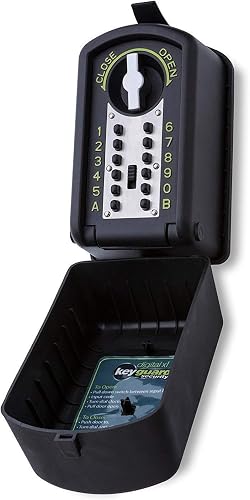
Best certified alternative — the same top rating as the winner, a little cheaper
Burton’s Keyguard Digital XL sits in the same certification tier as the Supra: LPS 1175 Issue 8 A5 and full Secured by Design Police Preferred status, the first key safe to reach that particular rating when it launched. The permanent rubber weather cover doubles as a drilling template, the 12-button keypad resets to any code the owner chooses, and it needs no batteries. Where it gives ground to the Supra is capacity — the internal cavity comfortably takes one or two keys on the hook rather than a full set, so it suits a single let more than a multi-key managing arrangement.
For
- Same LPS 1175 Issue 8 A5 rating as the top pick
- Weatherproof cover doubles as a fixing template
- Cheaper than the Supra for the same certification tier
Against
- Smaller cavity — one or two keys, not a full bunch
- Heavier body (around 2.5kg) to fix securely
Typically £55–£65
Check price on AmazonMaster Lock 5403EURD

Best for holding a full set — ten keys, no independent certification
Master Lock’s Select Access XL is the largest-capacity safe in this guide by some margin: a reinforced metal-alloy body with room for up to ten keys behind a simple resettable 4-digit dial, under a weatherproof shutter. There’s no LPS 1175 rating behind it, so it belongs on lower-risk sites — a garden gate, a holiday let where the value behind the door is modest — rather than the only key to a let property full of a tenant’s possessions. What it does well is genuinely swallow a full set without keys jamming against each other, which the certified options above don’t match.
For
- Genuinely holds a full bunch of keys, not just one or two
- Master Lock’s limited lifetime warranty
- Simple 4-wheel dial, nothing to charge or forget
Against
- No independent attack rating — the box is the weak point here
- Bulkier on the wall than the smaller 5401
Typically £25–£30
Check price on AmazonMaster Lock 5401EURD

Best recognised-brand budget pick
The smaller sibling in Master Lock’s Select Access range, and the sensible default for a single let where an agent or insurer just wants to see a proper key safe on the wall rather than a certified one specifically. Die-cast body, resettable 4-digit combination, a sliding shutter over the dials to keep the weather out, and room for up to six keys — enough for a front door key plus a communal fob or two. It won’t satisfy a “police preferred” clause in a licence condition, but for most ordinary lets it’s a trusted name at close to the cheapest price on this list.
For
- Trusted brand at a genuinely low price
- Six-key capacity covers most single lets
- Straightforward to reset
Against
- Same uncertified caveat as the 5403
- Smaller cavity than the XL if more than a couple of keys need to live in it
Typically £16–£20
Check price on AmazonYale Y500

Best for a single key and a name tenants recognise
A steel body wrapped in a rubberised oval surround, with a 4-wheel resettable dial and room for up to three keys — the smallest capacity in this guide, and clearly aimed at a homeowner storing one spare or a landlord who wants a recognisable name on the box more than raw capacity. It sits less obtrusively on a period façade than the boxier alternatives, which matters more than it sounds on a house a conservation officer might have an opinion about. No independent certification, so treat it the same way as the Master Lock pair above.
For
- Yale’s name carries genuine trust with tenants and contractors
- Compact, less obtrusive than the boxier alternatives
- Simple reset, no manual to hunt for
Against
- Three keys is tight for a shared managing arrangement
- No independent security certification
Typically £20–£25
Check price on AmazonKCT Wall Mounted Combination Key Safe

Best rock-bottom budget — low risk, low cost
The cheapest safe in this guide, and it reads like it: a basic zinc-alloy body, resettable 4-digit code and a sliding weatherproof shutter, with a smaller cavity than any of the branded options above. Fine for a shed key, an outbuilding, or a low-value holiday let where losing the key isn’t losing much — not what I’d want holding the only key to a let property with a tenant’s possessions behind that door. Budget key safes in this bracket are frequently the same generic shell sold under several storefront names, so check the current listing photos match what’s described before ordering.
For
- Cheapest option in this guide by a small margin
- Still weatherproof and resettable
Against
- No certification and no long track record to point to
- Smallest cavity here alongside the Yale
Typically £14–£18
Check price on AmazonWhat actually matters — and what doesn’t
LPS 1175 is the only rating worth trusting. It’s administered by the Loss Prevention Certification Board, part of the Building Research Establishment, and tests a sample against defined tools for a defined time — not a British Standard in the BS EN numbering sense, but the industry and insurance-recognised measure for security enclosures like these. An Issue 8 A1 rating means one minute’s resistance to a Category A attack; A5 means five. Only the Supra and the Burton in this guide currently carry it.
A key safe rarely voids your insurance outright — but check anyway. The National Residential Landlords Association warns members explicitly that some policies become ineffective once a key safe is fitted, purely because it’s treated as an additional unattended access point. Confirm with your specific insurer before installing one, and lean toward LPS 1175-rated hardware if there’s any doubt — it’s the detail most policies are actually assessing.
The code is usually the weak point, not the box. I’ve seen the combination written on a label stuck to the wall beside the safe more than once, which defeats the point entirely. Rotate the code after every contractor’s visit, and share it through an encrypted note or password manager rather than a text message that sits in someone’s phone indefinitely.
On a listed building, check before you drill. Fixing a key safe into ordinary brick or render doesn’t need planning permission. Original fabric on a listed building can need Listed Building Consent for even a small fixing, particularly on a principal elevation — a call to the local authority’s conservation officer first is cheaper than an enforcement notice later.
What the listings push that doesn’t matter. “Heavy duty,” “anti-tamper” and “commercial grade” on an uncertified box are just words a manufacturer chose to print; without an LPS 1175 number behind them, they carry no weight with an insurer or a determined thief. A smart, Bluetooth-connected key safe sounds like the obvious premium upgrade, but the ones I looked at for this guide are priced and marketed for fleet and property-management use, not a single let — a certified mechanical safe does the actual job for less.
Questions I get asked
Do landlords have to fit a key safe? No. There’s no legal duty, unlike smoke alarms or gas safety checks. Letting agents commonly ask for one so contractors and out-of-hours staff can get in without a landlord attending, and care agencies rely on them for scheduled visits, but it’s an operational expectation rather than a statutory one.
Does a key safe invalidate my home insurance? Not automatically, but check your policy. The NRLA’s own guidance warns that some insurance policies become ineffective once a key safe is fitted, treated as an extra unattended access point. Confirm with your specific insurer before installing one, and favour a certified, LPS 1175-rated safe if there’s any doubt.
What does “police preferred” mean on a key safe listing? It means the product has passed LPS 1175 testing administered by the Loss Prevention Certification Board and carries Secured by Design’s official accreditation — a scheme run with UK police forces, not a manufacturer’s own marketing claim. Only two safes in this guide, the Supra C500 Pro and the Burton Keyguard Digital XL, currently hold it.
Can I fit a key safe on a listed building? Usually, but check first. An unlisted house needs no permission for ordinary brick or render fixings. On a listed building, drilling into original fabric can require Listed Building Consent even for something as small as a key safe, particularly on a principal elevation — the local authority’s conservation officer is the right first call, not a guess.
For the wider compliance picture on a let property — what an HMO licence actually requires, or how a key safe sits alongside interlinked smoke and heat alarms — see the linked guides. For site and van security more generally, there’s a separate guide to padlocks worth buying. And a Buy to Let Survey looks at exactly this kind of compliance gap alongside the building’s condition — get in touch. For the rest of a landlord’s toolkit, there are more field-kit guides.
Small print. This guide is general information, not advice on your specific property, insurance policy or licence conditions, and does not replace checking your own insurer’s terms or your local authority’s conservation guidance. Prices are indicative, move constantly and were checked at the time of writing; the linked page always shows the current price. As an Amazon Associate I earn from qualifying purchases.