The telescopic inspection mirror is the least glamorous thing in my toolbag recommendations, and one of the most-reached-for. It doesn’t detect anything, log anything, or produce a number for a report. What it does is extend your eyeline round a corner you can’t get your head into — behind a boxed-in soil stack, over the top of a kitchen plinth, into a meter cupboard, along the underside of joists past a service riser. Half the time the answer to “is there a stopcock behind there” or “has that pipe been lagged” is a two-second job with the right mirror, and an awkward, undignified crawl without one.
It sits in the same drawer as a borescope, and people often ask which one they need. The honest answer is both, for different jobs. A mirror shows you a real, undistorted reflection at arm’s reach, in whatever light you point at it — no batteries, no screen lag, no cable to snag on a nail. A borescope goes through a hole you’ve drilled, round a bend a mirror can’t follow, and records what it sees. If you only ever need to look over or round an obstruction rather than through a small hole into a sealed void, the mirror is the quicker, cheaper, more reliable tool — and it never needs charging on the morning you forgot to plug it in.
What separates a mirror worth keeping in the bag from one that ends up in a drawer is not much: a decent-sized true mirror, a head that holds an angle instead of flopping, a shaft that reaches as far as claimed, and ideally some light of its own for the dark corners where you need it most. That’s the lens for everything below.
The one I’d buy

Sealey (Siegen) S0947 75mm LED Telescopic Inspection Mirror
The mirror I’d actually reach for in a dark void: a genuinely large 75mm head so you take in more of the space per look, two LEDs mounted at the rim rather than square in your eyeline, and a reach to 870mm that gets well past a joist or over a boxed section without you following it in.
Typically £15–£22
Check price on AmazonHow I judge an inspection mirror
Mirror size and shape. A bigger mirror shows more of the void per look, which matters when you’re working one-handed in an awkward crouch and don’t want to reposition six times. Round heads are the default and go anywhere; a rectangular head gives a wider flat field that suits scanning along a run of pipework or a joist bay in one sweep.
Reach. Survey voids are rarely conveniently close. A shaft that only reaches 300–400mm is fine for a meter cupboard or under a sink; getting over a joist, behind a bath panel or into a service riser wants something closer to 700–900mm. Extension claims on cheap listings are sometimes generous — a genuine trade brand’s stated figures are worth more than an unbranded one’s.
Head articulation. A proper ball joint holds any compound angle you set it to and doesn’t sag under its own weight when the shaft is fully extended and pointing down into a void. A simple hinge is fine for single-plane checks — looking straight up behind a lintel, say — but runs out of road the moment you need to angle sideways as well.
Illumination. Voids, risers and the underside of suspended floors are dark, and juggling a torch in one hand and a mirror in the other while trying to hold a beam and an angle steady is exactly the kind of fiddly job an LED mirror solves. It only helps if the lights are positioned so they light the target rather than bounce straight back into your eyes — more on that below.
Mirror quality and build. Real glass gives a true, undistorted reflection; the cheapest acrylic mirrors can be very slightly domed and give a softened, faintly warped image that’s harder to read at a glance. A chrome-plated shaft that won’t rust in a damp crawl space, and a locking collar on the extension that doesn’t creep shut mid-inspection, are what turn a £2 stocking-filler into something you’ll still have in a year.
The comparison
| Model | Mirror | Reach | Typical price | Best for | |
|---|---|---|---|---|---|
| Sealey (Siegen) S0947 | Ø75mm, 2 LEDs | 290–870mm | ~£18 | Dark voids, most view per look | View |
| Sealey AK652 | Ø40mm, ball joint | 125–690mm | ~£22 | Precision positioning, no light needed | View |
| C.K T5912-38 | 38mm, swivel | 125–685mm | ~£15 | Trade-grade durability, no batteries | View |
| Rolson 60515 | 42x65mm, 2 LEDs | 290–870mm | ~£7 | Budget illuminated, longest cheap reach | View |
| US PRO 6782 | 50x90mm rectangular | 290–460mm | ~£6 | Wide flat field, scanning a pipe run | View |
| Amtech (S2300) | 30mm, 360° swivel | Up to 450mm | ~£4 | Simple, cheap all-rounder | View |
| Blue Spot Tools swivel | 31mm, ball joint | 180–635mm | ~£3 | Rock-bottom budget | View |
The picks in detail
Sealey (Siegen) S0947 75mm LED Telescopic Inspection Mirror
Best overall — the one I’d buy, above
The Siegen name is Sealey’s own trade sub-brand, and this is the mirror I’d put in the bag first. The 75mm head is genuinely large next to the rest of this class — enough to take in most of a joist bay or a meter cupboard interior in one look rather than sweeping the shaft back and forth. Two LEDs sit at the rim of the mirror surround rather than dead centre, which matters more than it sounds: light aimed at the target instead of straight back at your eyes. The 870mm maximum reach is the longest here, useful getting past a boxed stack pipe or over a run of joists without following the tool in yourself.
It isn’t the most refined head articulation on this list — the AK652’s ball joint holds a set angle slightly more positively — but for the job most surveyors actually use a mirror for, seeing into a dark space clearly, this is the one that earns its keep.
For
- Large 75mm mirror — more of the void per look
- LEDs positioned to light the target, not your eyes
- Longest reach in this comparison at 870mm
- Rubber-grip handle, comfortable for one-handed use
Against
- Runs on watch-style batteries — carry spares
- Head holds an angle less positively than a dedicated ball joint
Typically £15–£22
Check price on AmazonSealey AK652 Telescopic Articulated Inspection Mirror
Best for precise positioning — where you need the angle to stay put
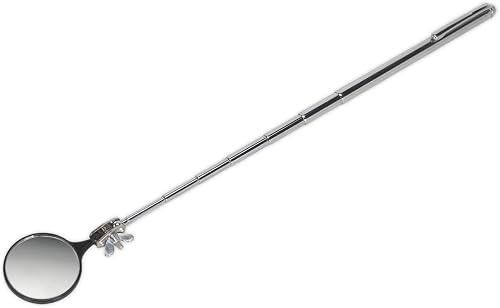
No light, and none needed if you’re working somewhere daylight or a head torch already reaches. What the AK652 does instead is hold a compound angle properly: the ball-and-butterfly-nut joint locks the 40mm mirror exactly where you set it, which matters when you’re trying to sight along the underside of a lintel or into a corner and don’t want the head drifting as you withdraw the shaft. Chrome-plated brass tube, a pocket clip, and a reputation among mechanics and surveyors alike for actually lasting.
For
- Positive ball-joint lock — the angle stays where you set it
- No batteries to go flat in the van overnight
- Chrome-plated brass shaft, genuinely durable
Against
- No illumination — useless in a genuinely dark void alone
- Costlier than most of the budget class
Typically £18–£26
Check price on AmazonC.K T5912-38 Telescopic Inspection Mirror
Best trade-grade non-illuminated — the durable, no-frills option
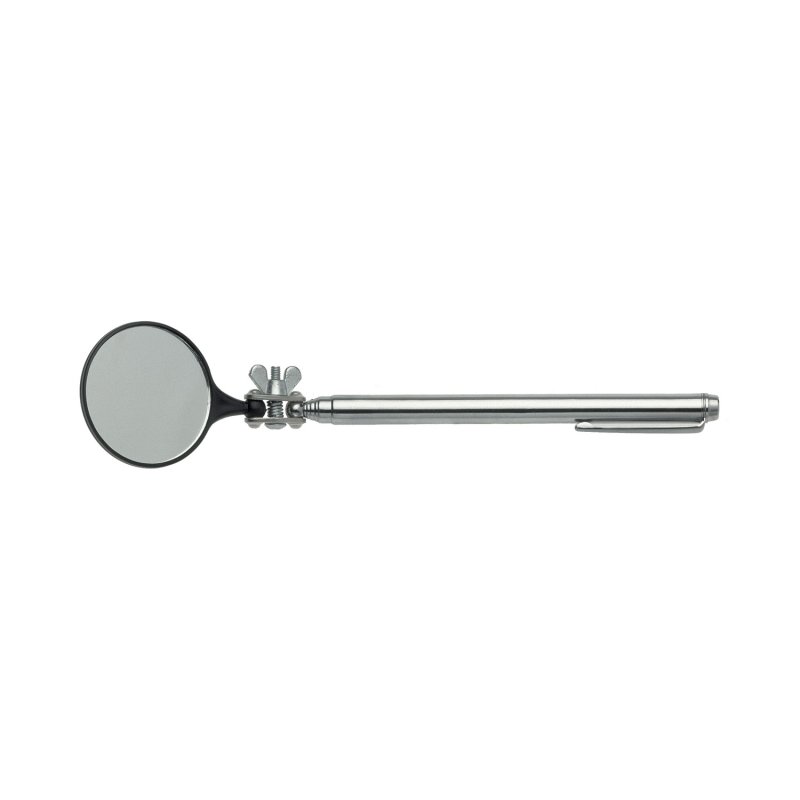
C.K is a proper trade tool brand, and the T5912 range is built accordingly: stainless steel shaft, a swivel head on a solid pivot, and a reach comparable to the premium picks above without the electronics to go wrong. It comes in three mirror sizes (32mm, 38mm and 55mm); the 38mm is the sensible middle ground for general survey use, big enough to be useful without being unwieldy in a tight gap. If you’d rather have one thing that can’t run out of battery, this is the trade-grade answer.
For
- Genuine trade-brand build quality
- Stainless shaft, nothing to corrode
- No batteries, nothing electronic to fail
Against
- No light — needs a torch or daylight
- Simple swivel rather than a locking ball joint
Typically £12–£18
Check price on AmazonRolson 60515 2 LED Telescopic Inspection Mirror

Best budget illuminated — long reach and a light, for not much money
Rolson has been a reliable mid-market trade brand for decades, and the 60515 packs the same 870mm reach as the Sealey top pick into a much cheaper tool. The trade-off is where the LEDs sit — mounted on the mirror face itself rather than the rim, so at some angles they shine back at you rather than the target. Owner feedback is consistent on this point: get the angle right and it’s genuinely useful; point it carelessly and you’ll dazzle yourself. Worth the small learning curve for the price.
For
- Same 870mm reach as the premium pick, far less money
- Cushion-grip handle, comfortable one-handed
- Batteries included
Against
- LED placement can reflect back into your eyes at some angles
- Build feels lighter-duty than the trade-brand picks
Typically £6–£9
Check price on AmazonUS PRO 6782 Rectangular Telescopic Inspection Mirror

Best wide field of view — scanning a run of pipe or a joist bay
Every other mirror here is round; this one is a 50x90mm rectangle, and that shape genuinely earns its place for certain jobs. Sweeping along a run of pipework or a length of joist, a wide rectangular field shows more of the run per pass than a round mirror of similar area, so you spend less time repositioning. Reach is modest at 460mm, which keeps it firmly in the “behind the immediate obstruction” category rather than a deep-void tool, but for what it does — a quick, wide look along a straight run — it’s the shape I’d reach for.
For
- Rectangular field suits scanning a run rather than a single spot
- Real glass mirror, cheap price
- Ball-joint head, positions easily
Against
- Shortest reach of the picks here at 460mm
- No light — needs a torch in dark voids
Typically £5–£8
Check price on AmazonAmtech Telescopic Inspection Mirror (S2300)
Best simple all-rounder — does exactly what it says, cheaply
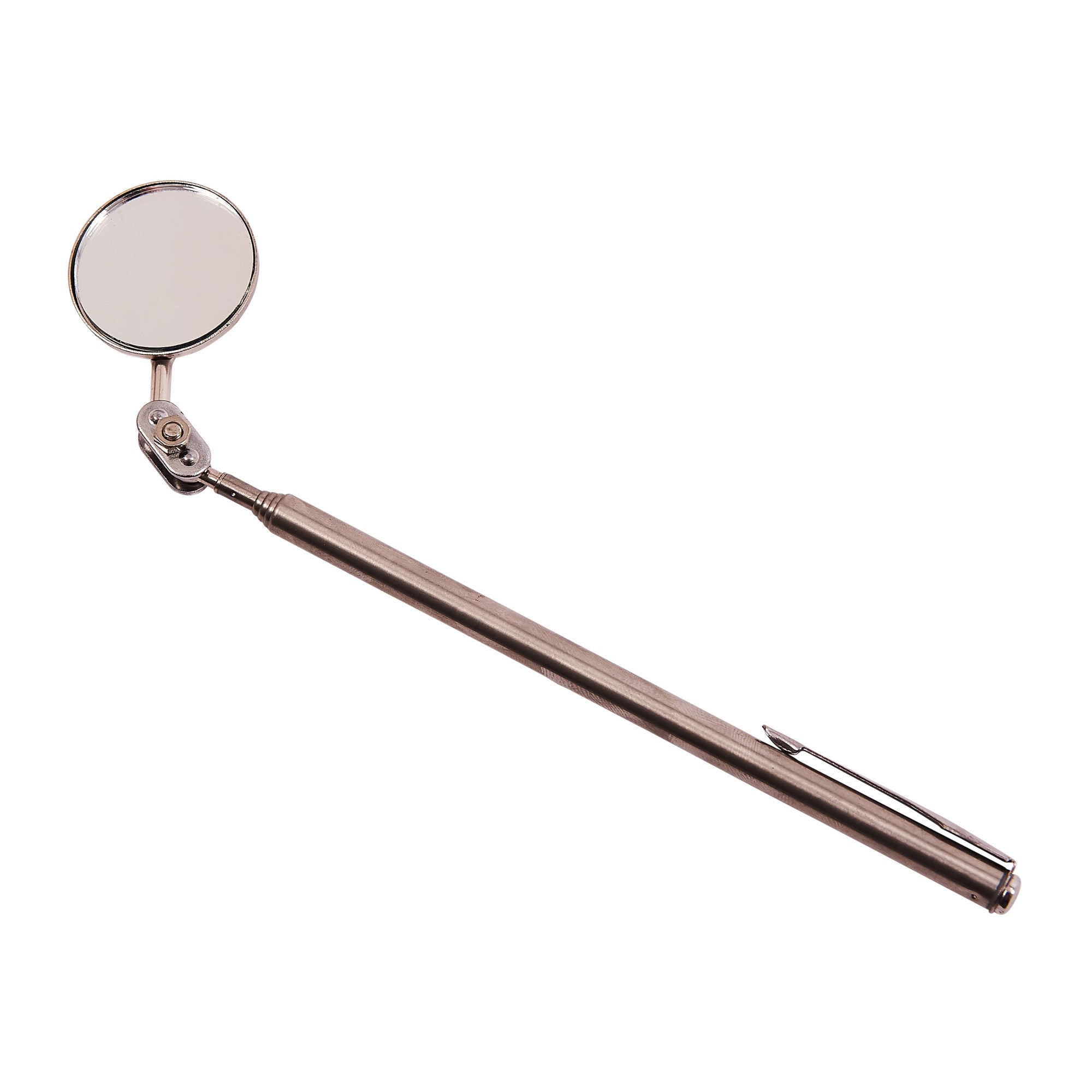
Amtech’s own budget line does the basics without pretending to be more than it is: a 30mm round mirror on a 360° swivel head, chrome shaft extending to 450mm. No light, no ball joint, no rectangular field — just a plain, cheap mirror on a stick that does the job for the huge majority of “is there anything behind there” checks that don’t need any of the fancier features above. It’s the one I’d put in a second van or hand to someone who’ll inevitably lose it down a void.
For
- Does exactly what a basic inspection mirror needs to
- Cheap enough not to worry about losing it
- Swivel head covers most single-plane checks
Against
- Shortest reach here bar the Blue Spot
- Swivel rather than a locking ball joint
Typically £3–£6
Check price on AmazonBlue Spot Tools Swivel Telescopic Inspection Mirror

Best on a rock-bottom budget — the £2–£3 stocking-filler that still works
The cheapest usable mirror on this list, and it’s a fair one: a 31mm mirror on a proper 360° ball-joint swivel, chrome-plated shaft to 635mm, with a pocket clip. Blue Spot is a long-standing budget trade brand rather than an anonymous Amazon reseller, which shows in small details — the joint holds its angle better than the price suggests it should. Keep one in the van door pocket for the quick, casual checks that don’t justify unpacking anything more capable.
For
- Ball-joint swivel at a genuinely low price
- Pocket clip, easy to keep to hand
- Established budget trade brand, not an anonymous listing
Against
- Small 31mm mirror, more repositioning needed
- No light, and the shaft is the shortest of the ball-joint picks
Typically £2–£5
Check price on AmazonWhat actually matters — and what doesn’t
Watch where the LEDs actually point. An illuminated mirror sounds like a straightforward upgrade, but the light only helps if it’s aimed at what you’re trying to see rather than back at your own eyes. Mirrors with the LEDs set into the rim of the mirror surround, angled outward, light the target properly. Mirrors with the LEDs mounted flat on the mirror face can dazzle you at exactly the angle you need most — a genuine and commonly reported complaint, not a rare fault. If in doubt, a mirror with no light plus a decent head torch beats a badly-lit mirror every time.
A locking ball joint is worth paying a little more for. The cheapest mirrors use a simple friction hinge that’s fine pointing straight up or straight down, but sags or drifts the moment you extend the shaft fully and try to hold an angled view — exactly the situation you’re usually in. A proper ball-and-locknut joint holds the angle you set until you deliberately change it.
Extension claims are sometimes optimistic. A listing that promises 900mm from an unbranded £3 mirror is describing the shaft fully extended with every section pulled to its absolute limit, which in practice flexes and wobbles too much to use for anything beyond arm’s length. The trade-brand figures in the table above are the ones I’d actually trust to be usable, not just technically achievable.
Magnetic pick-up combos are a genuine convenience, not a reason to pay double. Several manufacturers sell a mirror-and-magnetic-pickup-tool set in one case. If you’ve dropped a screw down a void often enough to want a magnetic retriever, buy one — but don’t pay a premium for a bundled set when a standalone mirror and a standalone magnetic pickup, bought separately, usually cost less between them.
A mirror is not a borescope, and knowing which job needs which saves time. A mirror extends your line of sight round a corner in a space you can otherwise see into, given enough light. It cannot go through a 10mm drilled hole into a sealed cavity, cannot bend round a genuine right angle, and cannot record what it shows you for a report. For that, you want a borescope instead — the two tools solve different problems and most survey bags have room for both.
Questions I get asked
What is an inspection mirror actually used for on a survey? Anywhere you need to see round or behind something without moving it or climbing into it: behind a boxed-in stack pipe to check for a leaking joint, over the back of a kitchen plinth, inside a meter cupboard, along the underside of joists near a service riser, behind a radiator to check for missing lockshields or old staining, or checking the far side of a loft hatch upstand before you commit your weight to it. It’s a cheap, quick first check before deciding whether a more invasive look is needed.
Can I use an inspection mirror instead of a borescope? For some jobs, yes — if the space is open enough that a reflection with a bit of light will show you what you need, a mirror is quicker and needs no batteries. Where a borescope earns its place is a sealed cavity you can only reach through a small drilled hole, or a space with a genuine bend a rigid mirror shaft can’t follow. Most surveyors end up carrying both and reaching for whichever suits the gap in front of them.
How do I stop the mirror fogging up in a damp void? A cold mirror carried in from outside into a warmer, humid crawl space or riser will mist exactly like a bathroom mirror after a shower — condensation forming on the colder glass. Give it a few seconds to acclimatise before relying on the reflection, and wipe the surface with a cloth kept for the purpose rather than a sleeve, which tends to leave smears that scatter torchlight.
Do I need the LED version, or is a separate torch enough? If you regularly work single-handed in genuinely dark spaces — risers, deep voids, unlit cellars — an integrated LED saves you juggling a torch and a mirror at the same time, which is exactly when you most need both hands doing their own job. If you’re usually working with a head torch already lighting the area, a plain mirror without electronics to fail is one less thing to go wrong.
If the thing you actually need to see is behind a wall rather than round a corner, that’s a job for a borescope and, on a full survey, a proper look with the right tools for the defect in front of you. The practice does building surveys that go beyond the visible and obvious, and PAS 2035 retrofit assessments where hidden voids and service routes are checked before any insulation goes near them — get in touch. And if you’re kitting out a survey bag, there are more field-kit guides.
Small print. This guide is general information, not a survey of your property; a mirror check is a first look, not a diagnosis, and hidden defects can exist beyond what any mirror or torch can reach. Prices are indicative, move constantly and were checked at the time of writing; the linked page always shows the current price. As an Amazon Associate I earn from qualifying purchases.