An infrared thermometer earns its place on a surprising range of jobs that aren’t primarily about temperature at all. On an EPC or RdSAP assessment it’s a quick way to check whether a wall reads noticeably colder near a lintel or a party wall junction than the plasterboard either side of it. On a PAS 2035 retrofit assessment it’s one half of a condensation risk check at a thermal bridge, run alongside a hygrometer. On a general damp diagnosis it’s the fast first pass that tells you where to go back with a contact moisture meter, rather than working blind across an entire wall. None of that needs a full thermal image — just a number, taken from across the room, in under a second.
The principle is simple: every surface radiates infrared energy in proportion to its temperature, the thermometer reads that radiation through a lens and converts it to a number on the display. Two settings decide whether that number is trustworthy. The distance-to-spot ratio (D:S) sets how large an area is being averaged at a given range — a 12:1 thermometer held 1.2m from a wall reads roughly a 10cm circle, while an 8:1 model at the same distance is averaging a wider patch and can blend a small cold spot into the surrounding wall. Emissivity is the other half: it’s a correction factor for how efficiently a surface radiates versus reflects, and most building materials — painted plaster, brick, timber, matt render — sit close enough to 0.95 that a fixed-emissivity gun reads them accurately. Glass, bare metal ductwork and foil-faced insulation don’t, and a fixed-emissivity thermometer won’t warn you when it’s wrong.
Worth being honest about what a single spot reading can’t do, too. It won’t show the shape or extent of a cold bridge the way a thermal imaging camera does — that’s a genuinely different instrument for a genuinely different question. And a cold surface reading is not a moisture reading: it flags where to look, not what’s actually there, which is still a job for a damp meter or a hygrometer’s dew point calculation. None of the six below have been run against a survey van’s worth of real jobs — this is built from manufacturers’ specifications and the pattern in published owner feedback, filtered through what actually matters when the reading has to mean something. First, the one I’d buy.
The one I’d buy
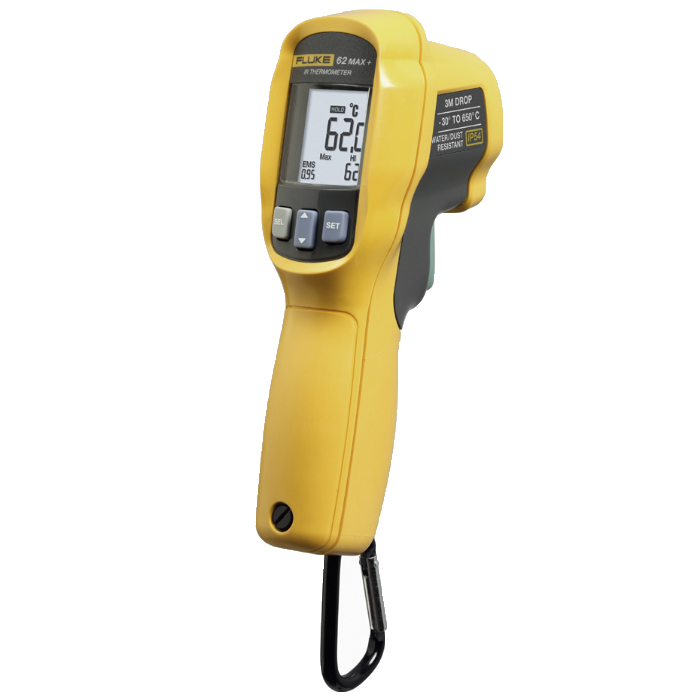
Fluke 62 Max Plus Infrared Thermometer
Fluke’s a familiar name from the electrical side of the van already, and the 62 Max Plus carries the same reputation into surface temperature work. Dual laser pointers show exactly where the reading’s coming from even across a room, the 12:1 distance-to-spot ratio holds accuracy at a genuine working range, and adjustable emissivity means it doesn’t get fooled by a glazed tile or a foil-faced insulation board the way a fixed-emissivity gun does. IP54-rated and built to survive a 3m drop, which matters more than the spec sheet suggests once it’s living in a tool bag with everything else.
Typically £85–£110
Check price on AmazonHow I judge an infrared thermometer
Distance-to-spot ratio, at a realistic working distance. A high D:S ratio only matters if it matches how you’ll actually use the thermometer — across a room, up a stairwell, from the base of a ladder to a ceiling — not a lab-bench distance of a few centimetres. Buy for the range you’ll stand at.
Adjustable emissivity, over a fixed 0.95 default. Fine for painted plaster, brick and timber; wrong, silently, on glass, bare metal and foil-faced insulation. Adjustable models let you correct for it; fixed ones just give you a confident-looking wrong number.
Resolution fine enough to catch a small differential. A thermal bridge often shows up as a 2–3°C dip against the surrounding wall, not a dramatic one — a thermometer that rounds to the nearest whole degree can hide the exact gap you’re trying to find.
What it can and can’t tell you. A single number, not an image, and never a moisture reading. Worth buying for what it actually does well — a fast comparative check — rather than expecting it to replace a thermal camera or a damp meter.
Build quality for a tool bag, not a lab. A drop rating and a backlit display matter more in a loft or a cellar than an extra 200°C of headroom no domestic survey will ever use.
The comparison
| Model | D:S ratio | Range | Typical price | Best for | |
|---|---|---|---|---|---|
| Fluke 62 Max Plus | 12:1, dual laser | -30 to 650°C | ~£85–£110 | Best overall | View |
| Testo 830-T1 | 10:1, single laser | -30 to 400°C | ~£140–£175 | Premium/professional pick | View |
| Klein Tools IR1 | 10:1, single laser | -20 to 400°C | ~£30–£45 | Best simple single-laser | View |
| General Tools IRT207 | 8:1 | -20 to 320°C | ~£25–£38 | Best mid-range value | View |
| Etekcity Lasergrip 1080 | 12:1 | -50 to 550°C | ~£14–£22 | Best on a budget | View |
| Silverline 633726 | Not published | -38 to 520°C | ~£14–£20 | Cheapest / occasional use | View |
The picks in detail
Fluke 62 Max Plus Infrared Thermometer
Best overall — dual laser, wide range, rugged enough for site
Fluke’s reputation on the electrical side of the trade carries straight across to this one. Dual laser pointers keep targeting accurate even across a room, the 12:1 distance-to-spot ratio holds up at a genuine working distance, and adjustable emissivity handles the reflective surfaces that trip up a fixed-emissivity gun. IP54-rated and drop-tested to 3m, with min/max/average/differential display for comparing two readings directly.
For
- Dual laser stays accurate at a genuine working distance
- Adjustable emissivity handles glass, metal and foil-faced surfaces
- IP54-rated, drop-tested to 3m
Against
- Pricier than a simple single-laser gun
- -30 to 650°C range is more headroom than a building ever needs
Typically £85–£110
Check price on AmazonTesto 830-T1 Infrared Thermometer
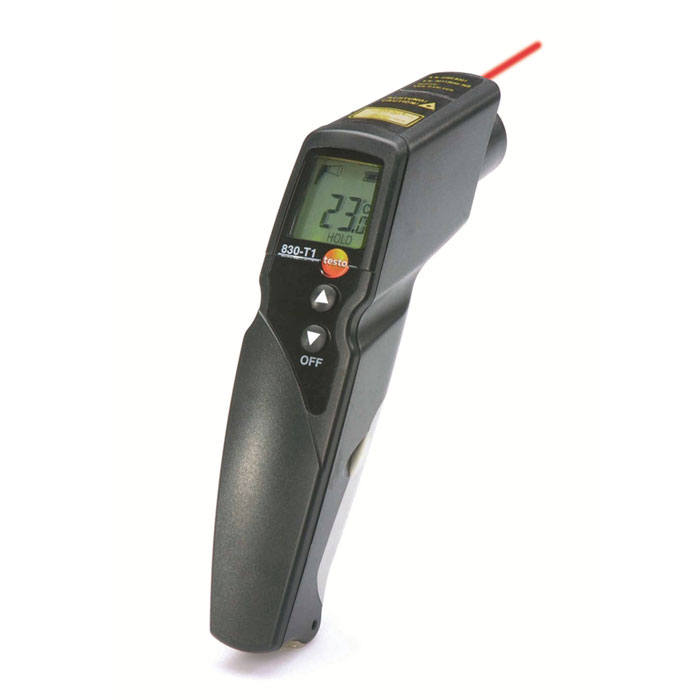
Premium/professional pick — German engineering, fine resolution
Testo instruments turn up across HVAC and building diagnostics work for a reason, and the 830-T1 is the brand’s entry point into infrared-only surface measurement — a single laser, 10:1 optics, and 0.1°C resolution that catches small differentials a coarser gun rounds away. That resolution matters more than raw temperature range on a domestic survey: spotting a 2–3°C dip at a thermal bridge is the actual job. Adjustable emissivity is standard across the 830 range.
For
- 0.1°C resolution catches small differentials
- Adjustable emissivity
- Trusted brand for building diagnostics work
Against
- Costs two to three times a Fluke for a narrower range
- Single laser only at this price point
Typically £140–£175
Check price on AmazonKlein Tools IR1 Infrared Thermometer
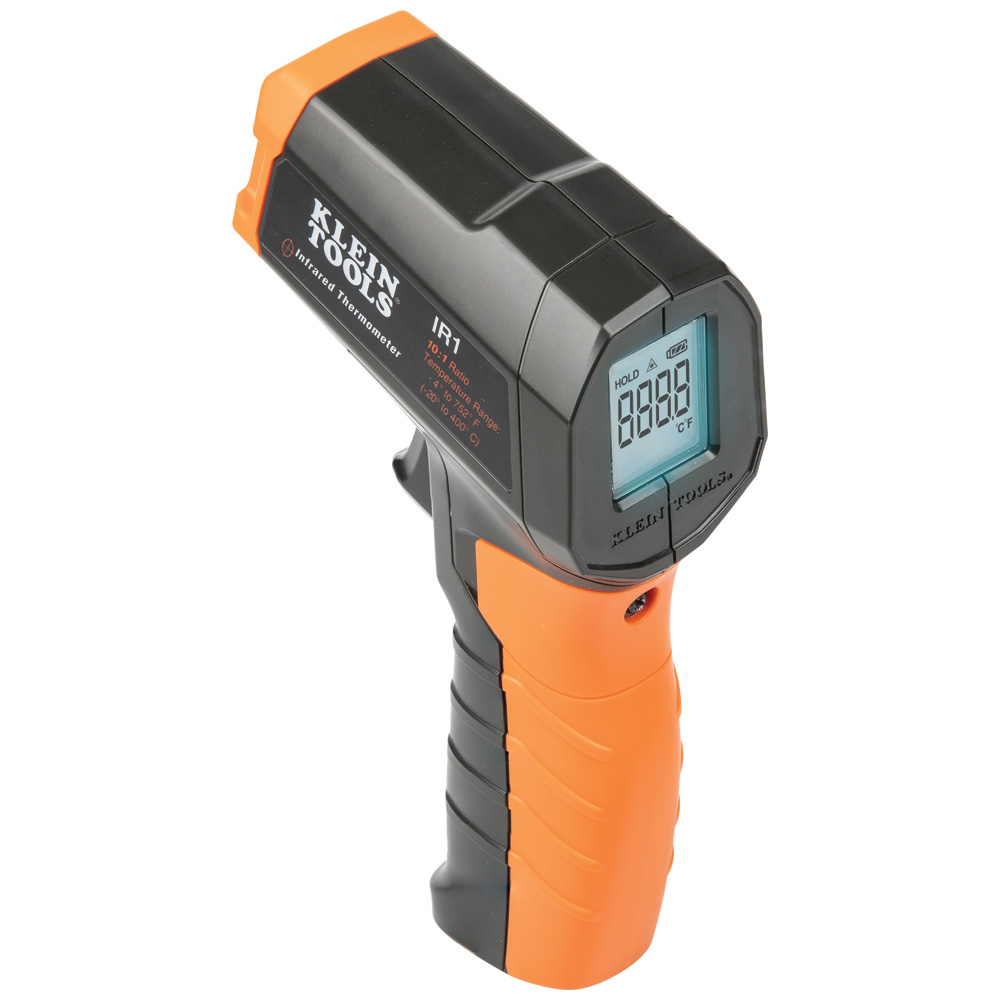
Best simple single-laser — no settings to get wrong
The IR1 strips the feature list down to a single laser, a 10:1 ratio and a backlit display, with emissivity fixed at 0.95 rather than left adjustable. That’s a genuine limitation on anything reflective, but it’s also one less setting to misconfigure on a quick check of a painted wall, a plastered ceiling or a timber joist — the matt building surfaces 0.95 was calibrated for in the first place.
For
- Simple, nothing to misconfigure
- Backlit display
- -20 to 400°C range covers everything domestic
Against
- Fixed emissivity reads wrong on glass, metal or foil-faced insulation
- 10:1 ratio needs a closer range than the Fluke
Typically £30–£45
Check price on AmazonGeneral Tools IRT207 Infrared Thermometer
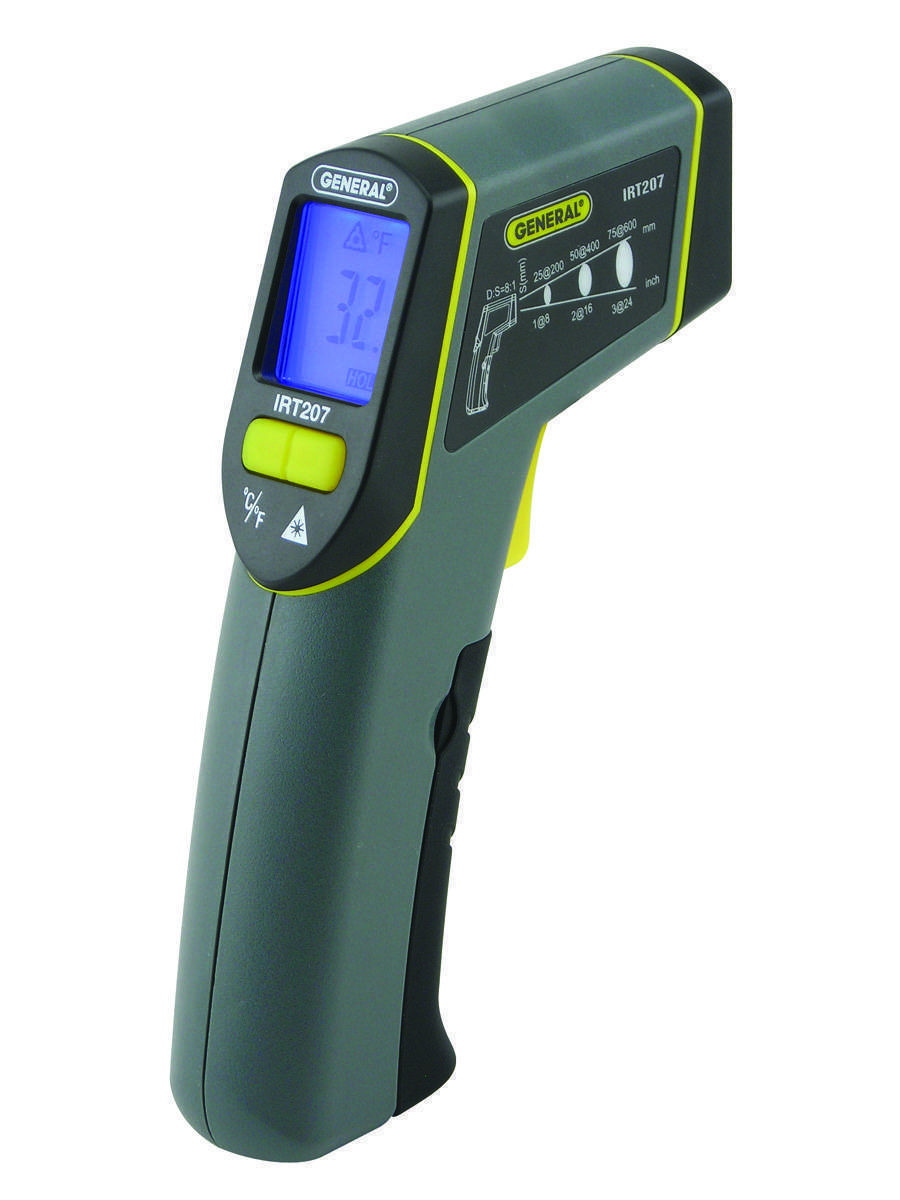
Best mid-range value — HVAC-oriented, budget-friendly
The Heat Seeker undercuts the Klein and Testo on price while keeping a similar spec on paper — fixed 0.95 emissivity and a -20 to 320°C range that comfortably covers anything a domestic or light commercial survey throws at it. The narrower 8:1 ratio means standing closer for the same spot size, which is rarely a problem indoors but worth knowing before ordering.
For
- Comfortably cheaper than the Klein or Testo
- Backlit display and switchable laser
- Auto power-off
Against
- 8:1 ratio is the narrowest published in this guide
- Fixed emissivity, same caveat as the IR1
Typically £25–£38
Check price on AmazonEtekcity Lasergrip 1080 Infrared Thermometer
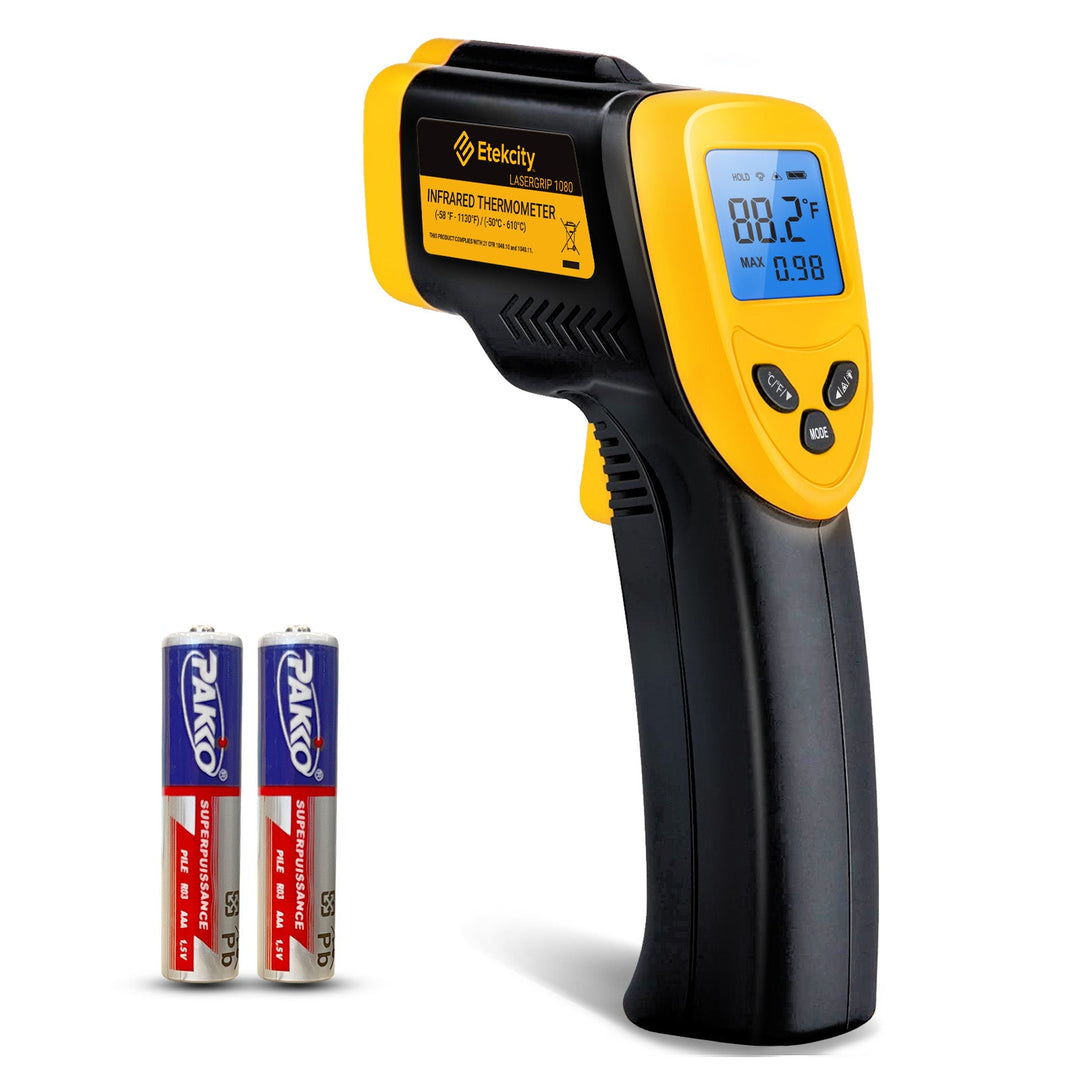
Best on a budget — adjustable emissivity at a bargain price
Etekcity’s Lasergrip 1080 is the one budget gun here that doesn’t drop adjustable emissivity to hit its price point — a genuinely useful feature at under a quarter of the Testo’s cost. The 12:1 ratio matches the Fluke on paper, and the wide -50 to 550°C range is more than a building survey needs, but it’s the emissivity adjustment that earns this one a place over the Silverline below.
For
- Adjustable emissivity, unusual at this price
- 12:1 ratio matches pricier models on paper
- Widely reviewed, easy to find
Against
- Plastic build feels it against the Fluke or Testo
- Single laser only
Typically £14–£22
Check price on AmazonSilverline 633726 Infrared Thermometer
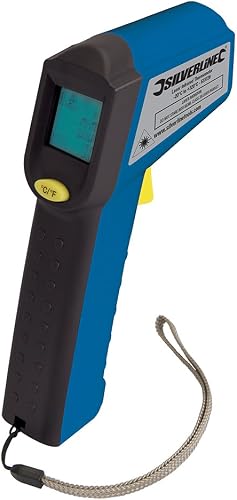
Cheapest — fine for a quick check, not a diagnostic tool
Silverline’s thermometer is the cheapest in this guide and does the one job it’s built for — point, pull the trigger, get a number — without adjustable emissivity or a published distance-to-spot ratio. Fine as a rough first check; not what should be doing the actual work of a condensation risk assessment.
For
- Cheapest thermometer in this guide
- Simple trigger operation
- Wide enough range for most jobs
Against
- No emissivity adjustment
- Distance-to-spot ratio isn’t published, so working range is a guess
Typically £14–£20
Check price on AmazonWhat actually matters — and what doesn’t
Distance-to-spot ratio matters more than maximum temperature. A building sits within a narrow band — roughly -10°C to 60°C even on a hot roof in summer. A 650°C ceiling is marketing headroom, not a feature that gets used.
Adjustable emissivity is a genuine upgrade, not a gimmick. On matt painted plaster, brick or timber a fixed 0.95 default is fine. On glazing, bare metal ductwork or a foil-faced insulation board it’s wrong, and a fixed-emissivity gun gives no warning — it just reports a confident, incorrect number.
A cold surface reading is not a moisture reading. It flags where to look, not what’s actually present. Confirming a problem is still a job for a contact damp meter or a hygrometer’s dew point calculation against the room’s air temperature and relative humidity.
It’s a spot check, not a map. For the shape and extent of a cold bridge, or finding a missing patch of loft insulation across an entire ceiling, that’s a job for a thermal imaging camera, not a single-point thermometer.
Resolution matters more than the accuracy spec suggests. A thermometer that rounds to the nearest whole degree can hide the exact 2–3°C differential that marks a thermal bridge. Fine resolution catches what a coarser reading smooths over.
Laser class and backlighting are baseline, not a differentiator. Every thermometer in this guide has both. It’s not worth paying extra for either on its own.
Questions I get asked
Can an infrared thermometer tell me if a wall has condensation or mould risk?
Indirectly, and only as one half of the sum. The logic that BS 5250 building physics guidance is built on compares a surface’s temperature against the room’s dew point — if the surface sits at or below the dew point, condensation is forming there; if it’s only a few degrees above it, mould risk climbs even without visible condensation. An infrared thermometer supplies the surface-temperature half of that comparison; a hygrometer supplies the air temperature and relative humidity needed to calculate the dew point. Neither instrument on its own confirms a problem — used together, they explain why a particular wall or ceiling is affected when others in the same room aren’t.
What’s the difference between an infrared thermometer and a thermal imaging camera?
An infrared thermometer gives one number for one point; a thermal imaging camera builds a full image from thousands of points at once, showing the shape and extent of a cold area rather than just confirming it exists. For a quick check — is this lintel colder than the wall around it — the thermometer is faster and far cheaper. For tracing the extent of a missing patch of insulation or a wider pattern of thermal bridging across a whole elevation, a thermal camera earns its higher price.
Does the emissivity setting actually matter for checking a house?
For most of what a survey involves — painted plaster, brick, render, timber — no, because those materials sit close enough to the standard 0.95 default that a fixed-emissivity thermometer reads them accurately. It matters the moment the target isn’t matt: glazing, polished or galvanised metal ductwork, and foil-faced insulation boards all have low emissivity, meaning they reflect more ambient infrared than they radiate their own, which skews a fixed-emissivity reading without any indication it’s wrong. An adjustable-emissivity model lets you correct for it; a fixed one doesn’t know it needs to.
How close do I need to stand for an accurate reading?
Close enough that the target is comfortably larger than the spot size the distance-to-spot ratio predicts. A 12:1 thermometer held 1.2m away is averaging roughly a 10cm circle; the same thermometer at 3m is averaging closer to 25cm, which can blend a narrow cold bridge into the wall either side of it. As a rule of thumb, halve the manufacturer’s quoted maximum distance before trusting a reading on anything smaller than a full wall panel.
An infrared thermometer earns its keep on plenty of jobs the practice carries out across Sussex, Kent and Surrey — EPCs, PAS 2035 retrofit assessments and general building surveys where a cold surface or a damp patch needs explaining, not just flagging — get in touch. Or browse the rest of the field-kit guides, including the thermal imaging cameras that pick up where a single spot reading stops, and the hygrometers that supply the other half of a condensation risk check.
Small print. This guide is general information, not a substitute for a full damp, condensation or thermal bridging survey; a surface temperature reading is an indicator, not a diagnosis. Prices are indicative, move constantly and were checked at the time of writing; the linked page always shows the current price. As an Amazon Associate I earn from qualifying purchases.