Indoor drying is often unavoidable in a British winter — nobody’s hanging a wash outside in November, and not every home has a tumble dryer or somewhere to vent one. How it’s done matters more than most households realise. A heated clothes airer puts the same few litres of water held in a wash load into the air as any other method of drying indoors, just gently and steadily from a low-wattage element running through each rail, rather than in one hot blast from a tumble dryer or slowly and passively off cold radiators overnight. Run in a room with somewhere for that moisture to go — an extractor fan on, a trickle vent open, the door onto a ventilated hallway — it’s a genuinely useful, cheap way to dry a load without the electricity draw or the venting a tumble dryer needs.
Run behind a closed bedroom door with the window shut and nothing else moving air, it’s doing exactly what produces streaming windows and black mould in the corner. If condensation is already a whole-house problem — windows misting every morning, damp patches migrating between rooms rather than sitting under one obviously wet load of washing — buying a better airer won’t fix it; that’s a ventilation question, and a PIV unit, a ventilation assessment, or in an especially airtight retrofit MVHR is the more useful next step. For drying a normal wash load in a room that can actually shed the moisture, here are the eight airers I’d look at.
The one I’d buy

Lakeland Dry:Soon Deluxe 3-Tier Heated Airer with Timer
Lakeland’s Dry:Soon range is the airer most households already half-recognise, and the Deluxe with timer is the version I’d point most families towards first. 300W across three open-front tiers gives 21m of drying space and a 15kg capacity — a full family wash in one go — and the built-in 1–12 hour timer means it switches itself off rather than running unattended into the small hours. It folds flat to 8cm for storage between loads.
Typically £150–£180
Check price on AmazonHow I judge a heated clothes airer
Wattage set against drying space, not looked at alone. A headline power figure means little without knowing how much rail or bar length it’s heating. Two airers rated within 50W of each other can dry noticeably differently once drying space and arm design are factored in.
A cover that’s actually doing something. A cover traps warm air around the fabric and can meaningfully cut drying time, but only where ventilation is also happening elsewhere in the room — otherwise it just holds the moisture closer to the clothes rather than letting it disperse anywhere useful.
Load capacity matched to an actual wash, not a marketing kg figure. A family wash with bedding and towels needs the 18–24kg end of this list; a single person’s laundry doesn’t need the biggest unit here, and paying for capacity that never gets used is money better spent elsewhere.
A timer or thermostat, not just a plug and a good memory. Leaving several hundred watts of bare heating elements running unattended overnight, or forgetting about it entirely, is the kind of thing that ends badly. A built-in timer is worth paying for on that basis alone.
Storage depth and weight. Folding flat to 8cm behind a door is a different proposition to a unit that’s effectively a permanent fixture in the utility room once it’s up. Check the folded dimensions against where it’s actually going to live.
The comparison
| Model | Drying space | Load capacity | Typical price | Best for | |
|---|---|---|---|---|---|
| Lakeland Dry:Soon Deluxe (Timer) | 21m | 15kg | ~£150–£180 | Best all-round pick | View |
| Minky SureDRI 4 Tier with Cover | 23m | 20kg | ~£105–£125 | Largest capacity, cover included | View |
| Lakeland Dry:Soon 3-Tier | 21m | 15kg | ~£125–£150 | The Deluxe spec, no timer | View |
| Minky SureDRI 3 Tier | 21m | 18kg | ~£115–£140 | Mid-capacity Minky | View |
| VonHaus 24-Rail with Cover | 11.2m | 24kg | ~£70–£90 | Best value large capacity | View |
| Daewoo 3-Tier with Cover | 12m | 15kg | ~£90–£110 | Compact footprint, cover included | View |
| Status 230W Winged | 20 rails | 15kg | ~£75–£95 | Narrow, folds flat to a wall | View |
| Beldray Winged (18 bars) | 18 bars | 15kg | ~£40–£55 | Cheapest overall | View |
The picks in detail
Lakeland Dry:Soon Deluxe 3-Tier Heated Airer with Timer
Best all-round — a built-in timer and full family capacity from a well-known brand
The Deluxe adds a 1–12 hour timer to Lakeland’s standard 3-tier airer, so it switches itself off instead of relying on someone remembering. 300W across three open-front tiers gives 21m of drying space and a 15kg capacity, enough for a full family wash in one go, and it folds flat to 8cm for storage. It costs meaningfully more than the standard version below purely for the timer, but for a household that’s likely to leave it running, that’s the point.
For
- Built-in 1–12 hour timer switches it off automatically
- 21m drying space and 15kg capacity handles a full family wash
- Well-known brand, wide parts and spares availability
Against
- Costs more than the standard version for the timer alone
- 300W is toward the higher end of the wattage range here
Typically £150–£180
Check price on AmazonMinky SureDRI 4 Tier Heated Airer with Cover
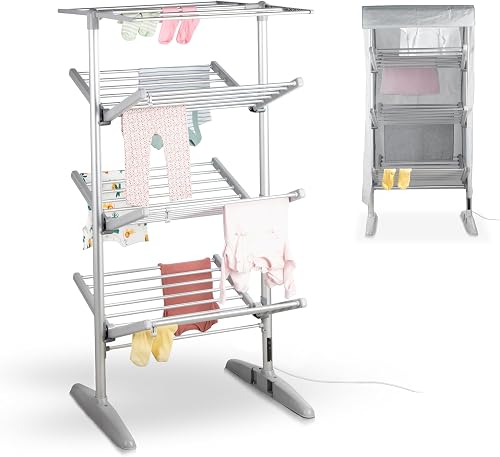
Best premium pick — the largest capacity here, with a cover and timer both included
Minky’s 4-tier SureDRI is the biggest unit on this list: 23m of drying space and a 20kg capacity, enough for bedding and towels alongside a normal wash. The angled Vertex arms are designed to keep garments separated for airflow rather than bunched together, the cover is included rather than a separate purchase, and a built-in timer means it doesn’t need remembering either. It’s the largest unit here to find room for once folded, and Minky doesn’t publish a wattage figure as prominently as Lakeland does.
For
- Largest drying space and capacity on this list
- Cover and timer both included as standard
- Angled Vertex arms keep garments separated for airflow
Against
- The biggest unit here to store once folded
- No clearly published wattage figure to compare against Lakeland or Daewoo
Typically £105–£125
Check price on AmazonLakeland Dry:Soon 3-Tier Heated Airer

Best if the timer isn’t essential — the Deluxe’s core spec for less
This is the timer-free sibling of the top pick: the same 300W element, 21m of drying space and 15kg capacity, at a meaningfully lower price. It suits a household with a fairly predictable laundry routine, where remembering to switch it off isn’t a real risk. Where the airer’s likely to be left running unattended, the Deluxe’s timer above is worth the extra cost.
For
- Same 21m drying space and 15kg capacity as the Deluxe pick
- Meaningfully cheaper without the timer
- Same folds-to-8cm storage and Lakeland build quality
Against
- No automatic shut-off
- Needs remembering to switch off
Typically £125–£150
Check price on AmazonMinky SureDRI 3 Tier Heated Airer

Best mid-capacity Minky — 18kg without the size or price of the 4-tier
The 3-tier SureDRI shares the 4-tier’s angled Vertex arms and 21m of drying space on a smaller footprint, with an 18kg capacity that comfortably covers most households’ regular wash. The cover isn’t included here, which is the main thing separating it from the 4-tier above at a meaningfully lower price. It suits a household that doesn’t need bedding-sized capacity every week.
For
- 21m drying space and 18kg capacity on a smaller unit than the 4-tier
- Angled arms for airflow
- Cheaper than the 4-tier version above
Against
- No cover included
- No published wattage figure
Typically £115–£140
Check price on AmazonVonHaus Heated Clothes Airer, 24 Rail with Cover

Best value large capacity — 24kg rated, with a cover, pegs and mesh shelf included
VonHaus rates this 24-rail airer to a genuinely high 24kg, with a 202W element running at a stated 40–55°C and 11.2m of drying space across the rails. A cover, pegs and a non-heated mesh top shelf all come included rather than as separate purchases, unusual at this price point. The trade-off against the Lakeland or Minky units above is drying space per pound — 11.2m is the shortest figure on this list set against a fairly generous kg rating.
For
- High 24kg capacity rating
- Cover, pegs and a mesh shelf all included
- Lower 202W running cost than most here
Against
- Shortest drying-space figure (11.2m) on this list
- Folds to a deeper 15.5cm than the Lakeland units
Typically £70–£90
Check price on AmazonDaewoo 3-Tier Heated Clothes Airer with Cover
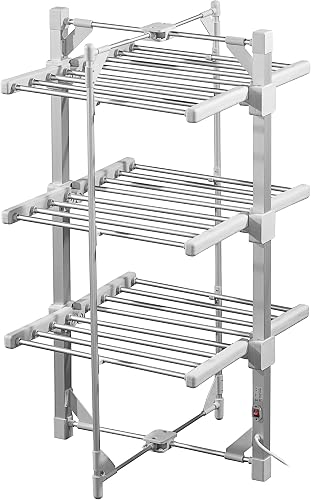
Best compact pick with a cover included — folds under a bed
Daewoo’s 3-tier airer is built for a smaller space: 60cm wide by 62cm deep, with 24 heated bars giving 12m of drying space and a 15kg capacity, and a cover included as standard. The 220W element is the lowest wattage on this list alongside VonHaus. It’s a sensible pick for a flat or a smaller utility space where the Lakeland or Minky units’ footprint doesn’t fit, without giving up a cover.
For
- Compact footprint for a smaller room
- Cover included as standard
- Low 220W running cost
Against
- 12m drying space is on the smaller side for a full family wash
- Less established brand recognition than Lakeland or Minky
Typically £90–£110
Check price on AmazonStatus 230W Heated Winged Clothes Airer
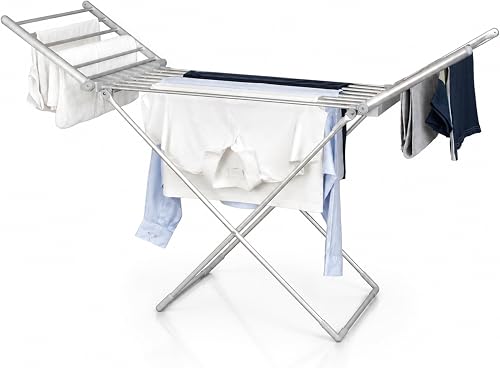
Best winged design — folds narrower than a tiered airer against a wall
Status’s winged airer folds flat against a wall rather than stacking as tiers, with 20 rails across a 94cm wingspan and a 15kg capacity from a 230W aluminium frame. The winged layout suits a narrow utility room or hallway where a tiered unit’s footprint is awkward, though it offers less total drying space than the tiered options above for a broadly similar price.
For
- Folds flat and narrow against a wall
- Corrosion-resistant aluminium frame
- 15kg capacity
Against
- Less drying space than the tiered Lakeland or Minky units at a similar price
- No cover included
Typically £75–£95
Check price on AmazonBeldray Winged Heated Airer (18 Bars)

Cheapest overall — 18 bars and 230W for close to half the tiered airers’ price
This is the cheapest genuinely heated airer on the list, and the one I’d point a first flat or a tight budget towards. 18 aluminium bars at 230W give a 15kg capacity in the same winged, fold-flat format as the Status above, with a 1.4m power cord for flexible positioning. It doesn’t come with a cover or a timer, and the drying space is smaller than the tiered units, but for occasional single-load use it’s hard to argue with the price.
For
- Cheapest airer on this list
- 15kg capacity despite the price
- Folds flat for storage
Against
- No cover or timer included
- Smaller drying space than the tiered options
Typically £40–£55
Check price on AmazonWhat actually matters — and what doesn’t
A heated airer doesn’t remove moisture from the house. It just gets it into the air faster than draping wet washing over a radiator. Running one in a closed bedroom overnight with the door shut and no extractor or window open is exactly the pattern that produces the condensation call the following week.
The running-cost comparison against a tumble dryer is real, but the timeframes aren’t equivalent. At these wattages a full drying cycle typically costs somewhere in the region of 15–40p across 4–8 hours, against upward of £1 for a vented or condenser tumble dryer cycle that finishes in under an hour. It’s genuinely cheaper per load, not cheaper per hour — it dries slower for less.
A cover is worth the extra cost, but it doesn’t turn an airer into a tumble dryer. It speeds drying by trapping warm air around the fabric, not by extracting moisture out of the room. The water evaporating off the clothes still has to go somewhere, cover or no cover.
Wattage isn’t a reliable proxy for drying speed on its own. The number of heated rails or bars and how the arms are angled to give clothes airflow matters as much as the raw power draw. Two airers rated within 50W of each other can dry noticeably differently.
What the marketing pushes that matters less than it sounds. A headline maximum temperature figure (40–55°C on some of these) says little on its own; it’s only useful alongside the airflow design and the room it’s actually drying in. None of it substitutes for drying space and capacity matched to the wash it’s meant to handle.
Questions I get asked
Will a heated clothes airer cause condensation or mould? Used in a room with somewhere for the moisture to go — an extractor fan running, a trickle vent open, the door onto a ventilated hallway — it’s no worse than any other method of indoor drying, and considerably better ventilated than washing draped over radiators behind a closed door. Used in a sealed room, it adds to the same moisture load that causes both.
Is a heated airer actually cheaper to run than a tumble dryer? On a straight cost-per-load basis, yes — typically 15–40p across 4–8 hours at these wattages, against upward of £1 for a vented or condenser tumble dryer cycle. It takes considerably longer to finish a load, so it suits a household that can leave washing drying overnight rather than one that needs it back in under an hour.
Do I need to leave a window open while it’s running? Not necessarily a window specifically, but the room needs somewhere for the moisture to disperse — an extractor fan, a trickle vent, or a door left ajar into a ventilated hallway. A sealed room with the airer running is the wrong setup regardless of which unit it is.
Is a cover worth buying separately if it isn’t included? For a cold room or a larger load, yes — it meaningfully speeds drying by holding warmth around the clothes. For a small load in an already-warm utility room, it’s a nice-to-have rather than essential.
I don’t sell or install clothes airers myself, but if indoor drying is turning into a condensation problem rather than solving one, that’s usually a ventilation question rather than a laundry one — a ventilation assessment shows what’s actually moving air through the house, and a PIV unit or MVHR installation covers the whole-house version of the fix. A working bathroom extractor fan matters just as much as where the washing dries. If the pattern on the wall doesn’t behave like condensation at all, see rising damp treatment costs instead. Get in touch for a second opinion, and there are more field-kit guides to work through.
Small print. This guide is general information, not a recommendation on whether your specific condensation problem needs better drying habits or a ventilation upgrade — get that diagnosed properly first. Prices are indicative, move constantly and are checked at the time of writing; the linked page always shows the current price. As an Amazon Associate I earn from qualifying purchases.