On a lot of surveys, the bathroom fan tells you as much as the loft does. Pull the cover off and it's either seized solid, wired to nothing, or connected straight to the light with none of the run-on that clears the air after the shower's finished. The fan is rarely the whole story, but it's often the first thing worth fixing — cheap, quick, and something a competent electrician can swap in an afternoon.
What it needs to do is straightforward: clear the warm, moisture-laden air a bath or shower generates before it finds a cold surface and condenses. Approved Document F sets a minimum intermittent extract rate of 15 litres per second for a bathroom (6 l/s for a separate WC), or a continuous alternative running low and slow all the time instead. Most fans sold today clear that bar on paper; where they fall down is duct runs that are too long, control that doesn't suit the wiring at the switch, or a rate too low for a room that's grown a power shower since the fan went in.
A working bathroom fan fixes moisture generated in that room. If damp or mould is spreading well beyond it — landing ceilings, bedroom corners, wardrobes on external walls — that's usually a whole-house question, and a PIV unit is the more likely fix. And if the pattern on the wall doesn't behave like condensation — there when it's cold, gone in summer — get that looked at as rising damp instead of buying a fan for it. With that sorted, here are the eight I'd look at.
The one I’d buy

Envirovent Silent 100HT
This is the one I'd point most condensation-prone bathrooms towards first. The humidistat responds to actual moisture rather than relying on someone leaving a pull-cord on, the adjustable overrun timer (1–30 minutes) keeps clearing air after the room's vacated, and 26 l/s comfortably clears the Part F minimum. A seven-year warranty is the longest of any fan here, and 26.5 dB(A) is genuinely quiet running mid-shower.
Typically £80–£95
Check price on AmazonHow I judge a bathroom extractor fan
Extract rate against the actual room, not just the spec sheet. 15 l/s clears Part F for a standard bathroom, but a long duct run, extra bends or an ensuite serving a large power shower all eat into what a fan delivers in practice. A rate with headroom over the minimum is worth more than one that scrapes it.
Control that matches the wiring already at the switch. A timer or humidistat needs three wires reaching the fan — permanent live, switched live and neutral. Plenty of older bathrooms only ever had two, which is the real reason plain pull-cord fans are still sold: sometimes it's the only option without opening up a wall.
Humidistat versus timer versus continuous dMEV. A timer clears the air after use but does nothing between showers; a humidistat reacts to moisture whenever it rises; a continuous dMEV unit runs low and slow all the time and never has to catch up.
Noise quoted honestly. A dB(A) figure at a stated distance and speed is useful; a fan that only sounds quiet because the figure was taken at the lowest of several speeds isn't the same as one that's quiet at the rate the room actually needs.
IPX4 and how it gets wired in. Every fan here is rated IPX4 or better, the minimum for bathroom zones 1 and 2 under BS 7671. What matters more is that it's connected via a fused spur or isolator sited outside those zones — never plug-and-socket in the room — which is an installer question, not a spec-sheet one.
The comparison
| Model | Control | Extract rate | Typical price | Best for | |
|---|---|---|---|---|---|
| Envirovent Silent 100HT | Humidistat + timer | 26 l/s | ~£80–£95 | Best all-round pick | View |
| Vent-Axia Svara | App, continuous or intermittent | Quiet-running, 4W | ~£100–£150 | Premium smart pick | View |
| Envirovent ECO dMEV+ | Continuous dMEV | 4–18 l/s | ~£130–£170 | Steadiest moisture control | View |
| Vent-Axia Silhouette 100T | Timer | 21 l/s | ~£45–£60 | Slimmest profile | View |
| Envirovent Silent 100T | Timer | 26 l/s | ~£40–£50 | Quietest timer-only fan | View |
| Xpelair Simply Silent DX100BTS | Twin-speed timer | 15/21 l/s | ~£28–£38 | Well-known DIY brand | View |
| Manrose XF100P | Pull-cord | 23.6 l/s | ~£20–£30 | Two-wire, like-for-like swap | View |
| Manrose XF100T | Timer | 23.6 l/s | ~£15–£25 | Cheapest overall | View |
The picks in detail
Envirovent Silent 100HT
Best all-round — humidistat and timer together, longest warranty here
The HT suffix means humidistat and timer both fitted, so the fan reacts to moisture whenever it appears and still clears the air after someone's finished. 26 l/s gives real headroom above the Part F minimum, 26.5 dB(A) at 3m is quiet enough not to be the reason it gets left off, and the adjustable humidistat (60–90% RH) tunes out short-cycling in a naturally steamy room. Envirovent backs the T/HT range with a seven-year warranty, the longest here.
For
- Humidistat and timer cover both use cases
- 26 l/s gives real headroom over the Part F minimum
- Seven-year warranty, longest here
Against
- Needs three wires at the switch to use the timer
- Costs more than a plain timer-only fan
Typically £80–£95
Check price on AmazonVent-Axia Svara

Best smart pick — app-controlled scheduling and continuous or intermittent running
Svara was the first UK bathroom fan commissioned and controlled entirely from a phone app over Bluetooth, with no wi-fi dependency and no fiddly internal jumpers for the installer to set. It runs as a conventional intermittent fan or switches to continuous low-trickle running, with a light sensor and humidistat both feeding into when it speeds up. At 17 dB(A) on its lowest setting it's about as close to silent as a bathroom fan gets, and the removable cartridge makes cleaning easy. It's priced well above the timer-only fans here for that convenience.
For
- App scheduling and continuous/intermittent modes in one unit
- 17 dB(A) low trickle — the quietest fan on this list
- Light sensor plus humidistat, not just a timer
Against
- A real step up in price over a conventional timer fan
- App dependency won't suit everyone
Typically £100–£150
Check price on AmazonEnvirovent ECO dMEV+

Best continuous pick — runs low and slow all the time rather than catching up after use
A dMEV unit is a decentralised continuous extract fan, and Part F explicitly allows one to replace an intermittent fan like-for-like. Rather than switching on when someone showers, it trickles constantly at as little as 4 l/s and boosts to 18 l/s on demand, at under 20 dB(A) — genuinely inaudible. It suits a bathroom that steams up quickly or sees heavy daily use better than a fan that only starts working once the room's already humid. The warranty is shorter than the Silent range at two years, and it costs more than any timer fan here.
For
- Continuous running heads off condensation before it starts
- Under 20 dB(A) — effectively silent
- Six adjustable trickle-speed settings
Against
- Only a two-year warranty against the Silent range's seven
- The most expensive fan on this list
Typically £130–£170
Check price on AmazonVent-Axia Lo-Carbon Silhouette 100T

Best for a shallow void — a 17mm slim profile with a five-year motor guarantee
Silhouette's selling point is depth: at 17mm it sits almost flush, which matters where the ceiling void or wall cavity behind it is shallow — a common problem in a flat conversion or an extension tied into an existing ceiling line. It delivers 21 l/s, comfortably above the Part F minimum, with an adjustable overrun timer and a five-year motor guarantee. It's timer-only rather than humidistat, so it won't react to moisture between uses.
For
- 17mm profile fits where depth behind the wall is tight
- 21 l/s clears the Part F minimum with headroom
- Five-year motor guarantee
Against
- Timer only, no humidistat option in this model
- Costs more than the equivalent Envirovent or Manrose timer fan
Typically £45–£60
Check price on AmazonEnvirovent Silent 100T

Best timer-only — the HT pick's build quality and 26 l/s rate, minus the humidistat
This is the plain timer version of the top pick above: same 26 l/s extract rate, same 26.5 dB(A) noise figure, same seven-year warranty, without the humidistat sensor. It suits a bathroom used at fairly predictable times, where an overrun timer alone is enough. Where a room steams up unpredictably or gets used outside a routine, the HT version above justifies the extra cost.
For
- Same 26 l/s rate and seven-year warranty as the HT version
- Genuinely quiet at 26.5 dB(A)
- Cheaper than the humidistat version
Against
- No automatic response to moisture between uses
- Still needs three wires at the switch for the timer to work
Typically £40–£50
Check price on AmazonXpelair Simply Silent DX100BTS

Best well-known DIY brand — twin-speed with an adjustable timer
Xpelair is the name most homeowners already recognise from the local electrical wholesaler or DIY shed, and DX100BTS gives a genuine choice between a quieter 15 l/s low setting and a 21 l/s boost for heavier use, both with an adjustable overrun timer. Published noise figures (22 dB(A) low, 34 dB(A) high) are competitive with the pricier fans here. The standard guarantee is shorter than most at two years, though it can be extended by registering the fan after purchase.
For
- Twin-speed gives a genuine low/high choice
- Competitive noise figures at both speeds
- Widely stocked, easy replacement parts
Against
- Shorter standard warranty than the Envirovent or Vent-Axia ranges
- No humidistat option in this model
Typically £28–£38
Check price on AmazonManrose XF100P

Best two-wire swap — for when a timer isn't wireable without opening up a wall
A timer or humidistat needs a permanent live reaching the fan alongside the switched live and neutral; plenty of older bathrooms only ever had two wires run to the light switch, and rewiring for a third isn't always practical. XF100P is the honest answer: a straightforward pull-cord fan at the same 23.6 l/s rate as Manrose's timer version, needing nothing the existing wiring can't already provide. It's not meaningfully cheaper than the timer version below — buy it for the wiring, not to save money.
For
- Works on a simple two-wire connection
- Same 23.6 l/s extract rate as the timer version
- Three-year warranty
Against
- No overrun after the cord's pulled off
- Costs about the same as the timer version, so buy it only for the wiring, not the price
Typically £20–£30
Check price on AmazonManrose XF100T
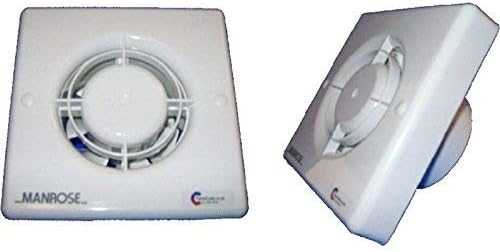
Cheapest overall — a proper adjustable timer for close to pull-cord money
This is genuinely the cheapest fan here, and because it prices so close to the pull-cord version above, it's the one I'd default to wherever the wiring allows a timer at all. The 2–20 minute adjustable overrun does the actual job of clearing air after use, the 23.6 l/s rate clears Part F, and the three-year warranty matches Manrose's other 100mm fans. It's louder than the Envirovent or Vent-Axia options at 41 dB(A), the trade-off for the price.
For
- Cheapest fan here, and barely pricier than the pull-cord version
- Adjustable 2–20 minute overrun timer
- Widely stocked, easy to source parts and replacements
Against
- 41 dB(A) is noticeably louder than the premium picks
- No humidistat option
Typically £15–£25
Check price on AmazonWhat actually matters — and what doesn’t
No window in the room means the overrun isn't optional. Approved Document F requires an intermittent fan to keep running for at least 15 minutes after the room is vacated where there's no openable window — which rules out a plain pull-cord fan with nothing else providing overrun in a windowless bathroom or WC.
A continuous dMEV fan isn't automatically cheaper to run than an intermittent one. The marketing angle is pennies a year in electricity, and that's true on its own terms — but a cheap timer fan that's off most of the day can cost less over a year than one running 24 hours. The real case for dMEV is steadier moisture control, not a smaller bill.
The bathroom fan is one line in a whole-dwelling sum. Part F's continuous ventilation rates aren't just a per-room figure; the total across every room has to clear a whole-dwelling minimum. A single fan swap rarely changes that picture on its own.
A long duct run or a windowless ensuite needs more than a wall fan. Every fan on this page is built to push air a short, direct distance through a wall or ceiling. Where the run to an outside wall is more than a couple of metres, has several bends, or serves more than one room, an inline mixed-flow fan sited mid-duct is the right tool, not a bigger wall-mounted unit.
IPX4 and where the isolator sits matters more than the fan's own spec. Every fan here meets the bathroom zone rating, but the wiring has to as well — a fused spur or ceiling switch sited outside zones 0–2, never plug-and-socket in the room itself. That's a job for a competent electrician, not a DIY afternoon.
What the marketing pushes that matters less than it sounds. A boosted maximum airflow figure isn't what the fan runs at day to day, and app control is a convenience, not a performance feature. None of it substitutes for real headroom on extract rate and a control type that suits the wiring at the switch.
Questions I get asked
Do I need Building Control sign-off to swap a bathroom fan? Replacing a fan like-for-like on its existing cabling generally doesn't need notifying to Building Control. Changing the ducting route, moving the fan, or converting a passive vent into a powered one is more likely to raise a question — ask whoever fits it to confirm.
Humidistat, timer or continuous dMEV — which one for my bathroom? If the wiring only gives two wires at the switch, a pull-cord fan is the practical answer regardless of preference. With three wires available, a timer suits predictable use, a humidistat suits a bathroom that steams up unpredictably, and a dMEV suits one in heavy daily use that never quite dries out between showers.
Will a low-wattage continuous fan push my electricity bill up? Not by much — a few pounds a year is typical — but it isn't necessarily cheaper than a fan switched off most of the day either. Buy a dMEV unit for steadier moisture control, not to save on the bill.
Can I fit a bathroom extractor fan myself? The fan and duct can be DIY, but the electrical connection sits inside a bathroom's special zones under BS 7671 and is notifiable work under Part P in most cases. Get a competent registered electrician to make the connection.
I don’t install extractor fans myself, but if condensation is driving the search, a ventilation testing visit shows what the current fan delivers against what Part F expects, and a PAS 2035 retrofit assessment is the right next step if it looks like a whole-house problem — exactly what a PIV unit is for, with MVHR installation costs covering the balanced-ventilation alternative. If the pattern on the wall isn't condensation at all, see rising damp treatment costs instead. Get in touch for a second opinion, and there are more field-kit guides to work through.
Small print. This guide is general information, not a recommendation on whether your specific bathroom needs a new fan or a different ventilation strategy — get that diagnosed properly first, and have the electrical connection made by a competent registered electrician given the bathroom zone rules involved. Prices are indicative, move constantly and are checked at the time of writing; the linked page always shows the current price. As an Amazon Associate I earn from qualifying purchases.