Drainage is the part of a building survey clients care about least until it costs them most. A blocked or broken foul drain sits behind a surprising amount of what I get called to look at — damp at the base of a wall that turns out to be a leaking gully, a “subsidence” crack over a fractured pipe. So the basic drainage investigation on a survey is old-fashioned and physical: lift the covers, watch the flow, and if something isn’t moving, put a rod down the line and learn where it stops. I’ve already written about the manhole keys that get the covers up; this guide is about what goes down the hole.
A drain rod set is gloriously simple — screw-together flexible rods, roughly a metre each, with a business end of your choosing — and it has barely changed in a century. Which is exactly why the differences between sets matter: there are no electronics to hide behind. A rod set is its materials and its joints, and when a joint fails it fails in the worst possible place — underground, out of reach, adding a stranded metre of plastic to the very blockage you were trying to clear. Screw-thread rods undo themselves if rotated the wrong way while flexed round a bend; unscrewing the set into the drain is the classic disaster of rodding, and it turns a £30 blockage into a £300 excavation. Everything below is written with that in mind.
The one I’d buy

Bailey 5431 Universal Drain Rod Set
The trade default, from the firm that has made drain rods in England since the 1850s. Ten 3ft polypropylene rods — thirty feet assembled — with brass universal joints, plus a 100mm rubber plunger, a drop scraper and a double worm screw, in a waterproof bag that fits down the side of the van. Owner feedback is consistent on the two things that matter: the joints hold, and the rods flex round benched channels without snapping.
Typically £45–£65
Check price on AmazonHow I judge a drain rod set
The joints, above everything. There are two systems. Universal joints are plain brass screw threads — simple, cheap, compatible across most brands, but they rely on you keeping the set turning clockwise so the threads tighten rather than undo. Lockfast joints add a locking coupling so the rods physically cannot unscrew, whichever way they’re rotated. Drainage contractors use lockfast almost exclusively. For occasional survey and household use, good universal joints plus correct technique are fine; if rods will go down drains you cannot see into, lockfast is worth the premium.
Rod diameter and flexibility. Rods must be stiff enough to push a blockage and flexible enough to get round the bend at the bottom of an inspection chamber. The sweet spot for domestic 100mm drains is polypropylene of around 19–25mm diameter. Thin, whippy rods buckle and snake instead of transmitting your push; cheap brittle plastic snaps at the ferrule in cold weather — and a snapped rod is in the drain just as surely as an unscrewed one.
The heads. Three earn their keep. The rubber plunger is the one you’ll use most: worked back and forth in a flooded line, it shunts water against the blockage and clears most soft stoppages hydraulically. The worm screw (corkscrew) bites into rag and root fibre so you can break it up or pull it back. The drop scraper is a hinged half-moon that flattens to pass along the pipe and drops open to drag silt back to the chamber. A clearing wheel — a disc that helps the rod train ride round bends — is a nice extra on long runs.
Reach. Ten rods is roughly nine or ten metres, which covers chamber-to-chamber on most domestic runs. Count what a set actually includes, though: some “12-piece” sets are ten rods and two tools, others eight rods and four tools. Rods can be added later; a set that can’t reach the next chamber teaches you nothing.
How it travels. Drain rods come back covered in exactly what you’d expect. A bag or case you can hose out — or a rigid container, as Horobin supply — matters more than it sounds if the set lives in a van with the rest of your kit.
The comparison
| Model | Joints | Rods / reach | Typical price | Best for | |
|---|---|---|---|---|---|
| Bailey 5431 Universal | Universal brass | 10 × 900mm + 3 tools | ~£55 | The all-round survey and household set | View |
| Bailey 5503 Lockfast | Lockfast (locking) | 10 × 900mm + 3 tools | ~£90 | Professional use, unknown drains | View |
| Horobin Lockfast kit | Lockfast (locking) | 10 rods + tools, rigid container | ~£75–£85 | Lockfast on a slightly smaller budget | View |
| Rothenberger 130080 | Universal brass | 10 × 900mm + 2 tools, straps | ~£45–£55 | Trade-brand universal alternative | View |
| Draper 53856 | Universal brass | 10 × 900mm + tools, case | ~£55–£65 | Tidy storage — the set in a proper case | View |
| Silverline 12-piece | Universal brass | 10 × 920mm + 2 tools | ~£20–£30 | Best on a budget | View |
| Rolson 60967 | Universal (zinc-alloy ends) | 10 × 920mm + 2 tools | ~£15–£25 | Emergency money — with caveats | View |
| Horobin 100mm drop scraper | Fits universal thread | Attachment only | ~£6–£10 | The silt-dragging add-on most sets lack | View |
The picks in detail
Bailey 5431 Universal Drain Rod Set
Best overall — the trade default, and my top pick above
Bailey of Birmingham is to drain rods roughly what Protimeter is to damp meters: the name the trade reaches for without thinking. The 5431 is their standard universal set — ten 3ft blue polypropylene rods with riveted brass ferrules (the rivet stops the ferrule pulling off the rod under tension, which is how cheap rods die), plus a 100mm plunger, a drop scraper and a double worm screw in a waterproof bag. The joints are still plain screw threads, so the clockwise rule applies in full — but user feedback over many years says the threads are machined well enough to stay snug, which is precisely what the difference over a £20 set buys.
For
- Riveted brass joints — the ferrules stay on the rods
- All three heads that matter: plunger, drop scraper and double worm screw
- Universal thread accepts a whole ecosystem of accessories
- Made by a firm that has been making exactly this since the 1850s
Against
- Screw joints can still unscrew if you turn the wrong way
- Roughly twice the price of the budget sets
Typically £45–£65
Check price on AmazonBailey 5503 Lockfast Drain Rod Set

Best professional set — joints that cannot unscrew into the drain
Same maker, same rods, same tools, different joint — and the joint is the whole argument. Bailey’s Lockfast coupling locks positively as it’s assembled, so the rod train can be rotated either way — even wound anticlockwise to back a worm screw out of a root mass — with no risk of the set parting company underground. With universal rods half your attention is on the rotation; with lockfast all of it is on the blockage, which is why drainage contractors specify it and many commercial sites ban screw-jointed rods outright. The penalty is money and compatibility: lockfast accessories cost more and tie you into the pattern. For a set used regularly on drains of unknown condition, it’s the right trade.
For
- Joints physically cannot unscrew — rotate either way, freely
- Same proven Bailey rods and tool set as the 5431
- The pattern drainage professionals standardise on
Against
- Costs half as much again as the universal set
- Lockfast accessories are dearer and less interchangeable
Typically £80–£100
Check price on AmazonHorobin Lockfast Drain Cleaning Kit

Best lockfast value — the other British maker, in a hoseable container
Horobin is the other old English drainage-tool name — a Midlands maker of rods and drain fittings for over a century, and the firm behind much of the kit sold under merchant brands. Their lockfast kit for 100mm drains undercuts the Bailey 5503 usefully and comes in a rigid plastic container rather than a canvas bag, which sounds trivial until you’ve smelt a rod bag that was zipped up wet. The locking joints do the same essential job: no unscrewing, rotate either way, full attention on the far end of the rods.
For
- Lockfast-type locking joints at a lower price than Bailey
- Rigid container you can rinse out
- Horobin’s accessory range (scrapers, plungers, wheels) is broad and cheap
Against
- Container is bulkier to stow than a soft bag
- Availability on Amazon fluctuates — merchant stock is steadier
Typically £70–£90
Check price on AmazonRothenberger 130080 Universal Drain Rod Set
Best universal alternative — plumbing-trade pedigree, keen price
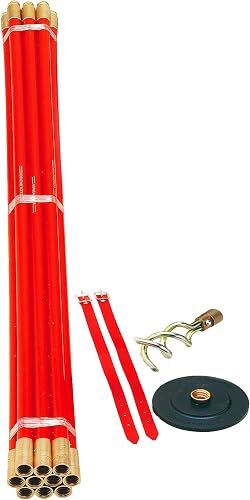
Rothenberger is a serious German plumbing-tool firm — their pipe benders and press tools are all over British sites — and their universal set is a straightforward take on the formula: ten red polypropylene rods with brass screw joints, a worm screw, a 4-inch plunger, and carry straps in place of a bag. It regularly sells for less than the Bailey 5431, and owner feedback is solid on the joints and rod stiffness. The straps are honest but basic; filthy rods go into the van less politely than they do in a zipped bag.
For
- Trade-brand build at close to budget-set money
- Stiff rods that transmit a push rather than snaking
- Standard universal thread for accessories
Against
- Straps, not a bag or case
- Two tools only — no clearing wheel or scraper in the set
Typically £40–£55
Check price on AmazonDraper 53856 Polypropylene Drain Rod Set
Best packaging — the set that stores like it means to be kept
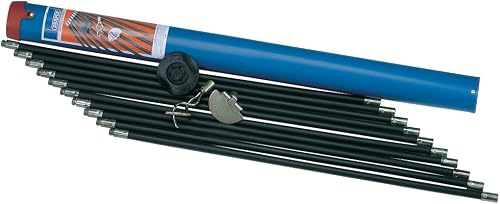
Draper’s 13-piece set covers nine metres with 900mm polypropylene rods and universal joints, includes plunger and worm screw, and — its party piece — packs into a proper storage case rather than a bag. For a set that lives in a garage and comes out a few times a year the case is genuinely worth something: rods stored straight stay straight, and threads stored clean start clean. Mid-table price, tidy execution, and Draper’s guarantee and spares are better than the no-name sets it competes with.
For
- Rigid case keeps rods straight and threads clean
- Established brand with a real guarantee behind it
- Standard universal fitting for extra heads
Against
- 900mm rods — fractionally less reach per rod than the metre sets
- Costs Bailey money without the Bailey joint pedigree
Typically £50–£65
Check price on AmazonSilverline 12-piece drain rod set

Best on a budget — the cheap set that behaves like a dear one, mostly
Silverline’s 12-piece set — ten 920mm rods, a 100mm plunger, a double worm screw, brass universal joints — is the honest end of the budget market. The rods are slimmer than the trade sets at 18mm, the crimped ends less convincing than Bailey’s rivets, and owner feedback says as much: treated gently and turned religiously clockwise it clears blockages fine; hauled on like a tug-of-war it will give up at a joint. For a homeowner who wants a set in the shed for the once-every-few-years event that’s a fair deal at around £25, and Silverline’s guarantee is more warranty than anything else at the price. Just accept what it is: a light-duty tool with a technique dependency.
For
- Nine metres of reach and both essential heads for ~£25
- Standard universal thread — upgrade heads later
- Guarantee unusual at this price
Against
- Joints demand strict clockwise discipline under load
- Rods whippier than the trade sets — push transmits less cleanly
Typically £20–£30
Check price on AmazonRolson 60967 drain rod set

The emergency purchase — fine once, know the caveats
Search “drain rods” on Amazon and a wall of near-identical sub-£25 sets comes back; Rolson’s 12-piece is the recognisable brand among them and representative of the class. Ten 920mm rods, plunger, double worm screw, zinc-alloy end connections rather than crimped brass. Owner feedback follows a pattern I’d trust: most buyers clear their blockage and are delighted; a persistent minority report joints stripping or rods parting under enthusiastic use — occasionally in the drain, the one failure this tool exists to avoid. As a same-day purchase for a flooded gully it’s better than no rods. As the set you keep, spend the extra £30 on the Bailey.
For
- Cheapest way to ten metres of reach, widely stocked
- Adequate for soft blockages with gentle technique
Against
- Zinc-alloy joints are the weak point — the failure mode is the expensive one
- No storage bag worth the name
Typically £15–£25
Check price on AmazonHorobin 100mm drop scraper

The add-on worth having — the head most sets leave out
Most sets ship with a plunger and a worm screw and stop there; the drop scraper is the head they leave out (of the sets above, only the Baileys include one), and it’s the head that deals with the commonest real-world condition — a line half-full of silt rather than blocked outright. The hinged blade folds flat to push up the pipe, drops open past the deposit, and drags it back to the chamber to be lifted out. Horobin’s 100mm version screws onto any universal-threaded set, costs less than a tenner, and turns a rod set into something closer to an investigation tool: what a scraper pulls back — silt, scale, root fibre, fragments of clayware — says a lot about the state of the run.
For
- Clears settled silt the plunger and worm can’t
- What it drags back is diagnostic in itself
- Universal thread, pocket money price
Against
- Universal-thread version only — lockfast sets need the lockfast pattern
- One job; it earns its place, not its keep, on a clean line
Typically £6–£10
Check price on AmazonWhat actually matters — and what doesn’t
Clockwise. Always, only, clockwise. With screw-jointed rods, every rotation you make while pushing, twisting a worm screw into rag or working round a bend must be clockwise as you look down the rods towards the drain — that direction tightens every joint in the train. One absent-minded anticlockwise wind, made while ten joints are flexed and under load somewhere you can’t see, and the set unscrews itself at its weakest coupling. Retrieving an abandoned rod train usually means a drainage contractor, sometimes an excavation. It is the whole case for lockfast joints, and the first thing to say to anyone borrowing your rods.
Rodding is investigation as much as clearance. On a survey, what the rods tell you matters more than what they clear. Where the rod stops, measured in rod-lengths from the chamber, locates the problem on a plan. What it feels like matters too: a soft squelch that yields is a blockage; a hard dead stop that doesn’t is displaced pipework, a collapse, or an intruding connection — and no amount of enthusiasm with a worm screw will fix any of those. That distinction — soft stop versus hard stop — is roughly where rodding ends and a CCTV drain survey begins. If the line blocks repeatedly, if the rods hit something solid, or if there’s any suggestion of movement in the building above, the camera is the next call, not a bigger push. A borescope will let you peer into a gully trap or the first metre of a run, but a proper tractor-camera survey with a location sonde is the tool for the line itself.
Water does the work. A plunger worked in a flooded line moves a slug of water that hits the blockage far harder than plastic ever will. If the chamber is dry, you’re usually on the wrong side of the blockage — go downhill one chamber and work back. This is also why rodding is best done early: a line surcharged to the cover is unpleasant to open and worse to work in.
What the listings push that you can skip. Piece counts, mostly. A “24-piece professional set” that turns out to be twelve rods and twelve novelty heads is worse than ten good rods and three heads that work. Skip the drill-powered rotation on screw-jointed sets entirely — powered rotation plus screw joints is the unscrewing disaster on fast-forward; only lockfast-type rods should ever see a drill, gently. And gloves are not optional kit: foul drainage carries real infection risk (Weil’s disease among them), so heavy rubber gauntlets and washing up like a surgeon afterwards are part of the job, not an accessory.
Questions I get asked
How do you use drain rods properly? Lift the covers either side of the suspect run (see the manhole keys guide), and work from the dry or downstream chamber towards the blockage. Start with the plunger: feed rods in, adding one at a time with a firm clockwise wind at each joint, and work it back and forth so the water in the line does the striking. If that fails, swap to the worm screw to bite into whatever’s down there and break it up or draw it back. Keep every rotation clockwise, don’t force a hard stop, and flush the run through from upstream when the flow returns — a partial clear that silts back up in a fortnight isn’t a clear.
Which way do you turn drain rods? Clockwise, viewed from your end looking along the rods towards the drain — the direction that screws the joints tighter. This applies while pushing, pulling and especially while twisting the worm screw into a blockage. Turn anticlockwise under load and screw-jointed rods will eventually undo at one of the couplings and leave the far end of the train in the pipe. Lockfast-pattern rods (the Bailey 5503 and Horobin kits above) are the exception: their joints lock mechanically and can be rotated either way — which is precisely what you’re paying for.
What size drain rods do I need? For domestic foul and surface-water drains — typically 100mm (4-inch) clayware or PVC — the standard sets here are right: rods around 19–25mm diameter, a metre or so long, with a 100mm plunger. Ten rods covers the distance between chambers on most house runs; buy extra rods (they’re sold in packs) for long rural runs to a septic tank. For 150mm mains-type drains there are 6-inch plungers and heavier rods, but a line that size in trouble is contractor territory anyway. The same universal-threaded rods, with brushes instead of plungers, also sweep chimneys — one reason the pattern has survived unchanged for a century.
Can drain rods damage the drain? Used sensibly, rarely — polypropylene is much softer than clayware. The damage cases are predictable: hammering a hard stop that turns out to be a displaced joint or a collapse can make the displacement worse; forcing a worm screw past an intruding connection can crack it; and the commonest “damage” is self-inflicted — unscrewed or snapped rods left in the line, which then have to be retrieved or dug out. If a line rods clear but blocks again within weeks, stop rodding and find out why: recurring blockage is a symptom of a defect — roots, a belly, scale, a collapse — and the diagnosis needs a camera, not a third go with the plunger.
If a slow gully or a recurring blockage is the reason you’re reading this, that’s the day job. The practice does building surveys in which lifting the covers and checking the drainage is part of the routine, and I’ll tell you plainly when a rod-clear is enough and when a CCTV survey is worth the money — get in touch. And if you’re kitting out a survey bag, there are more field-kit guides.
Small print. This guide is general information, not advice on your drains; foul drainage carries genuine health risks, buried services can lurk near chambers, and anything beyond a straightforward blockage belongs with a drainage contractor. Prices are indicative, move constantly and were checked at the time of writing; the linked page always shows the current price. As an Amazon Associate I earn from qualifying purchases.