The drainage section of a building survey starts at the inspection chamber, and the inspection chamber starts with a lid that has not moved since the last person gave up on it. Lifting covers is one of those jobs that looks trivial and is responsible for a steady stream of crushed fingers, strained backs and chipped cast iron. The tool that prevents most of it costs less than a sandwich, which is exactly why so few people have one in the van.
A manhole key is not one tool. British covers have accumulated half a dozen lifting patterns over a century of drainage: keyhole slots in galvanised pressed-steel lids that want a T-bar or D-end key, cast-iron covers with closed lifting eyes that want a hook, screw-down and recessed block-paving covers that take threaded lifting pins, and solid-top steel plates with nothing to grab at all — which is where magnets come in. The key does two jobs: it gives you purchase, and it moves your hands out of the shear line between a lid that weighs as much as a bag of cement and the frame it sits in.
So the buying question is really two questions. If you only ever lift the covers on your own property, a cheap pair matched to your pattern is all you need. If, like me, you meet a different cover on every job, the argument for a universal multi-pattern set makes itself — the day a single-pattern key doesn’t fit is the day the drainage section of the report reads “cover could not be raised”, and nobody is paying for that sentence.
The one I’d buy

Roughneck Universal Manhole Key Set (13 pieces)
Two proper triangular-bow handles, eleven interchangeable keys covering six lifting patterns — T-bar, D-end, hooks and threaded pins among them — and a carry bag that keeps the lot together in the van. One set, and the question of whether your key fits the cover in front of you effectively goes away.
Typically £55–£70
Check price on AmazonHow I judge a manhole key
Pattern coverage first. A manhole key that doesn’t fit the cover is scrap steel with a handle. Single-pattern pairs are fine when you know the cover — your own drive, a property you manage — but anyone lifting covers on unfamiliar buildings wants either a multi-pattern set or an honest acceptance that some lids will beat them. The common patterns to cover: straight keyhole slots (T-bar or D-end), closed lifting eyes on cast iron (hook or bent-O), and threaded sockets on screw-down and recessed covers (lifting pins).
Buy pairs, use pairs. Almost every cover is designed to be lifted with two keys, one in each slot, so the lid rises level instead of pivoting on one corner and jamming in the frame. One key in one slot is how covers get dropped, and how the corner of a 60kg lid finds a boot. Sets sold as singles are a false economy.
Length is leverage — and posture. A 125mm key has you folded double over the cover with a bent back doing the work. A 300–520mm key lets you address the lid with something closer to a straight spine and gives real leverage for the first break of the seal, which is the hard part. For anything beyond occasional light lids, longer is better.
Build where it matters. The failure points are the weld between shaft and foot, and the foot itself spreading open under load. Heavy-gauge zinc-plated or heat-treated steel from an established tool brand costs a pound or two more than the anonymous stuff and bends instead of snapping. A key that lets go mid-lift is worse than no key.
The lid with nothing to grab. Solid steel plates, screw-down lids with corroded sockets, and covers whose slots are packed solid with grit all defeat conventional keys. A magnetic lifter — a strong neodymium magnet with a proper handle — earns its place for these, and for keeping fingers out from under steel plates generally.
The comparison
| Model | Type / pattern | Reach | Typical price | Best for | |
|---|---|---|---|---|---|
| Roughneck Universal Manhole Key Set | Multi-pattern, 11 keys / 6 types | Full-length bow handles | ~£65 | Professional survey work | View |
| Metex Unikey Universal Set | Multi-pattern, interchangeable tips + stopcock key | Full-length bow handle | ~£75 | Facilities and utilities work | View |
| Faithfull Manhole Keys 520mm | T-shape end, pair | 520mm | ~£20 | Heavy lids, upright lifting | View |
| Monument MLK12 | Lift keys, pair | 304mm | ~£18 | The trade-brand middle ground | View |
| Draper 89721 | T-handle keys, pair | 130mm | ~£13 | Glovebox pair from a known brand | View |
| Silverline 225954 | T-end keys, pair | 170mm | ~£9 | Best on a budget | View |
| Mutuactor magnetic handle | Neodymium magnet, release lever | Hand-held | ~£33 | Steel plates and gritted slots | View |
| RKXKJ magnetic cover lifter | Lever-arm magnet on wheels, ~270kg pull | Stand-up operation | ~£240 | Frequent heavy covers, solo working | View |
The picks in detail
Roughneck Universal Manhole Key Set (13 pieces)
Best overall — one bag that opens nearly everything, and my top pick above
The spec is the argument: two triangular-bow handles, eleven interchangeable key ends covering six lifting patterns — T-bars and D-ends for keyhole slots, hooks for cast-iron eyes, threaded pins for screw-down and recessed covers — all in a zipped carry bag. Two handles matters more than it sounds, because it means you can still lift with a key in each slot whatever the pattern, which is the difference between a controlled lift and a lid pivoting on one corner. Owner feedback is consistent on the useful things: the fitments hold under load and the set genuinely does cover the odd municipal patterns that defeat a standard T-bar pair.
Is £65 a lot for what is essentially bent steel? Against a single £9 pair, yes. Against writing “inspection chamber could not be opened” on a survey where the drainage question was the whole instruction, it’s nothing.
For
- Six patterns, so unfamiliar covers stop being a lottery
- Two handles — proper two-key lifts on every pattern
- Full-size bows give real leverage and a straighter back
- Bagged, so the small ends don’t scatter round the van
Against
- Overkill if every cover you lift is your own
- Interchangeable ends are one more thing to lose on site
Typically £55–£70
Check price on AmazonMetex Unikey Universal Manhole Key Set

Best for utilities work — the universal set that also opens the stopcock
The other credible universal system. Same idea as the Roughneck — a full-size bow handle with interchangeable tips covering the common slot, eye and threaded-pin patterns — with one genuinely useful addition: a stopcock key in the kit, which turns it into a one-bag answer for water-meter chambers and boundary boxes as well as drainage. Facilities managers and utility contractors are the obvious audience. It usually prices a little above the Roughneck with one handle rather than two, which is why it sits second here rather than first.
For
- Interchangeable tips cover the common UK patterns
- Stopcock key included — water chambers and meter boxes too
- Bagged kit, tidy in the van
Against
- Typically dearer than the Roughneck set
- One handle in the kit, so heavy two-key lifts need a second tool
Typically £70–£85
Check price on AmazonFaithfull Manhole Keys, T-Shape 520mm (pair)

Best single-pattern pair — length enough to lift with a straight back
Faithfull’s heavy-duty zinc-plated T-shape keys in the longest of their sizes, and the length is the point. At 520mm you address the cover from something close to standing, your knees do the lifting instead of your lumbar spine, and the extra shaft gives real leverage for the initial crack of a bedded-in lid. The T-shape end suits the straight keyhole slots on the galvanised and ductile-iron covers that dominate domestic drainage. Faithfull also sell the same key in 170mm and 320mm, and a bent-O version for closed lifting eyes — buy the pattern your covers actually have.
For
- 520mm reach — kindest of the pairs here on the back
- Heavy-duty zinc-plated steel, sold as a proper pair
- Same pattern available in shorter lengths and O-end form
Against
- One pattern — no help on eyes or threaded sockets
- Half a metre of steel to find house room for in the van
Typically £18–£25
Check price on AmazonMonument MLK12 Manhole Cover Lift Keys (pair)
Best trade-brand pair — the plumber’s-merchant standard
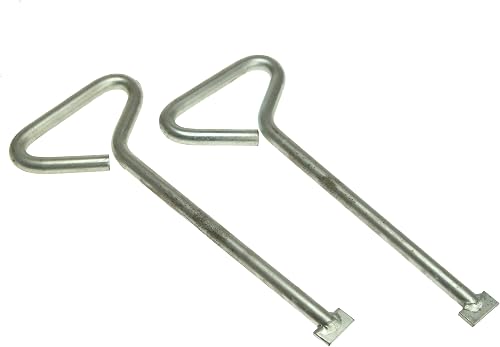
Monument is the drainage and plumbing tool brand you find in every merchant, and the MLK12 is their standard 12in (304mm) lifting key sold in a proper pair. Triangular bow handles you can get a gloved fist through, a foot sized for common cover slots, and enough length to lift without kneeling on the frame. It splits the difference between the stubby glovebox pairs and the 520mm Faithfulls: compact enough to live in a survey bag, long enough to lever with. Monument also list a 6in version (MLK06) for light lids where space is tight.
For
- Established trade brand at an own-label price
- 304mm — a sensible middle length
- Bow handles work with gloves on
Against
- Single pattern, like every plain pair
- Not the tool for the heaviest bedded-in covers
Typically £16–£22
Check price on AmazonDraper 89721 130mm Manhole Keys (pair)

Best glovebox pair — a known brand in the smallest useful size
Draper’s compact T-handle pair: 130mm keys with a mushroom-head handle and a flat foot for standard keyhole slots. The case for them is brand accountability in a category flooded with anonymous imports — Draper have been putting their name on tools since 1919 and the spec (and the replacement, if one ever fails) is traceable. At 130mm they are a crouch-and-lift tool for domestic lids rather than a lever for anything bedded in, and owner feedback says exactly that: fine on cooperative covers, short on leverage for stubborn ones.
For
- Proper brand, proper pair, small money
- Fits a glovebox or a survey bag side pocket
- All the key most free-moving domestic lids need
Against
- 130mm gives little leverage and a bent-over lift
- Standard slot pattern only
Typically £11–£15
Check price on AmazonSilverline 225954 Manhole Cover Keys, T-End 170mm (pair)

Best on a budget — the under-a-tenner answer for your own covers
A pair of 170mm zinc-plated T-end keys for less than a takeaway. For the homeowner whose interest in manhole keys begins and ends with the two covers on their own drive — checked once a year, or in a hurry when the downstairs loo backs up — this is the sensible amount of money to spend. Silverline’s three-year guarantee is more warranty than anyone expects on bent steel at this price. The triangular eye is on the small side for heavy gloves, and 170mm won’t win an argument with a lid that has been down for a decade, but paired with a squirt of penetrating oil and the technique below, it covers the domestic case.
For
- Cheapest credible pair here, from a warrantied brand
- 170mm — slightly more reach than the glovebox class
- Does the annual own-drive inspection perfectly well
Against
- Light-gauge steel — lever hard and it will complain
- Small eye, single pattern
Typically £7–£10
Check price on AmazonMutuactor magnetic lifting handle
Best for steel plates — purchase on lids with nothing to grab
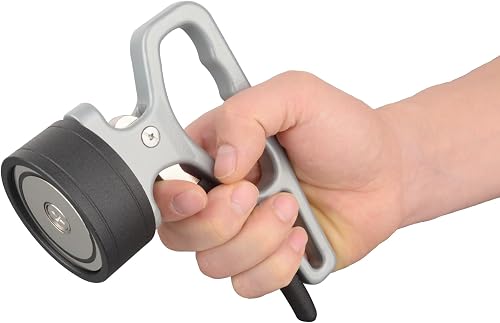
Some covers give a key nothing to work with: solid-top steel plates over internal chambers, galvanised lids whose slots are corroded shut or packed with a decade of grit, trench and duct covers. A hand-held neodymium magnet with a proper handle and a quick-release lever is the answer, and Mutuactor’s is the widely available version of the type. The physics deserves respect: rated pull is measured flat on thick clean steel, and drops sharply on thin, painted, rusty or curved surfaces — so treat it as a handle for tilting and sliding plates, not a crane hook, and use two (one each side) for anything sizeable. As a way of keeping fingertips out from under a steel plate, it earns its slot in the bag.
For
- Lifts what keys can’t touch — plain steel plates and gritted slots
- Release lever breaks the magnet’s grip without a fight
- Keeps fingers off the shear line entirely
Against
- Rated pull collapses on rust, paint and thin steel
- Useless on the cast concrete-infill covers that need keys most
Typically £28–£38
Check price on AmazonRKXKJ magnetic manhole cover lifter

The professional pick — lever, wheels and a magnet doing the work instead of a spine
This is the class of tool utility crews use: a wheeled lever arm with a switchable magnet on the business end, rated to around 270kg of pull, that breaks the seal and raises the cover while the operator stays upright and the load runs through the frame rather than a lower back. For a surveyor it is more tool than most days need — but for anyone lifting heavy covers frequently or working alone, it converts the worst manual-handling task in drainage into a lever operation. The caveats are the magnetic ones: it needs a ferrous lid (cast or steel, not concrete-topped recessed trays), a clean contact patch, and it is a £240, van-sized commitment. Owner feedback on the type is that the wheels and lever geometry matter more than the headline kilogram number.
For
- Breaks and lifts heavy covers with the operator upright
- Wheeled — walk the lid clear instead of carrying it
- Genuine solo-working and manual-handling win
Against
- Ferrous covers only; concrete-infill trays defeat it
- Serious money and serious van space for occasional use
Typically £220–£260
Check price on AmazonWhat actually matters — and what doesn’t
Seized covers are a technique problem before they’re a tool problem. A cover that hasn’t moved in years is held by a rind of compacted grit, corrosion and bedding compound around its rim, not by weight alone. Work the joint first: scrape the perimeter clean, run penetrating oil into the gap and give it time to creep, and tap around the frame — the frame, not the middle of the lid — with a mallet to shock the bond. Then lever, don’t lift: keys in both slots, break one edge free first, and let the lid pivot up rather than trying to haul it vertically out of its seat. If it moves a millimetre, you’ve won; work round the edges and it will come.
The lift is the dangerous bit, not the lever. Domestic inspection covers run from about 15kg to well over 50kg, and the double-triangular and carriageway-rated cast covers go far beyond that — into territory the HSE’s manual-handling guidance treats as a two-person or mechanical-aid job without apology. The rules that matter: slide rather than carry, keep the lid low and close, never stand it on edge where it can fall on a shin, and never put fingers under a raised cover — ever. A cover that comes free suddenly with your full weight on a short key is how people end up in A&E, which is the whole case for longer keys and levers.
Know when to stop. Some covers are beyond hand tools: carriageway covers, lids that have been mortared or tarmacked in, and anything that needs more force than you can apply with a straight back and bent knees. That’s what hydraulic seal-breakers (Roughneck make a 1-tonne jack-based kit for exactly this) and two people are for — and on a survey, it is also what the sentence “heavy cover; specialist lifting required” is for. A refused lift costs nothing; a prolapsed disc costs a season.
What the salesmen push that you can skip. “Heavy duty” stamped on a 115mm key with a seam-welded foot; stainless steel (zinc-plated carbon steel is stronger where it counts and lives in a wet chamber for minutes a year); padded grips and powder-coat colours. The spend that actually changes outcomes is pattern coverage, length, and — if you lift often — a lever or magnet doing the work instead of your back. Nothing else on the listing page matters much.
Questions I get asked
How do you lift a manhole cover that’s stuck? Patiently. Clean the grit out of the rim and the key slots, soak the perimeter with penetrating oil and give it ten minutes, then tap round the frame with a mallet to crack the corrosion bond. Set keys in both slots and lever one edge free first — the goal is a first millimetre of movement, not a heroic vertical lift. Repeat round the edges until the lid pivots. If oil, taps and levering with decent-length keys won’t shift it, stop: that’s hydraulic seal-breaker or second-pair-of-hands territory, not push-harder territory.
What type of manhole key do I need? Look at the cover, not the shop listing. Straight slots cut through the lid take a T-bar or D-end key — the most common pattern on domestic galvanised and ductile-iron covers. Closed cast-in eyes take a hook or bent-O key. Screw-down and recessed block-paving covers have threaded sockets that take M10/M12 lifting pins, usually after you’ve wound the retaining bolts out. If you’re buying blind for unknown covers, that’s the argument for a universal set covering all three families.
How heavy is a manhole cover — can one person lift it? A light pressed-steel domestic lid might be 15–25kg — a one-person lift done properly, with keys, knees bent and the lid slid rather than carried. Cast-iron covers and concrete-infilled recessed trays commonly run 50kg and beyond, and highway-rated covers multiples of that: two people or a mechanical aid, no debate. The honest test is the first lever — if you cannot raise one edge easily with long keys, you should not be attempting to move the whole lid alone.
Can I open a manhole cover with a screwdriver? You can, in the way you can open a tin with a chisel. A screwdriver in the slot gives no leverage, chews the slot edges so a proper key fits worse next time, and puts your hand exactly where the lid lands if it slips — the classic finger injury on these jobs. Given a serviceable pair of keys costs less than £10, improvising with flat-blade anything is a false economy in every direction.
Getting the cover up is the start of the job, not the job — once it’s open, the drain rods guide covers what happens next. If the state of your drains, chambers or anything else below the damp-proof course is the real question, the practice does building surveys with the drainage section done properly — get in touch. And if you’re kitting out a survey bag, there are more field-kit guides.
Small print. This guide is general information, not a survey of your property — and not manual-handling training; heavy covers are a genuine injury risk, and if in doubt leave the lid where it is. Prices are indicative, move constantly and were checked at the time of writing; the linked page always shows the current price. As an Amazon Associate I earn from qualifying purchases.