A chalk line reel earns its place in the bag doing something no digital tool does as fast: snapping a genuinely straight, visible reference line across a surface that’s too big, too rough or too far from anywhere sensible to eyeball accurately. Run a straight edge or a laser across a suspended timber floor before checking it for dip, or snap a line across a damp gable wall before setting out a grid of moisture meter readings, and what was a vague “it looks lower over there” becomes a fixed reference every measurement can be checked against.
Most calls for one come down to the same need: a repeatable starting point rather than a guess. Setting out a damp reading grid at regular centres up a suspect wall means every reading has a recorded position rather than wherever the probe happened to land; marking a datum line before recording floor level deviations gives the readings something fixed to work from; snapping reference lines across a slab before checking it for fall, or marking joist and rafter centres in a loft, are the same job in different rooms. None of it is glamorous, but a bag without one means doing all of that with a tape measure and a pencil, which is slower and less repeatable from one visit to the next.
None of the reels below have been carried on an actual survey — the notes are built from manufacturers’ specifications and recurring owner feedback, filtered through what setting out a grid or a datum line on site actually needs. First, the one I’d buy.
The one I’d buy
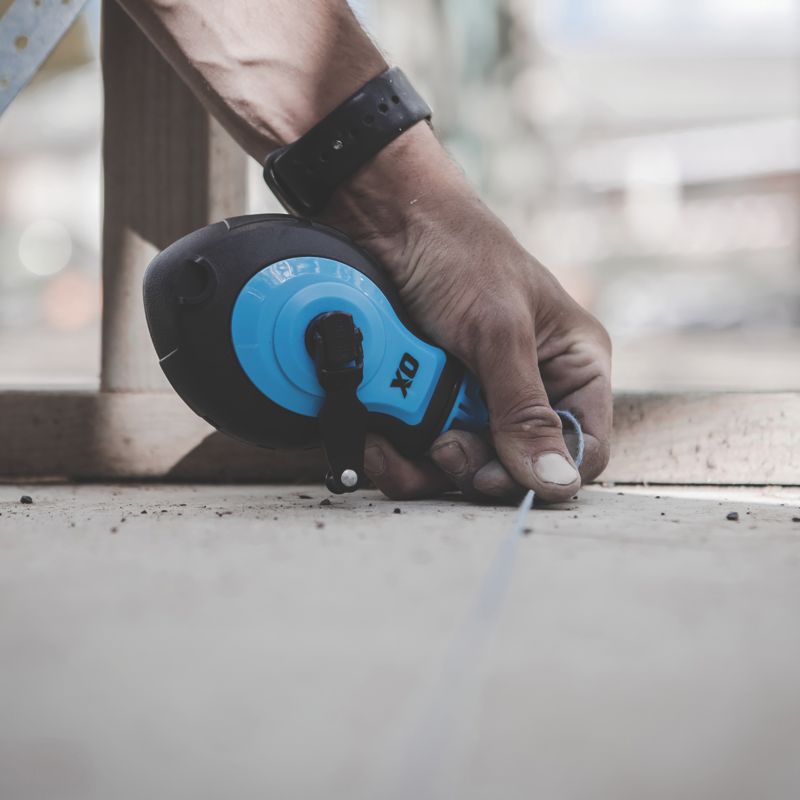
OX Chalk Line Reel 30m
The OX reel’s standout feature is the line itself — Kevlar-reinforced rather than plain braided nylon, which matters because abrasion, not age, is what actually kills a chalk line on site. Dragged repeatedly across old brick arrises, screw heads left in a stud wall, or gritty screed, a basic line frays and eventually snaps; Kevlar shrugs it off for far longer. It pairs that with an aluminium body, a 6:1 planetary gear for quick rewind between grid lines, and 113g of blue chalk included so it’s ready to use straight out of the packaging.
Typically £16–£22
Check price on AmazonHow I judge a chalk line reel
Line durability matters more than rewind speed. A basic braided nylon line frays and eventually snaps when it’s dragged repeatedly across old brick arrises, screwed studwork or gritty screed — exactly the surfaces most datum lines get snapped across on site. Kevlar-reinforced or heavier braided lines cost more but survive that abrasion for far longer.
Gear ratio, for the days with several lines to mark. A 3:1 crank needs roughly three turns of the handle for every metre rewound; a 6:1 planetary gear does it in about half that and jams less. On a survey with a single datum line it barely matters; setting out a full damp reading grid, the faster gear saves real minutes.
Case material. Aluminium and diecast metal bodies survive a drop down a loft hatch or a knock in a tool bag far better than ABS plastic, though the plastic-cased reels are lighter, cheaper, and adequate for occasional use.
Chalk capacity and how it’s filled. A reel that holds 100g or more and refills through a simple screw cap saves carrying a separate tub and topping up mid-survey; the smallest reels need refilling more often than is convenient.
Line lock and secondary uses. A lock that holds the line taut while it’s pinned against a surface gives a cleaner, straighter snap, and a few reels double as a rough plumb bob via a pointed metal claw on the end — a genuine bonus, but not a substitute for a dedicated plumb bob where the reading actually matters.
The comparison
| Model | Gear ratio | Case | Typical price | Best for | |
|---|---|---|---|---|---|
| OX Chalk Line Reel 30m | 6:1 | Aluminium | ~£16–£22 | Best overall | View |
| Milwaukee Bold Line Chalk Reel | 6:1 | Metal/plastic/rubber | ~£16–£22 | Best warranty | View |
| DEWALT 6:1 Chalk Line Reel | 6:1 | Aluminium/plastic | ~£14–£19 | Best value 6:1 | View |
| Hultafors Speedline CLP 30 | ~3:1 (quick gear) | ABS, metal crank | ~£24–£30 | Premium/professional pick | View |
| Faithfull Rapid Chalk Line 30m | 6:1 | Plastic | ~£18–£26 | Best plastic-cased rewind | View |
| Draper 11528 Self Chalking | 1:1 (manual) | Diecast metal | ~£13–£18 | Best self-chalking | View |
| Silverline CB61 Metal Chalk Line | 1:1 (manual) | Aluminium alloy | ~£5–£9 | Best on a budget | View |
The picks in detail
OX Chalk Line Reel 30m
Best overall — a Kevlar line that survives rough brick and screed
The OX reel’s Kevlar-reinforced line is the reason it tops this guide: abrasion, not age, is what actually kills a chalk line on site, and a line dragged repeatedly across old brick arrises, exposed screw heads or gritty screed shrugs off far more of that with Kevlar than with plain braided nylon. It pairs the line with an aluminium body, a 6:1 planetary gear for quick rewind between grid lines, and 113g of blue chalk supplied so it’s ready to use straight away.
For
- Kevlar line resists fraying on brick, screed and screw heads
- Aluminium body, 6:1 gear, chalk included
- Sensible price for the durability on offer
Against
- Costs a little more than the basic plastic-cased reels
- No self-chalking reservoir — refills through the standard fill port
Typically £16–£22
Check price on AmazonMilwaukee Bold Line Chalk Reel
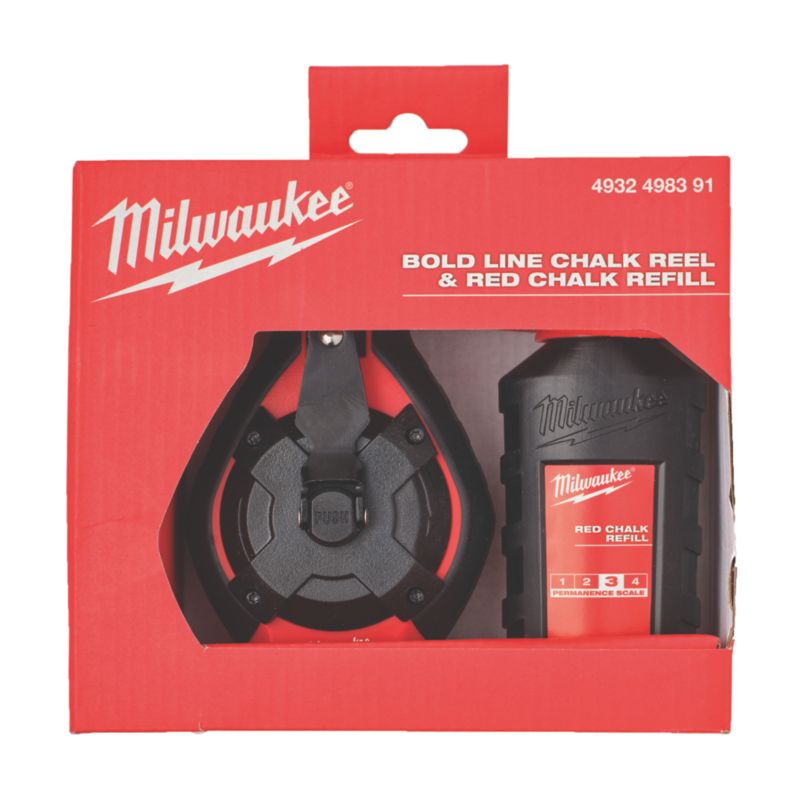
Best warranty — a three-year guarantee for daily trade use
Milwaukee’s entry in the same price bracket as the OX leans on brand-level confidence rather than a headline material: a planetary 6:1 gear, a rubber overmould grip that survives a drop better than bare plastic, and a three-year manufacturer guarantee — longer than anything else in this guide. It ships with a 225g red chalk refill rather than the more usual blue, which shows up better against pale render and plaster but is worth a moment’s thought before use on anything it might stain (see the FAQ on chalk colour below).
For
- Three-year guarantee, longest in this guide
- Rubber overmould grip, planetary 6:1 gear
- Larger 225g chalk refill included
Against
- Red chalk stains more surfaces than blue — needs care on soft or porous ones
- No Kevlar-line option
Typically £16–£22
Check price on AmazonDEWALT 6:1 Chalk Line Reel
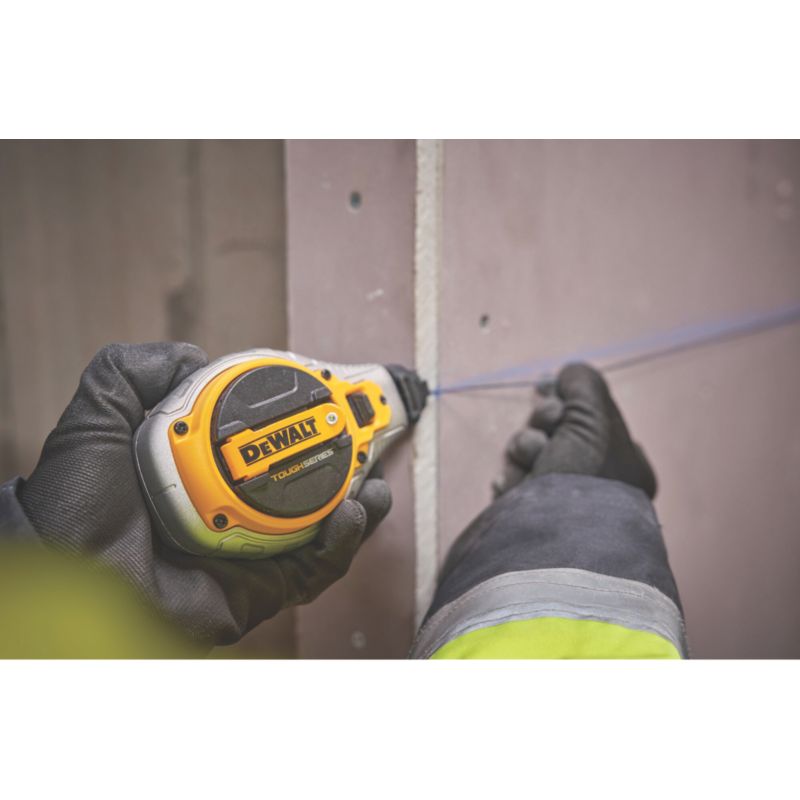
Best value 6:1 — a well-known brand at the lowest fast-rewind price
DEWALT’s reel undercuts the OX and Milwaukee by a few pounds while matching their 6:1 planetary gear and adding a line-lock mechanism that holds tension while the line’s pinned against a wall, plus a back access door that makes restringing straightforward once the line wears through. The aluminium-and-plastic case is a step down from the fully metal-bodied reels, but for the price it’s a sensible way into a fast-rewind reel without paying extra for Kevlar or a longer warranty most surveys won’t call for.
For
- Cheapest of the 6:1 gear reels here
- Line-lock mechanism holds tension while marking
- Back access door for easy restringing
Against
- Aluminium/plastic case less robust than the fully metal reels
- Chalk sold separately
Typically £14–£19
Check price on AmazonHultafors Speedline CLP 30
Premium/professional pick — Scandinavian trade-tool durability, at a price
Hultafors built its reputation on hand tools that survive daily trade use, and the Speedline CLP 30 follows that pattern: a metal crank rather than a moulded plastic one, an ABS housing built to Hultafors’ own durability standard, and a quick-gear function that speeds up rewind without going all the way to a 6:1 ratio. At around £26 it’s the most expensive reel here, and the rewind is genuinely slower than the OX, Milwaukee or DEWALT above it — the case for buying it is confidence in the mechanism over years of use, not outright speed.
For
- Metal crank, built to a trade-tool durability standard
- Established professional Scandinavian brand
Against
- Most expensive reel in this guide
- Rewind is slower than the 6:1 alternatives
Typically £24–£30
Check price on AmazonFaithfull Rapid Chalk Line 30m
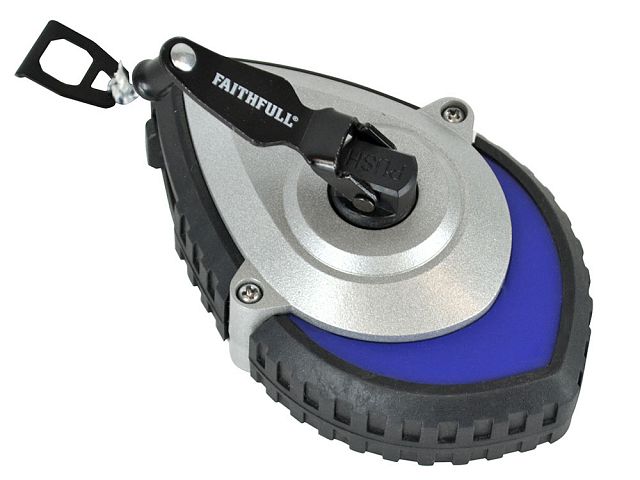
Best plastic-cased rewind — a well-known UK trade brand’s fast-rewind option
Faithfull is a familiar name in UK builders’ merchants, and the Rapid Chalk Line applies the same 6:1 planetary rewind as the pricier metal-cased reels inside a lighter plastic case. It’s a sensible middle ground for a reel picked up a handful of times a survey rather than run all day on a building site — fast enough to be no chore to rewind, without paying extra for an aluminium body or a Kevlar line that occasional use wouldn’t get the full benefit from.
For
- Fast 6:1 rewind at a mid-range price
- Recognisable UK trade tool brand
Against
- Plastic case less durable than the metal-bodied reels if dropped repeatedly
Typically £18–£26
Check price on AmazonDraper 11528 Self Chalking Chalk Line

Best self-chalking — coats the line automatically as it feeds out
Draper’s 11528 uses a diecast metal body with a self-chalking mechanism — the line picks up chalk from an internal reservoir as it’s pulled out, rather than needing a separate manual coating step. It also carries printed angle markings on the case, a small extra worth having for anyone using it to rough out angles as well as straight lines. The trade-off against the reels above is rewind speed: Draper doesn’t badge a fast-rewind gear ratio on this model, so it’s a slower hand-over-hand crank back after each snap.
For
- Self-chalking mechanism, no separate coating step
- Diecast metal body, printed angle markings
Against
- No fast-rewind gear ratio, slower to reel in than the 6:1 options
Typically £13–£18
Check price on AmazonSilverline CB61 Metal Chalk Line

Best on a budget — cheap, functional, and doubles as a rough plumb bob
Silverline’s CB61 strips a chalk line back to the basics: a lightweight aluminium alloy body, a self-chalking line, and a metal claw end that can be pressed into service as a rough plumb bob in a pinch. There’s no geared rewind, so it’s hand-over-hand to reel the line back in, and the fold-away handle and screw-top filler cap are the only real conveniences beyond that. For the price, it’s a sound reel to keep at the bottom of the bag as a backup rather than a daily tool.
For
- Cheapest reel in this guide
- Aluminium body; metal claw doubles as a rough plumb bob
Against
- No geared rewind, hand-over-hand only
- Not a substitute for a proper plumb bob where accuracy matters
Typically £5–£9
Check price on AmazonWhat actually matters — and what doesn’t
Kevlar and premium lines matter if it’s used weekly, not if it’s a rare backup. The abrasion resistance that justifies the OX or the Hultafors is only worth paying for if the reel’s actually getting dragged across brick arrises and screed regularly; for a chalk line that comes out once or twice a month, a basic braided line lasts long enough that the upgrade never earns its price back.
Chalk colour is a bigger deal than gear ratio on a period or listed property. Blue is the safe default and mostly weathers or brushes off; red and other bright colours show up better against pale masonry but stain more stubbornly, and on soft stone, lime render or unpainted plaster a mark that doesn’t fully disappear can be a genuine problem. Test an inconspicuous area first, or use a washable chalk, on anything historic.
A chalk line isn’t a substitute for a laser level or a plumb bob. It puts down a straight reference fast, but it doesn’t measure a slope or confirm vertical on its own — a chalked line across a floor still needs a level laid along it to read the fall, and a claw-end plumb function is a rough site check, not a replacement for a dedicated bob where the reading actually matters.
Fast rewind is a convenience, not an accuracy feature. A 3:1 crank and a 6:1 planetary gear put down an identical line — the only difference is how long it takes to wind back in afterwards. It’s worth paying for on a survey with several lines to mark; it’s not worth paying for on the strength of any accuracy claim, because there isn’t one to make.
Questions I get asked
What’s a chalk line actually used for on a building survey?
Mostly setting out reference points rather than the line itself — snapping a straight edge across a suspended timber floor before checking it for dip, marking a grid of positions up a damp wall so moisture meter readings come from fixed, repeatable points rather than wherever the probe happens to land, or marking joist and rafter centres in a loft before a closer look. The chalked line rarely appears in the report itself; it’s the tool that makes the measurement against it repeatable.
Will chalk mark a wall permanently?
Blue chalk is generally the safest choice and brushes or weathers off most painted and rendered surfaces without much trace. Red and other bright colours show up better in poor light or against pale masonry but are more likely to leave a mark that doesn’t fully disappear, particularly on soft or unpainted stone, lime render or bare plaster. On anything historic or delicate, testing an inconspicuous area first is worth the extra minute.
Is a Kevlar-reinforced line actually worth the extra cost?
If the reel gets dragged across old brickwork, screwed studwork or gritty screed regularly, yes — that abrasion is what actually kills a chalk line, not old age, and a Kevlar or reinforced line survives it for far longer than basic braided nylon. For a reel that mostly stays in the bag as an occasional backup, the extra cost is harder to justify.
Can a chalk line reel replace a laser level or plumb bob?
Not really — it’s complementary rather than a substitute. A chalk line puts down a fast, visible straight reference over a distance a laser or level might struggle to project clearly, but reading a fall or confirming true vertical still needs a level or bob laid against that line. The reels here that double as a plumb bob do it via a simple metal claw on the end, which is a rough site check rather than an accurate reading.
A chalk line earns its keep the same way a plumb bob does — not by measuring anything itself, but by giving every other measurement a fixed, repeatable reference to work from. If a damp reading grid, a sloping floor or a wall that needs a closer look is the actual question on your own property, the practice carries out building surveys across Sussex, Kent and Surrey — get in touch. Or browse the rest of the field-kit guides, including damp meters and plumb bobs.
Small print. This guide is general information, not a recommendation for any specific site condition; a snapped reference line is a starting point for measurement, not a substitute for the survey itself. Prices are indicative, move constantly and were checked at the time of writing; the linked page always shows the current price. As an Amazon Associate I earn from qualifying purchases.