“Woodworm” is one of the most reliable ways to raise a client’s pulse during a survey, and one of the findings I most often have to talk people down from. Flip back a loft hatch on a house built before about 1980 and there is a fair chance you will find small round holes in the rafters somewhere. That is not, on its own, a problem. It is frequently just a record of an insect that was active decades ago, in timber that has been bone dry ever since, and has nothing whatsoever to do with the structure today.
The insect responsible in the vast majority of UK cases is the common furniture beetle, Anobium punctatum. Its larvae live inside the timber for two to five years, tunnelling as they feed, before an adult beetle emerges through a neat, round exit hole — usually between April and September — leaving behind a scatter of fine bore dust known as frass. Whether that cycle is still running in your rafters, or finished forty years ago, is the entire question. It is also, conveniently, one you can usually answer for free with a torch and a bit of patience, which is most of what this guide is really about before it gets to the tins.
For a small number of active holes in timber you can reach, a tin of the right treatment brushed or sprayed on is genuinely often all that is needed — not a call-out, not a contract, not a twenty-year guarantee. Below is how I judge the treatments, seven worth buying, and where I think the line sits between a weekend job and one to hand to a professional.
The one I’d buy
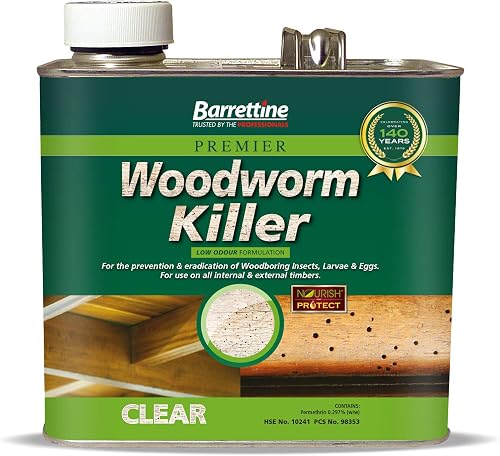
Barrettine Premier Woodworm Killer 2.5L
The oil/spirit-based liquid that most UK remedial treatment companies actually decant from their own vans, sold in the size that covers a genuine job — a few rafters, a suspended floor void, a run of skirting — rather than one hole. Low odour, HSE-registered active ingredient, and it soaks into raw softwood properly rather than sitting on the surface.
Typically £22–£28
Check price on AmazonHow I judge a woodworm treatment
A registered active ingredient, not just marketing. A genuine wood preservative biocide carries an HSE approval number on the tin (older permethrin-based products typically show one, along with a PCS number). That is what separates a regulated insecticide from a vaguely-worded “wood tonic” that does very little. If the label doesn’t say what it kills and how, be suspicious.
Format matched to the job. A brush-on or spray liquid is fine for accessible surface timber — rafters, joists, floorboards you can get a brush to. It does not meaningfully penetrate large-section timber or protect the buried end of a joist built into a damp wall. That job belongs to an injectable gel, pumped into drilled holes so the active ingredient sits inside the timber rather than on it.
Whether it also treats decay. Damp and woodworm travel together more often than not — the beetle’s larvae do best in timber that has been damp or partially decayed by fungus. A dual-purpose product that also protects against wet and dry rot is doing a more honest job than one that only claims the insect.
Low odour and safe indoors. Most of this gets used in occupied houses — a loft over a bedroom, exposed joists in a converted room. Solvent-heavy older formulations need ventilation and time before anyone sleeps nearby; newer low-odour and water-based products are far more forgiving.
Coverage that matches the actual job. A 500ml spray for three exit holes in a windowsill; a 5L tin for a whole roof void. Buying five litres to treat one joist end is money and shelf-life wasted — these products don’t keep indefinitely once opened.
The comparison
| Model | Format | Also treats | Typical price | Best for | |
|---|---|---|---|---|---|
| Barrettine Premier Woodworm Killer 2.5L | Brush/spray liquid, oil-based | Insect only | ~£25 | The trade-standard treatment, sized for a real job | View |
| Boracol B40/1 Boron Gel 400cc | Injectable gel, cartridge gun | Wet & dry rot | ~£31 | Embedded joist ends and high-risk structural timber | View |
| Cuprinol 5 Star Complete Wood Treatment 5L | Brush/spray liquid, water-based | Rot & water resistance | ~£52 | One tin that does three jobs at once | View |
| Everbuild Lumberjack Woodworm Killer 5L | Brush/spray liquid, low-solvent | Insect only | ~£24 | Fast-drying, low odour, internal roof timbers | View |
| Ronseal Woodworm Killer 5L | Brush/spray liquid | Insect only | ~£42 | The high-street DIY-shed default | View |
| Rentokil Woodworm Killer Solution 500ml | Squeeze-bottle liquid | Insect only | ~£13 | A handful of holes in furniture or skirting | View |
| Barrettine Premier Woodworm Killer Spray 500ml | Ready-to-use trigger spray | Insect only | ~£11 | Best on a budget — small, awkward or vertical spots | View |
The picks in detail
Barrettine Premier Woodworm Killer 2.5L
Best overall — the professional default, and my top pick above
Barrettine has been making this since long before the current wave of consumer DIY brands existed, and it is what a lot of remedial treatment firms actually put in their sprayers. It is a deep-penetrating, low-odour formulation carrying its own HSE registration, which means the label tells you exactly what it kills rather than leaning on the word “protect”. The 2.5L size is the sweet spot for a real domestic job — enough to treat a loft’s worth of rafters or a suspended floor void without half a tin going stale on a shelf.
It treats the insect only, not fungal decay, which is the right trade-off if the timber is dry and the woodworm is the whole story. If there is any hint of softness or damp alongside the holes, pair it with a look from a damp meter before you reach for the brush.
For
- HSE-registered active ingredient, clearly stated on the tin
- Genuine penetration into raw softwood, not a surface film
- Low odour formulation, usable in occupied lofts
- 2.5L covers a real job without excess left over
Against
- Insect only — no fungicide, so it won’t address rot
- Solvent-based, so it wants ventilation and time to dry
Typically £22–£28
Check price on AmazonBoracol B40/1 Boron Gel 400cc

Best for embedded and high-risk timber — where a brush can’t reach
A brush-on liquid treats the surface it touches; it does very little for the middle of a large joist, or the last 150mm of a beam that disappears into a solid wall. That buried section is exactly where damp and beetle activity concentrate, because it is the part of the timber a surveyor can’t see and a homeowner can’t reach. Boracol comes in caulking-gun cartridges of a boron-based gel, injected into a grid of drilled holes so the active ingredient sits inside the timber rather than evaporating off the surface. It is a dual-purpose product — insecticide and fungicide together — which matters because embedded joist ends are also where wet rot most often starts.
This is remedial-treatment-company kit, not a casual purchase, and it needs a cartridge gun and a drill to use properly. For a handful of accessible rafters it is overkill; for a joist end built into a damp Victorian solid wall, it is closer to the right tool than anything brushed on.
For
- Genuine deep penetration via injection, not surface contact
- Dual-purpose — woodworm and wet/dry rot in one product
- Very low odour, non-flammable, no VOC concerns
Against
- Needs a cartridge gun and drilled holes — not a quick job
- Overkill for a small number of surface holes
Typically £28–£35
Check price on AmazonCuprinol 5 Star Complete Wood Treatment 5L

Best all-purpose — when woodworm isn’t the only thing you’re worried about
Cuprinol’s 5 Star treatment is the one to reach for when you don’t just want a beetle killed, you want the timber generally looked after — it is a water-based, low-odour formulation that kills woodworm, prevents re-infestation, guards against rot and improves water resistance in the same coat. That makes it a sensible choice for a shed, an outbuilding, or a loft where you’re treating the whole structure as preventative maintenance rather than chasing a specific active infestation.
The trade-off is price per litre — you’re paying for three functions, and if all you actually have is a dry rafter with three old holes in it, a dedicated insect-only treatment does the same job for less.
For
- Genuinely three jobs in one tin — insect, rot, water resistance
- Water-based and low odour
- A recognisable, long-standing brand
Against
- Dearer per litre than a dedicated woodworm-only liquid
- More than most single-issue infestations actually need
Typically £48–£58
Check price on AmazonEverbuild Lumberjack Woodworm Killer 5L

Best fast-drying option — low solvent, quick turnaround
Everbuild (now part of the Sika group) built its name on trade sealants and fast-turnaround products, and the Lumberjack woodworm treatment follows the same brief: low-solvent, low-odour, and dry to the touch quickly enough that you’re not waiting days before boarding a loft back over. It is clear, over-paintable once dry, and rated for interior use only — internal roof timbers, floorboards and joists are its home ground.
Because it is interior-only, it isn’t the one for an exposed outbuilding or a timber frame exposed to weather — check the label against the job before buying.
For
- Fast drying — useful when you need the space back quickly
- Low odour, non-flammable
- Backed by a large, established manufacturer
Against
- Interior use only
- Insect only, no fungicidal protection
Typically £20–£27
Check price on AmazonRonseal Woodworm Killer 5L

The high-street default — familiar, straightforward, widely stocked
If you already know the Ronseal name from the fence paint aisle, this is the same straightforward promise applied to woodworm: kills the beetle, larvae and eggs, long-lasting protection, can be overpainted, stained or varnished once it’s dry. It doesn’t claim to be a specialist trade product and doesn’t need to — for a domestic infestation in accessible timber it does exactly what the tin says, and it’s the one most people will already recognise on a shelf.
For
- A trusted, familiar consumer brand
- Clear, simple instructions and coverage guidance
- Widely stocked, easy to buy a second tin if needed
Against
- Costs more than the Barrettine or Everbuild equivalents
- Insect only
Typically £36–£46
Check price on AmazonRentokil Woodworm Killer Solution 500ml

Best for a small job — a piece of furniture or a run of skirting
Rentokil is the name most homeowners already associate with pest control, and this squeeze-bottle solution is sized for exactly the job that usually prompts someone to search for it: a handful of holes in an old chest of drawers, a skirting board, or a single joist end you can see through a floorboard gap. The label states coverage up to roughly 2.5m², which is realistic — it is not meant to treat a whole loft, and buying several of these for a bigger job costs more than one larger tin.
For
- Right-sized for furniture and small, isolated infestations
- Recognisable brand, easy to find
- Simple pour-spout application, no spraying kit needed
Against
- Poor value per litre for anything beyond a small job
- Insect only
Typically £11–£15
Check price on AmazonBarrettine Premier Woodworm Killer Spray 500ml

Best on a budget — ready to use, no brush or decanting
The trigger-spray version of the same Barrettine Premier formulation as the top pick above, in a size and format built for speed rather than volume. No brush, no pouring, no waiting for a tin to be worth opening — point it at a vertical joist face or an awkward corner and go. For three or four holes in a spot you can reach easily, it is the cheapest sensible option on this list and shares the same trade-grade formulation as the litre tins.
For
- Cheapest option here, from a trusted formulation
- No brush or decanting — genuinely ready to use
- Good reach into vertical or awkward gaps
Against
- Not economical for anything beyond a handful of spots
- Spray drift needs masking nearby surfaces indoors
Typically £9–£13
Check price on AmazonWhat actually matters — and what doesn’t
Active vs historic is the whole diagnosis. Fresh exit holes are pale and sharp-edged, often with loose, cream-coloured frass sitting in or below them — run a finger under a suspect area and if fine dust comes away readily, that’s recent. Old holes are dark, sometimes filled with old paint or varnish from a previous decoration, with no frass and no fresh tunnelling visible if you gently probe with a bradawl. Flight season for common furniture beetle runs roughly April to September, so genuinely fresh holes and dust found outside that window are worth a second look before you assume the worst. Most of the loft rafters I’m asked about are the second kind: a record of something that happened, not something happening.
Moisture is the actual driver, not the beetle. Common furniture beetle overwhelmingly favours timber that has been damp, or has had some degree of fungal decay soften the wood — it is far less interested in dry, well-ventilated structural timber even where old flight holes show it was once present. This is why a woodworm finding on a survey is so often really a damp or ventilation finding wearing a different name: a blocked air brick starving a suspended floor void, a leaking valley gutter dampening a rafter end, condensation in an unventilated loft. Treat the beetle and ignore the moisture and, if conditions stay damp, you haven’t actually fixed anything. Check the timber with a damp meter before treating, and again a season later to confirm it’s drying out.
What a tin actually fixes, and when to call someone in. A small number of active holes in timber you can see and reach is a DIY job, and often a genuinely cheap one — a single tin at somewhere around £25–£30 covers most domestic cases, which is why what a woodworm finding costs to put right so often lands at the low end of the range rather than the alarming end. Get a proper look from a building survey instead where the damage is extensive, where timber sections look structurally reduced, where you can’t reach or see the affected areas, or where the beetle isn’t common furniture beetle at all — house longhorn beetle (see below) and death watch beetle in large old hardwoods both warrant a specialist rather than a tin from the shed.
What salesmen push that you can skip. An insurance-backed 20 or 30-year guarantee sounds reassuring, but for a straightforward, accessible domestic case it is largely paying for paperwork you don’t need — useful when a mortgage lender specifically asks for one, otherwise not. The same goes for pressure to spray an entire roof structure “to be safe” when only one corner shows any sign of activity: treating dry, uninfested timber protects against nothing and mostly protects the contractor’s invoice.
Questions I get asked
How do I know if woodworm is still active? Look for pale, sharp-edged exit holes with loose cream frass nearby or falling out when you tap the timber, ideally spotted during the April–September flight season. Old holes are dark, often painted or varnished over, with no dust and no give when you probe gently with a bradawl. When in doubt, mark a few holes with a pencil and check again in a few months — new dust or new holes nearby confirms activity; nothing changing points to history.
Do I need to treat every exit hole I find? No. If the timber is dry, well-ventilated and the holes are clearly old, treatment adds little — the beetle needs damp or decayed wood to thrive and dry structural timber is naturally poor habitat. Treatment earns its keep where you can see or reasonably suspect current activity, or as a precaution on timber you know has been damp until recently.
Is woodworm treatment safe to use indoors? The low-odour and water-based products on this list are designed for exactly that, but ventilate the space while it’s wet, keep pets and children out until it’s dry, and follow the label’s stated re-entry time. Older solvent-heavy formulations need more caution and more airflow — if a loft is over a bedroom, treat it when the room won’t be slept in that night.
What is house longhorn beetle, and why does it matter more? It’s a much more destructive species than common furniture beetle, capable of seriously weakening structural softwood, and in the UK it is essentially confined to parts of north-west Surrey and neighbouring areas of Hampshire and Berkshire — which is why Building Regulations specifically flag roof timbers in that zone for treatment. Its exit holes are larger and more oval than common furniture beetle’s neat round ones. If you’re in that area, or the holes look unusually large, that’s a case for a specialist survey rather than a tin from this list.
If a survey has just told you about woodworm, or you’re trying to work out whether the holes in your own rafters are worth worrying about, the practice does building surveys with proper timber and damp investigation as standard — get in touch. For what a woodworm finding typically costs to resolve, see the survey defect cost guide, and for more on diagnosing the moisture behind it, there are more field-kit guides.
Small print. This guide is general information, not a survey of your property; timber defects and their causes vary by building, and a wood-boring insect finding should always be considered alongside the moisture conditions around it. Prices are indicative, move constantly and are checked at the time of writing; the linked page always shows the current price. As an Amazon Associate I earn from qualifying purchases.