Hard water isn’t a fault in a building; it’s the water. Most of Kent and East Sussex sits over chalk or the Lower Greensand, and the mains supply drawn from those aquifers carries a lot of dissolved calcium and magnesium as a result — often into the “hard” to “very hard” bracket the water companies themselves publish for the area. None of that is a defect I’d write up on a survey. What I do write up, regularly, is what decades of that water does inside a heating system: a kettle with a crust in the bottom is the visible, low-stakes version of the same mineral scaling on a combi boiler’s plate heat exchanger and around a hot water cylinder’s immersion element, where it reduces heat transfer, forces the appliance to work harder for the same output, and eventually contributes to failure.
A water softener treats the water itself before it reaches the boiler, cylinder or taps, swapping calcium and magnesium ions for sodium through a bed of resin — genuine ion exchange, the chemistry municipal and industrial softening has used for the best part of a century. It’s a permanent, whole-house appliance decision: plumbed into the incoming main, needing space, a drain for the brine waste, and salt topped up. An electronic or electromagnetic “descaler” promises something similar from a strap clipped around the pipe, with none of that plumbing — but it doesn’t soften the water in any way a lab can measure calcium leaving it. At best, it may change the crystal structure of scale that still forms into something looser and easier to rinse away. That’s a difference in kind, not just price, worth being honest about before spending anything.
What follows mixes both categories deliberately: four salt-based softeners and three electronic units, ranked and compared on their own terms. If a scaled system has already cost you a boiler or a cylinder, the new boiler cost and boiler service cost guides cover what that runs to; a magnetic filter and inhibitor deal with a related but different problem — corrosion sludge, not limescale — covered in the boiler filters guide.
The one I’d buy

BWT WS355 Standard Electronic Water Softener
A WRAS-approved, electronic-demand softener from one of the few salt-based brands I could actually verify as a genuine, in-stock, buy-now item on Amazon rather than a dealer-quote-only system. Fourteen litres of resin is enough for a typical three-to-four-bedroom household on Kent or Sussex mains water, and demand-initiated regeneration (it measures water used rather than regenerating on a blind timer) keeps salt and water waste down.
Typically £550–£650
Check price on AmazonHow I judge a water softener
Genuine ion exchange, not just a marketing claim. A softener has to physically exchange calcium and magnesium ions for sodium through a resin bed and regenerate that resin with salt. That’s the only mechanism with real evidence behind it. Anything “electronic” or “magnetic” that claims to soften without salt is a different product, whatever the word on the box says.
Demand-initiated regeneration over a blind timer. Better units meter the water actually used and regenerate the resin only when needed, rather than on a fixed clock regardless of household occupancy. It saves salt, saves water, and on a metered supply it saves money.
Resin volume matched to the household and the hardness. A ten-litre unit copes with a couple in a flat; a family home on genuinely hard Kent or Sussex water wants more resin, or it’ll be regenerating uncomfortably often. Manufacturers publish capacity against people and hardness — worth checking against your water company’s published hardness figure, not a guess.
WRAS approval and a proper drinking-water bypass. Every unit plumbed into a UK mains supply needs to meet Water Regulations to prevent backflow contamination, and a decent installation leaves one unsoftened tap for drinking and cooking, since softened water carries more sodium — a real consideration for a low-sodium diet or mixing infant formula.
Space, drainage and access, not just the unit itself. A softener needs a spot near the incoming main, a drain point for the brine discharge, and enough clearance to top up salt without a fight. If none of that exists in the house, the best softener here is still the wrong purchase.
The comparison
| Product | Type | Capacity | Typical price | Best for | |
|---|---|---|---|---|---|
| BWT WS355 Standard | Salt, ion exchange | 14 litre resin | ~£600 | The default household softener | View |
| BWT PS20UK Perla Silk L | Salt, ion exchange | 20 litre resin, predictive regen | ~£930 | Larger households on very hard water | View |
| BWT WS455 Hi Flow | Salt, ion exchange | 10 litre resin, high flow | ~£680 | Power showers, high simultaneous demand | View |
| BWT PS10WIFI Perla Silk S | Salt, ion exchange | 10 litre resin, Wi-Fi | ~£875 | Landlords, remote salt/fault monitoring | View |
| Scalewatcher 2 Star | Electronic conditioner | Clip-on, up to 28mm pipe | ~£215 | The longest-established UK electronic brand | View |
| Water-King WK1-E Advanced | Electronic conditioner | Clip-on, up to 42mm pipe | ~£270 | Larger pipework and electric water heaters | View |
| Eddy Electronic Water Descaler | Electronic conditioner | Clip-on, single pipe | ~£140 | The cheapest entry point | View |
The picks in detail
BWT WS355 Standard Electronic Water Softener
Best overall — and my top pick above
BWT is a major European water-treatment manufacturer, and the WS355 is the sensible middle of its domestic range: WRAS approved, electronic-demand regeneration, fourteen litres of resin that suits a typical three-to-four-bedroom household on Kent or Sussex mains water without regenerating every other day. It takes block or tablet salt, which is the easier of the two to source locally and to lift into the cabinet. Nothing flashy, which for a permanent plumbed-in appliance is the point.
For
- WRAS approved with demand-initiated regeneration
- Genuinely in stock and buyable, unlike several named competitors
Against
- No app or remote monitoring — you find out about a fault at the unit itself
Typically £550–£650
Check price on AmazonBWT PS20UK Perla Silk L

Best premium/professional pick — for larger households on genuinely hard water
The Perla Silk range is BWT's higher tier: twenty litres of resin against the WS355's fourteen, and intelligent predictive regeneration that learns actual water-use patterns rather than just metering volume. On the hardest water in the region — parts of the Kent and Sussex chalk belt push well past 300mg/l calcium carbonate — the extra resin buys longer runs between regenerations for a five-or-more-bedroom household or a power shower running most evenings.
For
- Substantially more resin capacity than the standard range
- Predictive regeneration, not just metered
Against
- A genuinely large step up in price over the WS355 for most households' needs
Typically £880–£980
Check price on AmazonBWT WS455 Hi Flow Electronic Demand

Best for high simultaneous demand — power showers and larger bathrooms
Same demand-initiated regeneration and WRAS approval as the WS355, in a smaller ten-litre footprint tuned instead for flow rate rather than raw resin volume — a household running a power shower and a kitchen tap at once won't see softened water drop off mid-use the way a lower-flow unit can. The trade-off against the standard WS355 is capacity: more regenerations over a month on a big, thirsty household, which means more salt bought more often.
For
- Built for higher simultaneous flow than the standard range
- Same WRAS approval and demand regeneration
Against
- Smaller resin volume means more frequent regeneration under heavy use
Typically £630–£730
Check price on AmazonBWT PS10WIFI Perla Silk S with Wi-Fi

Best for landlords — remote salt and fault monitoring
The compact Perla Silk unit with a Wi-Fi module and companion app added, flagging low salt and fault conditions remotely instead of waiting for a tenant to notice hard water returning or, worse, not noticing at all. For an owner-occupier checking the salt themselves at a monthly glance, the standard WS355 does the identical softening job for a good deal less. For a rented property several miles from where the landlord lives, that remote visibility earns its premium.
For
- Remote alerts on salt level and faults
- Same core ion-exchange softening as the rest of the BWT range
Against
- Smaller ten-litre resin volume for a price above the higher-capacity WS455
Typically £820–£920
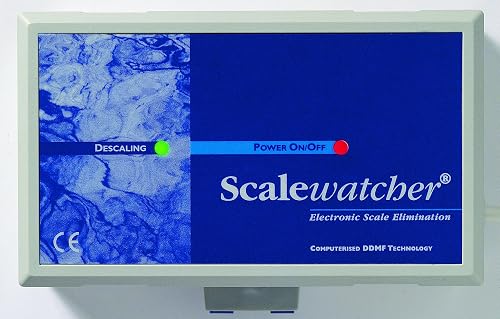
Check price on AmazonScalewatcher Limescale Control 2 Star
Best-established electronic conditioner — if you want to try that route first
Scalewatcher is a genuinely long-running UK brand, going back decades, and the 2 Star clips two coils around the incoming pipe and pulses a varying electronic signal through the water rather than dosing anything into it. No plumbing, no salt, no drain point, fitted in an afternoon. What it isn't is a softener: independent, controlled evidence for electronic scale-prevention claims remains thin and contested, and where trials do show an effect it's usually a softer, more easily rinsed scale texture rather than genuinely less calcium in solution. Worth trying only where a proper softener isn't practical.
For
- No plumbing-in, no drain, no ongoing salt cost
- One of the longest track records in UK electronic descaling
Against
- Doesn't remove hardness minerals — the evidence base is contested, not settled
Typically £190–£240
Check price on AmazonWater-King WK1-E Advanced

Best for larger pipework — up to 42mm, including electric water heaters
A newer electronic conditioner than Scalewatcher, working on the same clip-on, no-salt principle but rated to a wider 42mm pipe and marketed as suitable ahead of electric water heaters as well as combi boilers and cylinders. Same caveat as every electronic unit here applies, arguably more so given the shorter track record. Worth it mainly where the pipe diameter rules out the cheaper, smaller-rated units.
For
- Rated to larger 42mm pipework than most rivals
- Simple clip-on fitting, no plumbing skills needed
Against
- A newer, less independently tested brand than Scalewatcher
Typically £240–£300
Check price on AmazonEddy Electronic Water Descaler

Best budget pick — the cheapest way to try the electronic route
British-built and the cheapest genuinely branded electronic unit I could verify in stock, Eddy works on the same clip-on principle as Scalewatcher and Water-King, with two output cables for slightly more flexible coil placement on awkward pipework. It comes with a money-back guarantee, which is at least an honest acknowledgement from the manufacturer that results vary by household and water chemistry. As with every electronic pick here, treat it as a lower-cost experiment rather than an equivalent substitute for a salt-based softener.
For
- Cheapest branded electronic unit checked for this guide
- Manufacturer money-back guarantee
Against
- Same unresolved evidence question as every electronic conditioner
Typically £120–£160
Check price on AmazonWhat actually matters — and what doesn't
Salt-based softening and electronic conditioning are not the same claim. This is the single most important thing to be straight about. A salt-based softener genuinely removes calcium and magnesium through ion exchange — measurable, understood chemistry with a century of engineering behind it. An electronic or electromagnetic device does not remove anything; at best, the more credible evidence suggests it changes the physical structure of scale that still forms, making it softer and easier to rinse off rather than preventing it outright. Independent UK trade and consumer-body testing has generally been sceptical of the stronger prevention claims on the packaging. Buy an electronic unit as a lower-cost, lower-certainty experiment, not a like-for-like alternative to a softener.
It won't undo scale that's already there. Neither category reverses existing limescale inside a boiler's heat exchanger or around a cylinder's immersion element. A softener (or, less reliably, an electronic unit) stops the problem getting worse from here; a system already showing reduced hot water flow, kettling noises, or a failed immersion element needs a descale or a service first, alongside whatever prevention you fit afterwards.
A softener is a whole-house plumbing decision, not a DIY afternoon. Beyond the unit cost, it needs space near the incoming main, a drain point for the brine discharge, and Water Regulations-compliant fitting with backflow protection. That's a poor fit for a rented flat where you can't alter the plumbing, a property with nowhere sensible to route a drain, or anywhere the mains supply is already softened upstream, which does happen on some managed developments. An electronic conditioner sidesteps all of that, a genuine point in its favour even setting the evidence question aside.
Running cost is ongoing, not just upfront. A salt-based softener needs regular salt (block or tablet, bought in bags) and uses extra water regenerating the resin, which matters on a metered supply. Electronic units cost nothing to run beyond a trickle of electricity. Factor both into the comparison, not just the price on the box.
What gets pushed that doesn't matter as much as it sounds. Smart apps and Wi-Fi monitoring are genuinely useful for a landlord managing a property at a distance, and largely unnecessary for an owner-occupier glancing at the salt level once a month. “Star ratings” on electronic units are the manufacturer's own scale, not an independent standard, and shouldn't be read as if they were.
Questions I get asked
Do I actually need a water softener in Kent or Sussex? If the water company's published hardness figure for your postcode is in the “hard” or “very hard” band — common across the chalk and greensand catchment — and you're seeing scale on kettles, shower screens and taps, a softener is a legitimate and well-evidenced fix. It's not compulsory, and plenty of households simply live with descaling the kettle every few months instead.
Do electronic descalers actually work? The evidence is mixed and contested, and considerably weaker than for salt-based softening. Some trials report softer, more easily removed scale; others find no measurable difference. Treat one as an inexpensive experiment you can return under guarantee if it doesn't earn its keep, not a proven substitute for ion exchange.
Will a softener fix a boiler that's already noisy or scaled up? Not on its own. A softener (or an electronic unit) only affects water arriving from that point forward. A boiler or cylinder already suffering reduced flow or kettling from existing scale needs a proper descale or service first — see the boiler service cost guide — with a softener fitted afterwards to stop it recurring.
Is softened water safe to drink? Generally yes for most adults, but it does carry more sodium than the untreated supply, which is worth avoiding for anyone on a medically low-sodium diet or mixing infant formula. Most proper installations leave one kitchen tap plumbed ahead of the softener specifically for drinking and cooking — worth confirming with whoever fits it.
If scale has already cost you a heating system component, or you want an honest read on your property's heating and water setup first, that's covered in a PAS 2035 retrofit assessment or a domestic EPC — get in touch if you'd like one done properly. For the related sludge-and-corrosion side of an ageing heating system, see the magnetic filters and inhibitors guide. For the rest of the heating and hot water kit, there are more field-kit guides.
Small print. This guide is general information, not an inspection or a water-hardness assessment of your own property, and a water softener is not a substitute for a qualified plumber's advice on your specific supply, pipework and drainage. Prices are indicative, move constantly and are checked at the time of writing; the linked page always shows the current price. As an Amazon Associate I earn from qualifying purchases.