Every wet central heating system is quietly corroding itself. Steel radiators react with the oxygen in the water and produce magnetite — a fine black iron oxide sludge that settles in radiators, the heat exchanger and every low point in the pipework. A little is normal. Left unmanaged, it shows up on a survey with predictable regularity: radiators cold at the bottom despite bleeding, a boiler pump working harder than it should, and eventually pinholes in radiators thinned from the inside over a decade. None of it is dramatic on the day. All of it is expensive by the time someone notices.
The fix has two parts, and this is the bit people miss. A magnetic filter is a mechanical trap plumbed into the return pipe near the boiler that pulls circulating magnetite out of the water before it reaches the heat exchanger, ready to flush out at a service. A chemical inhibitor is dosed into the system to slow the corrosion producing new magnetite, and often manages limescale too. The filter catches what’s already there; the inhibitor stops more being made. Fit one without the other and it’s half a job.
It’s also increasingly not optional. Boiler manufacturers routinely make a system filter and an approved inhibitor a written warranty condition, naming specific brands — fit something off their list and a claim can be refused on exactly that technicality. Worth reading your own boiler’s warranty booklet before buying anything here. What follows is the filter I’d fit as standard, the inhibitor I’d pair with it, and the honest alternatives either side on price. Weighing this against the boiler itself, the new boiler cost guide covers what a full replacement runs to.
The one I’d buy

Adey MagnaClean Professional2
The UK’s best-selling magnetic filter, and the one most boiler manufacturers still name directly in their warranty small print. Simple, proven, not smart — a strong neodymium magnet in a housing an engineer can isolate and empty in minutes at a service. The single safest choice for protecting a warranty without thinking about it further.
Typically £85–£110
Check price on AmazonHow I judge a filter and an inhibitor
Named on the manufacturer’s approved list. This matters more than any spec sheet. Worcester Bosch, Vaillant, Ideal, Baxi and the rest each publish which filters and inhibitors satisfy their warranty conditions, and it isn’t always the same brand as the boiler. Buying whatever’s cheapest and assuming it’s fine is how warranty claims get refused on a technicality years later.
Genuine filtration, not just a strainer. A magnetic filter has to actually catch magnetite — fine, black, and mostly invisible until it’s built up. Reputable brands publish independent capture-rate data; unbranded budget filters mostly don’t, which tells you something.
Serviceable without draining the system. Good filters have isolation valves either side and a drain point, so an engineer can empty the sludge chamber at a service in minutes rather than draining the whole system. A filter nobody can be bothered to clean is dead weight within a year.
Simple, correct dosing for the inhibitor. One bottle, one system size, treats-to-X-litres on the label, compliant with BS 7593. Measuring cylinders and multi-stage dosing regimes belong in commercial plant rooms, not a semi-detached with a combi boiler.
Built to stay in the system for years. This is now a permanent fitting. Housing quality, seal life and spares availability matter more here than on almost anything else in a field-kit guide.
The comparison
| Product | Type | What it treats | Typical price | Best for | |
|---|---|---|---|---|---|
| Adey MagnaClean Professional2 | Magnetic filter | Magnetite, up to 22mm systems | ~£95 | The default, warranty-safe choice | View |
| Fernox TF1 Compact | Magnetic filter | Magnetite, 22mm | ~£85 | Tight pipework, cupboard-mounted boilers | View |
| Sentinel Eliminator Vortex 300 | Magnetic filter | Magnetite, 22mm | ~£85 | Best budget filter | View |
| Spirotech SpiroTrap MB3 | Magnetic filter | Magnetite & non-magnetic debris | ~£110 | What a lot of heating engineers actually carry | View |
| Adey MagnaClean Professional3 Sense | Smart magnetic filter | Magnetite, with app monitoring | ~£210 | Landlords and remote monitoring | View |
| Adey MC1+ Protector 500ml | Inhibitor | Corrosion & limescale, treats 125L | ~£19 | Pairing with an Adey filter | View |
| Fernox F1 Protector 500ml | Inhibitor | Corrosion & limescale, treats 100L | ~£15 | Best budget inhibitor | View |
| Sentinel X100 Inhibitor 1L | Inhibitor | Corrosion & limescale, treats 250L | ~£20 | Most widely named on approved-product lists | View |
The picks in detail
Adey MagnaClean Professional2
Best overall — and my top pick above
Adey have sold more of these than anyone else has sold anything comparable: a strong neodymium magnet, a housing that isolates with two integral valves, and a drain point that empties in a couple of minutes without touching the rest of the system. It’s also the filter most named directly in boiler manufacturers’ own warranty documentation, which for most households is the deciding factor. Nothing here is exciting. That’s rather the point.
For
- Named directly on most major boiler warranty lists
- Fits and empties in minutes, no full drain-down needed
Against
- No monitoring — you find out it’s full at the next service, not before
Typically £85–£110
Check price on AmazonFernox TF1 Compact

Best for tight pipework — a genuine alternative where the Pro2’s body won’t fit
Fernox is the other name that turns up on approved-product lists almost as often as Adey, and the TF1 Compact earns its place by being physically smaller than most of the field — useful in a cramped airing cupboard or a combi with barely a hand’s width of clearance either side. Filtration is comparable to the Pro2; owner feedback consistently rates the build as solid rather than flashy, exactly what you want in a permanent fitting.
For
- Smaller footprint than most rivals
- Also named on several manufacturers’ approved lists
Against
- Smaller sludge chamber needs checking slightly more often on a heavily contaminated system
Typically £70–£100
Check price on AmazonSentinel Eliminator Vortex 300
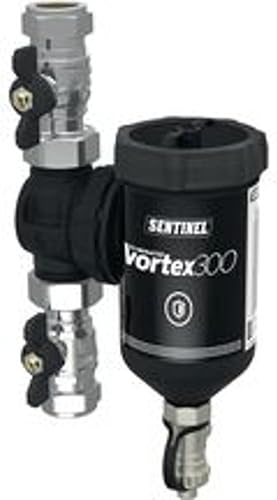
Best budget filter — a proper filter, not a token gesture at one
Sentinel is the third of the three names that dominate UK boiler manufacturers’ approved-product lists, and the Vortex 300 is their compact hydrocyclone-and-magnet filter aimed at exactly this budget bracket, with the same integral isolating valves as the pricier options. It won’t match the Pro2’s brand recognition with every installer, but as a genuine filter rather than a compromise, it’s the one I’d point a budget-conscious homeowner toward first.
For
- Named on Sentinel-approved manufacturer lists
- Magnet plus vortex separation, not magnet alone
Against
- Slightly less universal brand recognition among installers than Adey or Fernox
Typically £70–£100
Check price on AmazonSpirotech SpiroTrap MB3

Best professional-grade filter — what a lot of heating engineers actually carry on the van
Spirotech built its reputation on air and dirt separation for commercial plant before the SpiroTrap line brought the same engineering to domestic systems, with a brass body and a cyclonic chamber doing the physical work alongside the magnet — catching flux residue and limescale flakes that a magnet-only filter simply lets through. It’s a lesser household name than Adey, Fernox or Sentinel, but among heating engineers it’s genuinely respected, particularly on hard-water systems where scale is as much the problem as sludge.
For
- Combined magnetic and cyclonic separation
- Solid brass body, commercial-grade engineering
Against
- Check it’s specifically named before relying on it for a warranty claim
Typically £90–£130
Check price on AmazonAdey MagnaClean Professional3 Sense
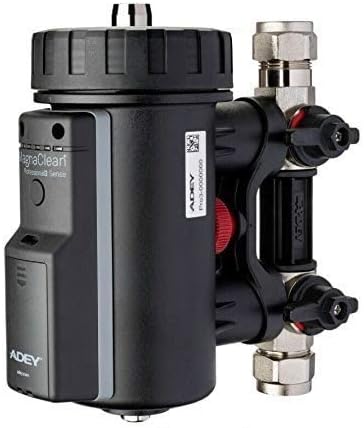
Best smart filter — for anyone who wants a warning before the next service, not at it
Same core filtration as the Professional2, with a Wi-Fi module and companion app that tracks system water quality and flags when the filter needs attention rather than waiting for an annual service to find out. For a landlord managing several rented properties, that’s a real feature rather than a gimmick. For a single owner-occupied home already on an annual service, the standard Professional2 does the identical filtration job for roughly half the money.
For
- App alerts on system water quality between services
- Same filtration hardware as the class-leading Pro2
Against
- A significant premium for monitoring most single-household owners won’t use
Typically £180–£240
Check price on AmazonAdey MC1+ Protector 500ml

Best inhibitor to pair with an Adey filter
Adey’s own inhibitor, formulated to work alongside their filters and named in the same warranty documentation as the Pro2. One 500ml bottle treats up to 125 litres of system water — enough for a typical two-to-four-bedroom house — and it’s BS 7593 compliant. If a boiler manufacturer’s warranty names “Adey products” specifically, this is the inhibitor half of satisfying that condition.
For
- Matches the Adey filter range on manufacturer warranty lists
- BS 7593 compliant, one-bottle dosing, treats 125 litres
Against
- No particular advantage over a rival brand if your boiler doesn’t specify Adey by name
Typically £15–£25
Check price on AmazonFernox F1 Protector 500ml
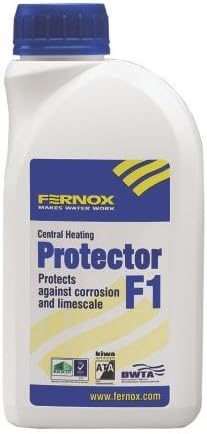
Best budget inhibitor — and a genuine alternative, not a cut-price copy
Fernox’s equivalent to the Adey MC1+, and usually the cheapest of the branded, BS 7593-compliant inhibitors rather than an unbranded imitation cutting corners. It protects against corrosion and limescale, treats a slightly smaller 100-litre system, and is the inhibitor most commonly paired with the TF1 Compact above on the same warranty documentation. Hard to fault on price or provenance.
For
- Reliably the cheapest of the major branded inhibitors
- BS 7593 compliant, pairs naturally with Fernox filters
Against
- Treats 100 litres against the MC1+’s 125, so larger systems may need a second bottle
Typically £12–£20
Check price on AmazonSentinel X100 Inhibitor 1L

Best all-round inhibitor — the one I see named most often on manufacturer approved-product lists
Sentinel X100 is the inhibitor Worcester Bosch, Ideal, Baxi and several others most commonly cite by name in their own warranty documentation. A full litre treats up to around 250 litres of system water — comfortably enough for a larger house — and protects against corrosion and the limescale that’s a bigger issue than sludge across much of the South East’s hard-water areas. If the warranty just says “a BS 7593-compliant inhibitor” without naming a brand, this is the safe, widely-recognised default.
For
- Most frequently named inhibitor across major boiler brands’ warranty terms
- Treats up to 250 litres from one bottle
Against
- The 1L bottle costs more upfront than a 500ml rival
Typically £15–£25
Check price on AmazonWhat actually matters — and what doesn’t
You need both, not either/or. This is the single most common mistake I see: a filter fitted with no inhibitor dosed, or an inhibitor topped up into a system that’s never been filtered or flushed. The filter deals with what’s already circulating; the inhibitor stops more being produced. A filter in untreated water fills with sludge fast; an inhibitor dosed into a system already thick with years of magnetite is treating water that’s already lost the fight.
Read the actual warranty wording before buying anything. Boiler manufacturers name specific approved filters and inhibitors — not always the same brand as each other, or of the boiler itself. A claim can be, and has been, refused because the fitted filter wasn’t on the approved list. Five minutes with the warranty booklet before ordering saves that argument entirely.
A filter doesn’t reverse existing damage. If a system is already knocking or radiators stay cold at the top despite bleeding, a filter and inhibitor won’t undo pinholed radiators or a heat exchanger already partially scaled. That’s a power flush and a conversation with a Gas Safe registered engineer — a filter and inhibitor are what you fit afterwards to stop it happening again, not instead of the flush.
What gets pushed that doesn’t matter as much as it sounds. Wi-Fi monitoring is genuinely useful for landlords, and largely decorative for a household already on an annual service — the filtration underneath is usually identical to the non-smart version at half the price. Dosing pots are a convenience, not a performance upgrade over a bottle poured in properly at commissioning.
Most Gas Safe engineers do this at a service or a flush anyway. Fitting a filter and dosing an inhibitor correctly is straightforward for a competent DIYer with the right tools, but most people have it done as part of a service, a power flush, or a new boiler install — ask for it by name if it isn’t already quoted.
Questions I get asked
Do I need a magnetic filter and an inhibitor, or is one enough? Both, ideally, and most boiler warranties now require both as a condition of cover. The filter is mechanical, trapping magnetite already circulating; the inhibitor is chemical, slowing the corrosion that produces new magnetite and protecting against limescale. Fitting just one is a common shortcut that undermines the point of doing either.
Will a magnetic filter fix noisy pipes or cold radiators? Not on its own, and not immediately. A filter stops the problem getting worse and, over time, reduces circulating sludge. But a radiator cold at the top because of a solid layer of sludge already sitting in it needs bleeding, and possibly power-flushing, to actually clear that radiator — the filter protects the boiler and prevents re-contamination afterwards, it doesn’t retroactively clean radiators already blocked.
How do I know what my boiler’s warranty actually requires? Check the warranty booklet or manufacturer’s website — most publish an approved products list or state the requirement plainly. If a Gas Safe registered installer did the work, ask what they fitted and whether it satisfies the warranty; it should be on the benchmark commissioning checklist left with the boiler.
How often does the inhibitor need topping up? Check every five years, or immediately after any drain-down (a radiator replacement, a leak repair, a power flush) since draining removes the inhibitor with the water. Manufacturers sell simple test strips that check concentration in minutes; an engineer can also check it at a routine service.
If a survey or an EPC assessment on your own home has flagged an ageing heating system, sludge, or a boiler nearing the end of its working life, that’s exactly the territory covered by a domestic EPC or a PAS 2035 retrofit assessment — get in touch if you’d like one done properly. For the wider cost picture, see what a new boiler or a routine boiler service typically runs to. And if you’re working through the rest of the heating system, there are more field-kit guides.
Small print. This guide is general information, not an inspection of your own heating system, and a filter and inhibitor are not a substitute for a Gas Safe registered engineer’s advice on a specific boiler and its warranty terms. Prices are indicative, move constantly and are checked at the time of writing; the linked page always shows the current price. As an Amazon Associate I earn from qualifying purchases.