A storage heater does one simple thing: it uses cheap off-peak electricity overnight to heat a block of dense ceramic bricks inside its case, then releases that stored heat through the day as the room needs it. The 1970s and 80s versions most people picture — a crude dial, a manual damper flap, no real feedback on what's happening inside the case — store roughly what they're told to regardless of the weather and release it on their own schedule, whether anyone's home or not. A high heat retention (HHR) unit is a different appliance behind a similar-looking case: better insulation around the core, a controller that adjusts the overnight charge to the forecast and the room's actual temperature, and a retention rating of at least 45% of stored heat still available 24 hours after a full charge — the figure Lot 20 of the EU Ecodesign regulation sets as the category baseline.
On an EPC, that difference matters more than most homeowners expect. RdSAP scores a heating system partly on its own efficiency and partly on how well it's controlled, and an old manual storage heater with no thermostat scores badly on both counts — sometimes badly enough to be the single biggest drag on an otherwise reasonable property. Swap it for a modern HHR unit with electronic charge control and the software recognises a materially better appliance, not just a newer-looking box. That's a genuinely low-disruption fix on a property with no gas main and no realistic case for a heat pump yet: no new pipework, just confirming the existing Economy 7 or Economy 10 circuit suits the new unit.
The honest caveat, and the one most affiliate pages skip: a storage heater upgrade improves the heating-system score, not the fabric of the house. If the real problem is a solid wall with no insulation or a loft that's never been topped up, new heaters on their own will move the rating a little and leave the running cost mostly where it was. Worth knowing which one you're actually solving before spending the money — more on that below, after the six units I'd look at.
The one I’d buy

Ecostrad Magma HHR
German-engineered core with Ferolite retention bricks, full daily and weekly programming as standard, and an optional WiFi SmartHub that adds remote control without forcing it on you at the point of purchase. Retention sits at 45–49% depending on the size chosen, comfortably clearing the Lot 20 baseline, and Ecostrad backs the heater body with a ten-year warranty — long by the standard of this category, where most competitors stop at two to five years on the electronics and a similar span on the case.
Typically £550–£950 depending on output
Check price on AmazonHow I judge a storage heater
Retention percentage, not just the “HHR” label. Lot 20 sets 45% as the floor for high heat retention; several units below sit at 45–49%, a meaningful difference in how much of an overnight charge is still usable heat by the following evening. Ask for the figure rather than trusting the badge alone.
Electronic charge control that actually learns. The genuine gain over an old unit is a controller that adjusts the overnight charge against room temperature, not a fixed dial set once and left. A basic 24-hour timer without adaptive charging is a smaller step up than the marketing suggests.
What it needs from the existing circuit. Every unit here runs on a standard Economy 7-style off-peak supply through the same two-cable arrangement an old storage heater already used. Confirm the existing circuit and fuse rating suit the new unit's input wattage before ordering — a same-wattage swap rarely needs an electrician beyond a competent DIY changeover; stepping up in size might.
Fan-assisted or natural convection. A fan-boosted unit releases heat faster on demand, useful in a room only occupied in the evening, but it adds a moving part and running noise a purely convective HHR case doesn't have.
Smart control as a genuine feature, not a headline. WiFi or app control is useful on a property you don't occupy every day; on a heater someone lives with full-time, a clear on-unit display and a sensible weekly programme often matter more than an app nobody opens after the first week.
The comparison
| Model | Retention | Control | Typical price | Best for | |
|---|---|---|---|---|---|
| Ecostrad Magma HHR | 45–49% | 7-day programme, optional WiFi hub | ~£550–£950 | Best all-round pick | View |
| Dimplex Quantum RF HHR | Lot 20 HHR | Adaptive algorithm, RF app control | ~£700–£900 | Best-documented brand for installers | View |
| Elnur Ecombi PROSSH208 | Lot 20 standard | WiFi via G-Control Hub (extra) | ~£400–£480 | Best smart retrofit on a budget | View |
| Elnur Ecombi ECOHHR10 | 45%+ HHR | Daily/weekly programme, open-window detection | ~£530–£635 | Best for a single small room | View |
| EHC Ecostore Smart Storage Heater | HHR core, fan-free venting | App control, geo-location, open-window sensor | ~£450–£900 | Best silent operation (no fan) | View |
| Creda TSRE050 | Not HHR — Lot 20 standard tier | 7-day programmable timer | ~£410–£495 | Best on a tight budget | View |
The picks in detail
Ecostrad Magma HHR
Best all-round — German core, ten-year body warranty, WiFi optional not mandatory
The Magma HHR range runs from 1.7kW up to 3.5kW, so it scales from a single room to a modest flat without changing brand partway through. Full daily and weekly programming is built in on every unit; the WiFi SmartHub is a genuinely optional extra rather than something the heater is crippled without, which isn't true of every smart storage heater on this list. Ecostrad's ten-year body warranty is the longest here, worth something on an appliance meant to run for decades between replacements.
For
- 45–49% retention across the range, comfortably above the Lot 20 floor
- Ten-year body warranty, longest on this list
- WiFi control genuinely optional, not a forced extra
Against
- WiFi SmartHub is sold separately if you do want it
- Less of an installer-household name in the UK than Dimplex
Typically £550–£950 depending on output
Check price on AmazonDimplex Quantum RF HHR
Best-documented brand for installers — the name most likely to already be on an EPC recommendation
Quantum is the storage heater installers and EPC software tend to already recognise, which counts for something when the point of the upgrade is a cleaner RdSAP entry. The controller runs an adaptive algorithm that learns the household's actual usage pattern rather than following a fixed schedule, and RF (radio frequency) app control is built in as standard across the range, from the compact QM050RF up to the QM150RF for a larger room. Dimplex publishes clear spec sheets and installation documentation, useful if an electrician needs to check compatibility before fitting.
For
- Adaptive learning control, not a fixed manual schedule
- RF app control built in as standard, not a paid extra
- Widely specified and recognised by UK installers
Against
- Sits at the pricier end of this list
- No manufacturer product photo available for this guide — check the current listing for exact dimensions
Typically £700–£900 depending on output
Check price on AmazonElnur Ecombi PROSSH208
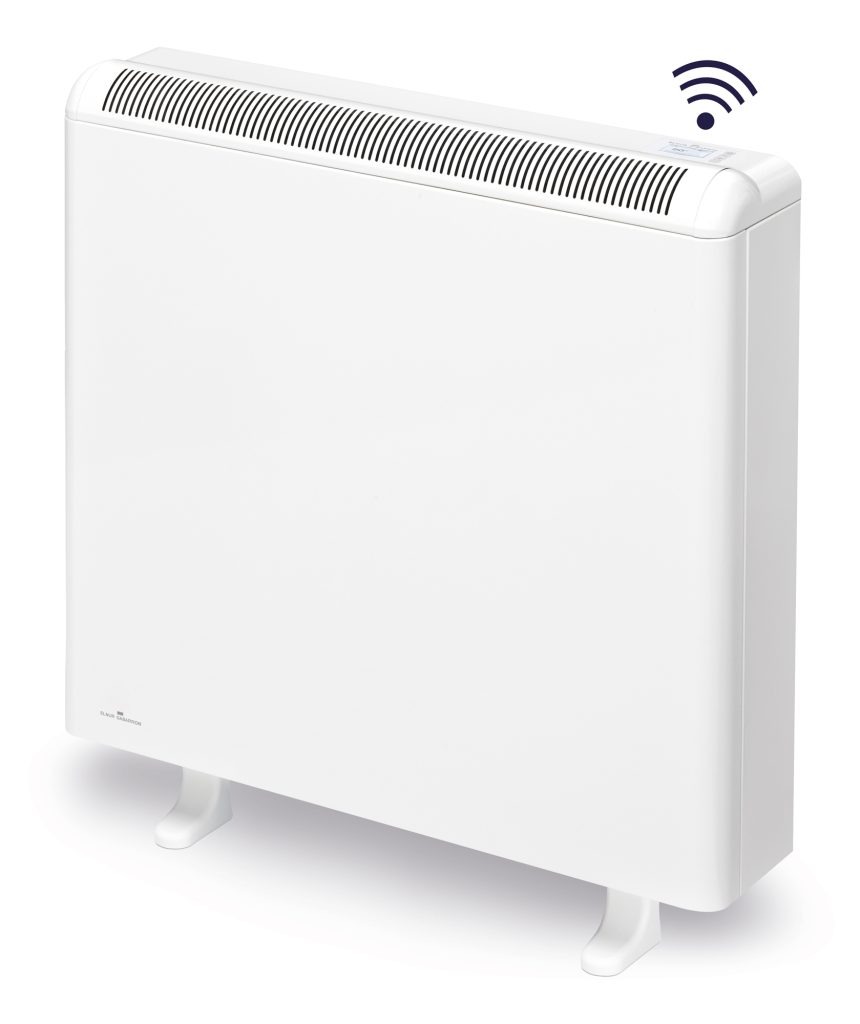
Best smart retrofit on a budget — WiFi control without the premium-brand price
The PROSSH range sits below Elnur's own ECOHHR line on price while still offering an integral energy manager and WiFi compatibility through Elnur's G-Control Hub, sold separately for roughly £100 if you want remote scheduling from day one. The 208 model is the mid-size option in a four-strong range (158 through to 408), with a 1300W storage input suited to an average bedroom or small living room — a lower-cost route into app-controlled heating than the premium HHR brands, provided the retention figure matters less to you than the control features.
For
- Lowest price here for app-controllable heating
- Four sizes across the range for different rooms
- Integral energy manager included as standard
Against
- WiFi hub is a separate purchase, not bundled
- Not marketed as a Lot 20 HHR unit — check the retention figure against ECOHHR if that matters most
Typically £400–£480 per unit; hub extra
Check price on AmazonElnur Ecombi ECOHHR10
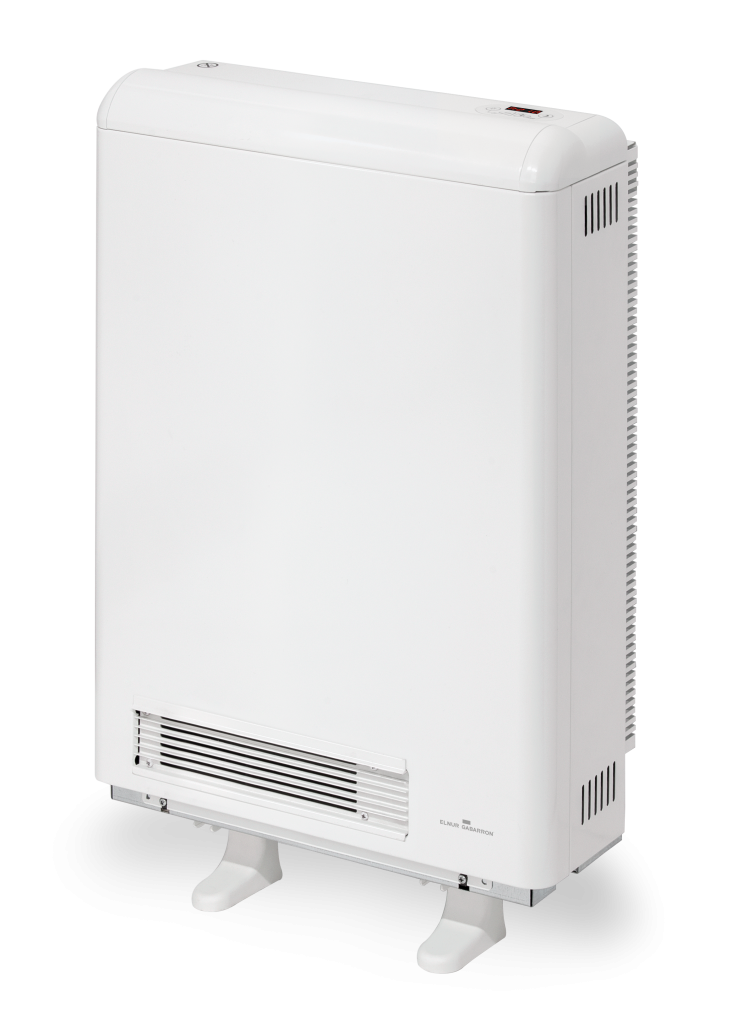
Best for a single small room — compact HHR case at 871W storage input
The ECOHHR range runs from the ECOHHR10 at 871W up to the ECOHHR40 at 3484W, all built around the same retention core and control logic, so the 10 is simply the smallest case rather than a cut-down feature set. Daily and weekly programming, open-window detection and three temperature levels come as standard across the whole range. It's the right-sized choice for a box room, a small bedroom or a hallway where a full-size HHR case would be oversized for the heat actually needed.
For
- Genuine Lot 20 HHR core in a compact case
- Open-window detection included, not a premium extra
- Same control logic as the larger ECOHHR models
Against
- 871W output is only realistic for a small room
- No WiFi without stepping up to the ECOHHR PLUS range
Typically £530–£635
Check price on AmazonEHC Ecostore Smart Storage Heater
Best silent operation — natural convection venting, no fan at all
EHC's Ecostore range uses a patented venting system that cycles stored heat by natural convection rather than a fan, meaning genuinely silent operation where a fan-assisted HHR unit has a low background hum most of the day. The app adds geo-location and an open-window sensor that cuts input if it detects a 2.4°C drop, and the range runs from a compact 850W up to a 3400W unit for a larger room. EHC is a UK-based manufacturer with a long track record specifically in electric heating.
For
- No fan — genuinely silent in operation
- Geo-location and open-window detection built into the app
- Wide size range from a single small room to a larger space
Against
- No manufacturer product photo available for this guide — check the current listing for exact dimensions
- Less widely stocked than Dimplex or Elnur through mainstream retailers
Typically £450–£900 depending on output
Check price on AmazonCreda TSRE050
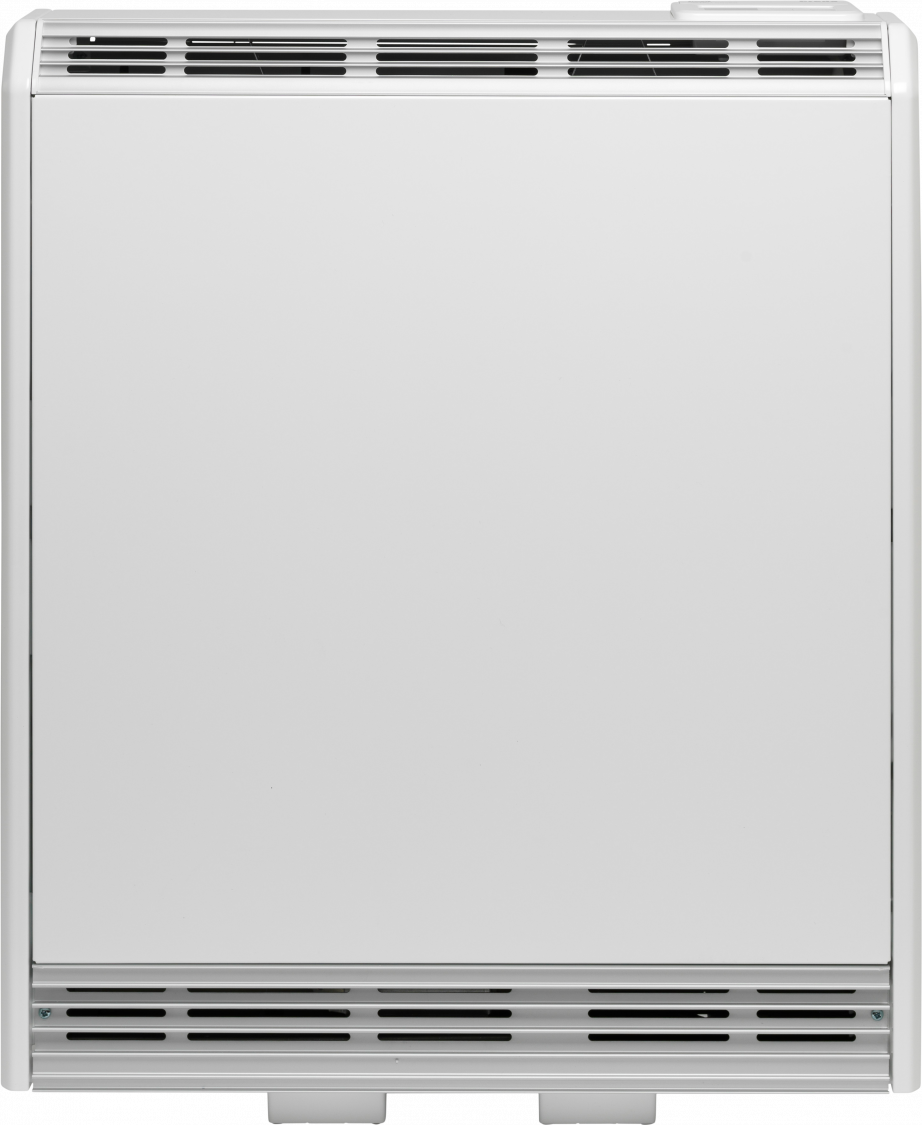
Best on a tight budget — a genuine Lot 20 upgrade on an old unit, not an HHR unit
Creda and Dimplex share a parent company, and the TSRE range is pitched a level below Quantum on both price and retention: it meets the standard Lot 20 requirement for dynamic charge calculation but doesn't claim the 45%+ HHR retention figure the premium units above do. For a straight swap on a failed 1980s storage heater where the budget is genuinely tight, that's still a real step up — a proper electronic thermostat and 7-day timer replacing a manual dial — even if it isn't the most efficient unit on this page. The 050 is the smallest in a five-size range up to 3.30kW, sized for a box room or small bedroom.
For
- Lowest price on this list for a genuine control upgrade
- Sold directly on Amazon, not just specialist heating retailers
- Five sizes available if a larger room needs more output
Against
- Not an HHR unit — lower retention than the units above
- Basic timer control rather than adaptive or app-based
Typically £410–£495
Check price on AmazonWhat actually matters — and what doesn’t
It improves the heating system's EPC score, not the building fabric. RdSAP marks a heating system on its efficiency and its controls; a modern HHR unit scores meaningfully better than an old manual storage heater on both. It does nothing to a solid wall with no insulation, a cold loft, or single glazing that's actually driving the running cost. If that's the real problem, a storage heater upgrade will nudge the rating and leave the bill mostly unchanged — worth checking what's actually being marked down first, which is exactly what a full EPC assessment tells you (see what an EPC costs if you haven't had one recently).
Off-peak tariff eligibility is the whole economic case. None of this makes sense on a standard single-rate tariff, where electricity used overnight costs the same as electricity used at 6pm. Confirm an Economy 7, Economy 10 or comparable time-of-use tariff is actually available and switched on before buying; without it, a storage heater is simply a worse radiator than a direct electric panel heater.
Retention percentage is the number that separates "HHR" from "storage heater." A unit genuinely clearing 45%+ overnight-to-evening retention behaves noticeably differently from one that doesn't — less heat wasted mid-morning, more still available by the time people are home in the evening. Ask for the figure rather than trusting a general "energy efficient" description.
A heat pump isn't always the answer it's presented as. On a gas-free property with a small heat demand and a tight budget, a modern HHR storage heater can be the pragmatic near-term fix while a heat pump conversion is planned or saved for. That's a fabric-first question a PAS 2035 retrofit assessment answers properly, rather than guessing from a single appliance swap.
What the marketing pushes that matters less than it sounds. A colour app dashboard is pleasant to use but doesn't change how much heat the case actually retains. "Smart" and "WiFi-enabled" describe the control layer, not the thermal performance — check the retention percentage and warranty length before the app screenshots.
Questions I get asked
Will new storage heaters actually improve my EPC rating? Usually yes, often by more than people expect, because RdSAP scores both the heating system's efficiency and how well it's controlled. An old manual unit with no thermostat can be dragging the whole assessment down; a modern HHR unit is recognised as a materially better appliance. It won't touch the fabric side of the rating, though — insulation and glazing are separate line items.
Do I need an electrician to fit one? A straight swap for an existing unit of similar wattage, on the same circuit, is within reach of a competent DIY changeover for some models, but always check the existing wiring and fuse rating first, and have a qualified electrician make the connection if there's any doubt. Stepping up significantly in wattage needs a proper electrical assessment.
What's the real difference between HHR and a standard storage heater? Retention percentage and control quality. An HHR unit is built to keep at least 45% of an overnight charge available 24 hours later; a standard Lot 20 unit still has dynamic charge calculation over the crude dial-and-damper units of the 1970s and 80s, but doesn't claim the same retention figure, and costs noticeably less as a result.
Would I be better off with a heat pump instead? Possibly, but not automatically — it's a fabric-and-budget question, not a straight heater-for-heater swap. A heat pump needs a building that can run at a lower flow temperature efficiently, plus a much bigger upfront cost. For a poorly insulated home, the insulation usually needs sorting first regardless of which heating system follows it.
I don’t specify or install heating appliances as part of a survey, but the heating system is a standard line item on every EPC I carry out, and on an all-electric property it's often the single biggest lever available without touching the fabric. If a heat pump or a wider retrofit is genuinely the better long-term answer for the house, that's exactly what a PAS 2035 retrofit assessment is built to work out properly before money goes on either. Get in touch for a second opinion, and there are more field-kit guides covering the rest of the home-energy list, including smart radiator valves for room-by-room control once the heat source itself is sorted.
Small print. This guide is general information, not a recommendation on what heating system suits your specific property — get that checked against your tariff, wiring and insulation before buying. Prices are indicative, move constantly and are checked at the time of writing; the linked page always shows the current price. As an Amazon Associate I earn from qualifying purchases.