A fair number of “draughty room” call-outs turn out to have nothing to do with the window everyone’s pointing at. The cold edge is real, but the air’s coming up through a suspended timber floor at the skirting, or down a loft hatch that’s never sealed properly, or being pulled backwards down a chimney by an extractor fan three rooms away doing exactly what it’s meant to do. A hand held near the frame tells you almost nothing reliable — body heat and draught both read as “a bit cold”. A thin trail of smoke settles it in seconds: it bends, stalls, or streams, and there’s no interpreting required.
On site that means holding a smoke source near a skirting board, a loft hatch edge, a service penetration, a boxed-in soil pipe, or the reveal of a window that’s been draught-proofed twice already and still isn’t right, and watching which way the trail moves. It’s also the quickest way to check whether ventilation is actually doing its job under Part F 2022’s whole-dwelling strategy — does that trickle vent draw, does the continuous extract fan in the bathroom actually pull air rather than just spin, is a newly-fitted MVHR unit pressurising the rooms it’s meant to. Paired with a thermal camera, smoke turns a cold patch on the image into an answer — cold bridge or moving air — in the time it takes to hold the trail up to the wall.
What a smoke pen won’t give you is a number. It tells you where air is moving and roughly how freely; it doesn’t tell you the air change rate, and it’s not evidence for a Part L or PAS 2035 air permeability sign-off — that comes from a blower door test with a calibrated fan and a manometer, where smoke’s role is only to help whoever’s holding the door rig see where the air the fan’s pulling is actually entering from. Seven worth having below, reusable pens through to disposable matches, and which end of that range actually suits the job in front of you.
The one I’d buy
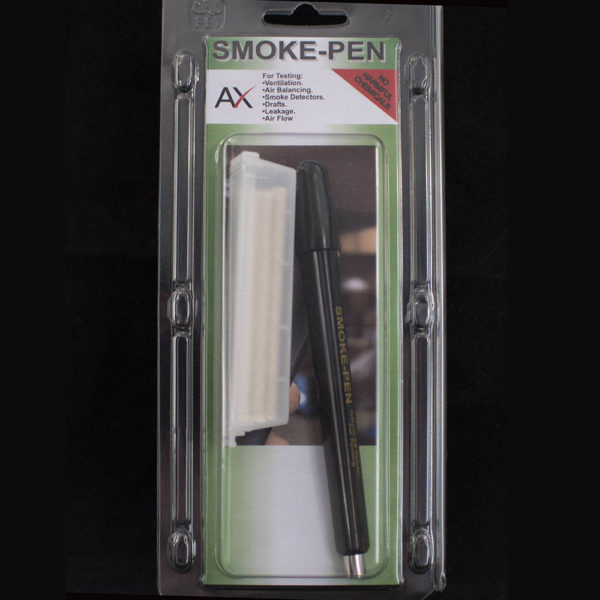
Regin S220 Smoke Pen
A mechanical-pencil-style barrel that takes a patented smoke-emitting wick, lit with a match or lighter and capped to stop the smoke whenever the trail’s made its point. No batteries, no fluid to mix, and a wick you can relight repeatedly rather than one that burns to nothing in a single pass. Six wicks in the box work out to roughly three hours of smoke, or about 360 individual thirty-second tests, which makes the running cost close to nothing once the pen itself is bought.
Typically £35–£45
Check price on AmazonHow I judge a smoke pen
How controllable the trail is. The job is pinpointing one gap, not fogging a room. A thin, directable stream you can hold an inch from a skirting board tells you something specific; a dense cloud that fills the room in five seconds tells you a draught exists somewhere in it, which you probably knew already, and it can set off a smoke alarm halfway through the survey.
Running cost over a year of surveys. A reusable pen or pencil costs more upfront but the wick or fluid refill is pence per test; a tub of matches or pellets costs less to buy but each one is gone after a single 20–30 second burn. Do the arithmetic against how often it’ll actually come out of the bag.
What’s actually in the smoke. The products worth buying now use a glycerine or glycol-based vapour, food-grade and non-toxic, rather than the older chemical smoke compositions some trade suppliers still sell for gas spillage work. Worth checking before use in an occupied home, especially with children, pets or anyone with respiratory sensitivity present.
Whether it needs a naked flame. A wick or a match needs lighting; a battery-heated smoke pencil doesn’t. That’s a genuine consideration near loft insulation, timber, or a client who’d rather you didn’t strike a match indoors, even briefly.
Burn time against the size of the job. A single loft hatch check needs seconds of smoke; a slow pass around every window and service penetration in an older house needs a source that lasts. Match the total smoke output on offer to how much of the house you’re actually covering that visit.
The comparison
| Model | Type | Smoke source | Typical price | Best for | |
|---|---|---|---|---|---|
| Regin S220 Smoke Pen | Reusable pen, 6 wicks | Glycerine wick, naked flame | ~£40 | Best overall — negligible running cost | View |
| Smoke Pencil Pro Draught Detector Kit | Reusable battery pencil, hard case | Glycerine/glycol fluid, battery-heated | ~£90 | Most complete kit, no flame needed | View |
| Smoke Pencil Draught Detector | Reusable battery pencil | Glycerine/glycol fluid, battery-heated | ~£55 | Same mechanism, no case or nozzle | View |
| Arctic Hayes Smoke Stick Pen Kit | Reusable pen, 3 sticks | Glycerine wick, naked flame | ~£30 | Gas-safe spillage and CO checks | View |
| Regin Fumax Smoke Pellets (tub of 100) | Single-use pellets | BS 5440-compliant smoke charge | ~£36 | Flue and drain testing | View |
| Hamilton Gas Products Smoke Matches (pack of 100) | Single-use matches | Impregnated match head | ~£13 | Bulk everyday testing | View |
| Arctic Hayes Strikes Smoke Matches (tub of 25) | Single-use matches | Impregnated match head | ~£8 | Cheapest way in | View |
The picks in detail
Regin S220 Smoke Pen
Best overall — reusable wick pen, close to zero running cost once bought
The S220 works like a fat mechanical pencil: a smoke-emitting wick slots into the barrel, 3/8 inch left exposed, lit with a match or lighter, and the glowing tip smokes for as long as needed. Cap it to snuff the ember out and it’s ready to relight at the next gap, so one wick covers a whole room’s worth of testing rather than a single burst. It’s the standard reach-for tool for air balancing, checking negative or positive pressure, and general leak-chasing across HVAC and building inspection work.
Six wicks in the box run to about three hours of total smoke, which in practice is somewhere around 360 individual thirty-second tests — enough that the per-test cost is effectively nothing once the pen’s paid for. The trade-off against the battery pencils below is the naked flame: fine outdoors or in most rooms, worth a moment’s thought near loft insulation or a smoke-sensitive alarm head.
For
- Negligible cost per test once the pen is bought
- Around three hours of smoke across six wicks
- Established, widely-used mechanism in HVAC and inspection work
Against
- Needs a match or lighter to start each wick
- Wicks are a separate consumable to keep stocked
Typically £35–£45
Check price on AmazonSmoke Pencil Pro Draught Detector Kit

Most complete kit — battery-powered, no naked flame, everything in one case
A battery-heated smoke pencil rather than a wick pen: fill the reservoir from the supplied glycerine and food-grade glycol fluid, press the trigger, and a plume rises with no match or lighter involved anywhere in the process. The Pro version adds a black nozzle for a narrower, more concentrated stream when a wider plume would be too vague to read against a specific gap, and the whole thing — pencil, nozzle, six AA batteries, fluid bottle and a small screwdriver for the battery cover — ships in a hard carry case built for it.
It’s the most expensive item on this list, and the case is really what’s being paid for on top of the base pencil below — worth it if this is going in a work bag alongside other instruments and needs to survive that, less so if it’s staying on a shelf between uses. No naked flame is a genuine advantage in a loft or near a sensitive smoke alarm.
For
- No match or lighter needed, battery-heated
- Concentrated-stream nozzle for precise targeting
- Hard case with all accessories included
Against
- Most expensive option here
- Batteries and fluid are still running costs over time
Typically £85–£95
Check price on AmazonSmoke Pencil Draught Detector
Same mechanism as the Pro kit, without the hard case or nozzle
The base version of the battery pencil above — same glycerine and glycol vapour, same trigger-fed plume, same freedom from needing a flame, just sold as the pencil and a refill bottle rather than a cased kit with a concentrator nozzle. For most domestic draught-tracing work that’s all that’s actually needed; the nozzle earns its keep on trickier, more precise leak-hunting rather than everyday use.
It costs noticeably less than the Pro kit for functionally the same core tool, which makes it the sensible pick if a hard case isn’t a priority and a wider, easier-to-see plume suits the work better than a narrow concentrated stream in any case.
For
- No naked flame, same reusable mechanism as the Pro kit
- Cheaper than the cased version for the same core tool
- Refill fluid sold separately when it runs low
Against
- No hard case or concentrator nozzle included
- Batteries not always included depending on listing
Typically £50–£60
Check price on AmazonArctic Hayes Smoke Stick Pen Kit
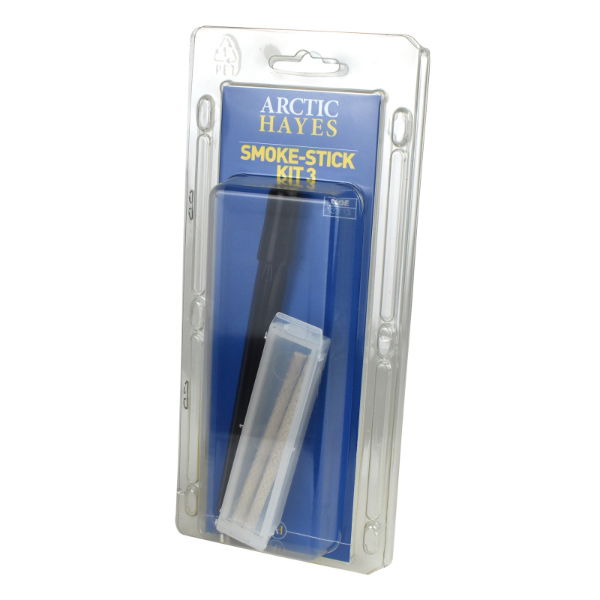
Gas-safe spillage and CO checks, alongside general draught tracing
A pencil-thin smoke pattern from a pen that takes replaceable smoke sticks rather than a bare wick, marketed heavily at the checks a gas engineer runs after fitting or refitting a boiler — spillage testing at the case sill, the mandatory CO spillage check, and general air-movement testing around flues and ducting. It works equally well for the same draught-tracing job as everything else on this list; the branding just leans toward the trade that uses it most.
Three smoke sticks in the kit give up to three hours of controllable smoke between them, non-corrosive and described by the manufacturer as non-hazardous in normal use. Worth having on the van if boiler-adjacent checks come up alongside general survey work, even if that’s not the primary reason for buying it.
For
- Pencil-thin, controllable smoke pattern
- Up to three hours of smoke across three sticks
- Doubles as the standard tool for spillage/CO checks
Against
- Needs a naked flame to light each stick
- Sticks are a separate consumable to restock
Typically £25–£35
Check price on AmazonRegin Fumax Smoke Pellets (tub of 100)

Flue and drain testing to a recognised standard
A different mechanism again: single-use encapsulated pellets, each lit by inverting the black surface over a match or lighter flame, that burn for about 30 seconds and produce roughly 5 cubic metres of dense white smoke. They’re BS 5440 Part 1 compliant, which is the relevant spec for flue and chimney testing rather than general draught chasing, and the same volume of smoke works just as well for tracing drain runs or checking directional flow through pipework.
A tub of 100 is a lot of pellets for occasional use, and each one is gone after a single burn — no relighting, no refilling. Where it earns its place over a reusable pen is specifically flue and drain work where the BS 5440 compliance and the sheer smoke volume matter more than running cost.
For
- BS 5440 Part 1 compliant for flue testing
- Dense smoke volume, good for drains and pipework
- 100 pellets in a resealable, waterproof tub
Against
- Single-use, no relighting once spent
- Overkill volume for occasional domestic draught checks
Typically £32–£40
Check price on AmazonHamilton Gas Products Smoke Matches (pack of 100)
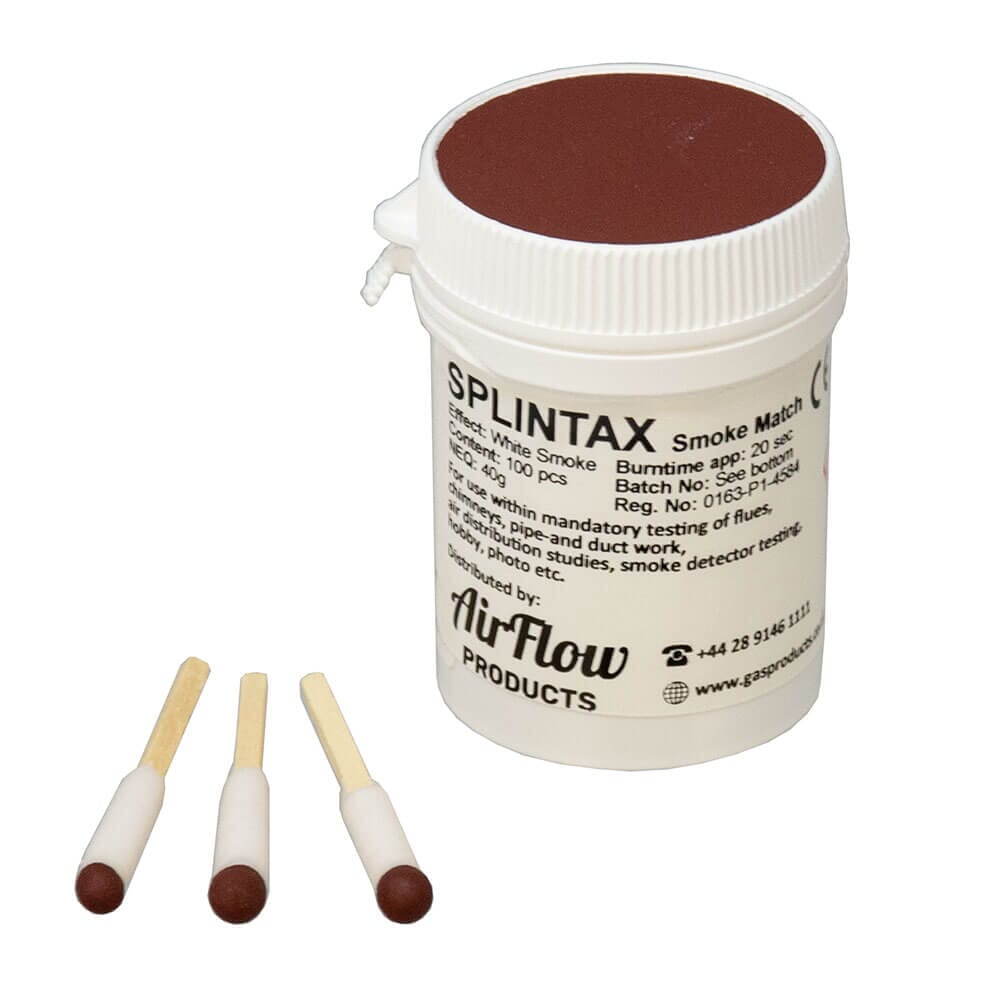
Bulk everyday testing, no pen or wick to maintain
A straightforward strike-and-hold match: light the tip, hold it near the gap being tested, and read the trail for about 20 seconds before it burns out. No pen barrel, no wick to replace, no fluid to mix — just a match, which makes it the simplest thing on this list to hand to someone else on site or keep a spare tub of in the van without worrying about upkeep.
A pack of 100 covers a genuinely large number of individual tests for a modest price, clean-burning with no residue left behind. The catch is the one every single-use consumable shares: nothing to relight, so a busy week of surveys works through the tub faster than the reusable pens above.
For
- Simple to use, nothing to maintain between tests
- 100 matches covers plenty of individual checks
- Clean-burning, no residue
Against
- Single-use, works out costlier over heavy repeat use
- Needs a lighter or match to strike each one
Typically £10–£15
Check price on AmazonArctic Hayes Strikes Smoke Matches (tub of 25)
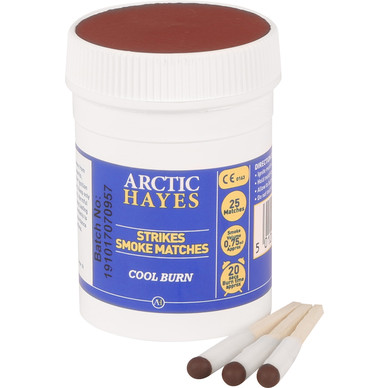
Cheapest way in — a small tub to try before committing to more
The smallest, cheapest commitment on this list: 25 matches in a tub, each burning for about 20 seconds and producing a decent plume for its size, cool to the touch once spent and clean enough to leave no mess behind. It’s the same basic mechanism as the pack of 100 above, just in a size worth buying to find out whether smoke testing earns a regular place in the bag before buying a reusable pen.
Twenty-five matches doesn’t go far across a week of surveys, and the manufacturer’s own safety sheet flags the usual irritant warnings for the smoke — standard for this category, worth reading once rather than assuming. As a first tub to try the whole idea out, it’s hard to argue with the price.
For
- Lowest price on this list
- Good trial size before committing to a reusable pen
- Cool to touch, clean burn, no residue
Against
- Only 25 matches, runs out fast with regular use
- Single-use, standard smoke irritant warnings apply
Typically £5–£10
Check price on AmazonWhat actually matters — and what doesn’t
Density isn’t the point, control is. Marketing around these products leans on the biggest, thickest cloud a source can produce, as if more smoke were automatically better. On site the opposite is usually true: a room-filling plume tells you a draught exists somewhere, which you likely knew before lighting anything, while a thin, directable trail held right at a specific gap tells you something you can act on. A dense cloud also has a habit of tripping the nearest smoke alarm, which nobody thanks you for mid-survey.
Reusable pays for itself fast if it comes out often. A pen costing £35–£40 with hundreds of tests in it is cheaper within a few months than buying matches every week; a £6–£13 tub of matches makes more sense for occasional use where a pen would mostly sit in a drawer. Worth doing that arithmetic against how often smoke tracing actually features in the work, rather than buying the most capable option by default.
BS 5440 matters for gas work, not for chasing a draught. The compliance stamped on the Fumax pellets is specifically about flue spillage testing under gas safety protocol. It’s a genuine spec worth knowing exists, and irrelevant if the job in hand is a sash window or a loft hatch — no need to pay for a certification that isn’t answering the question being asked.
A smoke pen finds gaps, it doesn’t quantify them. For a Part L compliance figure or a PAS 2035 whole-house air permeability number, smoke on its own is the wrong tool entirely — that number comes from a blower door test with a calibrated fan and a manometer, sustained pressure difference and all. Smoke’s job there is to help whoever’s running the test see where the air being pulled through the building envelope is actually entering, not to put a figure on how much of it there is.
Where it earns its keep day to day. Loft hatches, suspended floor edges at the skirting, service penetrations, boxed-in soil pipes, and confirming whether an extract fan is genuinely extracting rather than just running — cheap, fast, visual confirmation before anyone spends money sealing the wrong gap. Pairing a positive result with an anemometer reading turns “air is moving here” into an actual extract rate worth writing in a report.
Questions I get asked
Do I need training or a licence to use a smoke pen? No. The products in this guide are unrestricted retail items built around food-grade glycerine and glycol vapour, not the genuinely hazardous chemical smoke generators — some using titanium tetrachloride — that older trade suppliers still sell for specialist gas work. Follow the manufacturer’s instructions on ventilation and disposal and there’s nothing else to arrange beforehand.
Can a smoke pen replace a blower door air-tightness test? No. A smoke pen is qualitative and directional — it shows where air moves, not how much. A Part L or PAS 2035 air permeability figure needs a calibrated blower door and manometer; smoke is useful during that test to help the operator see where the pressure difference is pulling air from, not as a stand-alone substitute for it.
Will it set off the smoke alarm? It can, particularly with a dense plume held close to an optical alarm head. Warn anyone in the property beforehand, keep the trail thin and away from the alarm sensor, and test the smallest amount that answers the question rather than the biggest cloud the source can produce.
What’s the actual difference between a smoke pen and smoke matches? Reusability. A pen or pencil takes a refillable wick or fluid reservoir and can run hundreds of individual tests before it needs restocking; matches and pellets are struck or lit once, burn for 20–30 seconds, and that’s the end of that one. Which suits better comes down to how often smoke tracing actually features in the work, covered above.
Chasing a draught back to its actual source, rather than the wall it happens to be felt against, is standard groundwork for the practice’s ventilation assessments and retrofit assessments, where Part F compliance and post-improvement airtightness both get checked properly rather than guessed at. Get in touch. And for the rest of the kit worth carrying, there are more field-kit guides.
Small print. This guide is general information, not a survey, ventilation assessment or air-tightness test of your property; a smoke pen shows the direction of air movement only and is never a substitute for a calibrated pressure test. Some products in this guide involve a naked flame or combustion by-products — always follow the manufacturer’s instructions on ventilation, use and disposal. Prices are indicative, move constantly and were checked at the time of writing; the linked page always shows the current price. As an Amazon Associate I earn from qualifying purchases.