Half the times I’d reach for a podium step aren’t in a loft — they’re on a half-landing of a converted Victorian house, checking an emergency light fitting or a smoke detector bolted to the ceiling three metres up. A telescopic ladder gets a foot near it for long enough to glance and climb back down. A podium step gives a flat, guarded platform to actually stand on while you look properly, take a photograph, or write up a defect without one hand permanently locked to a rail. For EPC and retrofit work in particular — communal stairwells, hallway extract fans, meter cupboards fixed above head height — that difference adds up over a working week.
The products in this guide split into two genuinely different categories, and it matters which one a job actually calls for. A caged podium built to BS8620 (also referred to as PAS250) surrounds the platform on all four sides with a guardrail and usually a self-closing saloon gate, so you step in, the gate shuts behind you, and you’re enclosed before you start work. A platform stepladder built to EN131 Professional is closer to a wide-topped swingback ladder — no cage, often no gate, but lighter, cheaper, and frequently made from non-conductive fibreglass for work near electrics. Neither is universally “better”; they suit different jobs, and the comparison below covers both.
None of the units below have had a survey van’s worth of genuine use behind them — what follows is built from manufacturers’ specifications and the patterns in published owner feedback, filtered through what a working surveyor actually needs rather than what a warehouse fleet buyer needs. First, the one I’d buy.
The one I’d buy
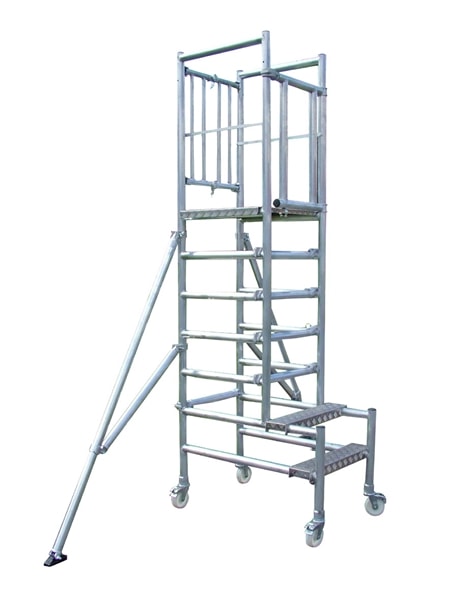
Lyte LYTEPOD 12X Podium Step
The LytePod is certified to BS8620 (PAS250), built by a long-established UK ladder manufacturer, and offers two platform heights — 0.975m and 1.225m — from the same unit, so it covers most of the low-level jobs a survey throws up without needing a second podium in the van. Saloon-type sprung gates close automatically once you’re on the platform, giving genuine four-sided fall protection rather than a rail you have to remember to latch, and the aluminium construction keeps the folded unit manageable for one person to lift.
Typically £650–£750
Check price on AmazonHow I judge a podium step
Certification, and which type it actually is. A caged unit built to BS8620/PAS250 and a platform stepladder built to EN131 Professional are both legitimate, but they’re not interchangeable — check which standard is quoted and what it actually covers before comparing price against price.
Guardrail and gate design. A self-closing gate that shuts automatically once you step onto the platform is a genuine safety feature, not a marketing line — it means the enclosure is complete without you having to remember to latch anything. A platform stepladder without a cage relies on a rear rail and your own balance instead.
Platform height matched to the actual job, not the maximum on the box. Most survey access points — stairwell fittings, meter cupboards, loft hatch surrounds — sit in the 1–1.75m platform range. A unit that goes taller than that is a specialist tool, not a better everyday one.
Weight and one-person handling. It has to come out of the van, up a stairwell without a lift, and back down again, alone, more often than not. A folded weight in the 20–40kg range is manageable; anything heavier needs a trolley or a second pair of hands.
Footprint and stability on the actual surface. Outriggers and non-slip platform surfaces matter on an uneven driveway or a worn stone hallway floor. A handful of podiums are built with adjustable rear legs specifically for use on a staircase — a standard flat-ground unit should never be improvised onto steps instead.
The comparison
| Model | Standard | Platform height | Typical price | Best for | |
|---|---|---|---|---|---|
| Lyte LYTEPOD 12X | BS8620/PAS250, caged | 0.975m / 1.225m | ~£650–£750 | Best overall | View |
| Deltadeck Work Platform | Guardrailed, 1-piece | 450–870mm (5 positions) | ~£450–£650 | Premium/professional pick | View |
| BS8620 Podium Step 1.75m | BS8620, caged | 1.5m / 1.75m | ~£650–£850 | Best for higher-level work | View |
| BPS Stair Podium Step | BS8620, caged, stair legs | Up to ~1.75m | ~£550–£650 | Best for stairs and narrow access | View |
| BS8620 Podium Step 1.25m | BS8620, caged | 1.0m / 1.25m | ~£500–£650 | Best value, BS8620-certified | View |
| Werner Fibreglass Podium 72010 | EN131 Professional, GRP | ~2.3m (10 tread) | ~£250–£400 | Best near live electrics | View |
| Zarges GRP Platform Steps | EN131 Professional, GRP | ~0.85m (4 tread) | ~£180–£220 | Best on a budget | View |
The picks in detail
Lyte LYTEPOD 12X Podium Step
Best overall — certified, adjustable, from an established UK brand
Lyte is one of the longer-standing names in UK access equipment, and the LytePod range is built specifically to BS8620/PAS250 rather than adapted from a general stepladder line. The 12X model gives two platform heights from one unit — 0.975m and 1.225m — covering most low-level jobs without a second purchase, and the sprung saloon gates close on their own once you’re inside, so the fall protection doesn’t depend on remembering to latch anything. It folds down for transport and locks securely into working position without tools.
For
- Two platform heights from one unit
- Self-closing saloon gates, genuine 4-sided protection
- Established UK manufacturer, BS8620/PAS250 certified
Against
- Priciest unit in this guide
- Bulkier to store than a fibreglass platform stepladder
Typically £650–£750
Check price on AmazonDeltadeck Work Platform Podium Step
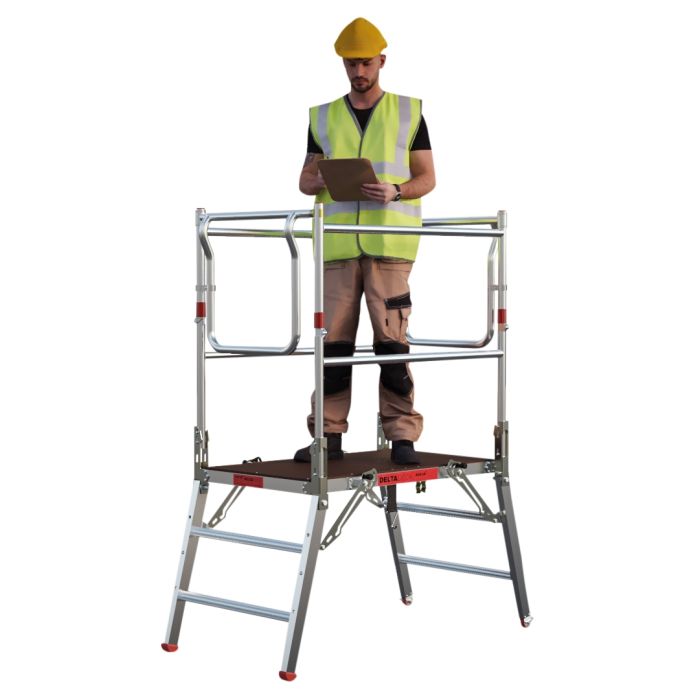
Premium/professional pick — five heights, one piece, no assembly
The Deltadeck is a genuinely different design — one complete folding unit with no pins or loose components, offering five platform positions between 450mm and 870mm and a 200kg safe working load rated for two people. Access and egress work from either end of the platform rather than a single gate, which suits jobs where you’re moving along a run of units — a stairwell of light fittings, say — rather than working from one fixed spot. At 26.8kg it’s still a one-person lift despite the wider platform and higher load rating.
For
- Five platform heights, no reassembly needed
- 200kg SWL, rated for two people
- One-piece design, nothing to lose or misplace
Against
- Lower maximum height than the caged BS8620 units
- No enclosed gate — guardrail only
Typically £450–£650
Check price on AmazonBS8620 Industrial Podium Step (1.75m Platform Height)

Best for higher-level work — double-height stairwells and soffit-level checks
This is the same BS8620-certified caged family as the 1.25m pick further down, sold in a taller build with an adjustable 1.5m or 1.75m platform — a genuine working height approaching 3.75m. That’s more than most survey work needs, but it earns a place for the jobs that don’t fit a standard unit: a double-height entrance lobby, a stairwell void, or an external soffit that would otherwise mean a scaffold tower quote. The self-closing gate and 150kg rating carry over from the rest of the range.
For
- Genuine height for double-height spaces
- Same BS8620 caged design and self-closing gate
- Avoids a scaffold tower hire for occasional taller jobs
Against
- Overkill for most routine low-level access
- Bulkier and heavier to transport than the 1.25m version
Typically £650–£850
Check price on AmazonBPS Stair Podium Step

Best for stairs and narrow access — purpose-built adjustable legs
Most podium steps are built for flat ground and shouldn’t be improvised onto a staircase; the BPS Stair Podium is the exception, with 580mm of adjustment on its rear legs specifically so the platform stays level when set up on a half-landing or stairwell. At 690mm wide it fits through door openings and narrow hallways that a standard-width podium wouldn’t clear, and the self-closing gates and 150kg rating match the rest of the BS8620 field. UK-manufactured, with a marine-ply platform surface for grip.
For
- Purpose-built adjustable legs for stairs
- 690mm width clears narrow hallways and doorways
- Self-closing gates, BS8620 certified
Against
- A specialist tool if most jobs are on flat ground
- Among the pricier picks in this guide
Typically £550–£650
Check price on AmazonBS8620 Industrial Podium Step (1.25m Platform Height)

Best value BS8620-certified — caged fall protection without the Lyte price
Certified caged podiums carry a real price premium over platform stepladders, and this is the most accessible entry into that category — an adjustable 1.0m/1.25m platform, self-closing gate and the full BS8620 150kg rating, at a noticeably lower price than the branded Lyte or Deltadeck units. It won’t have the name recognition or the resale value of an established brand, but the standard it’s certified to is the same standard, and for a sole trader that’s the part that actually matters on site.
For
- Genuine BS8620 caged certification at a lower price
- Self-closing gate, 150kg rating
- Adjustable platform height
Against
- Less brand recognition than Lyte or Deltadeck
- Prices vary more between sellers than for branded units
Typically £500–£650
Check price on AmazonWerner Fibreglass Podium Ladder 72010
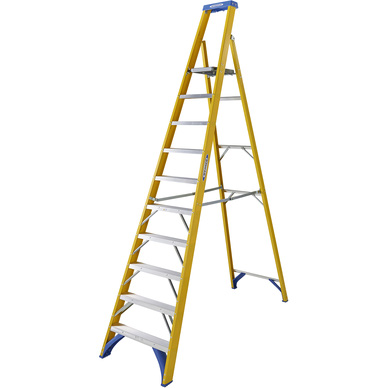
Best for work near live electrics — non-conductive, serious reach
Werner’s 72010 is a platform stepladder rather than a caged podium — ten treads to a platform around 2.3m up, built from seven-layer non-conductive fibreglass rather than aluminium. That construction is the reason to pick it over anything in the BS8620 field: for work anywhere near a consumer unit, overhead cabling or a distribution board, non-conductive stiles remove a risk a metal-framed podium simply carries. A waist-high guardrail and integrated tool holster come as standard, certified to EN131 Professional.
For
- Non-conductive fibreglass construction
- Genuine height — ten treads, big reach
- EN131 Professional rated, built-in tool holster
Against
- No enclosed cage or self-closing gate
- Taller and heavier than most jobs actually need
Typically £250–£400
Check price on AmazonZarges GRP Platform Step Ladder (4 Tread)
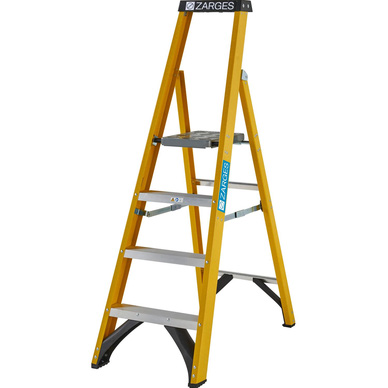
Best on a budget — compact, non-conductive, cheapest way in
Zarges’ 4-tread GRP platform step is the cheapest genuinely professional-grade option here — EN131 Professional certified, non-conductive fibreglass stiles, a 150kg rating and a proper platform with an integral tool tray rather than just a wide top rung. At 9.05kg it’s the lightest unit in this guide by some margin, easy to carry one-handed alongside a bag, though the closed height of 1.68m and platform around 0.85m mean it’s built for quick, low-level jobs rather than anything needing sustained time at height.
For
- Cheapest professional-grade pick in this guide
- Non-conductive GRP, EN131 Professional
- Lightest unit here at 9.05kg
Against
- Lowest platform height of any pick here
- No enclosed cage or gate
Typically £180–£220
Check price on AmazonWhat actually matters — and what doesn’t
Certification matters; the branding around it mostly doesn’t. BS8620/PAS250 for caged podiums and EN131 Professional for platform stepladders are the two standards worth checking for on any listing. Beyond that, marketing language like “industrial strength” or “heavy duty” on a product that already meets one of those standards is decoration, not a differentiator.
A self-closing gate is a genuine safety feature. It removes the single most common failure mode of an open-guardrail platform — someone forgetting, or not bothering, to close a manual barrier before starting work. It’s worth the extra cost and weight over a guardrail-only design if the job means standing on the platform for more than a minute or two at a time.
Castors are convenience, not a safety feature. A podium should never be moved with anyone standing on it, wheels or not — step down, wheel it, step back up. Locking castors matter for getting a heavy unit through a building without lifting it, not for working safely once it’s in position.
The 150kg load rating is standard, not a selling point. Nearly every unit in this guide, caged or platform-stepladder style, carries the same 150kg figure. It’s a baseline to confirm is present, not a spec worth comparing between products that all meet it.
Maximum height sells better than it performs on a typical job. A 2m-plus platform looks like more capability on a spec sheet, but most survey access points — stairwell fittings, meter cupboards, loft hatches — sit well under 1.75m. Buying more height than a job needs mostly buys more weight to carry and more storage space in the van.
Questions I get asked
Do I need a podium step, or is a stepladder enough?
It depends on how long you’re actually going to be at height. For a five-second glance — checking a loft hatch is shut properly, say — a step ladder or telescopic ladder is quicker to deploy and put away. Once a job needs both hands free for more than a moment — photographing a defect, checking a smoke detector properly, working on a fitting — a platform to stand on rather than a rung to balance on is the safer and, over a few minutes, less tiring option.
What’s the difference between BS8620 and EN131 Professional?
BS8620 (often marketed as PAS250, its predecessor standard) covers caged podium steps specifically — a platform enclosed by a guardrail on all sides, usually with a gate. EN131 Professional is a broader ladder standard that also covers platform stepladders — a wide-topped stepladder with a rear rail but no full cage. Both are legitimate professional standards; they simply apply to different product types, so check which one a specific listing is certified to rather than assuming either implies the other.
Can a podium step be used safely on a staircase?
Only if it’s specifically designed for it, like the BPS Stair Podium above with its adjustable rear legs. A standard flat-ground podium set up unevenly across steps is unstable in a way its rating doesn’t account for — if a job regularly means working on a staircase or half-landing, it’s worth buying the purpose-built version rather than improvising with a standard unit.
Do I need training or a certificate to use a podium step?
There’s no separate qualification required to use a podium step the way PASMA covers mobile scaffold towers — but the Work at Height Regulations 2005 still apply, meaning anyone using one, employed or self-employed, needs to be competent to assemble and use it correctly. In practice that means reading the manufacturer’s instructions properly, checking the platform is level and locked before stepping on, and never exceeding the rated load. It’s worth doing once, properly, rather than assuming a podium is self-explanatory because it looks simple.
A podium step earns its space in the van on the jobs a stepladder makes uncomfortable rather than impossible — communal stairwells, meter cupboards, anything needing more than a glance. The practice carries out building surveys, EPCs and PAS 2035 retrofit assessments across Sussex, Kent and Surrey, including the communal blocks and converted houses where this kind of kit earns its keep — get in touch. Or browse the rest of the field-kit guides.
Small print. This guide is general information, not health and safety advice; anyone using a podium step remains responsible for assembling, checking and using it in line with the manufacturer’s instructions and the Work at Height Regulations 2005. Prices are indicative, move constantly and were checked at the time of writing; the linked page always shows the current price. As an Amazon Associate I earn from qualifying purchases.