The call is usually the same shape: a client’s found a patch of black in the corner of a bedroom ceiling, or a smell that wasn’t there last winter, and before anyone mentions damp-proof courses or extract fans they want to know one thing — is it actually mould, and how bad is it. A mould test kit answers a narrower question than that promises. It tells you whether spores are present at a level worth noting, in the room or on the surface tested, and roughly what family they belong to. It doesn’t tell you why, and it doesn’t fix anything.
Inside the box is usually a petri dish of nutrient agar or a swab, left open in a room for an hour or wiped across a surface, then either read visually after 48 hours or posted off to a lab for a proper species count. A couple of the kits below skip the wait entirely with an immunoassay-style strip that gives a result in minutes rather than days. None of them measure concentration in any meaningful sense from a single sample — mould spores are in outdoor air everywhere, all the time, so what actually matters is comparison: how a sample from inside stacks up against a sample from outside, or against what’s normal for the time of year. A kit that ships one dish and calls that a diagnosis is only answering half the question.
Where that’s genuinely useful: a musty smell with no visible source, to decide whether it’s worth opening up a void or lifting a floor before spending more; a quick check before or after remediation work; documentation for a landlord–tenant dispute that needs something on paper. Where it isn’t: a wall that’s visibly black already — nobody needs a lab to confirm what they can see — or a house with a damp problem that keeps coming back after cleaning, which needs someone finding the moisture source, not another test confirming there’s mould growing in it. Six kits below, from a £17 petri dish to an £89 paired indoor–outdoor lab kit, and a clearer line on which side of that divide you’re actually on.
The one I’d buy

PRO-LAB DIY Mold Test Kit
Three sampling methods in one kit — air, surface or bulk, your choice depending on what you’re actually looking at — from a manufacturer that’s been making environmental test kits for over 25 years. The AIHA-accredited lab analysis is already paid for in the price, which matters, because the “extra $40 for an actual answer” surprise is the single most common complaint about the cheaper kits on this list.
Typically £45–£55
Check price on AmazonHow I judge a mould test kit
What it actually samples. Air (an open petri dish exposed to room air for an hour), surface (a swab across a stain or suspect patch), or bulk (a physical piece of material). Matching this to the actual question matters more than the brand on the box — an air test tells you about spore load in the room, a surface swab tells you about that specific patch, and using the wrong one wastes the kit.
Whether the lab fee is already paid. Several of these kits are cheap to buy and then ask for another $30–$40 per sample once you actually want species identification rather than a vague colour-and-fuzz description. That belongs in the price comparison up front, not as a surprise once you’ve already committed.
What the result can and can’t tell you. Presence, and a rough family — Aspergillus/Penicillium-type, Cladosporium, occasionally the rarer Stachybotrys — is the ceiling. None of these give you a number that means anything on its own without a comparison sample, and none of them tell you whether the source is a leaking gutter, a cold bridge or an extract fan that’s never actually worked.
Turnaround. 48 hours for visible growth on a settle plate, up to a week once a lab’s involved, or minutes for an immunoassay strip. Match it to whether you need a same-day steer or can wait for a proper answer.
How far one kit actually stretches. A single dish covers one room or one patch. Testing a whole house properly means buying enough kits — or a multi-room pack — to cover it, and the real cost climbs fast once you do the arithmetic.
The comparison
| Model | Method | Lab analysis | Typical price | Best for | |
|---|---|---|---|---|---|
| PRO-LAB DIY Mold Test Kit | Air / surface / bulk, your choice | Included | ~£50 | Best overall — no hidden fee | View |
| Accurate Mold Test Kit | Air, paired indoor/outdoor | Included | ~£89 | Most rigorous — genuine baseline comparison | View |
| Amatest AMA109 | Air / surface / bulk, your choice | Included | ~£51 | Alternative all-inclusive kit | View |
| Evviva Sciences 10-Test Kit | Air / surface / HVAC, 10 dishes | Optional, per dish | ~£49 | Testing several rooms at once | View |
| Healthful Home 5-Minute Test | Air, immunoassay strip | Not needed | ~£40 | Fastest result, no lab wait | View |
| Pro-Lab MO109 | Air / surface / HVAC, your choice | Optional, extra fee | ~£17 | Cheapest way to see visible growth | View |
The picks in detail
PRO-LAB DIY Mold Test Kit
Best overall — lab analysis included, no surprise fee, three sampling methods in one kit
Pro-Lab’s been making these for over 25 years and, by their own count, sold more than 21 million kits — not a guarantee of anything on its own, but it means the growth medium and the lab pipeline behind it are a known quantity rather than a private-label reseller’s best guess. The kit lets you choose whichever of three methods suits the job: a settle plate for room air, a swab for a specific stain, or a bulk sample if there’s a piece of material worth sending off directly.
The £30-ish lab fee that catches people out on the basic MO109 kit below is already paid here, so the price on the box is the price you’ll actually spend to get species ID back. Standard turnaround is about a week by email or the ProLab app, with an expedited option for more money. It’s not the cheapest kit here, and paying for lab analysis is money spent whether the result comes back clean or not — worth deciding before ordering whether an ID actually changes what you’ll do next.
For
- All-inclusive price, no add-on lab fee
- Three test methods in one kit
- Established manufacturer, 25+ years in environmental test kits
Against
- Costs more upfront than a basic petri dish kit
- Still one sample, no built-in outdoor comparison
Typically £45–£55
Check price on AmazonAccurate Mold Test Kit

Most rigorous — paired indoor and outdoor sampling, closest a DIY kit gets to real methodology
The single biggest flaw in most DIY mould testing is treating one air sample as a verdict, when outdoor spore counts vary hugely by season, weather and even time of day — a “positive” result from a lone indoor dish means very little without something to measure it against. This kit’s whole pitch is fixing that: two petri dishes to AIHA protocol, one exposed indoors and one outdoors as a control, so the lab comparison that comes back actually says something about whether the room tested is elevated relative to what’s blowing around outside anyway.
It’s the most expensive kit here, and the extra cost buys methodology rather than more coverage — you’re still getting one indoor result, just a properly anchored one. For a single room with a specific concern that’s worth having; for testing a whole house room by room, the cost adds up fast.
For
- Paired indoor/outdoor comparison, genuine methodology
- AIHA-accredited lab analysis and return shipping included
- Free consultation to interpret the result
Against
- Most expensive kit on this list
- Still just one indoor room per kit
Typically £80–£95
Check price on AmazonAmatest AMA109

Alternative all-inclusive kit — same three-method flexibility, different manufacturer badge
Functionally close to the Pro-Lab DIY kit above — a settle plate, a swab, or a bulk sample, AIHA-accredited lab analysis already paid for, and a pre-paid envelope for the return post — which isn’t entirely a coincidence; several of the “different” brands in this category are built on the same underlying testing infrastructure and packaged for different shelves.
What Amatest adds is mostly presentation and, at the time of writing, a price that sits a few pounds either side of the Pro-Lab kit, so the honest advice is to buy whichever is actually cheaper on the day rather than treat this as a meaningfully different product.
For
- Same all-inclusive, lab-fee-paid model as the market leader
- Free expert consultation on the result
- Free shipping
Against
- Little genuine difference from the Pro-Lab kit beyond branding
- Worth comparing live prices before choosing between them
Typically £45–£55
Check price on AmazonEvviva Sciences Mold Test Kit for Home (10 Tests)

Best for testing several rooms at once — ten dishes rather than one
Where the kits above are built around a single, thorough sample, this one is built around coverage: ten agar petri dishes and ten swabs, enough to run a settle-plate test in most rooms of a house, or split between air samples and surface swabs on a handful of suspect patches, for roughly the price of one all-inclusive single-sample kit elsewhere on this list. Lab analysis is optional and charged per dish sent off, at a discounted rate through their partner lab, so the sensible way to use it is as a screening pass — test broadly first, then pay for identification only on whichever dish actually shows growth worth explaining.
The trade-off against the paired kit above is the one that applies to every basic petri dish test: no built-in outdoor comparison, so a positive result on its own tells you less than it looks like without something to measure it against.
For
- Ten dishes for roughly the price of one premium single kit
- Flexible between air, surface and HVAC sampling
- Downloadable mould identification guide included
Against
- Lab analysis is a separate fee per dish for species ID
- No outdoor control sample built in
Typically £40–£50
Check price on AmazonHealthful Home 5-Minute Mold Test
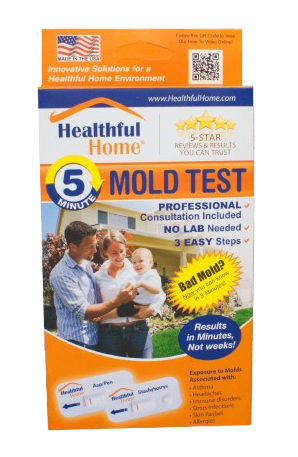
Fastest result — no petri dish, no waiting, no lab
A genuinely different mechanism from everything else here: rather than growing a culture over 48 hours or posting a sample off for a week, this is an immunoassay test strip, the same basic principle as a lateral flow test, calibrated to react to the three mould genera behind most household complaints — Aspergillus, Penicillium and Stachybotrys. Dust from a suspect area or a room air sample goes on the strip, and a result’s readable in minutes rather than days, with a professional consultation included to help make sense of what it shows.
That speed comes at a cost beyond the price tag: a lateral-flow strip is a narrower net than a lab culture and won’t pick up mould genera outside the three it’s built for, and a positive result in five minutes still doesn’t tell you why the mould’s there or what to do about the cause. It’s the right tool when a same-day steer matters more than a lab-grade answer.
For
- Result in minutes rather than days
- No lab post-off required
- Consultation included to interpret the strip
Against
- Detects three genera rather than a full lab culture’s range
- Priced high for what’s a screening test, not a lab report
Typically £35–£45
Check price on AmazonPro-Lab MO109 Mold Test Kit

Cheapest way in — confirms visible growth, lab ID costs extra
The basic version of the kit at the top of this list, and the one to buy if all you actually want is to see whether something grows on a settle plate left out in a room, without committing to the cost of species identification. Choose the air, surface or HVAC sampling method, leave the dish out as instructed, and within 48 hours you’ll have a visual read on whether there’s meaningful growth — plenty of an answer for a quick sanity check before deciding whether it’s worth spending more.
The catch, and it’s a common complaint in the reviews, is that the lab fee for an actual species report isn’t included — it’s roughly another £30 on top if you want to know what’s growing rather than just that something is. Budget for that separately, or accept that this kit only ever answers the first half of the question.
For
- Cheapest entry point on this list
- Same manufacturer and growth medium as the pricier Pro-Lab kit
- Choice of three sampling methods
Against
- Lab analysis is a separate paid extra, not included
- Visual read alone doesn’t identify species
Typically £15–£20, plus ~£30 lab fee if wanted
Check price on AmazonWhat actually matters — and what doesn’t
A kit tells you if, not why. That’s the whole honest-limits point of this guide. A positive result confirms mould spores are present at a level worth noting — it says nothing about whether the cause is a leaking parapet gutter, a cold bridge at a lintel, condensation from a bathroom with no working extract, or rising damp through a failed DPC. Fixing any of those needs someone finding the moisture, not a second test confirming there’s mould growing because of it. A damp meter reading against the affected wall is usually a faster, cheaper next step than a second mould kit.
One sample without a comparison means less than it looks like. Outdoor mould spore counts move constantly with season, weather and time of day, so a single indoor air sample read in isolation is a number without context. The kits that pair an indoor sample with an outdoor control — the Accurate kit above is built around exactly this — give you something to measure against; a lone petri dish left in a bedroom does not, whatever the number that comes back looks like.
Visible mould doesn’t need a kit to confirm it. If there’s already a black, fuzzy patch on a wall or ceiling, testing it just confirms what’s obvious — the £40–£90 is better spent finding out why it’s there and treating the cause. A test kit earns its keep on the cases where there’s a smell or a symptom with no visible source: inside a cold external wall, under a suspended timber floor, behind a bath panel.
Species identification rarely changes the fix. Marketing around “detects toxic black mould” leans on genuine anxiety about Stachybotrys, but it’s a rare finding next to the ordinary Aspergillus and Penicillium species behind most household damp and condensation problems — and in either case the remedial advice is the same: remove the growth, find and fix the moisture source, improve ventilation. Species ID matters for health-exposure cases and insurance disputes; for an ordinary damp patch, it’s interesting rather than actionable.
When a kit is the wrong tool. A problem that keeps returning after cleaning, ongoing respiratory symptoms in the household, a pre-purchase concern on a property, or anything that might end up in an insurance or tenancy dispute all need more than a DIY petri dish — a proper damp and ventilation survey identifies the cause and gives you a fix, which a test kit was never built to do.
Questions I get asked
Are mould test kits accurate? Within their limits, yes — a petri dish left in a room genuinely will grow whatever’s in the air, and a lab culture genuinely identifies genus. What they’re not reliably accurate about is severity: a single sample without an outdoor comparison, taken on one day, tells you far less about how serious a problem is than the number on the report makes it look.
Do I need a test kit if I can already see mould on the wall? No. Visible growth is confirmed by definition — testing it just proves what you can already see. That money is better spent on a hygrometer to check ongoing humidity, or on finding why the wall’s cold or damp in the first place.
What does a professional survey add that a kit doesn’t? A kit answers is-it-mould. A survey answers why, checking ventilation rates, thermal bridging, damp ingress and building fabric together, then sets out what actually needs to change — the practice’s retrofit assessments and building surveys cover exactly that ground.
Can a test kit tell me if mould is affecting my health? No consumer kit correlates a spore count to health risk — that’s not what any of these are designed or accredited to do. For symptoms, a GP is the right first stop; for a proper exposure assessment, that’s a job for an environmental health professional, not a £50 petri dish.
If a test kit comes back positive and the next question is why, that’s the day job — the practice carries out retrofit assessments, building surveys and ventilation assessments where damp and mould get diagnosed properly rather than guessed at. Get in touch. And for the rest of the kit worth carrying, there are more field-kit guides.
Small print. This guide is general information, not a survey or damp diagnosis of your property; a positive or negative reading from a mould test kit is never proof of what is or isn’t happening in a wall, floor or roof void. Prices are indicative, move constantly and were checked at the time of writing; the linked page always shows the current price. As an Amazon Associate I earn from qualifying purchases.