A stepladder poked through a hatch gets someone into a loft for five minutes; it’s not an answer for the loft that gets opened every few months for a meter reading, a router extender, or another run of insulation. That’s the gap a proper loft ladder fills, and on a retrofit or EPC job it’s worth flagging even when it isn’t the reason for the visit — a loose or missing ladder is a quick, cheap fix next to the insulation and glazing work it usually sits alongside, and it’s the difference between safe repeatable access and someone improvising with whatever’s in the shed.
Every loft ladder worth buying in the UK is built to BS EN 14975, the standard covering load rating, tread spacing and how the mechanism has to behave under test — it’s the one number worth checking on a spec sheet, ahead of any “heavy duty” language wrapped around it. Past that, the products below split into types that suit different hatches rather than different budgets: sliding aluminium ladders that hinge down in two or three sections, a concertina ladder that folds flatter for a genuinely tight opening, a telescopic ladder that adjusts continuously rather than in fixed steps, and a timber option usually sold with an insulated hatch bundled in.
None of the six below have had a survey van’s worth of genuine use behind them — this is built from manufacturers’ specifications and the pattern in published installer and owner feedback, filtered through what actually matters when a loft gets opened for work rather than storage. First, the one I’d buy.
The one I’d buy
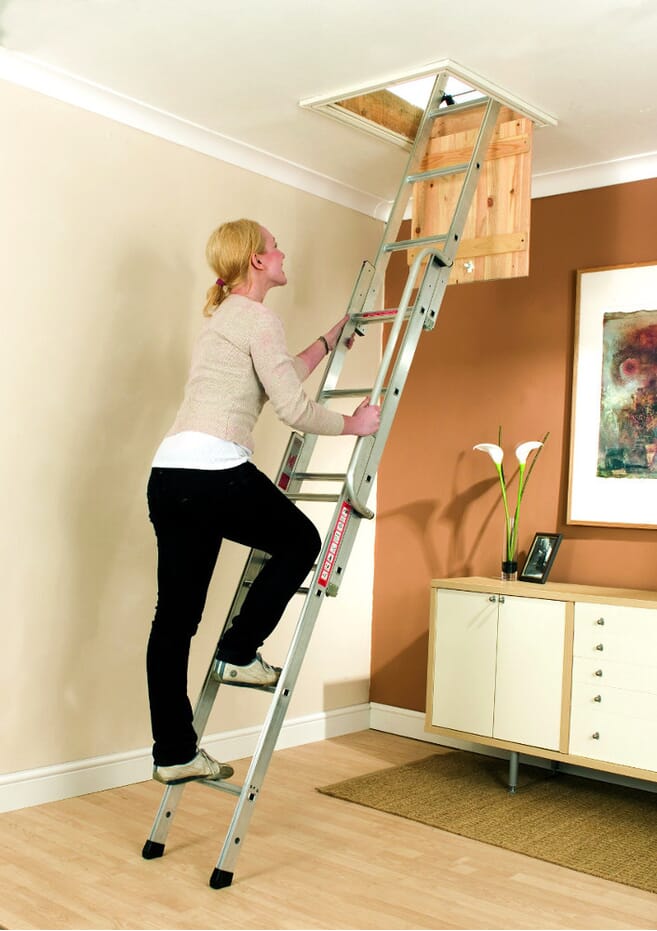
Werner Easiway 3 Section Aluminium Loft Ladder
The Easiway is the straightforward, well-proven choice for a standard domestic hatch — a three-section aluminium ladder that folds down small enough to clear most existing openings, certified to BS EN 14975 at a 150kg load rating, and finished with plastic slides that keep the mechanism quiet rather than clattering down mid-survey. At 7kg it’s light enough for one person to fit or replace without drama, and the dual-radius arm gives a smooth, controlled deployment rather than a ladder that drops its last section under its own weight.
Typically £180–£280
Check price on AmazonHow I judge a loft ladder
Certification and load rating, not the marketing language around it. BS EN 14975 is the standard that actually matters; “heavy duty” on the box is decoration until the spec sheet backs it up. Every ladder in this guide carries a 150kg rating — check for the standard, not the adjective.
Hatch opening and floor-to-ceiling height, measured before ordering. A period Victorian hatch can be smaller than a 1990s one, and the gap between a 500mm and a 700mm opening decides which ladders will even fit. Measure the actual hatch, not the joist bay, before choosing.
Handrail provision, for anyone making repeat trips. A single handrail is fine for a quick look; carrying a roll of insulation or a toolbag up and down all day is easier and safer with two.
What the hatch itself is doing to the loft’s thermal performance. An uninsulated hatch is a small hole with an outsized effect on heat loss — worth checking whether a ladder kit includes a sealed, insulated hatch or leaves that job separate.
Ease and quietness of operation in an occupied home. A ladder that needs wrestling down, or bangs and creaks doing it, is a bad look mid-survey with a client stood in the hallway — smooth, spring-assisted mechanisms are worth paying for.
The comparison
| Model | Type | Floor to ceiling | Typical price | Best for | |
|---|---|---|---|---|---|
| Werner Easiway 3 Section | Sliding aluminium, 3-section | 2.3–3.0m | ~£180–£280 | Best overall | View |
| Werner Deluxe 2 Section | Sliding aluminium, twin handrail | 2.3–3.2m | ~£450–£580 | Premium/professional pick | View |
| Dolle Alufix Concertina | Concertina aluminium | 2.2–3.0m | ~£205–£225 | Best for tight hatch openings | View |
| Werner Telescopic 2.9m | Telescopic aluminium | 2.43–2.88m | ~£320–£490 | Best for non-standard heights | View |
| Werner Eco S Line Timber | Timber, insulated hatch | Up to 2.81m | ~£200–£260 | Best insulated hatch | View |
| Abru 36000 2 Section | Sliding aluminium, 2-section | 2.13–2.69m | ~£100–£140 | Best on a budget | View |
The picks in detail
Werner Easiway 3 Section Aluminium Loft Ladder
Best overall — compact, certified, quiet to operate
Werner (formerly sold as Youngman, still the same manufacturer) is the closest thing the UK loft ladder market has to a default choice, and the Easiway is the model that fits the widest range of standard domestic hatches. Twelve treads across three sections keep the folded ladder compact for storage, the plastic slides run quietly rather than clattering down mid-survey, and the single metal handrail and dual-radius arm give a controlled, spring-assisted deployment. BS EN 14975 certified at 150kg, same as every other ladder here.
For
- Compact 3-section fold, suits most standard hatches
- Quiet plastic-slide operation, no clattering
- Light at 7kg — easy one-person fit or replacement
Against
- Single handrail only — the Deluxe below has two
- Hatch opening (510 x 430mm) needs checking against period joists first
Typically £180–£280
Check price on AmazonWerner Deluxe 2 Section Aluminium Loft Ladder
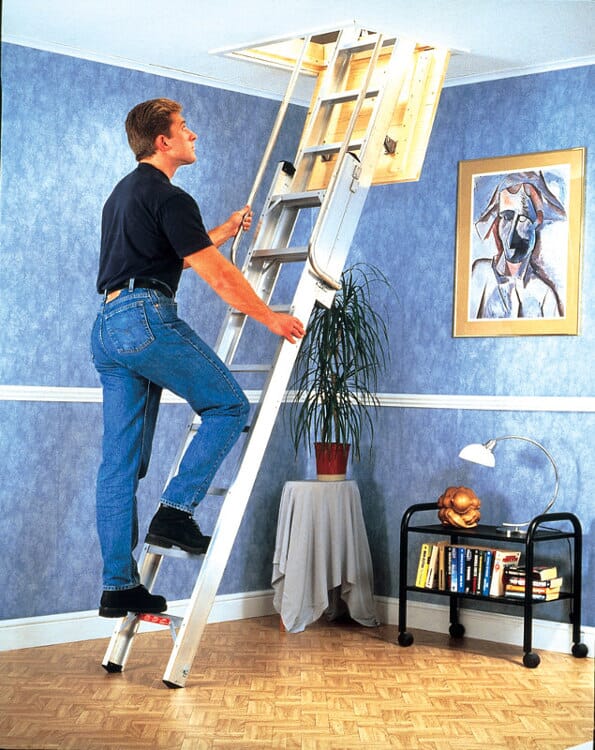
Premium/professional pick — twin handrails, wider opening, heavy-duty rated
The Deluxe is Werner’s heavier-duty sliding ladder, built for a wider 700mm x 520mm hatch opening rather than the Easiway’s more compact cut-out, and supplied with two handrails as standard rather than one. That wider frame and twin rail combination suit a loft that gets used properly — carrying insulation rolls, tools or a work light up and down — rather than an occasional glance. Spring-assisted pivot arm, BS EN 14975 certified, 150kg rated.
For
- Twin handrails standard, not an optional extra
- Wider 700 x 520mm opening handles bulkier loads
- Heavy-duty rated construction
Against
- Priciest ladder in this guide by some margin
- 2-section fold stows longer in the loft than a 3-section
Typically £450–£580
Check price on AmazonDolle Alufix Concertina Loft Ladder
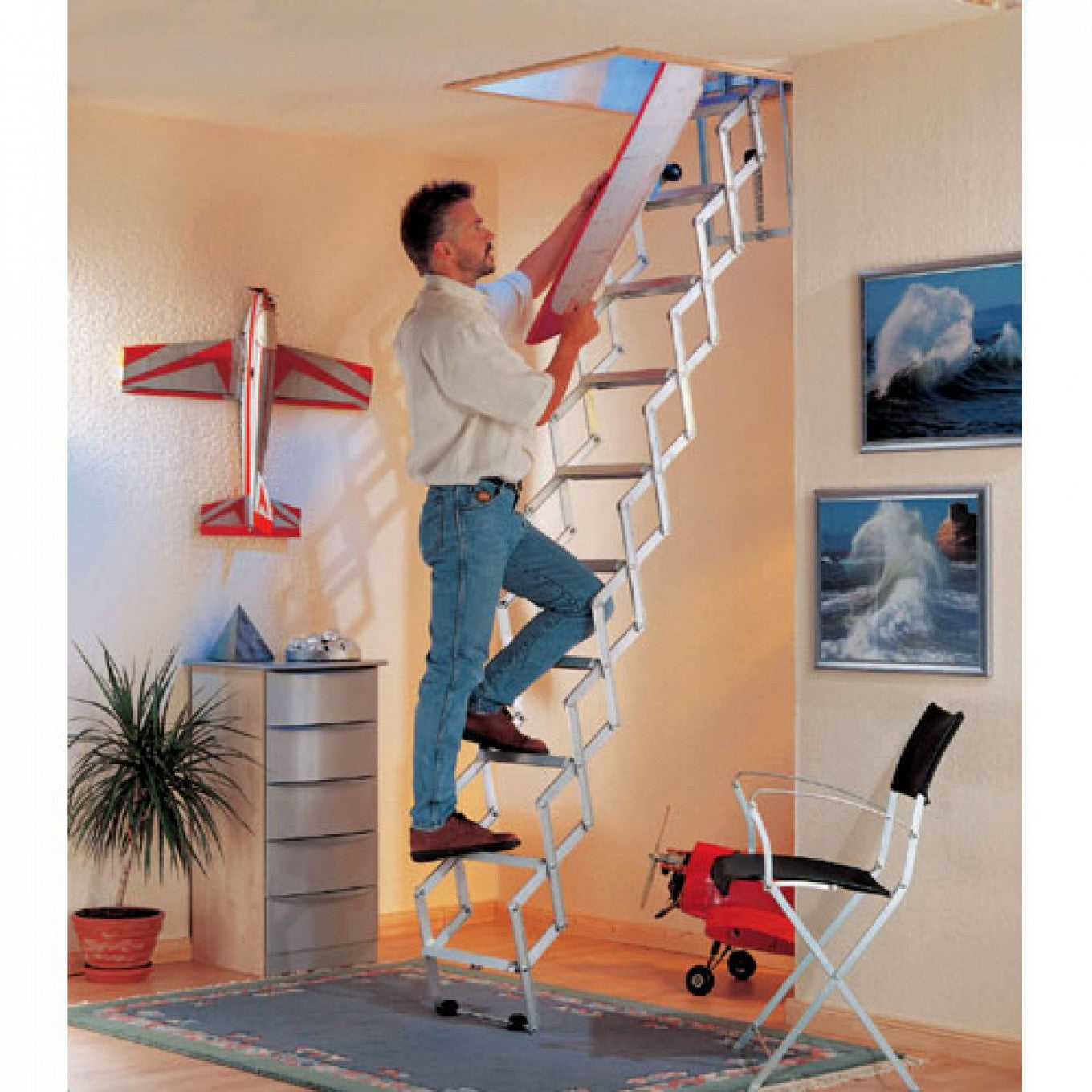
Best for tight hatch openings — fits where a sliding ladder won’t
Concertina ladders fold flatter than a hinged sliding type, which matters on a genuinely restricted hatch — the Alufix fits openings from 500mm x 600mm, smaller than either Werner sliding ladder above. Extra-wide 340mm treads and a spring-controlled suspension system keep it steady in use, and it’s BS EN 14975 certified with a 150kg rating despite being tested well beyond that in manufacturer testing. Supplied fully assembled, no fitting of loose sections required.
For
- Fits openings as small as 500 x 600mm
- Extra-wide 340mm treads underfoot
- Fully assembled, ready to fit
Against
- Concertina action needs more headroom to deploy than a hinged ladder
- Fixed choice of three heights rather than a continuous range
Typically £205–£225
Check price on AmazonWerner Telescopic Loft Ladder 2.9m
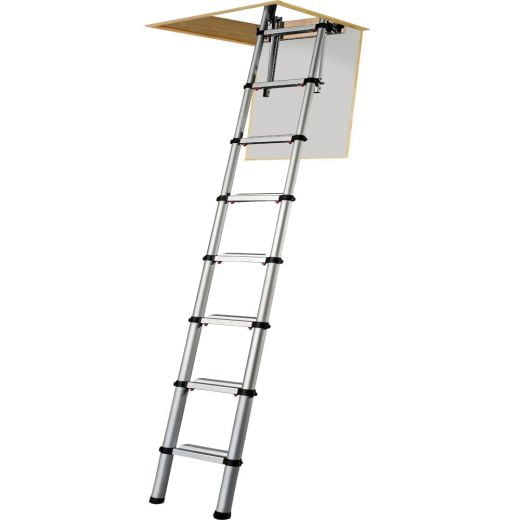
Best for non-standard heights — continuously adjustable, not fixed increments
Sectional ladders come in fixed height bands; the telescopic version adjusts continuously across a 2.43m–2.88m floor-to-floor range instead, which is genuinely useful on an older property where the floor-to-ceiling height doesn’t land neatly on a standard size. Anodised aluminium construction, deep treads and rubber feet, and at 13.2kg it’s the lightest ladder in this guide. Manufactured by Werner to the same BS EN 14975 standard as the rest of the range.
For
- Continuous height adjustment, not fixed steps
- Lightest ladder here at 13.2kg
- Deep treads and rubber feet
Against
- Narrower minimum hatch opening (510 x 600mm) needs checking
- Aluminium only, no timber option in this range
Typically £320–£490
Check price on AmazonWerner Eco S Line Timber Loft Ladder
Best insulated hatch — fixes the thermal weak point above it, not just access
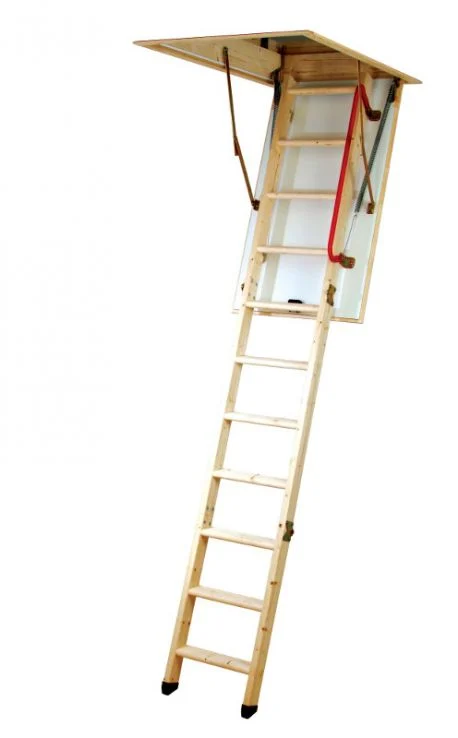
The Eco S Line is the one ladder in this guide that also solves a problem most of the others leave untouched — it comes complete with an insulated, draught-sealed hatch, rather than the ladder being a separate purchase from whatever trapdoor is already there. FSC and PEFC certified spruce, doweled joints, a spring counter-balanced mechanism and a single handrail, built to BS EN 14975 for floor-to-ceiling heights up to 2.81m. Worth specifying alongside a loft insulation top-up specifically because of the hatch.
For
- Insulated, draught-sealed hatch included as standard
- FSC/PEFC certified timber
- Relevant directly to retrofit and EPC loft work
Against
- Heaviest ladder here at 26kg
- Timber needs a dry, ventilated loft to stay sound long-term
Typically £200–£260
Check price on AmazonAbru 36000 2 Section Aluminium Loft Ladder
Best on a budget — still certified, still comes with a handrail
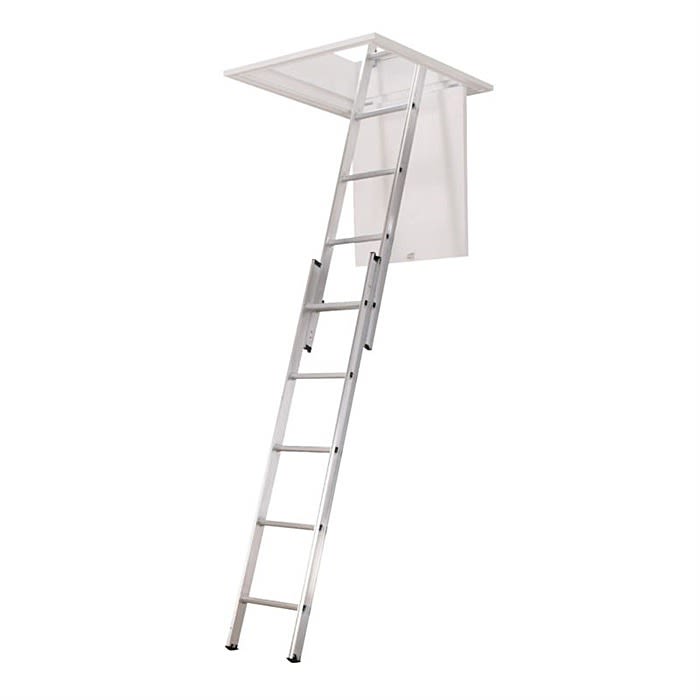
Abru sits under the same Werner ownership as the Easiway and Deluxe above, and the 36000 is its accessible entry point — a simple 2-section sliding ladder that still carries BS EN 14975 certification and the same 150kg rating as the pricier models. It covers a shorter 2.13m–2.69m floor-to-floor range and includes one handrail. At around 5kg shipping weight it’s straightforward for one person to lift into place, and it’s the option that makes sense for a loft that’s genuinely just storage.
For
- Cheapest ladder in this guide by some margin
- Still BS EN 14975 certified at 150kg
- Handrail included as standard
Against
- Shorter max height (2.69m) than the rest of the guide
- Fewer standard features than the pricier Werner range
Typically £100–£140
Check price on AmazonWhat actually matters — and what doesn’t
Certification matters; the branding around it mostly doesn’t. BS EN 14975 and the 150kg figure that comes with it are the numbers worth checking on a spec sheet. “Heavy duty” or “industrial” language on a ladder that already meets the standard is decoration, not a differentiator.
Two handrails over one is a genuine upgrade, not a marketing tier. Anyone making the trip repeatedly — not just checking a meter — will feel the difference in stability carrying kit or materials.
Concertina versus sliding is a fit decision, not a quality one. A concertina ladder earns its place on a genuinely tight hatch; on a standard-sized opening a sliding ladder is simpler to operate and usually cheaper for the same rating.
An insulated hatch is worth paying for specifically on a retrofit job. A loft ladder sits in the thermal envelope whether anyone thinks about it or not — a draught-sealed hatch closes a heat-loss route that’s easy to miss on an otherwise well-insulated loft.
Timber versus aluminium is about the loft’s conditions, not one being inherently better. Aluminium shrugs off damp and needs no maintenance; timber needs a dry, ventilated loft to stay sound over years of use.
A loft ladder is not a substitute for a proper staircase in a habitable loft conversion. That’s a different job entirely, governed by different Building Regulations requirements — a ladder is for a loft that stays storage.
Questions I get asked
Do I need building regulations approval to fit a loft ladder?
Fitting a loft ladder into an existing hatch, to access a loft used purely for storage, isn’t treated the same way as a proper staircase under Building Regulations. That changes the moment the loft becomes a habitable room rather than storage: a loft conversion with a bedroom or office above needs a fixed staircase built to Building Regulations Part K, not a loft ladder, whatever the ladder’s load rating.
What size hatch do I need for a loft ladder?
It varies by model — the ladders in this guide need openings from around 500mm x 600mm for the Alufix concertina up to 700mm x 520mm for the wider Deluxe. Measure the existing hatch before ordering rather than assuming; a period house hatch cut decades ago can be smaller than what a modern ladder kit expects, and enlarging one means cutting into joists, which is its own separate job.
Is a concertina loft ladder better than a sliding one?
Neither is universally better — they suit different hatches. A concertina ladder like the Alufix folds into a smaller footprint and copes with a tighter opening; a sliding sectional ladder like the Easiway or Deluxe is mechanically simpler, usually cheaper for the same load rating, and the more common choice where the hatch isn’t unusually restricted.
Does a loft ladder affect a property’s EPC or insulation performance?
Indirectly, yes. The hatch itself is a gap in the insulation layer and, if it isn’t sealed and insulated, a consistent source of heat loss regardless of how well the rest of the loft is insulated. It’s a small enough detail that it rarely gets its own line on an EPC recommendation, but it’s worth fixing alongside any loft insulation top-up — either with a ladder kit that includes an insulated hatch, like the Eco S Line above, or by draught-sealing the existing one separately.
A loft ladder is one of the cheaper fixes on a retrofit job and one of the most consistently overlooked — safe, repeatable access matters every time that hatch gets opened again, not just on survey day. The practice carries out EPCs, PAS 2035 retrofit assessments and building surveys across Sussex, Kent and Surrey, including advising on loft access as part of an insulation upgrade — get in touch. Or browse the rest of the field-kit guides, including the telescopic ladders and step ladders that get Dom up to the hatch in the first place, and loft boarding kits for what to do once you're up there.
Small print. This guide is general information, not building control or health and safety advice; anyone fitting or using a loft ladder remains responsible for following the manufacturer’s instructions and checking against current Building Regulations. Prices are indicative, move constantly and were checked at the time of writing; the linked page always shows the current price. As an Amazon Associate I earn from qualifying purchases.