An immersion heater timer does one job: it makes sure the element only draws current during the window you actually want to pay for, instead of whenever someone last left the wall switch. On a straightforward single-rate electricity tariff that's mostly about convenience — not leaving three kilowatts running all day for a bath nobody's had yet. On an Economy 7, Economy 10 or comparable time-of-use tariff, it's the whole economic case for the cylinder: the cheap overnight rate only pays off if the immersion is actually heating water during that window, and switched off — or on a proper boost — the rest of the time. I see the same finding often enough to flag it here first: a working timer on the wall, dial or display dead, immersion left on the manual override because nobody could work out how to reset it after the last power cut or the clocks changing. That's not a fault, it's just a timer nobody's used properly in years, quietly costing peak-rate money on every tank.
Horstmann is the name most people over forty still say when they mean this category, but the brand itself is now Secure — Horstmann became part of Secure Meters some years back, and the familiar Electronic 7 controller was discontinued and replaced by the E7+ below. Timeguard remains the other name you'll see on the wall in most UK homes, usually a plain mechanical dial rather than anything branded for a specific tariff. Between the two brands and a scattering of generic WiFi switches now selling on the back of the smart-plug trend, there's a genuinely useful range here from a £15 mechanical dial to a £90 app-controlled unit, and the right one depends far more on what's already on the wall and what tariff is actually running than on how much the box costs.
Worth saying plainly before the picks: none of this works without a real off-peak tariff behind it. A timer on a single-rate meter saves whatever it saves by not leaving the immersion on longer than needed, which is real but modest. The bigger saving only exists if the property is actually on Economy 7, Economy 10 or a similar time-of-use arrangement, and the timer's on/off window is set to match the hours that tariff is actually cheap — not a generic midnight-to-seven default that may or may not line up with the supplier's real off-peak period.
The one I’d buy

LavaTap Secure E7+
Secure's own successor to the Electronic 7 and Economy 7 Quartz, sold here through LavaTap as a retrofit-ready kit with the adaptor plate included. Full 7-day programming with three on/off periods, a 30/60/120-minute manual boost, and Bluetooth control built in as standard — genuinely standard, not a paid unlock — with an optional WiFi adaptor if remote control from outside the property matters. Rated to 3kW, tracks estimated off-peak and boost kWh through the app, and carries Secure's seven-year warranty, comfortably the longest of anything here.
Typically £85–£95
Check price on AmazonHow I judge an immersion heater timer
Load rating matched to the element, not just the price bracket. Most single-element immersion heaters draw around 3kW; some twin-element cylinders run closer to 3.68kW when both elements are on together. Check the timer's resistive rating — 13A/3kW and 16A/3.68kW both turn up here — against the rating plate on the immersion heater itself, not just whichever unit happens to be cheapest.
Genuine off-peak alignment, not a generic default. A timer set to a textbook midnight-to-seven window is worth nothing if the actual tariff's cheap period runs 01:00–08:00, or varies by supplier. Confirm the real off-peak hours on the bill or with the supplier, then set the timer to match — every unit here can be reprogrammed, but none of them know the tariff without being told.
A boost function that doesn't mean leaving it on override. Every household needs hot water outside the scheduled window occasionally. A proper 30, 60 or 120-minute boost button covers that without switching the whole thing to permanently-on and forgetting to switch it back — which is exactly the fault I find on survey.
Memory that survives a power cut. A mechanical dial can't lose its programme — the dial just sits where it was left. A digital unit needs genuine battery backup, or a short outage resets the clock to midnight and quietly stops saving anything until someone notices the display flashing.
What's actually on the wall already. A straight swap for an existing timer, on the same backbox and pin spacing, is a same-afternoon job for a competent person. A change in format — dial to digital, switched spur to a different footprint — is more likely to need an electrician, and matters more than any feature on the spec sheet.
The comparison
| Model | Control | Load rating | Typical price | Best for | |
|---|---|---|---|---|---|
| LavaTap Secure E7+ | Bluetooth app, optional WiFi, 7-day | 3kW | ~£85–£95 | Best all-round pick | View |
| Secure Economy 7 Quartz | Analogue dial, 1hr boost | 3kW | ~£95–£105 | Like-for-like Horstmann/Secure swap | View |
| Timeguard NTT03 | Digital, 24hr/7-day, 1–2hr boost | 16A / 3.68kW | ~£35–£40 | Best compact digital, no app | View |
| Lowenergie 7-Day Digital | Digital, 16 ON/OFF events | Check listing | ~£15–£25 | Best value digital | View |
| Timeguard NTT01 | Mechanical, 96 segments, override slider | 16A / 3.68kW | ~£18–£21 | Best mechanical with manual override | View |
| Timeguard TS900N | Mechanical, self-cancelling override | 13A / 3kW | ~£15–£18 | Best pure budget pick | View |
| ConBlom Smart Switch | WiFi app, Alexa/Google, touch panel | 40A / 8000W (generic) | ~£15–£20 | Best budget smart switch | View |
The picks in detail
LavaTap Secure E7+
Best all-round — the genuine successor to Horstmann Electronic 7, Bluetooth as standard, WiFi optional
Secure discontinued the old Electronic 7 controller and built the E7+ as its direct replacement, including an adaptor plate specifically so it drops onto an existing Horstmann or Economy 7 Quartz backbox without a rewiring job. The Bluetooth app is genuinely free to use within the property — full 7-day programming, boost, and an estimated kWh breakdown of off-peak versus boost use — and the optional plug-in WiFi adaptor only matters if remote control from outside the house is worth paying extra for. Seven-year warranty is the longest here by some margin.
For
- Drop-in replacement for old Horstmann/Secure units via the supplied adaptor plate
- Free Bluetooth app control, WiFi genuinely optional not forced
- Seven-year warranty
Against
- Pricier than a plain digital timeswitch if the app isn't needed
- WiFi remote control needs the separate adaptor
Typically £85–£95
Check price on AmazonSecure (Horstmann) Economy 7 Quartz

Best like-for-like swap for an existing Horstmann/Secure control — the same analogue design half the UK's off-peak homes already have
This is the unit the E7+ above was built to replace, and it's still sold new — a Summer/Winter time dial, a single Water Heater on/off switch and a quartz-accurate boost dial running 0 to 60 minutes, no display, no app, nothing to reset after a power cut beyond the rechargeable backup battery doing its job. Worth being honest about the price: it's higher than its feature set would suggest next to the digital options below, and the only real reason to choose it over the E7+ is matching a physical cutout or backbox that's already there, or a genuine preference for a dial over a screen.
For
- Exact match for the control half of UK off-peak homes already have fitted
- Quartz timing, rechargeable battery backup, seven-year warranty
- Nothing to reprogramme via an app if that's not wanted
Against
- Priced above several digital units with more features
- Single fixed boost dial, no weekly variation
Typically £95–£105
Check price on AmazonTimeguard NTT03
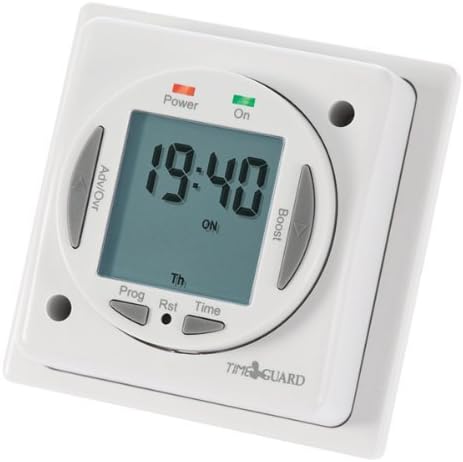
Best compact digital timer without an app — four on/four off periods a day, proper boost, no subscription anything
The NTT03 switches between full 7-day, 5+2, or straight 24-hour repeat programming, with four on and four off periods per day (28 of each across the week) in one-minute steps — enough granularity to match almost any real Economy 7 window precisely rather than approximately. The 1 or 2-hour boost button covers an out-of-schedule top-up, and 720 hours of rechargeable memory backup means a typical power cut doesn't reset the clock to midnight and quietly undo the schedule. Rated to 16A/3.68kW, so it covers twin-element cylinders a 13A/3kW unit can't.
For
- 4 on/4 off periods a day in 1-minute steps, precise tariff matching
- 720-hour battery memory backup
- 16A/3.68kW rating covers twin-element loads
Against
- No app or remote control at this price point
- Backlit LCD display is small compared with the smart units
Typically £35–£40
Check price on AmazonLowenergie 7-Day Digital Programmable Timer Switch
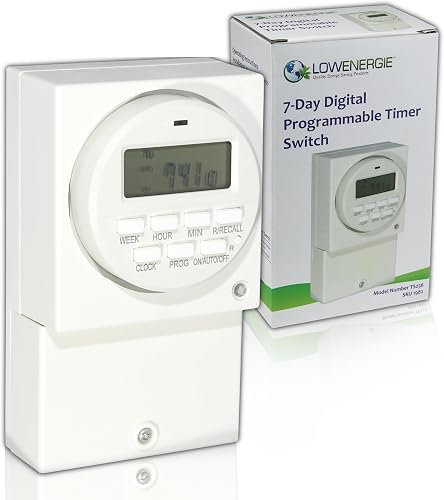
Best value digital — 16 on/off events a day for less than the Timeguard equivalent
A hardwired wall unit rather than a plug-in, aimed squarely at immersion heaters and other fixed appliances, with 16 on/off events a day across a full 7-day schedule and battery backup so the programme survives a power cut. It's the least well-documented brand of the digital units here — Lowenergie doesn't publish the same depth of spec sheet Timeguard does — but the listing is clear on load suitability and it undercuts the NTT03 on price while offering more daily switching events, useful if the household's hot water demand doesn't fit neatly into four windows.
For
- 16 on/off events a day, more than the Timeguard NTT03
- Cheaper than the equivalent Timeguard digital unit
- Battery backup retains the programme through a power cut
Against
- Less published spec detail than the established Timeguard/Secure brands
- Confirm the exact load rating against the immersion heater before fitting
Typically £15–£25
Check price on AmazonTimeguard NTT01
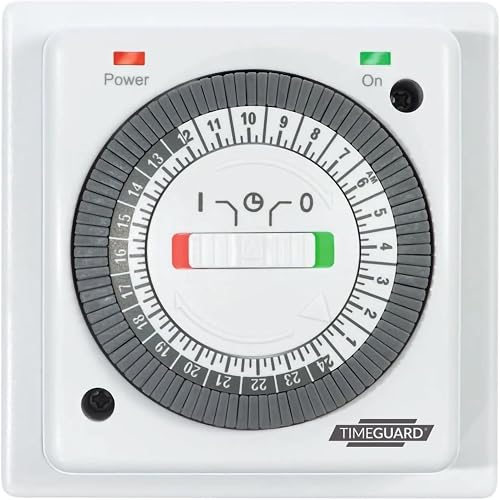
Best mechanical with a genuine manual override — a traffic-light slider, not a hidden menu
Ninety-six quick-set segments give 15-minute programming steps across the day, up to 48 on and 48 off events — more than most households will ever need, but it means the off-peak window can be set precisely rather than rounded to the nearest hour. The traffic-light slider — permanently on, timed, permanently off — is the simplest override interface in this list; no menu-diving needed to force hot water outside the schedule. Rated 16A/3.68kW, the same higher rating as the NTT03.
For
- 15-minute programming steps, up to 48 on/off events
- Simple traffic-light override slider
- 16A/3.68kW rating
Against
- No boost timer — override means switching to permanently on
- Mechanical segments wear over years of daily use like any dial timer
Typically £18–£21
Check price on AmazonTimeguard TS900N

Best pure budget pick — the cheapest timer on this list that still does the core job properly
A straightforward 24-hour mechanical segment timer with 24 on/off settings a day and a self-cancelling manual override — force it on for an unscheduled top-up and it reverts to the programme rather than needing to be remembered and switched back. Amazon's own listing describes it as a mechanical plug-in style unit; check what's actually on the wall before assuming that applies, since most immersion circuits run through a fused connection unit or double-pole switch rather than a standard socket. Three-year guarantee, the shortest here, matched to the lowest price.
For
- Lowest price on this list for a genuine 24-hour segment timer
- Self-cancelling override — no need to remember to switch it back
- Simple mechanical dial, nothing to reprogramme after a power cut
Against
- 13A/3kW rating only — check against a twin-element immersion heater
- Shortest guarantee of the units on this list
Typically £15–£18
Check price on AmazonConBlom Smart Immersion Heater Timer Switch

Best budget smart switch — touch-panel WiFi control at mechanical-timer money
A tempered-glass touch panel with WiFi, voice control through Alexa or Google Home, and app scheduling via Smart Life, at a price close to the plain mechanical units above it in this list. Worth flagging plainly: it's a generic switch marketed at immersion heaters rather than a purpose-built control from an established heating-controls brand, and its published 40A/8000W rating is far beyond anything a domestic immersion element needs — a real UK immersion heater runs at roughly 3kW, so that headroom isn't the selling point, the app is. Get a competent electrician to confirm it's suitable for a fixed, continuous-duty appliance circuit before fitting, not just wired like a light switch.
For
- WiFi, Alexa and Google Home control at a mechanical-timer price
- Touch panel is straightforward to use without an app for basic on/off
- Generic load rating comfortably covers any domestic immersion element
Against
- Generic brand, not a specialist heating-controls manufacturer
- No published safety certification detail to match Timeguard or Secure
Typically £15–£20
Check price on AmazonWhat actually matters — and what doesn’t
Off-peak tariff eligibility is the whole economic case. None of this saves serious money on a standard single-rate tariff, where electricity at 3am costs the same as electricity at 6pm. Confirm Economy 7, Economy 10 or a comparable time-of-use tariff is actually active, and check the real off-peak hours on the bill rather than assuming a textbook window — every timer here needs telling, none of them know on their own.
Matching the load rating is a safety check, not just a spec comparison. A 13A/3kW timer on a genuinely 3.68kW twin-element load is a real fault, not a rounding error. Check the rating plate on the immersion heater itself before ordering, and if there's any doubt, have an electrician confirm it.
“Plug-in” is misleading for most immersion circuits. Most UK immersion heaters are wired through a fused connection unit or a 20A double-pole switch, not a standard 13A socket. A genuinely plug-in-style unit only suits the minority of installations where the existing arrangement is already a socket outlet — check what's actually on the wall before assuming a product description applies to the property.
What it does to the EPC is smaller than what it does to the bill. RdSAP records the water heating control type, and a proper timer is recognised over no control at all, but the effect on the certificate itself is modest next to the effect on the running cost — see what an EPC costs if the property's due one anyway.
Smart control is a convenience, not the saving itself. An app is genuinely useful on a property nobody occupies every day, where a remote boost avoids a cold shower on arrival. But the actual saving comes from the schedule matching the real tariff window, which a £15 mechanical dial does exactly as well as a £90 app-controlled unit — check the schedule matches the tariff before paying extra for the interface.
Questions I get asked
Will an immersion timer really save me money? Only if there's a genuine off-peak tariff behind it and the timer's window is set to match it. Without Economy 7, Economy 10 or similar, the saving is limited to not leaving the element running longer than needed — real, but modest next to what the tariff itself delivers when the timer's actually aligned to it.
Do I need an electrician to fit one? A straight swap for an existing timer, on the same backbox and wiring, is within reach of a confident DIYer for some models, but always isolate the circuit first and check the connections match. Anything involving a new circuit, a change in format, or any doubt at all should go to a qualified electrician — this is a fixed wiring job, not a plug-in gadget for most properties.
What's the real difference between a mechanical dial and a digital timeswitch? Precision and memory, mostly. A mechanical segment dial like the Timeguard NTT01 gives fixed steps — typically 15 minutes — and never loses its programme because there's nothing to reset. A digital unit can be more precise and adds a proper boost function, but needs genuine battery backup to survive a power cut without reverting to a default schedule.
Can I just use a smart plug instead of a proper immersion timer? Not usually. Most immersion heaters aren't wired to a socket at all, and even where one is, a generic smart plug is rarely rated or certified for a continuous, resistive load that size on a wet-area appliance circuit. A purpose-built control — mechanical or smart — rated for the job is the safer route, not a repurposed plug meant for a lamp.
I don’t specify or install electrical controls as part of a survey, but a dead or bypassed immersion timer on an all-electric property is a common enough finding to be worth flagging here on its own, well before it shows up as a line item on an EPC. If the wider heating system is the real question — whether a storage heater upgrade or something bigger makes more sense for the property — that's exactly what a full assessment is built to answer properly. Get in touch for a second opinion, and there are more field-kit guides covering the rest of the home-energy list, including high heat retention storage heaters for the wider all-electric heating picture.
Small print. This guide is general information, not electrical advice for your specific property — get the wiring and load rating checked by a qualified electrician before fitting any timer or switch. Prices are indicative, move constantly and are checked at the time of writing; the linked page always shows the current price. As an Amazon Associate I earn from qualifying purchases.