Roof pitch comes up more often in this job than most non-surveyors would guess. RdSAP needs it to classify the roof and estimate heat loss through a loft or room-in-roof; a Level 3 building survey often needs it recorded honestly rather than eyeballed, particularly when a loft conversion or dormer is being weighed up and headroom against the slope becomes the whole question. "Looks like about 35 degrees" doesn’t hold up in a written report, and lining a spirit level up against a rafter by eye is slower than it needs to be.
Staircases are the other place a digital angle finder earns its keep. Approved Document K sets a maximum pitch for a private stair, and an existing staircase that’s steeper than that is worth flagging with a number attached rather than a description like "unusually steep." The same tool checks a proposed loft stair against the same limit before a client commits to a conversion, and settles an argument about whether a going-and-rise combination on an older property is actually non-standard or just feels that way underfoot.
What follows is what actually matters when buying a digital angle finder for this kind of work — not the woodworking-bench precision most of these are marketed around — and seven worth having in the bag.
The one I’d buy
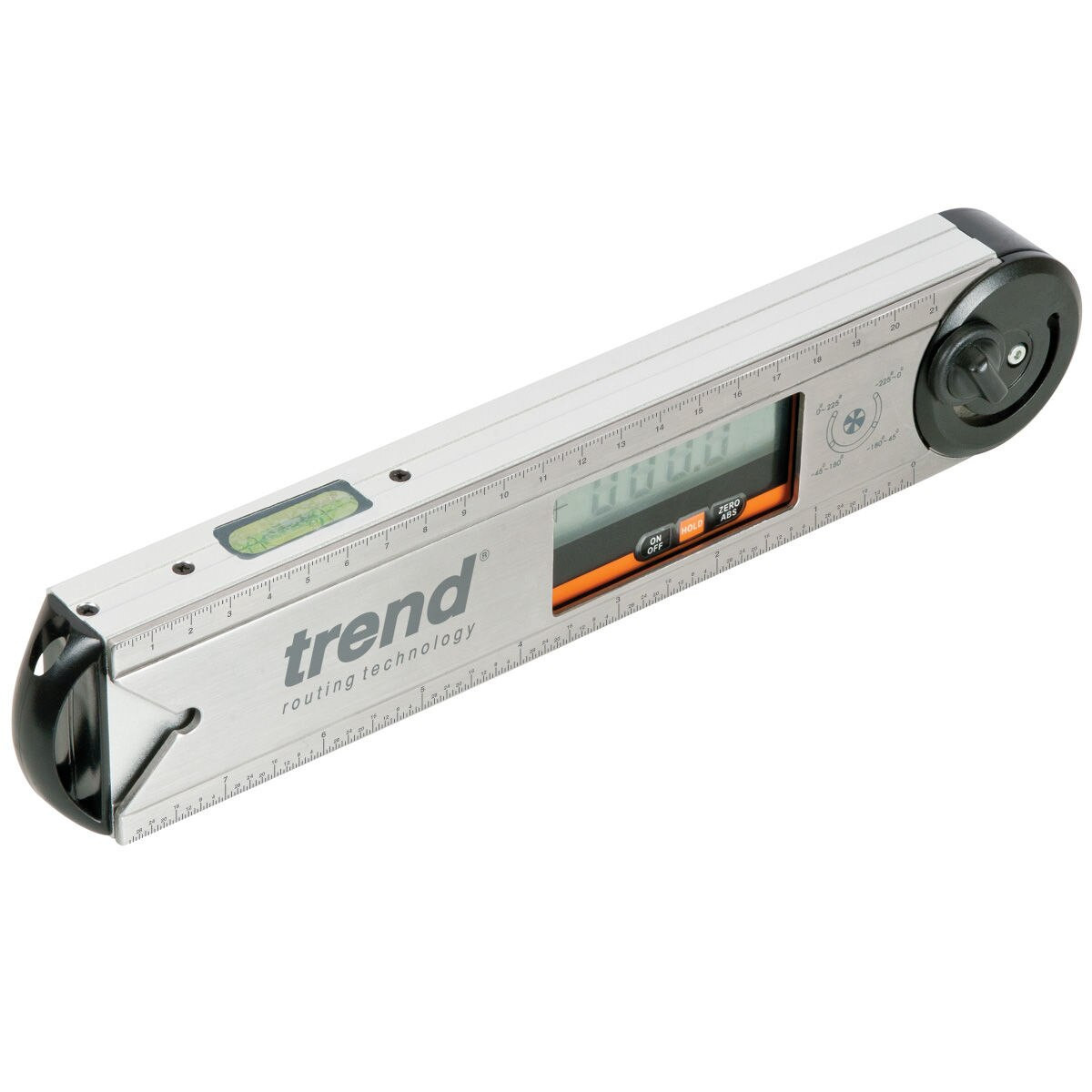
Trend DAF/8
Trend is a name most UK tradespeople already trust, and the DAF/8 covers what a survey actually needs: an aluminium two-arm body long enough (200mm) to bridge an uneven rafter or stair stringer without a false reading, a lock function to hold an angle steady while it’s read or photographed, and a built-in level vial for a quick plumb or level check without reaching for a second tool. The display reads to 0.05° resolution in absolute or zeroed-relative mode — more precision than any roof pitch or stair check will actually need — and the folding blade survives a tool bag without snagging on everything else in it.
Typically £35–£50
Check price on AmazonHow I judge a digital angle finder
Arm length long enough to bridge the surface being checked. A short gauge balanced on one rafter, or perched on a worn stair nosing, reads the local dip or wear rather than the true pitch. A blade of 200mm or more spans that unevenness and gives a number worth writing down.
Absolute and relative (zero) modes, not just one. Absolute mode records the actual pitch for an RdSAP entry or a report photo; relative or zero mode is what actually answers "is this baluster plumb" or "does this going match the others" without doing the subtraction by hand.
Magnetic base only where the substrate is actually ferrous. A magnetic gauge is genuinely quick against a steel purlin or an RSJ, but useless — worse than useless, since it won’t hold — against timber rafters, staircase stringers or masonry, which cover most domestic pitch checks. A two-arm protractor works against anything by bridging both surfaces mechanically rather than relying on a magnet.
Resolution that matches the decision, not the spec sheet. Site work doesn’t need 0.01° precision — the rafter itself isn’t flat to that tolerance, so a laboratory-grade sensor number rarely survives contact with real timber. Anything reading to 0.5° or better is genuinely enough to record a pitch, band it for RdSAP, or check it against a Building Regs limit.
A display that’s readable in a loft with a head torch, not a showroom. A backlit LCD, decent contrast and a lock or hold button that keeps a reading steady while it’s photographed matter more day to day than an accuracy claim that outstrips what a rafter can actually deliver.
The comparison
| Model | Type | Accuracy | Typical price | Best for | |
|---|---|---|---|---|---|
| Trend DAF/8 | Two-arm, 200mm | 0.05° | ~£40 | Best overall | View |
| Bosch GAM 220 MF | Two-arm, 400mm + mitre calc | ±0.1° | ~£210 | Best precision & professional | View |
| Draper 74307 | Two-arm, 250mm | 0.1° | ~£47 | Best robust trade alternative | View |
| Wixey WR300 Type 2 | Magnetic gauge | ±0.2° | ~£32 | Best on steelwork | View |
| General Tools 822 | Two-arm rule, 127mm | ±0.3° | ~£30 | Best compact | View |
| iGaging AngleCube | Magnetic cube | ±0.2° | ~£37 | Best magnetic bevel setting | View |
| Silverline 427637 | Two-arm, 320mm | 0.5° | ~£32 | Best on a budget | View |
The picks in detail
Trend DAF/8
Best overall — the one I’d buy, above
Trend is a name most UK tradespeople already trust, and the DAF/8 covers what a survey actually needs: an aluminium two-arm body long enough (200mm) to bridge an uneven rafter or stair stringer, a lock function to hold an angle steady while it’s read or photographed, and a built-in level vial for a quick plumb or level check without reaching for a second tool. The display reads to 0.05° resolution in absolute or zeroed-relative mode, which is more precision than any pitch check on site will actually need.
For
- Long enough blade to bridge an uneven rafter or stringer
- Lock function holds a reading steady for a photo
- Built-in level vial doubles as a quick plumb check
- Well-known, widely stocked UK brand
Against
- 200mm arm is shorter than the Bosch’s 40cm reach on a genuinely wide span
- CR2032 coin cell rather than a more common AA/AAA battery
Typically £35–£50
Check price on AmazonBosch Professional GAM 220 MF
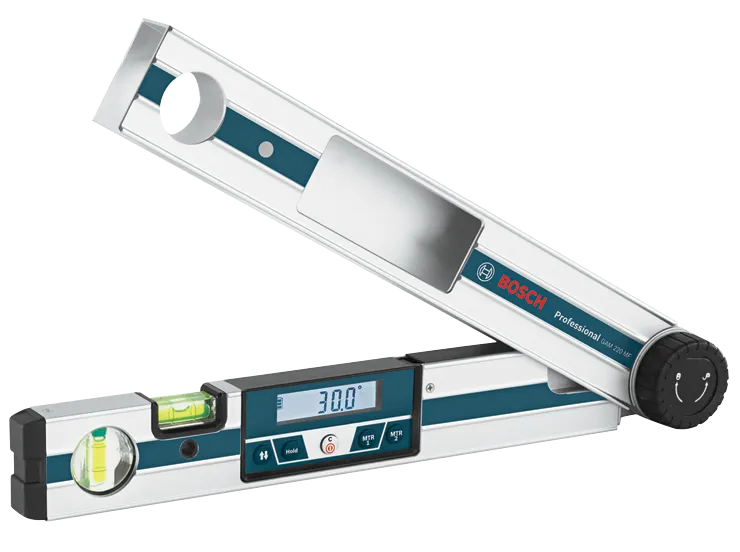
Best precision and professional pick — pays for itself on repeat use
Bosch’s GAM 220 MF is the instrument version of this category: a 40cm arm for genuinely long spans, ±0.1° accuracy, and a built-in calculation function that converts a measured pitch straight into a mitre or compound-angle setting — useful if valleys, hips or splayed dormer cheeks come up often enough to justify it. The extending leg reaches into corners a fixed-arm tool can’t. It costs roughly four times what the Trend does, which only makes sense if the extra reach and mitre calculation actually get used.
For
- Genuinely long 40cm reach for wide spans
- ±0.1° accuracy with a proper mitre-calculation function
- Robust professional build
Against
- Costs several times more than the rest of this list
- Mitre-calculation function is wasted on straightforward pitch recording
Typically £190–£230
Check price on AmazonDraper 74307

Best robust trade alternative — a familiar brand at a lower price than Bosch
Draper’s 74307 sits between the Trend and the Bosch on both price and spec: a 250mm anodised blade, 0.1° accuracy, and a display that reads the right way up even when the tool’s rotated through 180°, which matters more than it sounds when a rafter forces an awkward reading angle. It’s a straightforward, no-frills two-arm protractor rather than a precision instrument, which is exactly what most roof pitch and stair checks call for.
For
- Longer 250mm blade than the Trend or General Tools
- Display reads correctly even rotated 180°
- Recognised, widely stocked trade brand
Against
- No level vial built in, unlike the Trend
- No mitre-calculation function if that’s ever needed
Typically £40–£55
Check price on AmazonWixey WR300 Type 2

Best on steelwork — a magnetic gauge for purlins and RSJs
The WR300 Type 2 is a different shape of tool entirely: a small magnetic box rather than a two-arm protractor, designed to sit flat against a surface and read its angle relative to gravity. Against a steel purlin, an RSJ or any other flat ferrous surface it’s genuinely faster than lining up a blade on each side, and the backlit display earns its keep in a dim loft. It’s the wrong tool for timber rafters or masonry, where there’s nothing for the magnet to hold onto.
For
- Genuinely fast on steel — no lining up two arms
- Backlit display for dim lofts
- Compact enough to live in a pocket
Against
- Needs a flat ferrous surface to work at all
- No use on timber, masonry or anything the magnet won’t grip
Typically £25–£40
Check price on AmazonGeneral Tools 822
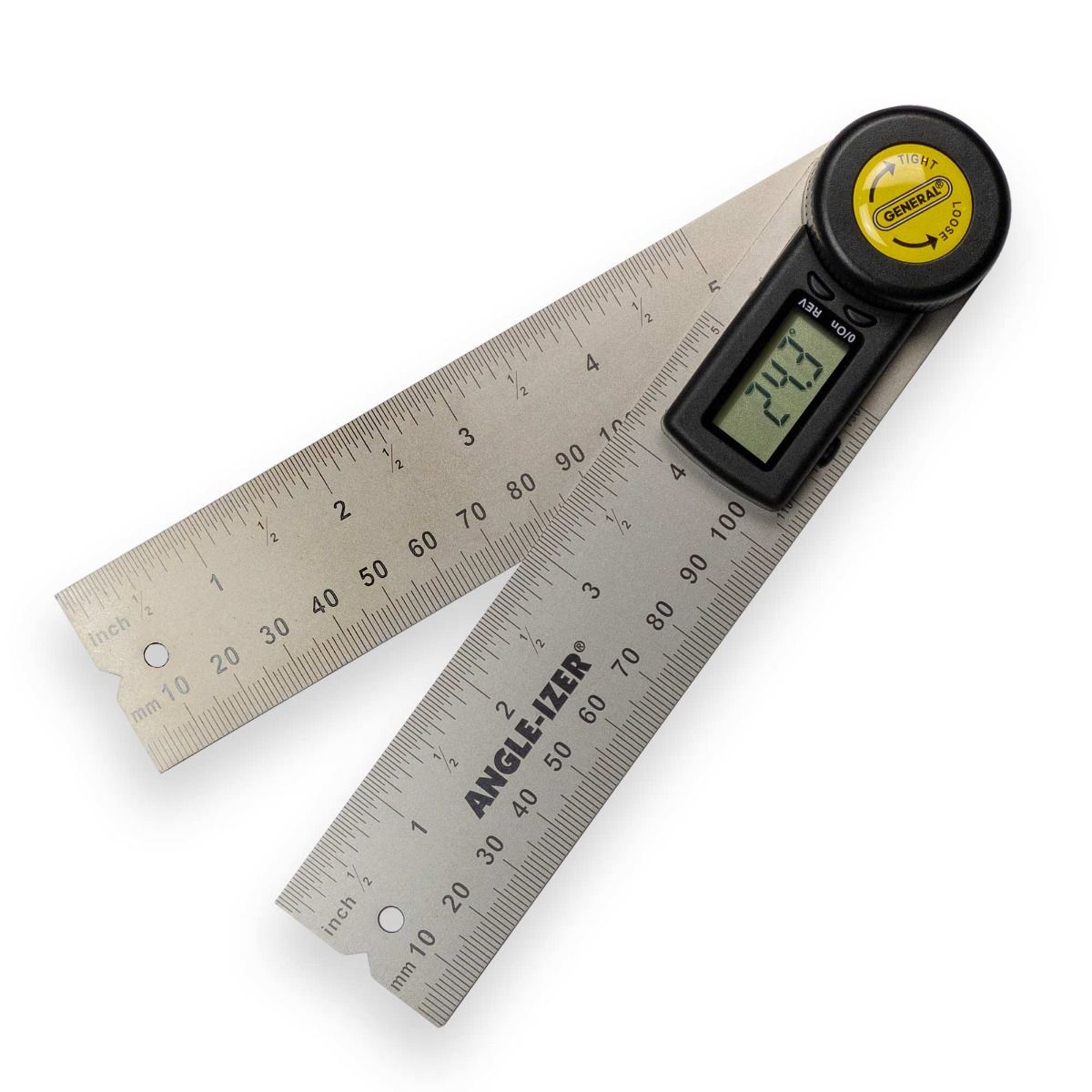
Best compact — tight stair spindles and joinery detail
At 5 inches (127mm), the 822 is the smallest two-arm finder on this list, with a stainless ruled blade and a reversible hinge that reads interior, exterior and reverse angles without repositioning. That makes it the pick for checking a baluster angle, a newel detail or anything else too tight for a longer blade to fit into, though the same short reach is a liability on an actual roof pitch check where a longer arm bridges unevenness better.
For
- Small enough for tight stair and joinery details
- Reversible hinge reads interior, exterior and reverse angles
- Doubles as a steel rule
Against
- Short 127mm blade is the wrong tool for bridging an uneven rafter
- Less robust housing than the trade-focused picks here
Typically £25–£35
Check price on AmazoniGaging AngleCube
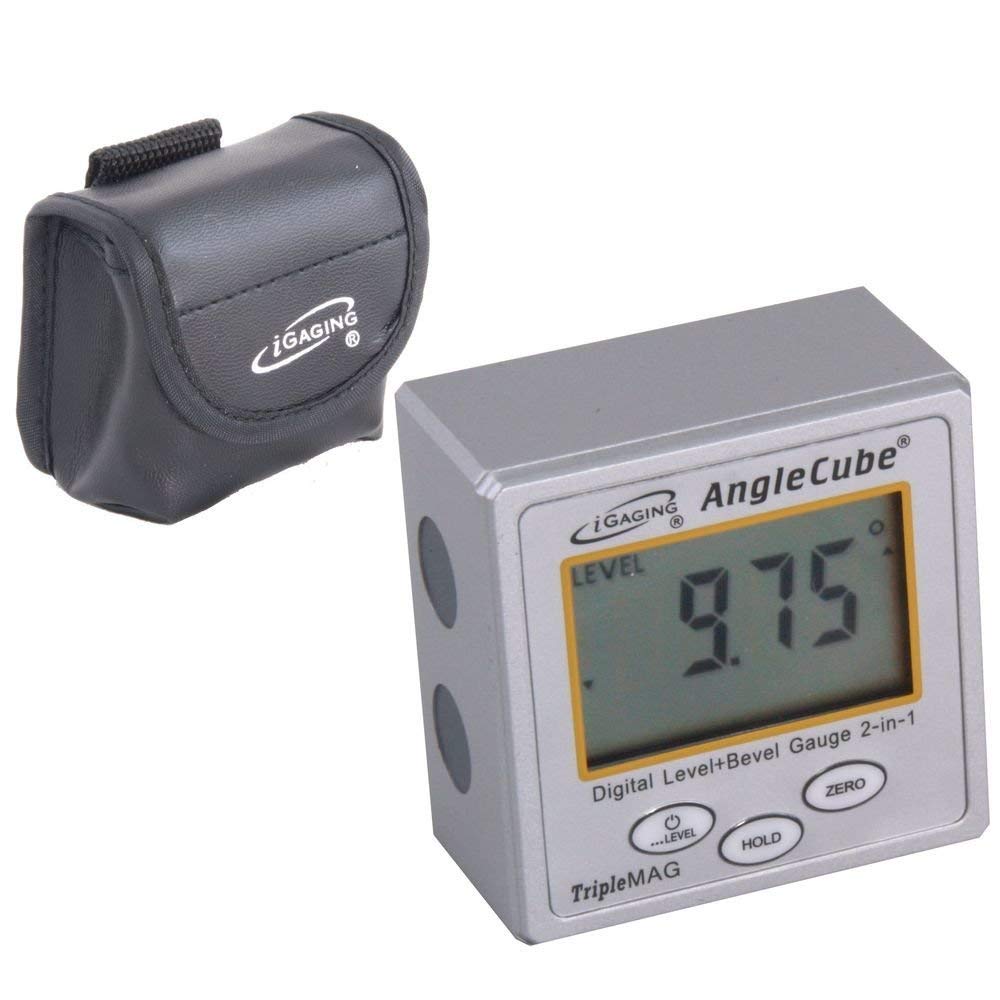
Best magnetic bevel gauge — setting angles against a fixed reference
The AngleCube is built for setting and holding an angle against a reference surface rather than measuring a one-off pitch — strong magnets on multiple faces let it sit against a steel edge or fence while a bevel or bracket is set to match. On site that makes it more of a specialist tool than an everyday pick, useful for checking a fixed steel bracket or template angle is actually what it claims to be, less useful for a straightforward roof or stair pitch reading.
For
- Strong magnets on multiple faces hold it steady hands-free
- Simple, large LCD readout
- Genuinely useful for checking a fixed steel reference angle
Against
- Same limitation as the Wixey on non-ferrous surfaces
- More of a workshop tool than a general site instrument
Typically £30–£45
Check price on AmazonSilverline 427637

Best on a budget — a longer blade than most for less than most
Silverline’s 427637 undercuts the Trend and Draper on price while still offering a 320mm blade — longer than either — plus horizontal and vertical spirit vials and a mitre-angle calculation above 90°. The trade-off is coarser accuracy, quoted at 0.5° rather than the 0.1° of the pricier picks, which is still perfectly adequate for a roof pitch or Building Regs stair check, just not for anything demanding finer tolerance.
For
- Longest blade of the budget picks at 320mm
- Built-in horizontal and vertical spirit vials
- Noticeably cheaper than the Trend or Draper
Against
- Coarser 0.5° accuracy than the pricier two-arm picks
- Build quality feels exactly as budget as the price suggests
Typically £25–£40
Check price on AmazonWhat actually matters — and what doesn’t
0.01° resolution on the spec sheet is a number, not a benefit. A rafter, stringer or purlin isn’t flat to a hundredth of a degree, so a sensor claiming lab-grade precision is reading the local imperfection in the timber as often as the true pitch. Anything at 0.1–0.5° is genuinely enough for every decision a roof pitch or stair check actually involves.
A magnetic base is a genuine time-saver — on the right surface. Against steelwork it beats a two-arm protractor for speed every time. Against timber, render or masonry it’s dead weight, since there’s nothing for the magnet to grip. Buy for the substrate that’s actually being checked most often, not the substrate on the packaging photo.
Bluetooth and app connectivity are a woodworking-bench feature, not a site one. A handful of these gauges pair with a phone app for logging a series of angles — genuinely useful on a production line setting up a saw, largely pointless for a one-off pitch reading that’s going straight into a report by hand or camera anyway.
Mitre and compound-angle calculation is worth paying for only if valleys and hips come up often. Bosch’s MF models and similar convert a measured slope straight into a mitre setting, which is a real time-saver on a job that involves cutting to that angle. For simply recording what a pitch is, it’s an unused feature on an otherwise more expensive tool.
A lock or hold button matters more than an extra decimal place. Being able to freeze a reading on the display, rather than having it drift as the tool’s repositioned for a photo, is what actually makes a number trustworthy enough to go in a report.
Questions I get asked
How accurate does a digital angle finder need to be for recording roof pitch? Far less precise than most of these tools claim. Roof pitch for RdSAP or a survey report is generally recorded to the nearest degree rather than a fraction of one, so a finder reading to 0.5° is comfortably accurate enough — the limiting factor is usually how flat the rafter or purlin being measured against actually is, not the tool’s resolution.
What’s the maximum pitch allowed for a private staircase under Building Regulations? Approved Document K sets 42° as the steepest pitch permitted for a private stair, measured as the angle between the pitch line and the horizontal. An existing staircase measured steeper than that on an older property isn’t automatically a defect requiring work — many predate current regulations and are assessed differently — but it’s worth recording precisely rather than describing as "steep," particularly where a loft conversion is proposing a new flight.
Is it better to measure roof pitch from inside the loft or from outside on the roof itself? Inside, almost always. Placing a two-arm finder directly against a rafter or purlin gives a clean read off the structural timber, while measuring the roof covering risks reading the profile of the tiles or slates rather than the true pitch, and getting onto an occupied roof slope safely is rarely worth the risk for a figure that’s just as reliable from the loft.
Do I need a magnetic angle gauge, a two-arm protractor, or both? For most domestic roof and stair work, a two-arm protractor is the more versatile default — it works against timber, masonry or steel alike by bridging both surfaces mechanically. A magnetic gauge earns its place as a second tool specifically for steelwork, where it’s genuinely faster, but it’s the wrong first purchase if most of what’s being checked is timber rafters and stair stringers.
A digital angle finder sits in the same pocket of the bag as the rest of the measuring kit — pairing it with one of the laser levels or a decent spirit level covers most of what a floor, wall or roof check on site actually needs. The practice covers building surveys, EPCs and PAS 2035 retrofit assessments across the South East, including exactly the sort of loft conversion feasibility and staircase compliance checks this guide has in mind — get in touch. And for more of what actually goes in the van, there are more field-kit guides.
Small print. This guide is general information, not building control or regulatory advice; whether a specific staircase or roof detail complies with current Building Regulations depends on the individual property and should be confirmed with building control or a qualified surveyor. Prices are indicative, move constantly and were checked at the time of writing; the linked page always shows the current price. As an Amazon Associate I earn from qualifying purchases.